Knowledge Grounding for Chatbots: A Practical Guide
Knowledge Grounding for Chatbots: A Practical Guide
Insights
18 min

Knowledge grounding means your chatbot answers from your own approved content, such as help articles, policies, product data and price lists, instead of from whatever its language model remembers. In practice, the bot looks up the relevant passages at the moment a customer asks, then writes its reply from them. If you want a chatbot that quotes your return policy correctly and does not invent one, grounding is the foundation you build on.
This guide explains what grounding is, how it differs from fine-tuning and prompt instructions, how retrieval works step by step, which sources to use, and how to test and maintain the result.
DroxyGive Chatbots Your Approved AnswersDroxy lets you connect multiple knowledge sources to AI agents, helping them answer customer questions across chat, phone, and social channels.Explore Droxy
TL;DR
Grounding gives a chatbot external, curated sources to answer from, usually through retrieval-augmented generation (RAG), so answers can use private or current information the model never saw in training.
It differs from fine-tuning (which changes the model) and from prompting (which only steers it): grounding supplies evidence at answer time.
Good grounding depends on clean, current, well-scoped content, plus a clear rule for what the bot does when it finds nothing reliable.
Test with real customer questions, including ones outside your scope, and review them on a schedule.
Droxy lets you connect multiple knowledge sources to AI agents without writing code.
Table of Contents
What knowledge grounding means for a chatbot
Grounding vs. fine-tuning vs. prompt instructions
How a grounded chatbot finds and uses information
What to ground your chatbot in
How to implement and evaluate a grounded chatbot
Keeping knowledge current and handling gaps
What can still go wrong
Perspective
Put grounded answers to work with Droxy
Sources
What knowledge grounding means for a chatbot
A language model on its own answers from patterns learned during training. Stanford’s Speech and Language Processing points out three limits of that approach: the model can hallucinate, it cannot normally answer questions about private corporate documents or records, and its knowledge is frozen at its training cutoff.
Grounding addresses all three by supplying external evidence at answer time. The same source describes it as giving the model curated external sources and using them to answer, typically through RAG, which retrieves relevant passages and conditions the generated answer on them.
For a business, that translates into everyday situations:
A customer asks whether you ship to Canada. The bot reads your current shipping page rather than guessing.
A patient asks about office hours on a holiday. The bot reads the schedule you published.
A lead asks which plan includes a feature. The bot reads the pricing and feature documentation.
There is a second benefit. According to the Stanford authors, grounding improves factual accountability, because the answer can come with the retrieved passage or document and people can inspect the evidence instead of trusting an unsupported reply. That matters for your team too: when an answer looks wrong, you can see which passage produced it and fix the source.
Grounding vs. fine-tuning vs. prompt instructions
These three tools get confused constantly, and they do different jobs.
Prompt instructions steer the model with text placed in front of it. Together AI’s documentation describes prompting as immediately reversible, because nothing about the model itself changes. Prompts are the right place for tone, format, escalation rules and boundaries. If you want to go deeper on writing them well, our guide on prompt engineering for chatbots covers treating prompts like code.
Fine-tuning continues training a model on examples. OpenAI’s guide to optimizing accuracy says fine-tuning optimizes a model for a task using examples that should represent what the model will meet in production. Together’s documentation adds that it changes model weights and creates a new trained model state. It is a good fit for consistent style or task behavior. It is a heavier tool for keeping facts current, since new information means a new training cycle.
Grounding supplies facts at runtime. When your return window changes from 30 to 45 days, you update one document and the next answer reflects it.
Approach | What it changes | Best for | Updating facts |
|---|---|---|---|
Prompt instructions | The text the model sees first | Tone, format, rules, escalation | Edit the prompt |
Fine-tuning | The model itself | Consistent style and task behavior | Train again |
Grounding (RAG) | The evidence supplied per question | Policies, products, prices, procedures | Edit the source content |
The three work together. A typical well-built support agent uses prompt instructions for voice and boundaries, and grounding for facts. Researchers describe it the same way: a 2024 workshop paper by Angus Addlesee and coauthors treats fine-tuning as another approach alongside grounding methods such as guardrails and RAG, and defines grounding to in-prompt knowledge as making the model use the domain information explicitly supplied rather than relying on potentially outdated or conflicting pretrained knowledge.
How a grounded chatbot finds and uses information
The mechanics are simpler than they sound. Illinois Chat’s documentation describes the flow: the user’s question is embedded, matched against the chatbot’s index, and the best passages are handed to a language model, which answers with citations.
Here is that flow as steps you can map to your own setup:
Ingest. Your documents, web pages and data are collected and split into passages.
Index. Each passage is converted into an embedding, a numeric representation of its meaning, and stored for search.
Retrieve. When a customer asks a question, it is embedded the same way, and the closest passages are pulled from the index.
Generate. The model receives the question, the retrieved passages and your instructions, and writes a reply based on them.
Cite or hand off. The reply points to its source, or, when nothing relevant was found, the bot says so and routes the customer to a person.
The same documentation also lists research ideas that are not product features, such as rewriting queries, filtering irrelevant passages with a small model, and LLM-guided retrieval. They show where the field is heading: better retrieval means better answers, because the model can only be as accurate as the passages it is handed.
The retrieval step is also where many results are won or lost. The same embed, retrieve and answer pattern that powers support bots is behind how content gets surfaced in AI search, as explained in this overview of retrieval steps for ChatGPT answers. If you want the engineering view for support, see our breakdown of production RAG chatbots with hybrid retrieval, metadata and a confidence gate.
What to ground your chatbot in
Stanford’s chapter gives medical or legal records, personal emails and corporate documents as examples of external sources, and describes grounding answers in a curated dataset. The word that matters is curated. More content is not better content. Start with what customers actually ask.
Good first sources
Help center and FAQ pages. The closest match to real questions.
Policies. Returns, shipping, cancellation, warranty, privacy.
Product or service catalogs. Descriptions, specs, availability, pricing pages.
Operational details. Hours, service areas, booking rules, intake steps.
Internal playbooks. Escalation rules and approved wording for sensitive topics.
Different industries lean on different sources. An ecommerce store grounds on product data and shipping rules. A home service provider grounds on service areas, job types and scheduling rules. A real estate team grounds on listings and viewing procedures. A healthcare practice grounds on office information, visit preparation and insurance guidance written by staff.
Prepare the content before you connect it
The retrieval system cannot fix confusing source material. Before connecting anything:
Remove duplicates and contradictions. If two pages give different return windows, the bot may quote either one.
Write one fact per passage where you can. Short, self-contained sections retrieve more cleanly than long pages mixing many topics.
Use the customer’s words. If people ask about “refunds” and your page says “reimbursement,” add the common term.
Date and own your content. Note who maintains each document and when it was last verified.
Keep private material out. Ground only on content you are comfortable having the bot paraphrase to the public.
Our guides on how to train a chatbot on your documents and on the five RAG parts of a knowledge base chatbot walk through preparation in more detail.
How to implement and evaluate a grounded chatbot
A grounded bot is not finished when it is switched on. It is finished when you have evidence it answers correctly. Here is a workable process for a small team.
Step 1: Define the scope
Write down what the bot should answer, what it should hand off, and what it must never do, such as quoting legal terms or giving medical advice. Scope is easier to enforce when it is explicit, and it belongs in your prompt instructions.
Step 2: Build a question set
Pull 50 to 100 real questions from your inbox, chat logs, call notes and social messages. Include:
Common questions that make up most of your volume.
Edge cases such as partial matches, ambiguous wording and multi-part questions.
Out-of-scope questions the bot should decline or hand off.
Manipulation attempts, like asking the bot to ignore its rules.
The last two matter. The Addlesee paper recommends testing out-of-domain questions, and cautions that bad actors may try to manipulate a model through dialogue, so safety guardrails and resetting context between users are worth considering. Our guide to AI chatbot security for enterprise teams goes further on this.
Step 3: Score each answer
For every test question, record three things:
Was the answer correct against the current source?
Was it grounded, meaning it came from your content and not from general model knowledge?
Was the behavior right if the answer was missing: a clear “I don’t have that” plus a hand-off, rather than a guess?
A simple spreadsheet works. When an answer fails, trace it. Either the right passage did not exist, the right passage existed but was not retrieved, or it was retrieved and the instructions let the model drift. Each cause has a different fix: write the content, restructure it, or tighten the prompt.
Step 4: Pilot, then watch real conversations
Launch on one channel or one topic first. Read real transcripts daily for the first weeks, then weekly. Look for repeated questions with weak answers, since each one is a content gap you can close. Analytics help here, as do the conversation patterns described in our guide to FAQ chatbot design, which aims for resolving a question in two exchanges.
Keeping knowledge current and handling gaps
Grounding makes updates easy, but only if someone owns them. Chatbots go wrong in practice when the business changes and the source content does not.
Set up a maintenance rhythm
Assign an owner per source. Shipping belongs to operations, pricing to sales, policies to whoever signs them.
Tie updates to business changes. A new promotion, a price change or a new service area should trigger a content update the same day.
Schedule reviews. Re-run your question set monthly, and after any large content change.
Retire old material. Delete outdated pages from the knowledge source instead of leaving them next to the new version.
Decide what the bot does when sources conflict
Conflicts are best prevented, but you still need a rule. A sensible one: prefer the most recent, officially owned document; if two equally authoritative sources disagree, do not guess. Hand off to a person and flag the conflict to the content owner so it gets fixed.
Decide what the bot does when nothing matches
This is the most important setting in a grounded bot. When retrieval returns nothing relevant, the bot should say it does not have that information and offer a next step: a human hand-off, a booking link or a contact form. A confidence threshold, described in our piece on production RAG, is the usual way to enforce it.

Good fallbacks protect trust. Customers forgive “let me connect you with someone” far more easily than a confident wrong answer, and the missed question then becomes a to-do item for your content owner.
What can still go wrong
Grounding reduces hallucination risk. It does not make a bot infallible, and a careful rollout plans for that.
Retrieval misses. The right passage exists but is not found, so the model answers from weaker evidence. Fix by restructuring content and adding customer wording.
Stale or conflicting content. The bot faithfully repeats an outdated fact. Fix with ownership and review.
Prompt manipulation. Researchers warn that bad actors may try to manipulate a model through dialogue. Keep guardrails in place and keep sessions separate between users.
Sensitive topics. In safety-sensitive domains, Addlesee’s research argues that grounding matters because pretrained knowledge may be outdated or conflict with local information, and that systems still need testing for out-of-domain questions and prompt manipulation. For a healthcare or legal practice, that means keeping clinical or legal judgment with qualified staff and building a clear hand-off.
Ethics and disclosure. Tell customers they are talking to an AI and give them an easy path to a person. See our practical guide to AI chatbot ethics.
Perspective
We see the same pattern in almost every business that deploys a customer-facing AI agent. The model is rarely the problem. The knowledge is. Teams that spend a few days cleaning their policies, merging duplicate pages and writing down the answers their staff give by phone get a bot that sounds knowledgeable from the first day. Teams that skip it blame the technology.
That is why we built Droxy around knowledge integration from multiple sources, not a single upload box. Your answers live in a website, a catalog, a handful of documents and the heads of your best people. An agent should be able to draw on all of them, stay in your brand’s voice, and know when to hand the conversation to a human.
We also think grounding should be something a business owner can run without a developer. No-code setup, clear analytics on what customers ask, and the ability to update a source and see the answer change the same day: that is what keeps a grounded agent accurate month after month. For agencies, the same approach scales across clients, with each white-labeled agent grounded in that client’s own content.
Elena
Put grounded answers to work with Droxy
Droxy is a no-code platform for deploying AI agents that answer customers on website chat, phone, WhatsApp, Instagram, Facebook and Shopify. You bring your knowledge from multiple sources, customize how the agent speaks so it matches your brand, and keep human hand-off, lead capture and appointment booking in the same flow. Analytics show what customers are asking, so you can see where your content needs work.
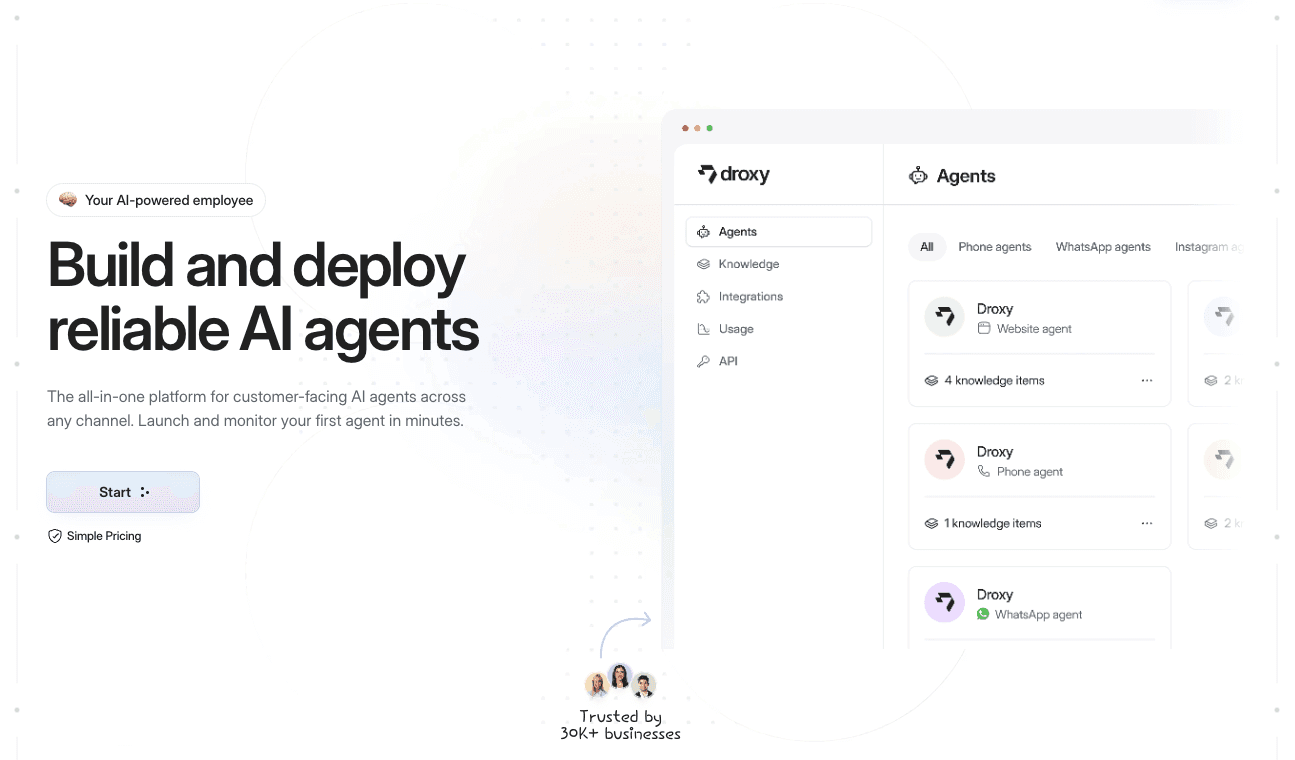
Plans are published at Droxy pricing: Basic from $16 per month, Advanced from $80 per month and Enterprise from $240 per month. If your customers mostly start on your site, begin with the AI website agent. Or try Droxy and connect your first knowledge source.
FAQ
What is knowledge grounding in a chatbot?
It is the practice of giving a chatbot curated external sources and requiring it to answer from them. Usually that is done with RAG, where relevant passages are retrieved and the answer is generated from them. The result is replies based on your current, private information instead of only what the model learned in training.
Is grounding the same as fine-tuning?
No. Fine-tuning continues training a model on examples and changes its weights, while grounding leaves the model alone and supplies evidence at answer time. For facts that change, such as prices and policies, grounding is easier to keep current because you edit the source content. Many teams use both with prompt instructions.
Does grounding stop a chatbot from making mistakes?
It lowers the risk of unsupported answers and lets people inspect the passage behind a reply, but it needs good content, good retrieval and testing. Check answers against a question set that includes out-of-scope and manipulation attempts. Give the bot a clear hand-off rule for when it has no reliable answer.
What content should I start with?
Start with the pages your customers already read: FAQs, shipping and return policies, service descriptions, hours and pricing. Remove duplicates and contradictions first. Then add more material as your chat logs show gaps.
How often should I update a grounded chatbot’s knowledge?
Update it whenever the underlying facts change, and re-run your test questions at least monthly. Give each source an owner so changes do not depend on someone remembering. Reading real conversations will show you which answers need attention first.
Sources
Information Retrieval and Retrieval-Augmented Generation, Speech and Language Processing (Stanford)
Grounding LLMs to In-prompt Instructions (ACL Anthology, 2024)
Recommended
Knowledge grounding means your chatbot answers from your own approved content, such as help articles, policies, product data and price lists, instead of from whatever its language model remembers. In practice, the bot looks up the relevant passages at the moment a customer asks, then writes its reply from them. If you want a chatbot that quotes your return policy correctly and does not invent one, grounding is the foundation you build on.
This guide explains what grounding is, how it differs from fine-tuning and prompt instructions, how retrieval works step by step, which sources to use, and how to test and maintain the result.
DroxyGive Chatbots Your Approved AnswersDroxy lets you connect multiple knowledge sources to AI agents, helping them answer customer questions across chat, phone, and social channels.Explore Droxy
TL;DR
Grounding gives a chatbot external, curated sources to answer from, usually through retrieval-augmented generation (RAG), so answers can use private or current information the model never saw in training.
It differs from fine-tuning (which changes the model) and from prompting (which only steers it): grounding supplies evidence at answer time.
Good grounding depends on clean, current, well-scoped content, plus a clear rule for what the bot does when it finds nothing reliable.
Test with real customer questions, including ones outside your scope, and review them on a schedule.
Droxy lets you connect multiple knowledge sources to AI agents without writing code.
Table of Contents
What knowledge grounding means for a chatbot
Grounding vs. fine-tuning vs. prompt instructions
How a grounded chatbot finds and uses information
What to ground your chatbot in
How to implement and evaluate a grounded chatbot
Keeping knowledge current and handling gaps
What can still go wrong
Perspective
Put grounded answers to work with Droxy
Sources
What knowledge grounding means for a chatbot
A language model on its own answers from patterns learned during training. Stanford’s Speech and Language Processing points out three limits of that approach: the model can hallucinate, it cannot normally answer questions about private corporate documents or records, and its knowledge is frozen at its training cutoff.
Grounding addresses all three by supplying external evidence at answer time. The same source describes it as giving the model curated external sources and using them to answer, typically through RAG, which retrieves relevant passages and conditions the generated answer on them.
For a business, that translates into everyday situations:
A customer asks whether you ship to Canada. The bot reads your current shipping page rather than guessing.
A patient asks about office hours on a holiday. The bot reads the schedule you published.
A lead asks which plan includes a feature. The bot reads the pricing and feature documentation.
There is a second benefit. According to the Stanford authors, grounding improves factual accountability, because the answer can come with the retrieved passage or document and people can inspect the evidence instead of trusting an unsupported reply. That matters for your team too: when an answer looks wrong, you can see which passage produced it and fix the source.
Grounding vs. fine-tuning vs. prompt instructions
These three tools get confused constantly, and they do different jobs.
Prompt instructions steer the model with text placed in front of it. Together AI’s documentation describes prompting as immediately reversible, because nothing about the model itself changes. Prompts are the right place for tone, format, escalation rules and boundaries. If you want to go deeper on writing them well, our guide on prompt engineering for chatbots covers treating prompts like code.
Fine-tuning continues training a model on examples. OpenAI’s guide to optimizing accuracy says fine-tuning optimizes a model for a task using examples that should represent what the model will meet in production. Together’s documentation adds that it changes model weights and creates a new trained model state. It is a good fit for consistent style or task behavior. It is a heavier tool for keeping facts current, since new information means a new training cycle.
Grounding supplies facts at runtime. When your return window changes from 30 to 45 days, you update one document and the next answer reflects it.
Approach | What it changes | Best for | Updating facts |
|---|---|---|---|
Prompt instructions | The text the model sees first | Tone, format, rules, escalation | Edit the prompt |
Fine-tuning | The model itself | Consistent style and task behavior | Train again |
Grounding (RAG) | The evidence supplied per question | Policies, products, prices, procedures | Edit the source content |
The three work together. A typical well-built support agent uses prompt instructions for voice and boundaries, and grounding for facts. Researchers describe it the same way: a 2024 workshop paper by Angus Addlesee and coauthors treats fine-tuning as another approach alongside grounding methods such as guardrails and RAG, and defines grounding to in-prompt knowledge as making the model use the domain information explicitly supplied rather than relying on potentially outdated or conflicting pretrained knowledge.
How a grounded chatbot finds and uses information
The mechanics are simpler than they sound. Illinois Chat’s documentation describes the flow: the user’s question is embedded, matched against the chatbot’s index, and the best passages are handed to a language model, which answers with citations.
Here is that flow as steps you can map to your own setup:
Ingest. Your documents, web pages and data are collected and split into passages.
Index. Each passage is converted into an embedding, a numeric representation of its meaning, and stored for search.
Retrieve. When a customer asks a question, it is embedded the same way, and the closest passages are pulled from the index.
Generate. The model receives the question, the retrieved passages and your instructions, and writes a reply based on them.
Cite or hand off. The reply points to its source, or, when nothing relevant was found, the bot says so and routes the customer to a person.
The same documentation also lists research ideas that are not product features, such as rewriting queries, filtering irrelevant passages with a small model, and LLM-guided retrieval. They show where the field is heading: better retrieval means better answers, because the model can only be as accurate as the passages it is handed.
The retrieval step is also where many results are won or lost. The same embed, retrieve and answer pattern that powers support bots is behind how content gets surfaced in AI search, as explained in this overview of retrieval steps for ChatGPT answers. If you want the engineering view for support, see our breakdown of production RAG chatbots with hybrid retrieval, metadata and a confidence gate.
What to ground your chatbot in
Stanford’s chapter gives medical or legal records, personal emails and corporate documents as examples of external sources, and describes grounding answers in a curated dataset. The word that matters is curated. More content is not better content. Start with what customers actually ask.
Good first sources
Help center and FAQ pages. The closest match to real questions.
Policies. Returns, shipping, cancellation, warranty, privacy.
Product or service catalogs. Descriptions, specs, availability, pricing pages.
Operational details. Hours, service areas, booking rules, intake steps.
Internal playbooks. Escalation rules and approved wording for sensitive topics.
Different industries lean on different sources. An ecommerce store grounds on product data and shipping rules. A home service provider grounds on service areas, job types and scheduling rules. A real estate team grounds on listings and viewing procedures. A healthcare practice grounds on office information, visit preparation and insurance guidance written by staff.
Prepare the content before you connect it
The retrieval system cannot fix confusing source material. Before connecting anything:
Remove duplicates and contradictions. If two pages give different return windows, the bot may quote either one.
Write one fact per passage where you can. Short, self-contained sections retrieve more cleanly than long pages mixing many topics.
Use the customer’s words. If people ask about “refunds” and your page says “reimbursement,” add the common term.
Date and own your content. Note who maintains each document and when it was last verified.
Keep private material out. Ground only on content you are comfortable having the bot paraphrase to the public.
Our guides on how to train a chatbot on your documents and on the five RAG parts of a knowledge base chatbot walk through preparation in more detail.
How to implement and evaluate a grounded chatbot
A grounded bot is not finished when it is switched on. It is finished when you have evidence it answers correctly. Here is a workable process for a small team.
Step 1: Define the scope
Write down what the bot should answer, what it should hand off, and what it must never do, such as quoting legal terms or giving medical advice. Scope is easier to enforce when it is explicit, and it belongs in your prompt instructions.
Step 2: Build a question set
Pull 50 to 100 real questions from your inbox, chat logs, call notes and social messages. Include:
Common questions that make up most of your volume.
Edge cases such as partial matches, ambiguous wording and multi-part questions.
Out-of-scope questions the bot should decline or hand off.
Manipulation attempts, like asking the bot to ignore its rules.
The last two matter. The Addlesee paper recommends testing out-of-domain questions, and cautions that bad actors may try to manipulate a model through dialogue, so safety guardrails and resetting context between users are worth considering. Our guide to AI chatbot security for enterprise teams goes further on this.
Step 3: Score each answer
For every test question, record three things:
Was the answer correct against the current source?
Was it grounded, meaning it came from your content and not from general model knowledge?
Was the behavior right if the answer was missing: a clear “I don’t have that” plus a hand-off, rather than a guess?
A simple spreadsheet works. When an answer fails, trace it. Either the right passage did not exist, the right passage existed but was not retrieved, or it was retrieved and the instructions let the model drift. Each cause has a different fix: write the content, restructure it, or tighten the prompt.
Step 4: Pilot, then watch real conversations
Launch on one channel or one topic first. Read real transcripts daily for the first weeks, then weekly. Look for repeated questions with weak answers, since each one is a content gap you can close. Analytics help here, as do the conversation patterns described in our guide to FAQ chatbot design, which aims for resolving a question in two exchanges.
Keeping knowledge current and handling gaps
Grounding makes updates easy, but only if someone owns them. Chatbots go wrong in practice when the business changes and the source content does not.
Set up a maintenance rhythm
Assign an owner per source. Shipping belongs to operations, pricing to sales, policies to whoever signs them.
Tie updates to business changes. A new promotion, a price change or a new service area should trigger a content update the same day.
Schedule reviews. Re-run your question set monthly, and after any large content change.
Retire old material. Delete outdated pages from the knowledge source instead of leaving them next to the new version.
Decide what the bot does when sources conflict
Conflicts are best prevented, but you still need a rule. A sensible one: prefer the most recent, officially owned document; if two equally authoritative sources disagree, do not guess. Hand off to a person and flag the conflict to the content owner so it gets fixed.
Decide what the bot does when nothing matches
This is the most important setting in a grounded bot. When retrieval returns nothing relevant, the bot should say it does not have that information and offer a next step: a human hand-off, a booking link or a contact form. A confidence threshold, described in our piece on production RAG, is the usual way to enforce it.
Good fallbacks protect trust. Customers forgive “let me connect you with someone” far more easily than a confident wrong answer, and the missed question then becomes a to-do item for your content owner.
What can still go wrong
Grounding reduces hallucination risk. It does not make a bot infallible, and a careful rollout plans for that.
Retrieval misses. The right passage exists but is not found, so the model answers from weaker evidence. Fix by restructuring content and adding customer wording.
Stale or conflicting content. The bot faithfully repeats an outdated fact. Fix with ownership and review.
Prompt manipulation. Researchers warn that bad actors may try to manipulate a model through dialogue. Keep guardrails in place and keep sessions separate between users.
Sensitive topics. In safety-sensitive domains, Addlesee’s research argues that grounding matters because pretrained knowledge may be outdated or conflict with local information, and that systems still need testing for out-of-domain questions and prompt manipulation. For a healthcare or legal practice, that means keeping clinical or legal judgment with qualified staff and building a clear hand-off.
Ethics and disclosure. Tell customers they are talking to an AI and give them an easy path to a person. See our practical guide to AI chatbot ethics.
Perspective
We see the same pattern in almost every business that deploys a customer-facing AI agent. The model is rarely the problem. The knowledge is. Teams that spend a few days cleaning their policies, merging duplicate pages and writing down the answers their staff give by phone get a bot that sounds knowledgeable from the first day. Teams that skip it blame the technology.
That is why we built Droxy around knowledge integration from multiple sources, not a single upload box. Your answers live in a website, a catalog, a handful of documents and the heads of your best people. An agent should be able to draw on all of them, stay in your brand’s voice, and know when to hand the conversation to a human.
We also think grounding should be something a business owner can run without a developer. No-code setup, clear analytics on what customers ask, and the ability to update a source and see the answer change the same day: that is what keeps a grounded agent accurate month after month. For agencies, the same approach scales across clients, with each white-labeled agent grounded in that client’s own content.
Elena
Put grounded answers to work with Droxy
Droxy is a no-code platform for deploying AI agents that answer customers on website chat, phone, WhatsApp, Instagram, Facebook and Shopify. You bring your knowledge from multiple sources, customize how the agent speaks so it matches your brand, and keep human hand-off, lead capture and appointment booking in the same flow. Analytics show what customers are asking, so you can see where your content needs work.
Plans are published at Droxy pricing: Basic from $16 per month, Advanced from $80 per month and Enterprise from $240 per month. If your customers mostly start on your site, begin with the AI website agent. Or try Droxy and connect your first knowledge source.
FAQ
What is knowledge grounding in a chatbot?
It is the practice of giving a chatbot curated external sources and requiring it to answer from them. Usually that is done with RAG, where relevant passages are retrieved and the answer is generated from them. The result is replies based on your current, private information instead of only what the model learned in training.
Is grounding the same as fine-tuning?
No. Fine-tuning continues training a model on examples and changes its weights, while grounding leaves the model alone and supplies evidence at answer time. For facts that change, such as prices and policies, grounding is easier to keep current because you edit the source content. Many teams use both with prompt instructions.
Does grounding stop a chatbot from making mistakes?
It lowers the risk of unsupported answers and lets people inspect the passage behind a reply, but it needs good content, good retrieval and testing. Check answers against a question set that includes out-of-scope and manipulation attempts. Give the bot a clear hand-off rule for when it has no reliable answer.
What content should I start with?
Start with the pages your customers already read: FAQs, shipping and return policies, service descriptions, hours and pricing. Remove duplicates and contradictions first. Then add more material as your chat logs show gaps.
How often should I update a grounded chatbot’s knowledge?
Update it whenever the underlying facts change, and re-run your test questions at least monthly. Give each source an owner so changes do not depend on someone remembering. Reading real conversations will show you which answers need attention first.
Sources
Information Retrieval and Retrieval-Augmented Generation, Speech and Language Processing (Stanford)
Grounding LLMs to In-prompt Instructions (ACL Anthology, 2024)
Recommended


🚀
Powered by Droxy
Turn every interaction into a conversion
Customer facing AI agents that engage, convert, and support so you can scale what matters.
✨
Learn more
Recent posts
Insights
3 min read
Introducing Agent Memories
Improve your agents' performance with Agent Memories. Prevent agents from repeating the same mistakes by giving them feedback.
Read more

Insights
15 min read
HVAC Marketing in 2025: The Definitive Lead Gen Guide
Discover 15 proven HVAC marketing strategies, plus learn how Droxy's AI website agent converts curious visitors into qualified leads by answering their questions instantly - right when they're most interested in your services.
Read more
Insights
10 min read
10 Best AI Sales Agents in 2025: Tested & Ranked
Discover the top 10 AI sales agents of 2025, designed to enhance lead generation, personalize outreach, and ultimately, close more deals
Read more
Insights
3 min read
Introducing Agent Memories
Improve your agents' performance with Agent Memories. Prevent agents from repeating the same mistakes by giving them feedback.
Read more
Insights
15 min read
HVAC Marketing in 2025: The Definitive Lead Gen Guide
Discover 15 proven HVAC marketing strategies, plus learn how Droxy's AI website agent converts curious visitors into qualified leads by answering their questions instantly - right when they're most interested in your services.
Read more