AI Chatbot Benchmarks for Buyers: 3 Families, Style Controls
AI Chatbot Benchmarks for Buyers: 3 Families, Style Controls
Insights
13 min

AI chatbot benchmarks fall into three families: capability tests, human-preference leaderboards, and safety evaluations. No single score tells the whole story, so a defensible evaluation pulls from all three, adds domain-specific tests, and controls for style before comparing anything.
TL;DR:
MMLU, GSM8K, and HumanEval remain useful screens, but newer multimodal, science, and software engineering tests expose gaps older benchmarks increasingly miss.
Treat accuracy, preference, and operational performance as separate questions; track latency, throughput, context capacity, and cost under traffic matching your expected volume.
Human preference rankings can shift when answer length and formatting change, so normalize both before comparison; length is the stronger style factor.
Pair a public safety framework such as HELM Safety with red team tests and private customer prompts, then run a two to four week pilot.
DroxyEvaluate AI in Real Customer InteractionsDroxy deploys customizable AI agents across chat, phone, messaging, and Shopify to answer customer inquiries around the clock.Explore Droxy
Table of Contents
1. The most-cited public benchmarks for chatbot capability
2. Common performance metrics and how to interpret them
3. How benchmarks are built: prompts, voters, controls, and aggregation
4. Safety benchmarking and where the gaps show up
5. A practical checklist for evaluating a chatbot for your business
6. Weighing leaderboard scores against pilot evidence
7. Why benchmark-first thinking gets evaluations wrong
Sources
1. The most-cited public benchmarks for chatbot capability
Capability benchmarks measure what a model knows and can do under controlled conditions. MMLU tests broad academic knowledge across dozens of subjects, GSM8K checks grade-school math reasoning, and HumanEval scores whether generated code actually runs and passes tests. These three have anchored model comparisons for years, but they’re getting easier for frontier models to ace, which is why evaluators now lean on harder tests.
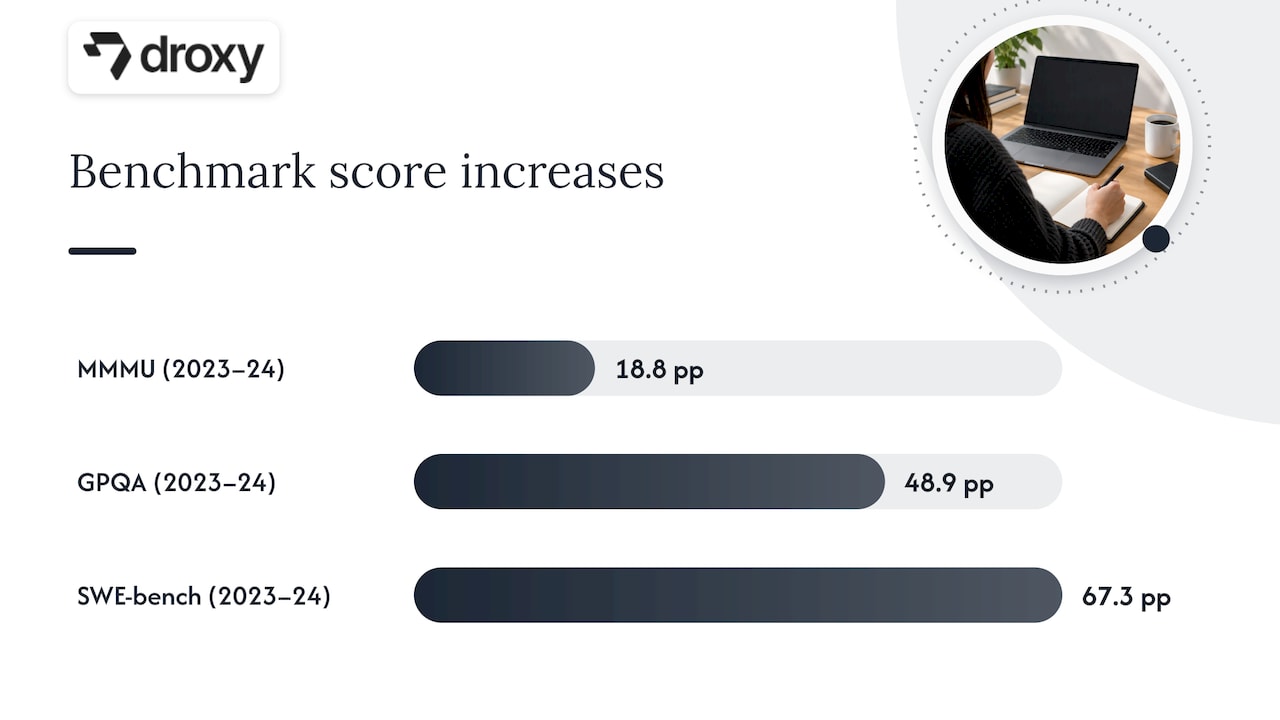
MMMU (multimodal reasoning), GPQA (graduate-level science questions), and SWE-bench (real-world software engineering tasks) were built to expose gaps the older benchmarks no longer catch. Progress on them has been fast: scores on MMMU, GPQA, and SWE-bench rose by 18.8, 48.9, and 67.3 percentage points respectively between 2023 and 2024, according to the Artificial Intelligence Index Report 2025.
Alongside capability tests sits a different kind of measure: Chatbot Arena, which ranks models by Elo score based on human pairwise votes rather than correctness. It tells you which answers people prefer, not which answers are right, and that distinction matters when you choose which benchmark to trust for a given decision.
2. Common performance metrics and how to interpret them
Each benchmark family reports a different kind of number, and mixing them up leads to bad procurement decisions. Capability tests use exact-match, accuracy, or pass@k, which tell you how often a model lands on a verifiably correct answer. Preference leaderboards use Elo or Arena scores, which reflect what human voters liked better in a head-to-head comparison, a measure that’s sensitive to writing style as much as substance.
None of these capture what actually breaks a production deployment, which is why operational metrics deserve equal weight:
Latency: how long a reply takes to generate, which shapes whether a chat or phone interaction feels natural.
Throughput: how many conversations a system can handle at once without slowing down.
Context window: how much conversation history a model can hold before it starts forgetting earlier turns.
Cost per query: what each exchange costs at the volume your business actually runs.
A model that tops a capability leaderboard but takes eight seconds to respond on a live chat widget will frustrate customers no matter how accurate its answers are. Treat accuracy, preference, and operational metrics as three separate questions, not one combined score.
3. How benchmarks are built: prompts, voters, controls, and aggregation
The methodology behind a benchmark score often matters more than the score itself. Four choices shape every published leaderboard:
Prompt construction and sample selection: which questions get asked, and how representative they are of real use, determines whether a benchmark predicts production behavior or just measures performance on a narrow slice of tasks.
Human voting versus LM evaluators: human pairwise judgments carry high variance between raters, while LM evaluators are faster and cheaper but show systematic leniency on certain criteria, a pattern documented in HELM Instruct’s multidimensional rating framework.
Style controls: answer length and markdown formatting measurably skew human preference votes. LMSYS Org’s style-control analysis found that controlling for length and markdown shifted Chatbot Arena rankings, with length acting as the dominant style factor.
Aggregation frameworks: Elo and Bradley-Terry regressions convert pairwise votes into a single ranking, while newer approaches like CAE (Chatbot Arena Estimate) reduce a benchmark set into two interpretable scores, “Goodness” for accuracy and “Fastness” for latency and cost, which the NAACL Industry 2025 paper on CAE found correlates more closely with full Arena Elo than many individual benchmarks do on their own.
4. Safety benchmarking and where the gaps show up
Safety evaluation is the least standardized part of chatbot benchmarking, and it’s the part procurement teams tend to skip. HELM Safety v1.0 was built to close that gap by standardizing evaluation across six risk categories: violence, fraud, discrimination, sexual content, harassment, and deception, using a curated set of benchmarks that includes BBQ, HarmBench, and XSTest.
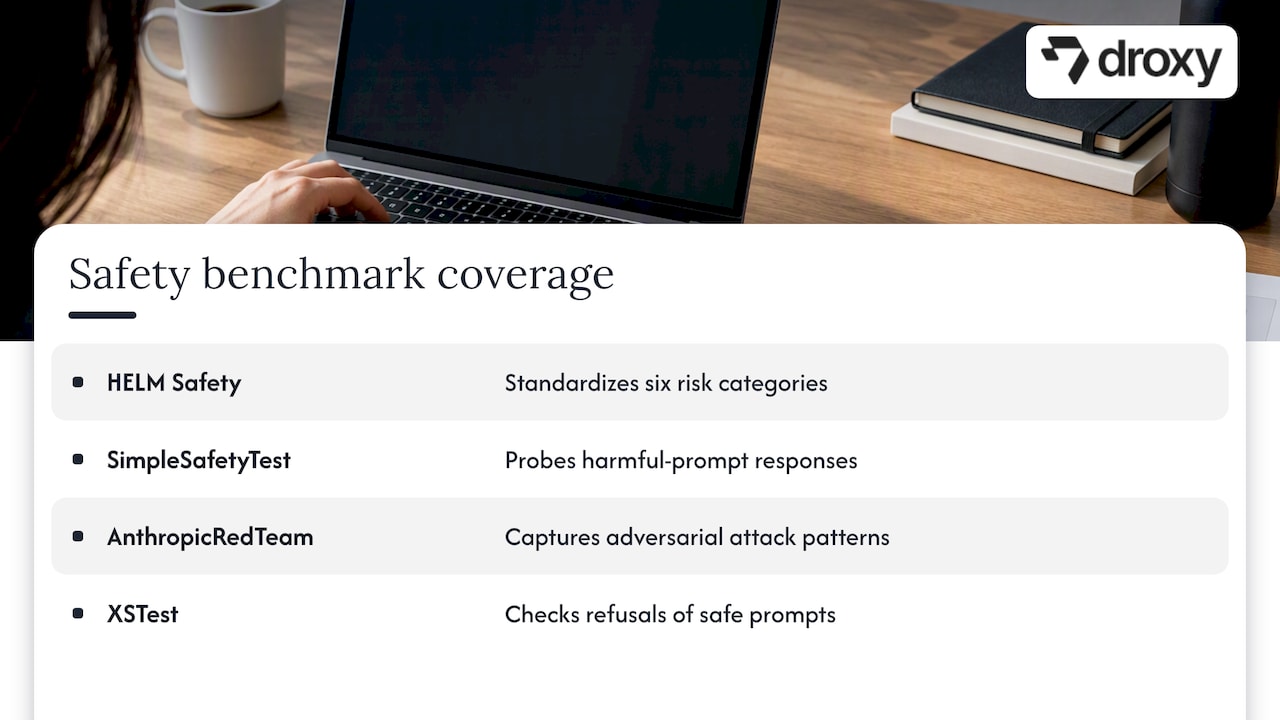
Other named benchmarks fill in specific angles: SimpleSafetyTest probes for unsafe responses to plain harmful prompts, AnthropicRedTeam captures adversarial attack patterns, and XSTest checks whether a model refuses safe prompts it shouldn’t refuse, a failure mode that’s just as costly as missing a genuinely harmful one.
The uneven part is coverage and transparency. Vendors and independent reports often test different risk categories, use different thresholds, and publish different levels of detail, so a “safety score” from one source rarely maps cleanly onto another. For a deeper look at how enterprise teams can structure their own safety practices around this gap, our breakdown of chatbot security for enterprise teams walks through the practical side.
5. A practical checklist for evaluating a chatbot for your business
Here’s how to turn these benchmark families into a decision you can actually defend to a procurement committee.
Build a test suite: combine public capability scores, a safety benchmark like HELM Safety, a preference leaderboard, and a private set of prompts drawn from your own customer conversations.
Control for style before comparing: normalize answer length and formatting across candidates, or at least note when one model’s preference score may be inflated by verbosity.
Document your prompt templates: write down exactly what you asked and how, so results are reproducible next quarter when a new model version ships.
Capture operational metrics under real load: measure latency, cost per query, and context handling with traffic that resembles your actual volume, not a quiet afternoon.
Run red-team safety checks: test edge cases, abusive inputs, and ambiguous requests, and keep a record of every failure so you can track whether a vendor fixes it.
Set success criteria before you start: decide what “good enough” looks like for accuracy, latency, and safety before the pilot begins, then run a short pilot to confirm those numbers hold in production.
Pro Tip: Score your domain-specific prompts separately from public benchmarks: a model that leads every public leaderboard can still misread your product catalog or booking rules.
Our guide on training a chatbot step by step covers how to build the private prompt set this checklist depends on. For a broader view of why domain tests matter so much, 21 Make or Break Questions for Successful Chatbot Adoption offers a complementary checklist built around adoption decisions rather than raw scores.
6. Weighing leaderboard scores against pilot evidence
When leaderboards disagree, and they often do, trust domain-specific tests and safety outcomes over a general Elo ranking. A model that wins Chatbot Arena by a wide margin can still fumble your return policy or mishandle a frustrated customer, and that gap only shows up in a pilot built around your actual intents.
Scope pilots around your core intents plus the edge cases that matter most: ambiguous requests, multi-turn conversations, and the handful of questions that account for most support volume. A two to four week pilot across those scenarios tells you more than any public leaderboard. A large number of businesses run customer interactions on AI platforms across website, phone, and messaging channels, and the pattern holds consistently: real conversation data beats a leaderboard score every time a decision is on the line.
— Elena
7. Why benchmark-first thinking gets evaluations wrong
The conventional advice tells buyers to find the model with the highest aggregate score and move on. That advice undersells how much methodology shapes the number itself. A leaderboard built on unstyled human votes rewards confident, well-formatted answers over correct ones, and a capability benchmark built on academic questions says little about how a model handles an irritated customer asking about a late shipment.
What the research actually supports is a layered read: use capability benchmarks to screen out weak models, use safety benchmarks to rule out risky ones, and use your own domain prompts, under realistic load, to make the final call. Style control deserves more weight than it gets, since a few lines of formatting can flip a ranking without changing the quality of the underlying answer.
If we had to prioritize one thing for a reader short on time, it’s this: build the private, domain-specific test set before worrying about which public leaderboard to trust. Public benchmarks tell you who’s roughly capable. Your own prompts tell you who actually fits your business.
FAQ
What are AI chatbot benchmarks used for?
AI chatbot benchmarks measure how well a model performs on specific tasks like knowledge recall, math, coding, or how much human raters prefer its answers. They help buyers compare models before committing, though they work best alongside private, domain-specific tests.
What’s the difference between MMLU and Chatbot Arena?
MMLU tests knowledge accuracy across academic subjects using a right-or-wrong scoring method, while Chatbot Arena ranks models by Elo score based on human preference votes in head-to-head comparisons. One measures correctness, the other measures what people liked better, and those don’t always agree.
Why does style control matter when comparing chatbot scores?
Answer length and markdown formatting measurably shift human preference rankings on leaderboards like Chatbot Arena, with length acting as the strongest style factor according to LMSYS Org’s analysis. Comparing models without controlling for style can favor a verbose model over a more accurate, concise one.
How do I evaluate chatbot safety before deployment?
Standardized frameworks like HELM Safety v1.0 test models across risk categories including violence, fraud, discrimination, and deception using benchmarks such as BBQ and HarmBench. Pairing a public safety benchmark with your own red-team testing on realistic prompts gives a fuller picture than either alone.
Can I trust a single benchmark score to choose a chatbot platform?
A single score rarely tells you enough, since capability, preference, and safety benchmarks each measure something different. If you’re evaluating a platform like one of Droxy’s plans for production use, a short pilot against your own customer intents is the most reliable final check.
Sources
HELM resources cover multidimensional evaluation and safety taxonomy in depth. LMSYS Org documents preference leaderboards and style-control methodology. The AI Index Report tracks yearly benchmark progress, and the CAE paper explains aggregation techniques for resource-constrained teams.
Does style matter? Disentangling style and substance in Chatbot Arena - LMSYS Org
CAE: a practical aggregation framework (NAACL Industry 2025)
Recommended
AI chatbot benchmarks fall into three families: capability tests, human-preference leaderboards, and safety evaluations. No single score tells the whole story, so a defensible evaluation pulls from all three, adds domain-specific tests, and controls for style before comparing anything.
TL;DR:
MMLU, GSM8K, and HumanEval remain useful screens, but newer multimodal, science, and software engineering tests expose gaps older benchmarks increasingly miss.
Treat accuracy, preference, and operational performance as separate questions; track latency, throughput, context capacity, and cost under traffic matching your expected volume.
Human preference rankings can shift when answer length and formatting change, so normalize both before comparison; length is the stronger style factor.
Pair a public safety framework such as HELM Safety with red team tests and private customer prompts, then run a two to four week pilot.
DroxyEvaluate AI in Real Customer InteractionsDroxy deploys customizable AI agents across chat, phone, messaging, and Shopify to answer customer inquiries around the clock.Explore Droxy
Table of Contents
1. The most-cited public benchmarks for chatbot capability
2. Common performance metrics and how to interpret them
3. How benchmarks are built: prompts, voters, controls, and aggregation
4. Safety benchmarking and where the gaps show up
5. A practical checklist for evaluating a chatbot for your business
6. Weighing leaderboard scores against pilot evidence
7. Why benchmark-first thinking gets evaluations wrong
Sources
1. The most-cited public benchmarks for chatbot capability
Capability benchmarks measure what a model knows and can do under controlled conditions. MMLU tests broad academic knowledge across dozens of subjects, GSM8K checks grade-school math reasoning, and HumanEval scores whether generated code actually runs and passes tests. These three have anchored model comparisons for years, but they’re getting easier for frontier models to ace, which is why evaluators now lean on harder tests.
MMMU (multimodal reasoning), GPQA (graduate-level science questions), and SWE-bench (real-world software engineering tasks) were built to expose gaps the older benchmarks no longer catch. Progress on them has been fast: scores on MMMU, GPQA, and SWE-bench rose by 18.8, 48.9, and 67.3 percentage points respectively between 2023 and 2024, according to the Artificial Intelligence Index Report 2025.
Alongside capability tests sits a different kind of measure: Chatbot Arena, which ranks models by Elo score based on human pairwise votes rather than correctness. It tells you which answers people prefer, not which answers are right, and that distinction matters when you choose which benchmark to trust for a given decision.
2. Common performance metrics and how to interpret them
Each benchmark family reports a different kind of number, and mixing them up leads to bad procurement decisions. Capability tests use exact-match, accuracy, or pass@k, which tell you how often a model lands on a verifiably correct answer. Preference leaderboards use Elo or Arena scores, which reflect what human voters liked better in a head-to-head comparison, a measure that’s sensitive to writing style as much as substance.
None of these capture what actually breaks a production deployment, which is why operational metrics deserve equal weight:
Latency: how long a reply takes to generate, which shapes whether a chat or phone interaction feels natural.
Throughput: how many conversations a system can handle at once without slowing down.
Context window: how much conversation history a model can hold before it starts forgetting earlier turns.
Cost per query: what each exchange costs at the volume your business actually runs.
A model that tops a capability leaderboard but takes eight seconds to respond on a live chat widget will frustrate customers no matter how accurate its answers are. Treat accuracy, preference, and operational metrics as three separate questions, not one combined score.
3. How benchmarks are built: prompts, voters, controls, and aggregation
The methodology behind a benchmark score often matters more than the score itself. Four choices shape every published leaderboard:
Prompt construction and sample selection: which questions get asked, and how representative they are of real use, determines whether a benchmark predicts production behavior or just measures performance on a narrow slice of tasks.
Human voting versus LM evaluators: human pairwise judgments carry high variance between raters, while LM evaluators are faster and cheaper but show systematic leniency on certain criteria, a pattern documented in HELM Instruct’s multidimensional rating framework.
Style controls: answer length and markdown formatting measurably skew human preference votes. LMSYS Org’s style-control analysis found that controlling for length and markdown shifted Chatbot Arena rankings, with length acting as the dominant style factor.
Aggregation frameworks: Elo and Bradley-Terry regressions convert pairwise votes into a single ranking, while newer approaches like CAE (Chatbot Arena Estimate) reduce a benchmark set into two interpretable scores, “Goodness” for accuracy and “Fastness” for latency and cost, which the NAACL Industry 2025 paper on CAE found correlates more closely with full Arena Elo than many individual benchmarks do on their own.
4. Safety benchmarking and where the gaps show up
Safety evaluation is the least standardized part of chatbot benchmarking, and it’s the part procurement teams tend to skip. HELM Safety v1.0 was built to close that gap by standardizing evaluation across six risk categories: violence, fraud, discrimination, sexual content, harassment, and deception, using a curated set of benchmarks that includes BBQ, HarmBench, and XSTest.
Other named benchmarks fill in specific angles: SimpleSafetyTest probes for unsafe responses to plain harmful prompts, AnthropicRedTeam captures adversarial attack patterns, and XSTest checks whether a model refuses safe prompts it shouldn’t refuse, a failure mode that’s just as costly as missing a genuinely harmful one.
The uneven part is coverage and transparency. Vendors and independent reports often test different risk categories, use different thresholds, and publish different levels of detail, so a “safety score” from one source rarely maps cleanly onto another. For a deeper look at how enterprise teams can structure their own safety practices around this gap, our breakdown of chatbot security for enterprise teams walks through the practical side.
5. A practical checklist for evaluating a chatbot for your business
Here’s how to turn these benchmark families into a decision you can actually defend to a procurement committee.
Build a test suite: combine public capability scores, a safety benchmark like HELM Safety, a preference leaderboard, and a private set of prompts drawn from your own customer conversations.
Control for style before comparing: normalize answer length and formatting across candidates, or at least note when one model’s preference score may be inflated by verbosity.
Document your prompt templates: write down exactly what you asked and how, so results are reproducible next quarter when a new model version ships.
Capture operational metrics under real load: measure latency, cost per query, and context handling with traffic that resembles your actual volume, not a quiet afternoon.
Run red-team safety checks: test edge cases, abusive inputs, and ambiguous requests, and keep a record of every failure so you can track whether a vendor fixes it.
Set success criteria before you start: decide what “good enough” looks like for accuracy, latency, and safety before the pilot begins, then run a short pilot to confirm those numbers hold in production.
Pro Tip: Score your domain-specific prompts separately from public benchmarks: a model that leads every public leaderboard can still misread your product catalog or booking rules.
Our guide on training a chatbot step by step covers how to build the private prompt set this checklist depends on. For a broader view of why domain tests matter so much, 21 Make or Break Questions for Successful Chatbot Adoption offers a complementary checklist built around adoption decisions rather than raw scores.
6. Weighing leaderboard scores against pilot evidence
When leaderboards disagree, and they often do, trust domain-specific tests and safety outcomes over a general Elo ranking. A model that wins Chatbot Arena by a wide margin can still fumble your return policy or mishandle a frustrated customer, and that gap only shows up in a pilot built around your actual intents.
Scope pilots around your core intents plus the edge cases that matter most: ambiguous requests, multi-turn conversations, and the handful of questions that account for most support volume. A two to four week pilot across those scenarios tells you more than any public leaderboard. A large number of businesses run customer interactions on AI platforms across website, phone, and messaging channels, and the pattern holds consistently: real conversation data beats a leaderboard score every time a decision is on the line.
— Elena
7. Why benchmark-first thinking gets evaluations wrong
The conventional advice tells buyers to find the model with the highest aggregate score and move on. That advice undersells how much methodology shapes the number itself. A leaderboard built on unstyled human votes rewards confident, well-formatted answers over correct ones, and a capability benchmark built on academic questions says little about how a model handles an irritated customer asking about a late shipment.
What the research actually supports is a layered read: use capability benchmarks to screen out weak models, use safety benchmarks to rule out risky ones, and use your own domain prompts, under realistic load, to make the final call. Style control deserves more weight than it gets, since a few lines of formatting can flip a ranking without changing the quality of the underlying answer.
If we had to prioritize one thing for a reader short on time, it’s this: build the private, domain-specific test set before worrying about which public leaderboard to trust. Public benchmarks tell you who’s roughly capable. Your own prompts tell you who actually fits your business.
FAQ
What are AI chatbot benchmarks used for?
AI chatbot benchmarks measure how well a model performs on specific tasks like knowledge recall, math, coding, or how much human raters prefer its answers. They help buyers compare models before committing, though they work best alongside private, domain-specific tests.
What’s the difference between MMLU and Chatbot Arena?
MMLU tests knowledge accuracy across academic subjects using a right-or-wrong scoring method, while Chatbot Arena ranks models by Elo score based on human preference votes in head-to-head comparisons. One measures correctness, the other measures what people liked better, and those don’t always agree.
Why does style control matter when comparing chatbot scores?
Answer length and markdown formatting measurably shift human preference rankings on leaderboards like Chatbot Arena, with length acting as the strongest style factor according to LMSYS Org’s analysis. Comparing models without controlling for style can favor a verbose model over a more accurate, concise one.
How do I evaluate chatbot safety before deployment?
Standardized frameworks like HELM Safety v1.0 test models across risk categories including violence, fraud, discrimination, and deception using benchmarks such as BBQ and HarmBench. Pairing a public safety benchmark with your own red-team testing on realistic prompts gives a fuller picture than either alone.
Can I trust a single benchmark score to choose a chatbot platform?
A single score rarely tells you enough, since capability, preference, and safety benchmarks each measure something different. If you’re evaluating a platform like one of Droxy’s plans for production use, a short pilot against your own customer intents is the most reliable final check.
Sources
HELM resources cover multidimensional evaluation and safety taxonomy in depth. LMSYS Org documents preference leaderboards and style-control methodology. The AI Index Report tracks yearly benchmark progress, and the CAE paper explains aggregation techniques for resource-constrained teams.
Does style matter? Disentangling style and substance in Chatbot Arena - LMSYS Org
CAE: a practical aggregation framework (NAACL Industry 2025)
Recommended


🚀
Powered by Droxy
Turn every interaction into a conversion
Customer facing AI agents that engage, convert, and support so you can scale what matters.
✨
Learn more
Recent posts
Insights
3 min read
Introducing Agent Memories
Improve your agents' performance with Agent Memories. Prevent agents from repeating the same mistakes by giving them feedback.
Read more

Insights
15 min read
HVAC Marketing in 2025: The Definitive Lead Gen Guide
Discover 15 proven HVAC marketing strategies, plus learn how Droxy's AI website agent converts curious visitors into qualified leads by answering their questions instantly - right when they're most interested in your services.
Read more
Insights
10 min read
10 Best AI Sales Agents in 2025: Tested & Ranked
Discover the top 10 AI sales agents of 2025, designed to enhance lead generation, personalize outreach, and ultimately, close more deals
Read more
Insights
3 min read
Introducing Agent Memories
Improve your agents' performance with Agent Memories. Prevent agents from repeating the same mistakes by giving them feedback.
Read more
Insights
15 min read
HVAC Marketing in 2025: The Definitive Lead Gen Guide
Discover 15 proven HVAC marketing strategies, plus learn how Droxy's AI website agent converts curious visitors into qualified leads by answering their questions instantly - right when they're most interested in your services.
Read more