6 KPIs That Prove Call Center Automation AI ROI for Contact Centers
6 KPIs That Prove Call Center Automation AI ROI for Contact Centers
Insights
22 min
AI-driven call center automation handles routine contacts, gives agents real-time assistance, and produces measurable gains in first-contact resolution and customer satisfaction. It works best as an augmentation layer, not a replacement: IBM’s implementation research shows containment and agent-assist tools freeing staff for complex cases, while platforms like Droxy put that technology into production across chat, voice, and messaging channels. The rest of this guide breaks down the technology, the rollout steps, and the numbers that prove it’s working.
TL;DR:
Effective AI call center automation can increase containment rates and first-contact resolution, especially when paired with agent-assist tools and continuous retraining.
Systems must interpret natural language accurately, handle multi-channel context seamlessly, and support smooth human handoffs with full conversation history.
Pilot deployments should focus on high-volume, low-complexity intents with controlled testing, clear success criteria, and regular performance monitoring over at least one week.
KPIs such as FCR, CSAT, containment, and escalation accuracy provide a comprehensive picture of automation success, avoiding false positives from simple deflection metrics.
Consider a no-code platform like Droxy for rapid, customized deployment across multiple channels, ensuring data security, transparency, and ongoing governance.
Table of Contents
What Is Call Center Automation AI, Exactly?
What Business Outcomes Does AI Automation Actually Deliver?
Which Technologies Actually Belong In A Call Center Automation Stack?
How Do You Roll Out Call Center Automation Without Breaking Everything?
Which KPIs Actually Prove Call Center Automation Is Working?
Where Does Call Center Automation AI Fit In Practice?
What Goes Wrong With Call Center Automation, And How Do You Prevent It?
How Droxy Puts This Into Production
Where Does Customer Data Actually Go?
Can AI Automation Be Fair, And How Do You Keep It That Way?
What’s Coming Next For Call Center Automation?
What Should You Actually Do About This In The Next Quarter?
Try Call Center Automation AI Without The Build-Out
Sources
What Is Call Center Automation AI, Exactly?
Call center automation AI refers to systems that use natural language understanding, automatic speech recognition, and generative language models to handle customer conversations without a human typing or speaking every response. That’s a different animal from the automation most operations teams grew up with.
Legacy automation, the touch-tone IVR menus and rigid RPA scripts, follows fixed decision trees. Press 1 for billing, press 2 for support, and heaven help you if your question doesn’t fit a branch. AI-driven automation instead interprets intent from natural language, whether typed or spoken, and generates a contextually appropriate response instead of matching a keyword to a script.
The practical capability stack looks like this:
Natural language understanding (NLU) interprets what a customer actually wants, even with typos, slang, or incomplete sentences.
Automatic speech recognition (ASR) converts spoken audio into text accurately enough to work in noisy, real-world call conditions.
Large language model (LLM) orchestration generates responses, pulls from knowledge bases, and manages multi-turn conversations.
Analytics layers score sentiment, flag compliance risks, and surface trends across thousands of interactions at once.
Omnichannel context carries a customer’s history from a website chat into a phone call or a WhatsApp thread without forcing them to repeat themselves.
The data flow is straightforward at a high level: a customer message or utterance enters the system, NLU or ASR converts it into structured intent, the orchestration layer decides whether to answer directly, pull a knowledge article, trigger a workflow, or hand off to a human, and the analytics layer logs the outcome for reporting. Salesforce’s overview of automated customer service walks through how chatbots, IVR, and automated ticketing fit into that pipeline, and Droxy’s own breakdown of how conversational AI works goes deeper on the mechanics if you want the technical layer explained plainly.
What Business Outcomes Does AI Automation Actually Deliver?
Four metrics move when AI automation is implemented well: containment rate, first-contact resolution (FCR), average handle time (AHT), and customer satisfaction (CSAT). Containment measures how many contacts the AI resolves without a human touching them. FCR tracks whether the customer’s issue got solved on the first try, not after three callbacks. AHT drops when agents get real-time answer suggestions instead of searching three systems mid-call. CSAT reflects whether any of this actually felt good to the customer.
AI virtual agents have helped organizations increase containment and agent efficiency simultaneously, according to IBM’s call center modernization research, which documents deployments where automated resolution improved alongside faster overall handling.
Beyond the KPI dashboard, the benefits show up in day-to-day agent experience:
Real-time assist tools suggest answers and next steps while an agent is still on the call, cutting research time.
After-call work (ACW) shrinks when the AI auto-generates call summaries and updates CRM fields.
Coverage extends to 24/7 without adding headcount for overnight or weekend shifts.
Cost per contact drops as routine, repetitive volume shifts away from human agents entirely.
None of this works if leadership treats automation as a headcount-reduction play instead of a capacity and quality lever. The operations teams seeing the strongest results are the ones reinvesting saved capacity into complex-case handling and proactive outreach.
Which Technologies Actually Belong In A Call Center Automation Stack?
Evaluating a platform, whether you’re building internally or vetting a vendor, comes down to checking for a specific set of capabilities rather than trusting a features list. Here’s what actually matters:
Conversational AI with LLM orchestration: the system needs to hold context across a multi-turn conversation, not just answer isolated questions.
ASR tuned for your call environment: accuracy in a quiet demo doesn’t predict accuracy on a customer’s cell phone in a parking lot.
Speech and text analytics: sentiment detection and compliance flagging should run automatically, not require a separate QA tool.
Predictive routing: matching a caller to the agent or resource most likely to resolve their issue quickly, based on history and behavior patterns rather than a simple round-robin queue.
RPA integration: automation that can actually update a record, issue a refund, or reschedule an appointment, not just talk about doing it.
Omnichannel continuity: a customer who starts on WhatsApp and calls in an hour later shouldn’t have to re-explain anything.
Predictive behavioral routing has moved from a nice-to-have to a genuine differentiator, matching communication styles between customers and agents in ways that measurably lift FCR and CSAT when paired with solid CRM data.
Human handoff deserves its own line item on any evaluation checklist. The system needs a clean, fast escalation path that carries full conversation context to the human agent, not a cold transfer that makes the customer start over. On the integration side, confirm the platform connects to your CRM, ticketing system, and knowledge base through documented APIs, and that it handles authentication and data access with the same security posture as your other customer-facing systems. Droxy’s piece on how AI is transforming contact centers covers how these pieces typically fit together in production.
How Do You Roll Out Call Center Automation Without Breaking Everything?
A phased rollout beats a big-bang launch every time, mostly because it lets you catch expensive mistakes while the blast radius is still small.
Discovery. Map your top customer journeys and identify the two or three highest-volume, lowest-complexity intents. Password resets, order status checks, and appointment scheduling are usually good starting candidates. Pull historical transcripts or call recordings to use as training data.
Pilot. Scope which channels the pilot covers (start with one, maybe two) and define success criteria before you launch, not after. Run the pilot against a control group so you’re comparing AI-handled contacts to a genuine baseline, not just watching a number go up in isolation.
Scale. Once the pilot clears your acceptance criteria, integrate with workforce management and CRM systems, establish a governance process for reviewing AI responses, and set a retraining cadence, monthly is a reasonable starting point for most operations.
Before you flip the switch on any phase, confirm you have: a data connector to your knowledge base that stays current automatically, a fallback flow for when the AI can’t confidently answer, and a documented escalation SLA that specifies how fast a human picks up when the AI hands off. Skipping any of these three is how pilots turn into support tickets about the pilot.
Best practices synthesized across IBM, Salesforce, and industry reporting consistently point to starting with high-frequency, low-complexity intents and agent-assist features first. That sequencing proves ROI fast and builds internal trust before you tackle harder use cases.
Pro Tip: Run your pilot with a true A/B split, not a before-and-after comparison. Seasonal volume shifts and staffing changes can make an unrelated variable look like an AI win, and you want evidence that survives a skeptical CFO.
Which KPIs Actually Prove Call Center Automation Is Working?
Six metrics tell you whether automation is delivering or just moving numbers around. FCR measures whether the issue got solved without a callback. CSAT and NPS capture how the customer actually felt about the experience. Containment shows the percentage of contacts the AI resolved solo. AHT tracks how long resolution takes, for both AI and human-assisted contacts. Escalation accuracy measures whether the AI handed off to a human at the right moment, not too early and not too late. Cost per contact rolls all of it into a number finance cares about.
The biggest measurement trap is treating containment as the finish line. A contact can be “contained” and still leave the customer frustrated enough to call back tomorrow angrier. IBM’s guidance on outcome-focused measurement argues for weighting FCR and CSAT over raw deflection numbers, and tracking escalation accuracy as the practical middle signal.
Run pilots long enough to hit a sample size that survives normal day-to-day variance, a week is rarely enough.
Set target ranges before launch, not after you see the results, or you’ll rationalize whatever number shows up.
Compare against a real control group, not last year’s numbers from a different season.
Where Does Call Center Automation AI Fit In Practice?
The use cases that deliver the fastest wins tend to be the ones nobody enjoys handling manually. FAQ and self-service resolution, appointment booking, order tracking, payment processing, lead qualification, quality assurance sampling, and outbound sales follow-up all show up repeatedly as high-volume, rules-friendly candidates for automation.
FAQs and self-service: account questions, hours, policy lookups, the stuff that eats agent time without needing a human brain.
Appointment booking: scheduling, rescheduling, and reminders across voice and chat.
Order and shipment tracking: status checks that customers increasingly expect to self-serve.
Payments and billing: balance inquiries, payment collection, and dispute intake.
Lead qualification: screening inbound interest before it reaches a sales rep, covered in more depth in Droxy’s guide to AI for sales calls.
Outbound automation: appointment confirmations, renewal reminders, and follow-up campaigns, detailed in this breakdown of AI outbound calling.
Channel expectations differ sharply. Voice callers expect near-instant, natural-sounding responses; messaging users tolerate a slight delay if the answer is accurate. Regulated industries, banking and healthcare especially, need extra scrutiny around what the AI is permitted to say and store, and those rules vary by region, so check local requirements before automating anything touching financial or medical data. Droxy’s look at voice AI in banking covers how one regulated sector handles that balance.
A mid-sized retail support team piloting order-tracking automation on chat saw average handle time on that intent drop substantially once the AI handled status lookups directly, freeing agents to focus on exceptions like damaged shipments and refund disputes.
What Goes Wrong With Call Center Automation, And How Do You Prevent It?
The failure modes are predictable, which is good news, because predictable problems have known mitigations. AI systems occasionally hallucinate, generating a confident but wrong answer. Misrouting sends a customer to the wrong queue or intent. Escalation gaps leave a frustrated customer stuck in a bot loop with no clear way to reach a human.
Hallucinations get caught by grounding responses strictly in your knowledge base, not letting the model improvise on policy questions.
Misrouting drops when intent classification gets regular review against real transcripts, not just initial training data.
Escalation gaps close with a visible, always-available “talk to a human” option, not a buried menu option.
On privacy, log retention, consent for recorded interactions, and data residency requirements all vary by jurisdiction, so confirm your specific obligations with legal counsel rather than assuming one region’s rules apply everywhere. Gartner’s research on customer sentiment found a significant share of customers would rather companies not use AI for service interactions at all, a signal that consent and transparency about when a customer is talking to a bot are not optional extras.
Pro Tip: Build a live monitoring dashboard that flags low-confidence AI responses in real time, and route those specific interactions to human review before they ship, not after a customer complains.

How Droxy Puts This Into Production
Droxy is a no-code platform for deploying AI agents across website chat, phone, WhatsApp, Instagram, Facebook, and Shopify, without writing a line of code to launch or customize one. Over 60,000 users currently run their customer interactions through it.
Deep customization keeps the agent’s voice consistent with your brand instead of sounding like a generic bot.
Knowledge integration pulls from multiple existing sources, so the agent answers from your actual documentation.
Human handoff routes complex or sensitive conversations to a live agent with full context intact.
API and Zapier integrations connect Droxy to the CRM and business systems you’re already running.
Onboarding typically starts with connecting a knowledge source, configuring the agent’s tone and scope, and testing on a single channel before expanding, which mirrors the phased pilot approach that mitigates most implementation risk.
Where Does Customer Data Actually Go?
Every AI interaction generates a data trail: transcripts, voice recordings, sentiment scores, and metadata about what the customer asked and how the system responded. That trail needs handling with the same rigor you’d apply to any other sensitive customer record, arguably more, since it’s now feeding a model that learns from it.
Consent matters more than most teams initially plan for. Customers should know when they’re talking to an AI system versus a human, and that disclosure should happen early in the interaction, not buried in a terms-of-service link nobody reads. Recording and transcript retention policies need clear limits: how long is data kept, who can access it, and is it used to retrain models without additional consent.
Data residency is where things get genuinely complicated for multinational operations. Where customer voice and chat data gets stored, and which country’s laws govern access to it, differs by jurisdiction, and the rules shift depending on whether you’re handling healthcare data, financial data, or general customer service inquiries. Check your specific regional and industry requirements before assuming a vendor’s standard setup covers you.
Security basics still apply and still get skipped surprisingly often: encryption in transit and at rest, role-based access controls limiting who inside your organization can view raw transcripts, and audit logging that tracks who accessed what and when. Vendor contracts should spell out data ownership explicitly. If the relationship ends, you want a documented right to export your data and a documented obligation for the vendor to delete it, not a vague promise buried in a terms page.
Can AI Automation Be Fair, And How Do You Keep It That Way?
Bias in AI call center systems usually enters through training data, not through any deliberate design choice. If historical transcripts used to train a model reflect patterns where certain accents, dialects, or phrasings got misrouted or dismissed more often, the AI can learn to repeat that pattern at scale, which is a much bigger problem than one biased human agent having a bad day.
Speech recognition accuracy varies across accents and dialects, a well-documented limitation across the ASR field generally, not specific to any one vendor. That gap can translate directly into worse service for some customers, longer resolution times or more frequent misunderstandings, purely because of how they speak. Testing your system’s accuracy across a genuinely diverse set of voices and phrasings, before launch and periodically afterward, is the practical mitigation.
Transparency does real ethical work here too. Customers deserve to know they’re interacting with an AI system, and they deserve an easy, unhidden path to a human if they’d prefer one. Gartner’s survey on AI sentiment found a substantial portion of customers actively prefer humans, which means forcing everyone through an AI-only path with no visible exit isn’t just a risk, it’s a trust problem waiting to surface publicly.
Regular auditing catches drift before it becomes a pattern. Review a sample of AI-handled interactions across different customer demographics on a set cadence, and treat any consistent disparity in outcomes as a defect worth fixing, not an acceptable margin of error.
What’s Coming Next For Call Center Automation?
Predictive behavioral routing is moving from an emerging feature to a default expectation. Instead of routing purely on skill tags or queue position, systems increasingly analyze communication style and interaction history to match customers with the agent or AI persona most likely to resolve their issue smoothly on the first attempt.
Voice quality is closing the gap with text-based AI fast. The stiff, obviously-synthetic voice agent of a few years ago is giving way to systems that handle interruptions, tone shifts, and natural conversational pacing far more convincingly, which matters enormously for voice channel adoption since customers abandon awkward voice bots quickly.
Proactive service is the next frontier past reactive automation. Rather than waiting for a customer to call about a shipping delay, systems are starting to trigger outbound notifications before the customer even notices a problem, shifting the entire model from response to anticipation.
Agent-AI collaboration tools are getting more sophisticated too, with real-time coaching that suggests not just what to say next, but how to say it based on the customer’s detected emotional state. Expect tighter integration between speech analytics and live agent guidance over the next couple of years, along with continued scrutiny over where automation should stop and human judgment should take over.
What Should You Actually Do About This In The Next Quarter?
Start with an AI-first pilot that keeps a human safety net visible at every step. That combination, not full automation and not cautious half-measures, is what actually produces defensible results you can take to leadership.
For the next 90 to 180 days, focus on three things: pick two or three high-volume intents you can automate with confidence, deploy agent-assist tools for your human team before you deploy fully autonomous agents, and instrument your measurement stack before you launch anything, not after. Teams that build the KPI dashboard first tend to make better decisions in month two than teams still arguing about what “success” means in month four.
Governance isn’t a one-time setup task. The retraining cadence, the audit reviews, the escalation policy, all of it needs revisiting as your call volume, customer base, and AI capabilities keep shifting under you.
— Droxy
Try Call Center Automation AI Without The Build-Out
Most teams evaluating this space face a choice between a slow, expensive custom build or a rigid off-the-shelf bot that can’t flex to their brand voice. Droxy skips both problems: it’s a no-code platform, so you configure and launch an AI agent yourself, without a developer backlog standing between you and a working pilot.
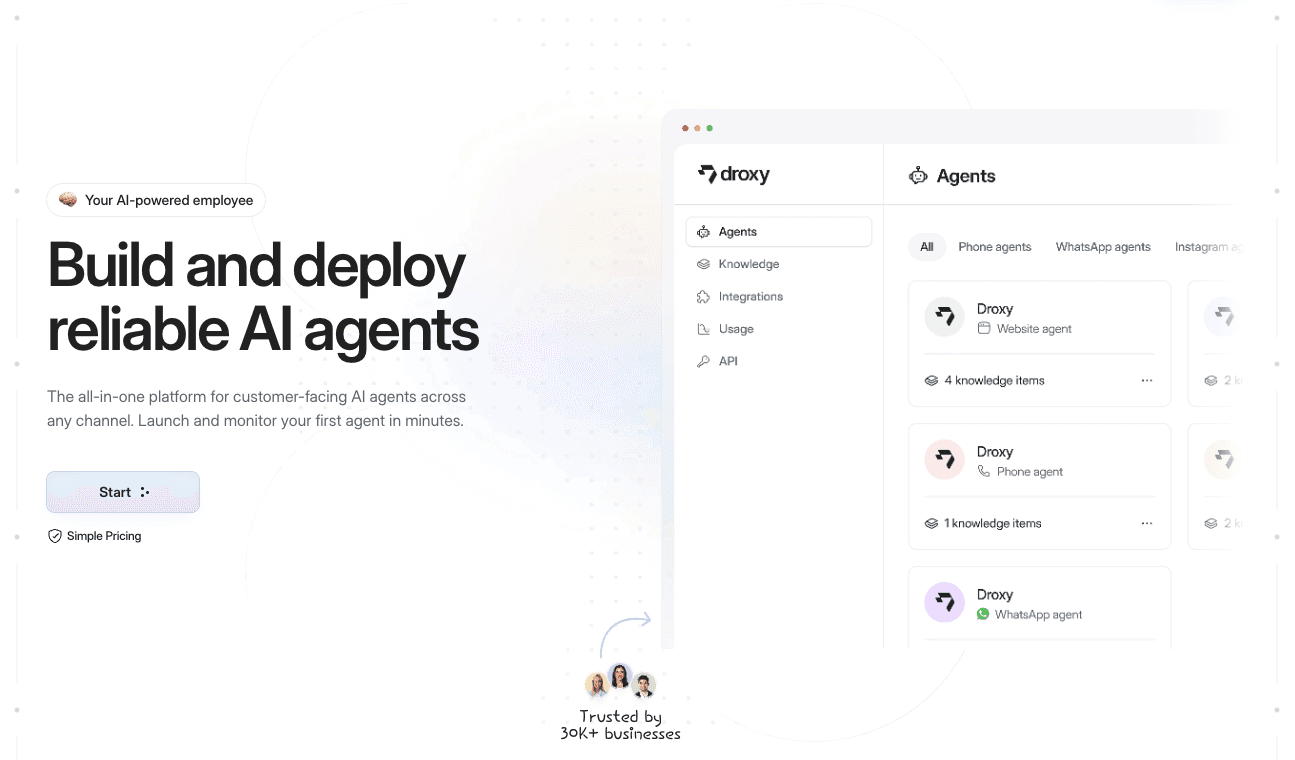
You can deploy across website chat, phone, WhatsApp, Instagram, and Facebook, plus native Shopify integration if you run ecommerce, all from one dashboard, with human handoff built in so nothing falls through a gap. Agencies and consultants can resell Droxy under their own brand through the white-label agency program, a route worth checking if you’re managing automation for multiple clients rather than one operation.
If you want to see how it handles your specific use case, start by reviewing the plans options and configuring a test agent on your own knowledge base. That’s the fastest way to know whether it fits before you commit anything at scale.
Sources
Recommended
AI-driven call center automation handles routine contacts, gives agents real-time assistance, and produces measurable gains in first-contact resolution and customer satisfaction. It works best as an augmentation layer, not a replacement: IBM’s implementation research shows containment and agent-assist tools freeing staff for complex cases, while platforms like Droxy put that technology into production across chat, voice, and messaging channels. The rest of this guide breaks down the technology, the rollout steps, and the numbers that prove it’s working.
TL;DR:
Effective AI call center automation can increase containment rates and first-contact resolution, especially when paired with agent-assist tools and continuous retraining.
Systems must interpret natural language accurately, handle multi-channel context seamlessly, and support smooth human handoffs with full conversation history.
Pilot deployments should focus on high-volume, low-complexity intents with controlled testing, clear success criteria, and regular performance monitoring over at least one week.
KPIs such as FCR, CSAT, containment, and escalation accuracy provide a comprehensive picture of automation success, avoiding false positives from simple deflection metrics.
Consider a no-code platform like Droxy for rapid, customized deployment across multiple channels, ensuring data security, transparency, and ongoing governance.
Table of Contents
What Is Call Center Automation AI, Exactly?
What Business Outcomes Does AI Automation Actually Deliver?
Which Technologies Actually Belong In A Call Center Automation Stack?
How Do You Roll Out Call Center Automation Without Breaking Everything?
Which KPIs Actually Prove Call Center Automation Is Working?
Where Does Call Center Automation AI Fit In Practice?
What Goes Wrong With Call Center Automation, And How Do You Prevent It?
How Droxy Puts This Into Production
Where Does Customer Data Actually Go?
Can AI Automation Be Fair, And How Do You Keep It That Way?
What’s Coming Next For Call Center Automation?
What Should You Actually Do About This In The Next Quarter?
Try Call Center Automation AI Without The Build-Out
Sources
What Is Call Center Automation AI, Exactly?
Call center automation AI refers to systems that use natural language understanding, automatic speech recognition, and generative language models to handle customer conversations without a human typing or speaking every response. That’s a different animal from the automation most operations teams grew up with.
Legacy automation, the touch-tone IVR menus and rigid RPA scripts, follows fixed decision trees. Press 1 for billing, press 2 for support, and heaven help you if your question doesn’t fit a branch. AI-driven automation instead interprets intent from natural language, whether typed or spoken, and generates a contextually appropriate response instead of matching a keyword to a script.
The practical capability stack looks like this:
Natural language understanding (NLU) interprets what a customer actually wants, even with typos, slang, or incomplete sentences.
Automatic speech recognition (ASR) converts spoken audio into text accurately enough to work in noisy, real-world call conditions.
Large language model (LLM) orchestration generates responses, pulls from knowledge bases, and manages multi-turn conversations.
Analytics layers score sentiment, flag compliance risks, and surface trends across thousands of interactions at once.
Omnichannel context carries a customer’s history from a website chat into a phone call or a WhatsApp thread without forcing them to repeat themselves.
The data flow is straightforward at a high level: a customer message or utterance enters the system, NLU or ASR converts it into structured intent, the orchestration layer decides whether to answer directly, pull a knowledge article, trigger a workflow, or hand off to a human, and the analytics layer logs the outcome for reporting. Salesforce’s overview of automated customer service walks through how chatbots, IVR, and automated ticketing fit into that pipeline, and Droxy’s own breakdown of how conversational AI works goes deeper on the mechanics if you want the technical layer explained plainly.
What Business Outcomes Does AI Automation Actually Deliver?
Four metrics move when AI automation is implemented well: containment rate, first-contact resolution (FCR), average handle time (AHT), and customer satisfaction (CSAT). Containment measures how many contacts the AI resolves without a human touching them. FCR tracks whether the customer’s issue got solved on the first try, not after three callbacks. AHT drops when agents get real-time answer suggestions instead of searching three systems mid-call. CSAT reflects whether any of this actually felt good to the customer.
AI virtual agents have helped organizations increase containment and agent efficiency simultaneously, according to IBM’s call center modernization research, which documents deployments where automated resolution improved alongside faster overall handling.
Beyond the KPI dashboard, the benefits show up in day-to-day agent experience:
Real-time assist tools suggest answers and next steps while an agent is still on the call, cutting research time.
After-call work (ACW) shrinks when the AI auto-generates call summaries and updates CRM fields.
Coverage extends to 24/7 without adding headcount for overnight or weekend shifts.
Cost per contact drops as routine, repetitive volume shifts away from human agents entirely.
None of this works if leadership treats automation as a headcount-reduction play instead of a capacity and quality lever. The operations teams seeing the strongest results are the ones reinvesting saved capacity into complex-case handling and proactive outreach.
Which Technologies Actually Belong In A Call Center Automation Stack?
Evaluating a platform, whether you’re building internally or vetting a vendor, comes down to checking for a specific set of capabilities rather than trusting a features list. Here’s what actually matters:
Conversational AI with LLM orchestration: the system needs to hold context across a multi-turn conversation, not just answer isolated questions.
ASR tuned for your call environment: accuracy in a quiet demo doesn’t predict accuracy on a customer’s cell phone in a parking lot.
Speech and text analytics: sentiment detection and compliance flagging should run automatically, not require a separate QA tool.
Predictive routing: matching a caller to the agent or resource most likely to resolve their issue quickly, based on history and behavior patterns rather than a simple round-robin queue.
RPA integration: automation that can actually update a record, issue a refund, or reschedule an appointment, not just talk about doing it.
Omnichannel continuity: a customer who starts on WhatsApp and calls in an hour later shouldn’t have to re-explain anything.
Predictive behavioral routing has moved from a nice-to-have to a genuine differentiator, matching communication styles between customers and agents in ways that measurably lift FCR and CSAT when paired with solid CRM data.
Human handoff deserves its own line item on any evaluation checklist. The system needs a clean, fast escalation path that carries full conversation context to the human agent, not a cold transfer that makes the customer start over. On the integration side, confirm the platform connects to your CRM, ticketing system, and knowledge base through documented APIs, and that it handles authentication and data access with the same security posture as your other customer-facing systems. Droxy’s piece on how AI is transforming contact centers covers how these pieces typically fit together in production.
How Do You Roll Out Call Center Automation Without Breaking Everything?
A phased rollout beats a big-bang launch every time, mostly because it lets you catch expensive mistakes while the blast radius is still small.
Discovery. Map your top customer journeys and identify the two or three highest-volume, lowest-complexity intents. Password resets, order status checks, and appointment scheduling are usually good starting candidates. Pull historical transcripts or call recordings to use as training data.
Pilot. Scope which channels the pilot covers (start with one, maybe two) and define success criteria before you launch, not after. Run the pilot against a control group so you’re comparing AI-handled contacts to a genuine baseline, not just watching a number go up in isolation.
Scale. Once the pilot clears your acceptance criteria, integrate with workforce management and CRM systems, establish a governance process for reviewing AI responses, and set a retraining cadence, monthly is a reasonable starting point for most operations.
Before you flip the switch on any phase, confirm you have: a data connector to your knowledge base that stays current automatically, a fallback flow for when the AI can’t confidently answer, and a documented escalation SLA that specifies how fast a human picks up when the AI hands off. Skipping any of these three is how pilots turn into support tickets about the pilot.
Best practices synthesized across IBM, Salesforce, and industry reporting consistently point to starting with high-frequency, low-complexity intents and agent-assist features first. That sequencing proves ROI fast and builds internal trust before you tackle harder use cases.
Pro Tip: Run your pilot with a true A/B split, not a before-and-after comparison. Seasonal volume shifts and staffing changes can make an unrelated variable look like an AI win, and you want evidence that survives a skeptical CFO.
Which KPIs Actually Prove Call Center Automation Is Working?
Six metrics tell you whether automation is delivering or just moving numbers around. FCR measures whether the issue got solved without a callback. CSAT and NPS capture how the customer actually felt about the experience. Containment shows the percentage of contacts the AI resolved solo. AHT tracks how long resolution takes, for both AI and human-assisted contacts. Escalation accuracy measures whether the AI handed off to a human at the right moment, not too early and not too late. Cost per contact rolls all of it into a number finance cares about.
The biggest measurement trap is treating containment as the finish line. A contact can be “contained” and still leave the customer frustrated enough to call back tomorrow angrier. IBM’s guidance on outcome-focused measurement argues for weighting FCR and CSAT over raw deflection numbers, and tracking escalation accuracy as the practical middle signal.
Run pilots long enough to hit a sample size that survives normal day-to-day variance, a week is rarely enough.
Set target ranges before launch, not after you see the results, or you’ll rationalize whatever number shows up.
Compare against a real control group, not last year’s numbers from a different season.
Where Does Call Center Automation AI Fit In Practice?
The use cases that deliver the fastest wins tend to be the ones nobody enjoys handling manually. FAQ and self-service resolution, appointment booking, order tracking, payment processing, lead qualification, quality assurance sampling, and outbound sales follow-up all show up repeatedly as high-volume, rules-friendly candidates for automation.
FAQs and self-service: account questions, hours, policy lookups, the stuff that eats agent time without needing a human brain.
Appointment booking: scheduling, rescheduling, and reminders across voice and chat.
Order and shipment tracking: status checks that customers increasingly expect to self-serve.
Payments and billing: balance inquiries, payment collection, and dispute intake.
Lead qualification: screening inbound interest before it reaches a sales rep, covered in more depth in Droxy’s guide to AI for sales calls.
Outbound automation: appointment confirmations, renewal reminders, and follow-up campaigns, detailed in this breakdown of AI outbound calling.
Channel expectations differ sharply. Voice callers expect near-instant, natural-sounding responses; messaging users tolerate a slight delay if the answer is accurate. Regulated industries, banking and healthcare especially, need extra scrutiny around what the AI is permitted to say and store, and those rules vary by region, so check local requirements before automating anything touching financial or medical data. Droxy’s look at voice AI in banking covers how one regulated sector handles that balance.
A mid-sized retail support team piloting order-tracking automation on chat saw average handle time on that intent drop substantially once the AI handled status lookups directly, freeing agents to focus on exceptions like damaged shipments and refund disputes.
What Goes Wrong With Call Center Automation, And How Do You Prevent It?
The failure modes are predictable, which is good news, because predictable problems have known mitigations. AI systems occasionally hallucinate, generating a confident but wrong answer. Misrouting sends a customer to the wrong queue or intent. Escalation gaps leave a frustrated customer stuck in a bot loop with no clear way to reach a human.
Hallucinations get caught by grounding responses strictly in your knowledge base, not letting the model improvise on policy questions.
Misrouting drops when intent classification gets regular review against real transcripts, not just initial training data.
Escalation gaps close with a visible, always-available “talk to a human” option, not a buried menu option.
On privacy, log retention, consent for recorded interactions, and data residency requirements all vary by jurisdiction, so confirm your specific obligations with legal counsel rather than assuming one region’s rules apply everywhere. Gartner’s research on customer sentiment found a significant share of customers would rather companies not use AI for service interactions at all, a signal that consent and transparency about when a customer is talking to a bot are not optional extras.
Pro Tip: Build a live monitoring dashboard that flags low-confidence AI responses in real time, and route those specific interactions to human review before they ship, not after a customer complains.
How Droxy Puts This Into Production
Droxy is a no-code platform for deploying AI agents across website chat, phone, WhatsApp, Instagram, Facebook, and Shopify, without writing a line of code to launch or customize one. Over 60,000 users currently run their customer interactions through it.
Deep customization keeps the agent’s voice consistent with your brand instead of sounding like a generic bot.
Knowledge integration pulls from multiple existing sources, so the agent answers from your actual documentation.
Human handoff routes complex or sensitive conversations to a live agent with full context intact.
API and Zapier integrations connect Droxy to the CRM and business systems you’re already running.
Onboarding typically starts with connecting a knowledge source, configuring the agent’s tone and scope, and testing on a single channel before expanding, which mirrors the phased pilot approach that mitigates most implementation risk.
Where Does Customer Data Actually Go?
Every AI interaction generates a data trail: transcripts, voice recordings, sentiment scores, and metadata about what the customer asked and how the system responded. That trail needs handling with the same rigor you’d apply to any other sensitive customer record, arguably more, since it’s now feeding a model that learns from it.
Consent matters more than most teams initially plan for. Customers should know when they’re talking to an AI system versus a human, and that disclosure should happen early in the interaction, not buried in a terms-of-service link nobody reads. Recording and transcript retention policies need clear limits: how long is data kept, who can access it, and is it used to retrain models without additional consent.
Data residency is where things get genuinely complicated for multinational operations. Where customer voice and chat data gets stored, and which country’s laws govern access to it, differs by jurisdiction, and the rules shift depending on whether you’re handling healthcare data, financial data, or general customer service inquiries. Check your specific regional and industry requirements before assuming a vendor’s standard setup covers you.
Security basics still apply and still get skipped surprisingly often: encryption in transit and at rest, role-based access controls limiting who inside your organization can view raw transcripts, and audit logging that tracks who accessed what and when. Vendor contracts should spell out data ownership explicitly. If the relationship ends, you want a documented right to export your data and a documented obligation for the vendor to delete it, not a vague promise buried in a terms page.
Can AI Automation Be Fair, And How Do You Keep It That Way?
Bias in AI call center systems usually enters through training data, not through any deliberate design choice. If historical transcripts used to train a model reflect patterns where certain accents, dialects, or phrasings got misrouted or dismissed more often, the AI can learn to repeat that pattern at scale, which is a much bigger problem than one biased human agent having a bad day.
Speech recognition accuracy varies across accents and dialects, a well-documented limitation across the ASR field generally, not specific to any one vendor. That gap can translate directly into worse service for some customers, longer resolution times or more frequent misunderstandings, purely because of how they speak. Testing your system’s accuracy across a genuinely diverse set of voices and phrasings, before launch and periodically afterward, is the practical mitigation.
Transparency does real ethical work here too. Customers deserve to know they’re interacting with an AI system, and they deserve an easy, unhidden path to a human if they’d prefer one. Gartner’s survey on AI sentiment found a substantial portion of customers actively prefer humans, which means forcing everyone through an AI-only path with no visible exit isn’t just a risk, it’s a trust problem waiting to surface publicly.
Regular auditing catches drift before it becomes a pattern. Review a sample of AI-handled interactions across different customer demographics on a set cadence, and treat any consistent disparity in outcomes as a defect worth fixing, not an acceptable margin of error.
What’s Coming Next For Call Center Automation?
Predictive behavioral routing is moving from an emerging feature to a default expectation. Instead of routing purely on skill tags or queue position, systems increasingly analyze communication style and interaction history to match customers with the agent or AI persona most likely to resolve their issue smoothly on the first attempt.
Voice quality is closing the gap with text-based AI fast. The stiff, obviously-synthetic voice agent of a few years ago is giving way to systems that handle interruptions, tone shifts, and natural conversational pacing far more convincingly, which matters enormously for voice channel adoption since customers abandon awkward voice bots quickly.
Proactive service is the next frontier past reactive automation. Rather than waiting for a customer to call about a shipping delay, systems are starting to trigger outbound notifications before the customer even notices a problem, shifting the entire model from response to anticipation.
Agent-AI collaboration tools are getting more sophisticated too, with real-time coaching that suggests not just what to say next, but how to say it based on the customer’s detected emotional state. Expect tighter integration between speech analytics and live agent guidance over the next couple of years, along with continued scrutiny over where automation should stop and human judgment should take over.
What Should You Actually Do About This In The Next Quarter?
Start with an AI-first pilot that keeps a human safety net visible at every step. That combination, not full automation and not cautious half-measures, is what actually produces defensible results you can take to leadership.
For the next 90 to 180 days, focus on three things: pick two or three high-volume intents you can automate with confidence, deploy agent-assist tools for your human team before you deploy fully autonomous agents, and instrument your measurement stack before you launch anything, not after. Teams that build the KPI dashboard first tend to make better decisions in month two than teams still arguing about what “success” means in month four.
Governance isn’t a one-time setup task. The retraining cadence, the audit reviews, the escalation policy, all of it needs revisiting as your call volume, customer base, and AI capabilities keep shifting under you.
— Droxy
Try Call Center Automation AI Without The Build-Out
Most teams evaluating this space face a choice between a slow, expensive custom build or a rigid off-the-shelf bot that can’t flex to their brand voice. Droxy skips both problems: it’s a no-code platform, so you configure and launch an AI agent yourself, without a developer backlog standing between you and a working pilot.
You can deploy across website chat, phone, WhatsApp, Instagram, and Facebook, plus native Shopify integration if you run ecommerce, all from one dashboard, with human handoff built in so nothing falls through a gap. Agencies and consultants can resell Droxy under their own brand through the white-label agency program, a route worth checking if you’re managing automation for multiple clients rather than one operation.
If you want to see how it handles your specific use case, start by reviewing the plans options and configuring a test agent on your own knowledge base. That’s the fastest way to know whether it fits before you commit anything at scale.
Sources
Recommended


🚀
Powered by Droxy
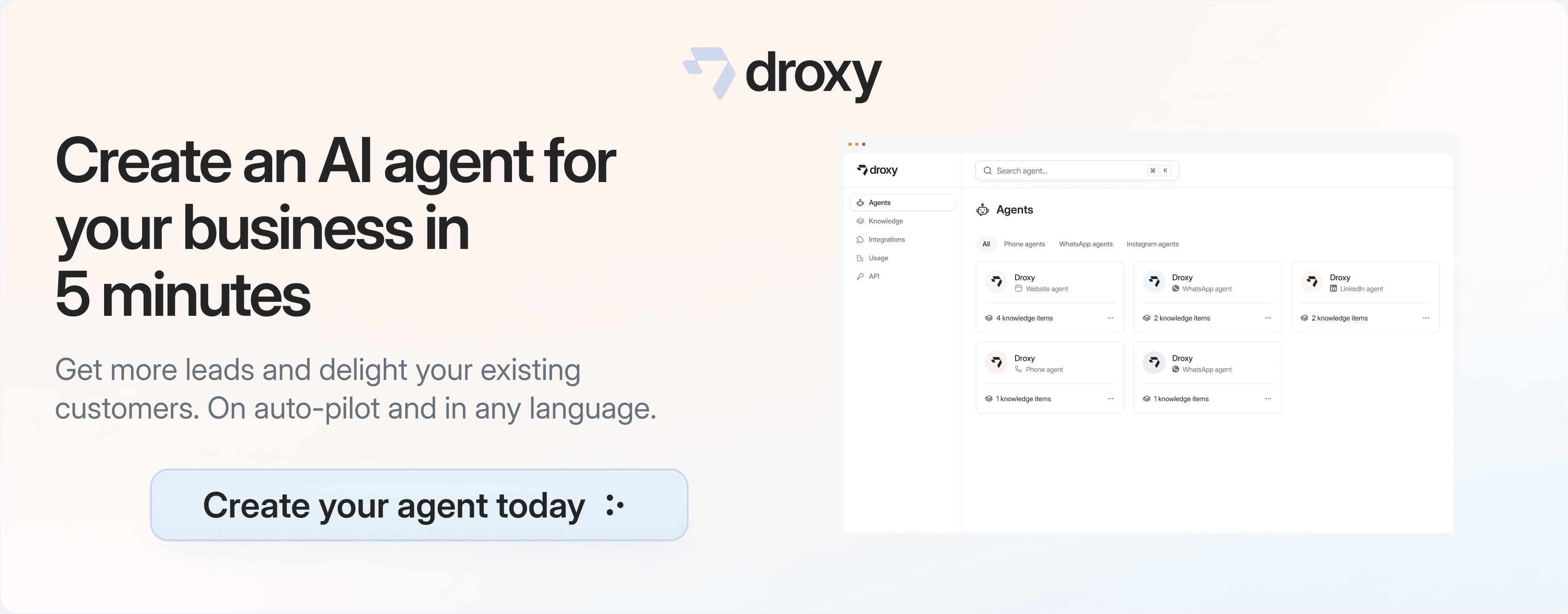
Turn every interaction into a conversion
Customer facing AI agents that engage, convert, and support so you can scale what matters.
✨
Learn more
Recent posts
Insights
3 min read
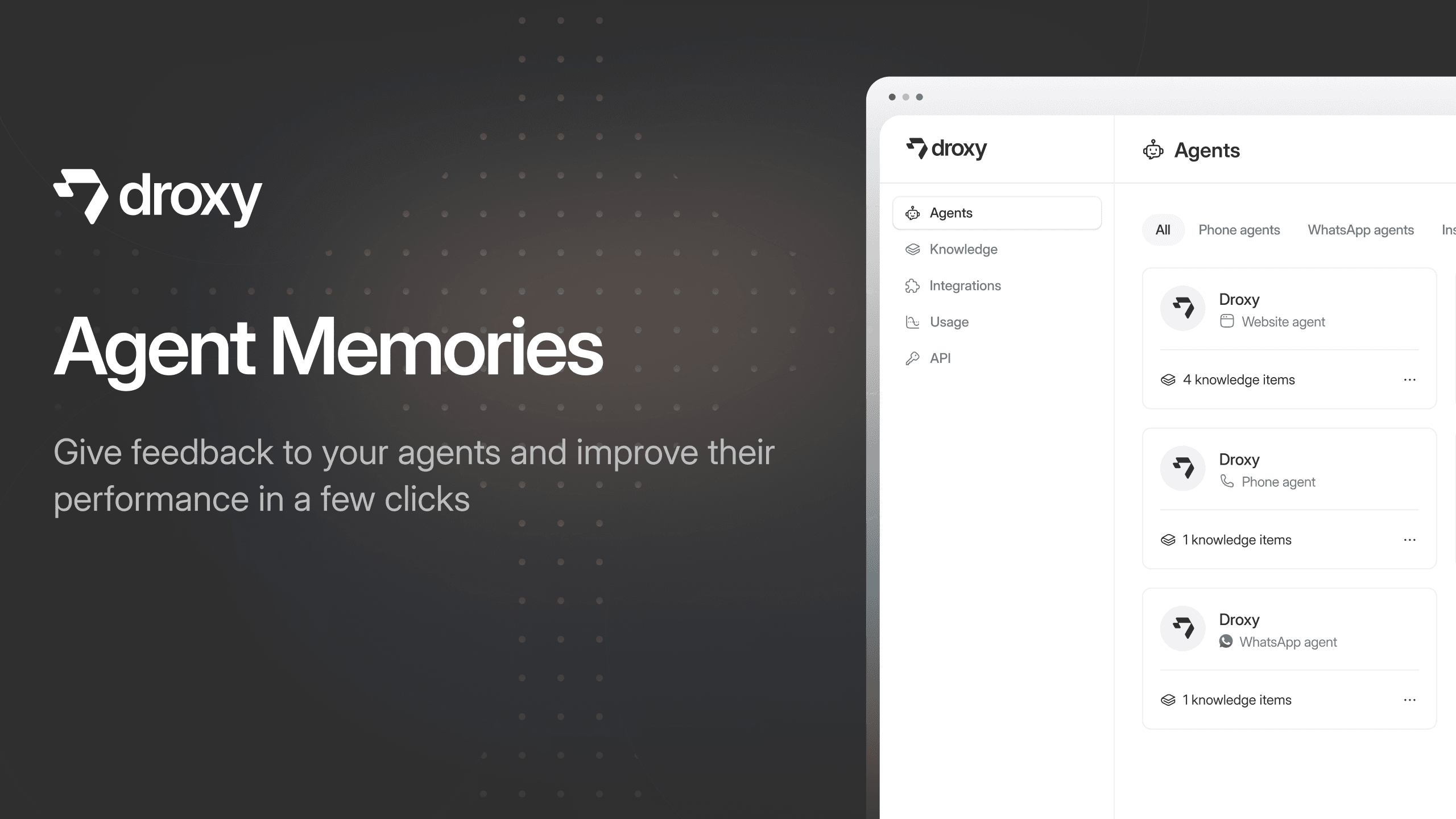
Introducing Agent Memories
Improve your agents' performance with Agent Memories. Prevent agents from repeating the same mistakes by giving them feedback.
Read more

Insights
15 min read
HVAC Marketing in 2025: The Definitive Lead Gen Guide
Discover 15 proven HVAC marketing strategies, plus learn how Droxy's AI website agent converts curious visitors into qualified leads by answering their questions instantly - right when they're most interested in your services.
Read more
Insights
10 min read
10 Best AI Sales Agents in 2025: Tested & Ranked
Discover the top 10 AI sales agents of 2025, designed to enhance lead generation, personalize outreach, and ultimately, close more deals
Read more
Insights
3 min read
Introducing Agent Memories
Improve your agents' performance with Agent Memories. Prevent agents from repeating the same mistakes by giving them feedback.
Read more
Insights
15 min read
HVAC Marketing in 2025: The Definitive Lead Gen Guide
Discover 15 proven HVAC marketing strategies, plus learn how Droxy's AI website agent converts curious visitors into qualified leads by answering their questions instantly - right when they're most interested in your services.
Read more