Chatbot Fallback Strategy: A Practical Guide for 2026
Chatbot Fallback Strategy: A Practical Guide for 2026
Insights
15 min

A good chatbot fallback strategy decides, before a customer ever gets stuck, what the bot does when it cannot answer. The best pattern is simple: ask one specific clarifying question, offer two or three choices, then hand the conversation to a person after about three failed attempts, with the context attached. Do that and a missed answer stops being a lost customer.
This guide shows you how to set the trigger, build the ladder, measure fallback rate and test it all before your customers find the gaps.
DroxyKeep Customer Conversations MovingDroxy deploys customizable AI agents across chat, phone, and social channels to answer inquiries instantly and help reduce missed conversations.Explore Droxy
TL;DR
A fallback is the planned response your bot gives when no intent matches with enough confidence. It should acknowledge the gap and give the customer a way forward.
Never let a customer fail more than about three times in a row. Siemens, IBM and Google all describe a three-attempt limit in their guidelines.
Build a ladder: retry, clarify, offer choices, then human handoff or a ticket. Each step should change the approach, not repeat the last one.
Track fallback rate by reply and by conversation, and read the actual transcripts to fix the cause.
Test with deliberately confusing input, including after hours when no agent is online.
Table of Contents
What a chatbot fallback is, and when it should fire
Build a fallback ladder instead of one error message
Write fallback messages that keep customers moving
Design the handoff so nothing is lost
Measure fallback rate and know what it tells you
Test your fallback before customers do
Our perspective on fallback
Put the strategy to work with Droxy
Fallback strategy by channel
Sources
What a chatbot fallback is, and when it should fire
A chatbot fallback is a predefined response or flow used when the bot cannot confidently handle a message. It is triggered when no recognized intent meets the required confidence threshold. It acknowledges the gap and gives the user a way to continue.
That last part is what separates a strategy from a default error message. “Sorry, I didn’t get that” on its own is a dead end. A fallback worth shipping does one of three things, according to the same source: it offers clear choices so the user can try again, suggests another function the bot can perform, or offers a connection to a human representative.

Three situations that need a fallback
Not every failure looks the same, and your bot should treat them differently:
No match. The message does not fit any intent, or the confidence score is below your threshold. This is the classic fallback.
Partial match. The bot has a likely intent but is missing detail, such as an order number or a date. This calls for a targeted question, not a generic apology.
Out of scope or sensitive. The customer asks for something the bot should not handle, such as a billing dispute or a medical question. Skip the retries and route straight to a person.
If you are choosing between a stricter or looser confidence threshold, remember what each costs. A high threshold sends more conversations to fallback but gives fewer wrong answers. A low threshold feels smoother until the bot confidently answers the wrong question. Start conservative on anything involving money, bookings or health, and loosen it as your transcripts show the bot is right.
For a deeper look at how intent matching works under the hood, see our guide to three-tier intent detection and our overview of how conversational AI works.
Build a fallback ladder instead of one error message
The most useful way to think about fallback is as a ladder. Each rung changes the approach, and the bot counts failures so it moves up instead of repeating itself. Here is a version that works for most customer support setups.
Rung | What the bot does | Example |
|---|---|---|
1. Safe retry | Rephrases the request lightly, without blaming the customer | “Let me make sure I have this right. Are you asking about an order?” |
2. Specific clarifying question | Asks one narrow question tied to the likely topic | “Is this about a delivery, a return, or something else?” |
3. Two or three choices | Shows buttons or short options | “Track an order, start a return, talk to our team” |
4. Adjacent help | Offers the closest knowledge-base answer | “Here’s our returns policy. Does that help?” |
5. Human handoff | Passes the full conversation to a person | “I’m bringing in a teammate, and they’ll see everything we’ve discussed.” |
6. Callback or ticket | Used when nobody is online | “We’re closed right now. Leave your email and we’ll reply by morning.” |
The exact rungs depend on your channel. On a phone agent, choices are spoken, so keep them to two or three. In chat, buttons make rung 3 easy. On WhatsApp or Instagram, short quick replies work well and customers expect a quick answer.
Why three attempts is the usual limit
Several major design guidelines converge on the same number:
Siemens’ conversational design guidance says a chatbot should hand users off when it has failed to clarify what they want or reach an accurate response, and should not keep asking, clarifying or funneling more than 3 times.
IBM’s watsonx Orchestrate documentation describes an assistant that asks the customer to try again three times by default. After that, another invalid attempt triggers the fallback action, which can offer options such as connecting to a live agent.
Google’s conversation design guidelines say users should experience no more than 3 No Input or No Match errors in a row, after which the system plays a max-error prompt and exits. They also advise that quick reprompts combine an apology with a short repeat of the question, without dwelling on the error.
Treat three as a starting point, then adjust it using your own transcripts. For high-value inquiries, like a quote request or a booking, you may want to escalate after two.
Write fallback messages that keep customers moving
The wording of a fallback decides whether a customer stays. A few rules hold up across industries.
Own the gap, briefly. “I’m not sure I understood” is enough. Long apologies waste a turn.
Say what the bot can do. Name two or three things it handles well so the customer can pick one.
Ask one question at a time. Two questions in one message produce a muddled answer and another failure.
Keep the customer’s words. If they typed “my package is late,” a reply that mentions the package feels attentive.
Never loop. If the third fallback sounds like the first, you have built a trap.
Match your brand voice. A fallback is still your brand speaking. A relaxed home services company and a healthcare practice should sound different here.
Compare two versions of the same moment. Weak: “Sorry, I don’t understand. Please try again.” Stronger: “I want to get this right. Are you asking about pricing, booking a visit, or something else? You can also type ‘person’ to reach our team.” The second names options, offers an exit and keeps the conversation moving.
Design the handoff so nothing is lost
Handoff is the most important rung, and the one most often done badly. A customer who has explained a problem three times to a bot should never have to explain it a fourth time to a person.
A clean handoff has four parts:
Context passes along. The transcript, the customer’s contact details and the likely intent arrive with the conversation.
The customer knows what happens next. Say who is coming, roughly when and where the reply will arrive.
An out-of-hours path exists. If nobody is online, collect an email or phone number and promise a specific follow-up window you can actually keep.
The customer can ask for a person at any time. Do not hide the option until the bot has failed.
We go further into routing rules and timing in our guides to chatbot human handoff and chatbot escalation policies. If your team wants to store transcripts for review or follow-up, the save conversation API covers that.
Measure fallback rate and know what it tells you
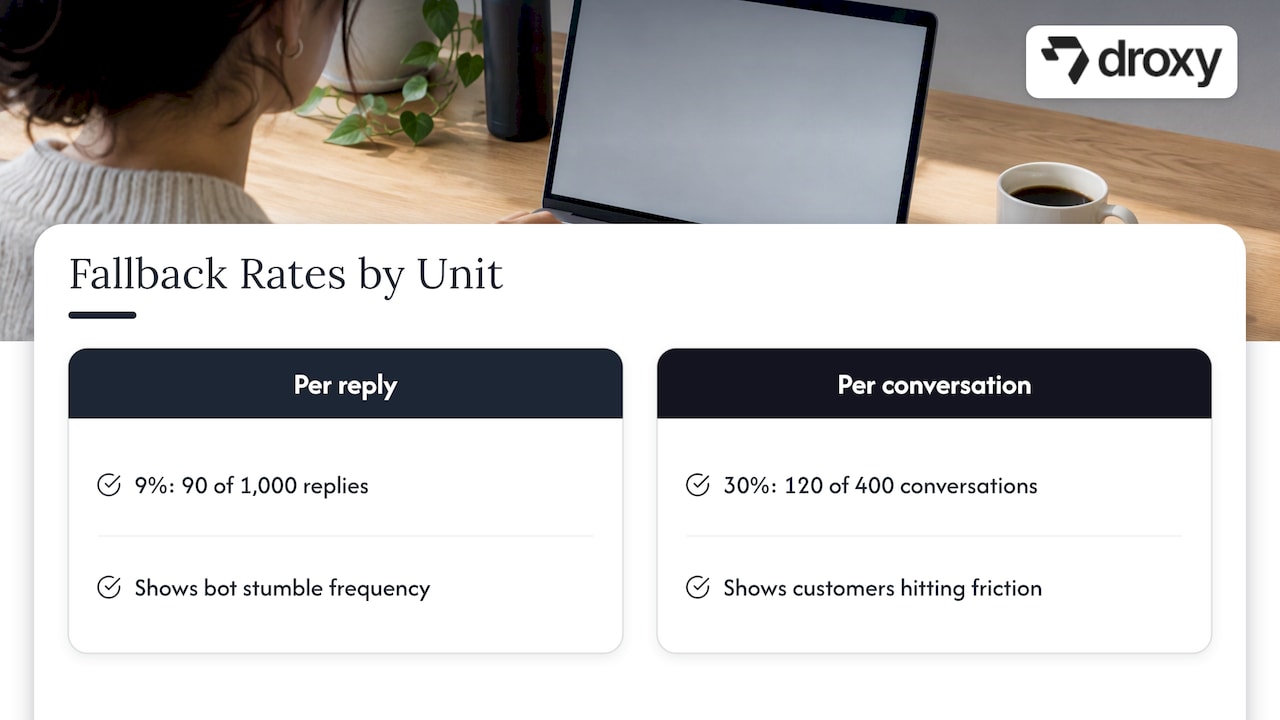
Fallback rate is the share of bot replies that returned a fallback or no-match message: fallback replies divided by all bot replies. The same source points out that you can also calculate it per conversation, so any report should state which unit it uses. Pick one and stay consistent, or your month-to-month comparisons will mislead you.
A worked example: if your bot sent 1,000 replies last week and 90 were fallbacks, your per-reply fallback rate is 9%. If 400 conversations took place and 120 contained at least one fallback, your per-conversation rate is 30%. Both are true, and they tell you different things. The per-reply number shows how often the bot stumbles. The per-conversation number shows how many customers hit friction.
What a high rate usually means
A high rate is a symptom. In our experience, the cause is usually one of these:
Missing content. Customers ask about shipping to a new country, a service area or a new product, and the knowledge base has no answer.
Missing intents. The bot has no category for a common request, such as rescheduling.
Phrasing gaps. Customers use slang, typos or other languages the bot has not seen.
A weak handoff path. The bot recognizes it cannot help but has nowhere to send the customer.
A threshold set too tight. The bot understands but is not allowed to answer.
A weekly routine for lowering it
Export the conversations that triggered a fallback.
Group them by topic. Ten minutes of sorting usually shows three or four clusters.
For each cluster, decide: add an answer, add an intent, or route it to a person on purpose.
Publish the change and watch that cluster’s count the next week.
Review the conversations where customers asked for a human immediately, since those show where trust is low.
Do not chase zero. Some fallbacks are healthy: they mean the bot recognized its limit and passed the customer along. What you want to cut is the fallback that ends in silence or abandonment.
Test your fallback before customers do
Fallback paths run rarely, which is exactly why they break unnoticed. Test them on purpose.
Send nonsense. Random characters, a single emoji, a blank message.
Send the unexpected. Ask a pricing question to a booking bot, or ask about a competitor.
Repeat the failure. Type three confusing messages in a row and confirm the ladder advances rather than looping. Google’s guidance above is a handy benchmark for that limit.
Test handoff both ways. Try it with an agent available and with none available.
Check context. Confirm the person receiving the chat can see the whole conversation.
Try every channel. A fallback that works on your website may behave differently on WhatsApp, Instagram or the phone.
Our chatbot testing checklist gives you 11 cases to run by hand or by script, and our guide to chatbot conversation design helps you write the flows these tests will exercise.
Our perspective on fallback
We build Droxy on a simple belief: a customer should never be left talking to a wall. Most businesses we talk to worry about the questions their AI agent can answer. We think the better question is what happens on the ones it cannot.
That is why the parts of Droxy that matter most for fallback sit around the agent, not inside it. You can feed the agent knowledge from several sources, so there are fewer gaps to fall into. Human hand-off and smart routing mean a hard question reaches a person instead of looping. Analytics show you where conversations stall, so you can fix the cause and not just the symptom.
We also think fallback should sound like your business. Because the agents are customizable to your brand voice, a “let me get a teammate” message can feel as warm as the rest of the conversation. And the same logic carries across website chat, phone, WhatsApp, Instagram and Facebook, so customers get a consistent experience wherever they reach you.
Our advice: design your fallback first, then your happy path. If the worst moment of the conversation is handled well, customers forgive the rest.
Elena
Put the strategy to work with Droxy
If you would rather not wire all of this up from scratch, Droxy is a no-code platform for deploying AI agents that answer customers around the clock. You can set up knowledge sources, human hand-off, lead capture and appointment booking without writing code, then review analytics to tighten your fallback over time.
Plans start at $16 per month for Basic, $80 per month for Advanced and $240 per month for Enterprise, all listed on the Droxy pricing page. If you want to start with one channel, the website agent is a natural first step, and the WhatsApp agent suits businesses where customers already message you there.
Fallback strategy by channel
The ladder stays the same, but the details shift with where the customer is.
Website chat: Buttons are cheap, so rung 3 works well. Show your most common three topics. Keep a visible “talk to a person” option.
Phone: Customers cannot scroll. Offer two options at a time, repeat briefly after a miss and move to a human or a callback quickly, since repeating prompts on a call grates fast.
WhatsApp: Customers expect short, fast replies. Use quick replies and make sure a handoff keeps the same thread.
Instagram and Facebook: Messages often arrive as casual one-liners or reactions to a post. Ask what the customer is looking for before assuming.
In every channel, count failures per conversation, not per message, so the bot knows when the customer’s patience is running out.
FAQ
What is the difference between a fallback and a handoff?
A fallback is the bot’s response when it cannot understand or answer. A handoff is one possible outcome of a fallback, where a person takes over the conversation. Good fallback design tries a clarifying question or choices first and uses handoff when those fail or when the topic needs a human.
How many times should a chatbot retry before escalating?
About three. Siemens, IBM and Google’s published guidelines all describe a limit of three attempts or errors before handing off or exiting. Consider escalating sooner for high-value or sensitive requests such as quotes, complaints or health questions.
What is a good fallback rate?
There is no single number that fits every business, since it depends on your industry, channels and how you count. Measure it consistently, per reply or per conversation, and aim for a steady decline as you add content and intents. Reading the actual transcripts matters more than hitting a target.
Should every unanswered question go to a human?
No. Try a clarifying question and a few choices first, since many customers just need to rephrase. Go straight to a person for sensitive topics, angry customers or anything the bot is not allowed to handle.
Sources
Fallback, Natural Language Processing in Action, Second Edition (Manning)
Providing options when a question or request cannot be answered, IBM watsonx Orchestrate
Recommended
A good chatbot fallback strategy decides, before a customer ever gets stuck, what the bot does when it cannot answer. The best pattern is simple: ask one specific clarifying question, offer two or three choices, then hand the conversation to a person after about three failed attempts, with the context attached. Do that and a missed answer stops being a lost customer.
This guide shows you how to set the trigger, build the ladder, measure fallback rate and test it all before your customers find the gaps.
DroxyKeep Customer Conversations MovingDroxy deploys customizable AI agents across chat, phone, and social channels to answer inquiries instantly and help reduce missed conversations.Explore Droxy
TL;DR
A fallback is the planned response your bot gives when no intent matches with enough confidence. It should acknowledge the gap and give the customer a way forward.
Never let a customer fail more than about three times in a row. Siemens, IBM and Google all describe a three-attempt limit in their guidelines.
Build a ladder: retry, clarify, offer choices, then human handoff or a ticket. Each step should change the approach, not repeat the last one.
Track fallback rate by reply and by conversation, and read the actual transcripts to fix the cause.
Test with deliberately confusing input, including after hours when no agent is online.
Table of Contents
What a chatbot fallback is, and when it should fire
Build a fallback ladder instead of one error message
Write fallback messages that keep customers moving
Design the handoff so nothing is lost
Measure fallback rate and know what it tells you
Test your fallback before customers do
Our perspective on fallback
Put the strategy to work with Droxy
Fallback strategy by channel
Sources
What a chatbot fallback is, and when it should fire
A chatbot fallback is a predefined response or flow used when the bot cannot confidently handle a message. It is triggered when no recognized intent meets the required confidence threshold. It acknowledges the gap and gives the user a way to continue.
That last part is what separates a strategy from a default error message. “Sorry, I didn’t get that” on its own is a dead end. A fallback worth shipping does one of three things, according to the same source: it offers clear choices so the user can try again, suggests another function the bot can perform, or offers a connection to a human representative.
Three situations that need a fallback
Not every failure looks the same, and your bot should treat them differently:
No match. The message does not fit any intent, or the confidence score is below your threshold. This is the classic fallback.
Partial match. The bot has a likely intent but is missing detail, such as an order number or a date. This calls for a targeted question, not a generic apology.
Out of scope or sensitive. The customer asks for something the bot should not handle, such as a billing dispute or a medical question. Skip the retries and route straight to a person.
If you are choosing between a stricter or looser confidence threshold, remember what each costs. A high threshold sends more conversations to fallback but gives fewer wrong answers. A low threshold feels smoother until the bot confidently answers the wrong question. Start conservative on anything involving money, bookings or health, and loosen it as your transcripts show the bot is right.
For a deeper look at how intent matching works under the hood, see our guide to three-tier intent detection and our overview of how conversational AI works.
Build a fallback ladder instead of one error message
The most useful way to think about fallback is as a ladder. Each rung changes the approach, and the bot counts failures so it moves up instead of repeating itself. Here is a version that works for most customer support setups.
Rung | What the bot does | Example |
|---|---|---|
1. Safe retry | Rephrases the request lightly, without blaming the customer | “Let me make sure I have this right. Are you asking about an order?” |
2. Specific clarifying question | Asks one narrow question tied to the likely topic | “Is this about a delivery, a return, or something else?” |
3. Two or three choices | Shows buttons or short options | “Track an order, start a return, talk to our team” |
4. Adjacent help | Offers the closest knowledge-base answer | “Here’s our returns policy. Does that help?” |
5. Human handoff | Passes the full conversation to a person | “I’m bringing in a teammate, and they’ll see everything we’ve discussed.” |
6. Callback or ticket | Used when nobody is online | “We’re closed right now. Leave your email and we’ll reply by morning.” |
The exact rungs depend on your channel. On a phone agent, choices are spoken, so keep them to two or three. In chat, buttons make rung 3 easy. On WhatsApp or Instagram, short quick replies work well and customers expect a quick answer.
Why three attempts is the usual limit
Several major design guidelines converge on the same number:
Siemens’ conversational design guidance says a chatbot should hand users off when it has failed to clarify what they want or reach an accurate response, and should not keep asking, clarifying or funneling more than 3 times.
IBM’s watsonx Orchestrate documentation describes an assistant that asks the customer to try again three times by default. After that, another invalid attempt triggers the fallback action, which can offer options such as connecting to a live agent.
Google’s conversation design guidelines say users should experience no more than 3 No Input or No Match errors in a row, after which the system plays a max-error prompt and exits. They also advise that quick reprompts combine an apology with a short repeat of the question, without dwelling on the error.
Treat three as a starting point, then adjust it using your own transcripts. For high-value inquiries, like a quote request or a booking, you may want to escalate after two.
Write fallback messages that keep customers moving
The wording of a fallback decides whether a customer stays. A few rules hold up across industries.
Own the gap, briefly. “I’m not sure I understood” is enough. Long apologies waste a turn.
Say what the bot can do. Name two or three things it handles well so the customer can pick one.
Ask one question at a time. Two questions in one message produce a muddled answer and another failure.
Keep the customer’s words. If they typed “my package is late,” a reply that mentions the package feels attentive.
Never loop. If the third fallback sounds like the first, you have built a trap.
Match your brand voice. A fallback is still your brand speaking. A relaxed home services company and a healthcare practice should sound different here.
Compare two versions of the same moment. Weak: “Sorry, I don’t understand. Please try again.” Stronger: “I want to get this right. Are you asking about pricing, booking a visit, or something else? You can also type ‘person’ to reach our team.” The second names options, offers an exit and keeps the conversation moving.
Design the handoff so nothing is lost
Handoff is the most important rung, and the one most often done badly. A customer who has explained a problem three times to a bot should never have to explain it a fourth time to a person.
A clean handoff has four parts:
Context passes along. The transcript, the customer’s contact details and the likely intent arrive with the conversation.
The customer knows what happens next. Say who is coming, roughly when and where the reply will arrive.
An out-of-hours path exists. If nobody is online, collect an email or phone number and promise a specific follow-up window you can actually keep.
The customer can ask for a person at any time. Do not hide the option until the bot has failed.
We go further into routing rules and timing in our guides to chatbot human handoff and chatbot escalation policies. If your team wants to store transcripts for review or follow-up, the save conversation API covers that.
Measure fallback rate and know what it tells you
Fallback rate is the share of bot replies that returned a fallback or no-match message: fallback replies divided by all bot replies. The same source points out that you can also calculate it per conversation, so any report should state which unit it uses. Pick one and stay consistent, or your month-to-month comparisons will mislead you.
A worked example: if your bot sent 1,000 replies last week and 90 were fallbacks, your per-reply fallback rate is 9%. If 400 conversations took place and 120 contained at least one fallback, your per-conversation rate is 30%. Both are true, and they tell you different things. The per-reply number shows how often the bot stumbles. The per-conversation number shows how many customers hit friction.
What a high rate usually means
A high rate is a symptom. In our experience, the cause is usually one of these:
Missing content. Customers ask about shipping to a new country, a service area or a new product, and the knowledge base has no answer.
Missing intents. The bot has no category for a common request, such as rescheduling.
Phrasing gaps. Customers use slang, typos or other languages the bot has not seen.
A weak handoff path. The bot recognizes it cannot help but has nowhere to send the customer.
A threshold set too tight. The bot understands but is not allowed to answer.
A weekly routine for lowering it
Export the conversations that triggered a fallback.
Group them by topic. Ten minutes of sorting usually shows three or four clusters.
For each cluster, decide: add an answer, add an intent, or route it to a person on purpose.
Publish the change and watch that cluster’s count the next week.
Review the conversations where customers asked for a human immediately, since those show where trust is low.
Do not chase zero. Some fallbacks are healthy: they mean the bot recognized its limit and passed the customer along. What you want to cut is the fallback that ends in silence or abandonment.
Test your fallback before customers do
Fallback paths run rarely, which is exactly why they break unnoticed. Test them on purpose.
Send nonsense. Random characters, a single emoji, a blank message.
Send the unexpected. Ask a pricing question to a booking bot, or ask about a competitor.
Repeat the failure. Type three confusing messages in a row and confirm the ladder advances rather than looping. Google’s guidance above is a handy benchmark for that limit.
Test handoff both ways. Try it with an agent available and with none available.
Check context. Confirm the person receiving the chat can see the whole conversation.
Try every channel. A fallback that works on your website may behave differently on WhatsApp, Instagram or the phone.
Our chatbot testing checklist gives you 11 cases to run by hand or by script, and our guide to chatbot conversation design helps you write the flows these tests will exercise.
Our perspective on fallback
We build Droxy on a simple belief: a customer should never be left talking to a wall. Most businesses we talk to worry about the questions their AI agent can answer. We think the better question is what happens on the ones it cannot.
That is why the parts of Droxy that matter most for fallback sit around the agent, not inside it. You can feed the agent knowledge from several sources, so there are fewer gaps to fall into. Human hand-off and smart routing mean a hard question reaches a person instead of looping. Analytics show you where conversations stall, so you can fix the cause and not just the symptom.
We also think fallback should sound like your business. Because the agents are customizable to your brand voice, a “let me get a teammate” message can feel as warm as the rest of the conversation. And the same logic carries across website chat, phone, WhatsApp, Instagram and Facebook, so customers get a consistent experience wherever they reach you.
Our advice: design your fallback first, then your happy path. If the worst moment of the conversation is handled well, customers forgive the rest.
Elena
Put the strategy to work with Droxy
If you would rather not wire all of this up from scratch, Droxy is a no-code platform for deploying AI agents that answer customers around the clock. You can set up knowledge sources, human hand-off, lead capture and appointment booking without writing code, then review analytics to tighten your fallback over time.
Plans start at $16 per month for Basic, $80 per month for Advanced and $240 per month for Enterprise, all listed on the Droxy pricing page. If you want to start with one channel, the website agent is a natural first step, and the WhatsApp agent suits businesses where customers already message you there.
Fallback strategy by channel
The ladder stays the same, but the details shift with where the customer is.
Website chat: Buttons are cheap, so rung 3 works well. Show your most common three topics. Keep a visible “talk to a person” option.
Phone: Customers cannot scroll. Offer two options at a time, repeat briefly after a miss and move to a human or a callback quickly, since repeating prompts on a call grates fast.
WhatsApp: Customers expect short, fast replies. Use quick replies and make sure a handoff keeps the same thread.
Instagram and Facebook: Messages often arrive as casual one-liners or reactions to a post. Ask what the customer is looking for before assuming.
In every channel, count failures per conversation, not per message, so the bot knows when the customer’s patience is running out.
FAQ
What is the difference between a fallback and a handoff?
A fallback is the bot’s response when it cannot understand or answer. A handoff is one possible outcome of a fallback, where a person takes over the conversation. Good fallback design tries a clarifying question or choices first and uses handoff when those fail or when the topic needs a human.
How many times should a chatbot retry before escalating?
About three. Siemens, IBM and Google’s published guidelines all describe a limit of three attempts or errors before handing off or exiting. Consider escalating sooner for high-value or sensitive requests such as quotes, complaints or health questions.
What is a good fallback rate?
There is no single number that fits every business, since it depends on your industry, channels and how you count. Measure it consistently, per reply or per conversation, and aim for a steady decline as you add content and intents. Reading the actual transcripts matters more than hitting a target.
Should every unanswered question go to a human?
No. Try a clarifying question and a few choices first, since many customers just need to rephrase. Go straight to a person for sensitive topics, angry customers or anything the bot is not allowed to handle.
Sources
Fallback, Natural Language Processing in Action, Second Edition (Manning)
Providing options when a question or request cannot be answered, IBM watsonx Orchestrate
Recommended


🚀
Powered by Droxy
Turn every interaction into a conversion
Customer facing AI agents that engage, convert, and support so you can scale what matters.
✨
Learn more
Recent posts
Insights
3 min read
Introducing Agent Memories
Improve your agents' performance with Agent Memories. Prevent agents from repeating the same mistakes by giving them feedback.
Read more

Insights
15 min read
HVAC Marketing in 2025: The Definitive Lead Gen Guide
Discover 15 proven HVAC marketing strategies, plus learn how Droxy's AI website agent converts curious visitors into qualified leads by answering their questions instantly - right when they're most interested in your services.
Read more

Insights
10 min read
10 Best AI Sales Agents in 2025: Tested & Ranked
Discover the top 10 AI sales agents of 2025, designed to enhance lead generation, personalize outreach, and ultimately, close more deals
Read more
Insights
3 min read
Introducing Agent Memories
Improve your agents' performance with Agent Memories. Prevent agents from repeating the same mistakes by giving them feedback.
Read more
Insights
15 min read
HVAC Marketing in 2025: The Definitive Lead Gen Guide
Discover 15 proven HVAC marketing strategies, plus learn how Droxy's AI website agent converts curious visitors into qualified leads by answering their questions instantly - right when they're most interested in your services.
Read more