Cut time to human under 30s: Chatbot human handoff for engineers
Cut time to human under 30s: Chatbot human handoff for engineers
Insights
13 min

A correct chatbot human handoff is a warm transfer: the bot recognizes the right moment, hands off a full context payload, and a live agent arrives inside your timing target with everything needed to respond without asking the customer to repeat themselves. Getting there means locking down four things: escalation triggers, the context payload, routing and agent briefing, and an after-hours fallback. The rest of this guide walks through each piece, including a prelaunch checklist and the KPIs that tell you whether your handoff is actually working.
TL;DR:
Establish specific, testable triggers such as explicit requests, low confidence scores, negative sentiment trends, and high-stakes topics to ensure reliable escalations.
Provide the agent with immediate access to a concise summary, recent transcript, sentiment flag, account info, and bot actions at the moment of handoff to prevent detective work and improve resolution.
Validate critical configurations before launch, including trigger rules, context formatting, agent briefing, routing map, and after-hours protocols, to avoid common onboarding failures.
Track key KPIs like time-to-human under 30 seconds, escalation rate, and post-escalation contact times to measure handoff effectiveness and inform ongoing improvements.
Use provided best practices for technical integration, such as managing payload size, avoiding duplicate messages, and limiting PII, to ensure a seamless and compliant handoff process.
Table of Contents
Chatbot Human Handoff Integration Models: Bot-as-Agent vs Bot-as-Proxy
What Triggers Should Move a Conversation to a Human?
Handoff Protocol: What to Send and How Status Works
[An agent who has to click into a summary, hunt for the transcript, and guess at sentiment is not experiencing a handoff; they’re doing detective work while a customer waits, so the briefing needs to be visible the instant the conversation lands, which is explained well in how to humanize AI text.](#an-agent-who-has-to-click-into-a-summary-hunt-for-the-transcript-and-guess-at-sentiment-is-not-experiencing-a-handoff-theyre-doing-detective-work-while-a-customer-waits-so-the-briefing-needs-to-be-visible-the-instant-the-conversation-lands-which-is-explained-well-in-how-to-humanize-ai-texthttpsbabylovegrowthaibloghow-to-humanize-ai-text)
Prelaunch Checklist: Five Things to Configure Before Go-Live
What KPIs Tell You the Handoff Is Actually Working
Technical Integration Notes Engineers Shouldn’t Skip
The Biggest Handoff Mistake Teams Still Make
Droxy’s Approach to Chatbot Human Handoff
Sources
Chatbot Human Handoff Integration Models: Bot-as-Agent vs Bot-as-Proxy
Every handoff system runs on one of two integration patterns, and picking the wrong one early creates rework later. Microsoft’s Bot Framework documentation names them plainly: the bot as an agent model and the bot as a proxy model.
In bot-as-agent, the bot behaves like just another agent inside your engagement hub. It joins a queue, gets routed by the hub’s existing logic, and steps aside once a human accepts the conversation. This is simpler to build and works well if you already run a mature agent desk.
In bot-as-proxy, the bot stays in the loop and mediates the conversation, which matters when you’re running the same bot across web chat, WhatsApp, and voice at once. The bot decides when to bring in a human, keeps the channel session alive, and can resume automated support afterward.
Bot-as-agent: less custom code, but you depend on the hub’s routing engine to handle nuance.
Bot-as-proxy: more control over triggers and multi-channel consistency, but you own more of the plumbing.
Either way, someone has to own the
handoff.initiateevent and decide where the transcript lives, in the hub or in your own database, before you write a line of trigger logic.
What Triggers Should Move a Conversation to a Human?
Vague rules like “escalate when the bot is stuck” don’t survive production. You need triggers that are specific, testable, and visible in your logs.
Explicit request. Give users a persistent “talk to a person” control, not just a hope that they’ll type the right keyword. Back it up with keyword detection (“agent,” “human,” “representative”) as a safety net.
Low confidence or retrieval score. Expose your model’s confidence score to the orchestration layer so a threshold, not a hunch, decides when to escalate.
Negative sentiment trend. Track sentiment across the last three to five turns rather than a single angry message, which catches frustration building rather than one sharp word.
High-stakes topics. Billing disputes, cancellations, medical or legal questions, and anything involving account security should route to a human by default, regardless of confidence score.
Repeated failure. If the bot gives the same type of answer twice without resolving the issue, that’s a failure threshold, not a third attempt.
Pro Tip: Log every trigger hit even when it doesn’t fire an escalation. You’ll need that data to safely raise or lower thresholds later without guessing.
Handoff Protocol: What to Send and How Status Works
The handoff itself is an event, not a vibe. Microsoft’s design pattern defines a handoff.initiate event with a specific shape, and Copilot Studio’s documentation adds a set of context variables worth adopting directly: va_Scope, va_LastTopic, va_Phrases, va_ConversationId, and va_AgentMessage are built for exactly this handoff moment.
At minimum, your handoff.initiate payload needs:
Field | Purpose |
|---|---|
Name ( | Identifies the event type to the receiving system |
Conversation ID | Ties the handoff to the existing session so context isn’t orphaned |
Value (JSON) | Carries routing hints, intent, sentiment flag, and account identifiers |
Attachments/transcript | Gives the agent the conversation history |
Beyond the required fields, the briefing an agent actually needs includes a one-line summary of the issue, the last several turns of transcript, a sentiment flag, extracted intent and entities, relevant account identifiers, and a note on what the bot already tried. Skip any of these and the agent starts by asking the customer to repeat themselves, which defeats the point of automating the first contact at all.
Status handling matters just as much as initiation. The protocol defines three states: accepted (a human has picked up and the bot should go quiet), failed (no agent available, trigger your fallback), and completed (the conversation is closed and can return to the bot if reopened). Build explicit bot behavior for each state rather than assuming “accepted” is the only outcome.
Keep transcripts inline only when they’re short; for anything longer, use a
ContentUrlreference instead of embedding the full history, a pattern Twilio’s Conversations blueprint uses to avoid payload bloat.Reject or ignore unsupported attachment types at the bot layer rather than letting them silently break routing downstream.
An agent who has to click into a summary, hunt for the transcript, and guess at sentiment is not experiencing a handoff; they’re doing detective work while a customer waits, so the briefing needs to be visible the instant the conversation lands, which is explained well in how to humanize AI text.
An agent who has to click into a summary, hunt for the transcript, and guess at sentiment is not experiencing a handoff. They’re doing detective work while a customer waits. The briefing needs to be visible the instant the conversation lands: a one-line summary, the recent transcript, a sentiment flag, any relevant account records, and what the bot already attempted. This is the difference between a warm transfer and a cold one, and it’s the single biggest lever on resolution time.
Route into the agent’s existing desk software whenever possible. Forcing a new UI onto agents at scale is a change-management problem you don’t need.
Route by skill and issue type, not by channel alone. A billing question from WhatsApp and a billing question from web chat should land with the same specialist.
Match routing to SLA tier so your highest-value accounts don’t wait behind general queue traffic.
Set a visible time-to-human target and hold the bot to it with bridge phrases and an on-screen timer so the customer isn’t staring at silence.
Pro Tip: If your agent desk can’t display a bot-generated summary before the agent’s first reply, treat that as a blocking bug, not a nice-to-have feature. It’s the single requirement that separates a warm handoff from a frustrating one.
Prelaunch Checklist: Five Things to Configure Before Go-Live
Industry playbooks converge on the same five configuration items as the real determinants of whether a handoff system succeeds or generates complaints on day one.
Trigger rules. Every trigger should be testable in staging and auditable in production logs, not buried in a prompt.
Context format. Standardize your field contract with the agent hub before launch, so a schema change doesn’t break routing later.
Agent briefing. Confirm the summary, transcript, and sentiment flag render before the agent’s first reply, every time, on every channel.
Routing map. Define issue-type-to-queue mapping and a fallback queue for anything that doesn’t match a known category.
After-hours protocol. Decide what the bot says when no agent is available and what data it captures instead.
Run through these five in order. Skipping the after-hours protocol is the most common gap teams discover only after their first overnight complaint.
What KPIs Tell You the Handoff Is Actually Working
Three numbers matter more than the rest, and all three should be visible on the same dashboard.
Time-to-human. In chat, under 30 seconds is a healthy target, under 15 seconds is excellent, and anything past 60 seconds risks abandonment. For voice, silence after handoff should be kept very short to maintain customer satisfaction.
Escalation rate. Track it in both directions. Too low suggests the bot is overconfident and frustrating people who need a human; too high suggests it’s deflecting nothing.
Repeat contacts and average handle time after escalation. A spike here usually means agents aren’t getting a usable briefing, not that the issues themselves got harder.
Log every trigger firing, not just the escalations that succeed, so thresholds can move up or down with evidence instead of guesswork.
Technical Integration Notes Engineers Shouldn’t Skip
A few pitfalls show up in nearly every handoff deployment, and they’re avoidable with the right defaults from day one.
Use
ContentUrlreferences instead of inline text for long transcripts to keep payloads manageable across channels.Manage webhook and channel bindings carefully to prevent dual delivery, where both the bot and the agent send messages into the same thread.
Expose retrieval and model confidence scores to the orchestration layer so escalation triggers stay automatic and auditable, not manual.
Limit PII in the context payload to what the agent actually needs, and encrypt attachments and transcripts in transit and at rest.
The Biggest Handoff Mistake Teams Still Make
Most failed handoffs aren’t a triggering problem. They’re a briefing problem: the trigger fires correctly, but the agent lands in a blank window and starts asking the customer to repeat what they just told the bot. That single gap does more damage to trust than a slightly late escalation ever will.
If you fix nothing else this quarter, fix three things: put a visible “speak to an agent” control in every conversation, capture three key fields (intent, sentiment, account identifier) before the transfer fires, and route by issue type instead of channel. Then put a time-to-human number on a dashboard someone actually looks at. Metrics you don’t watch don’t get better.
— Elena
Droxy’s Approach to Chatbot Human Handoff
Droxy is built to hand off cleanly, not just talk cleanly. Its no-code agents run across website chat, phone, WhatsApp, Instagram, and Facebook, and each one carries conversation context, sentiment, and attempted actions into the handoff instead of dropping them at the door.
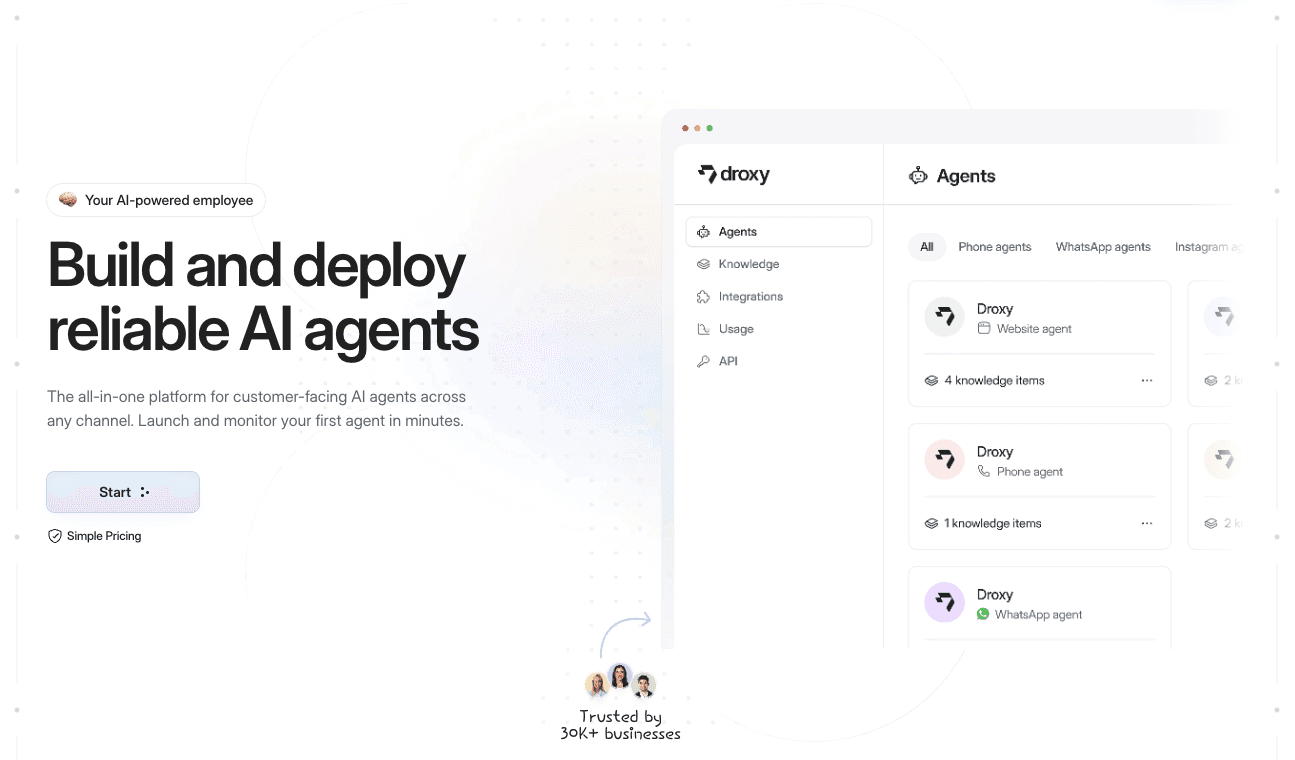
Where the models discussed above ask you to choose between building bot-as-agent or bot-as-proxy logic from scratch, Droxy gives you both without custom engineering: agents route to a live person when a trigger fires, briefed with the transcript and account context an agent actually needs to respond without asking the customer to start over. That matters most across channels like WhatsApp and Facebook, where a dropped handoff means a lost conversation, not just a slow one. Built-in analytics track your time-to-human and escalation rate automatically, so you’re not wiring up logging yourself.
If you’re ready to test this against your own trigger rules and routing map, start with the Droxy plans and run a pilot on your highest-volume channel first.
Sources
For protocol-level detail, see Microsoft’s bot-to-human design pattern, Copilot Studio’s hand-off docs, Twilio’s Conversations blueprint, and the Unity Connect playbook.
Recommended
A correct chatbot human handoff is a warm transfer: the bot recognizes the right moment, hands off a full context payload, and a live agent arrives inside your timing target with everything needed to respond without asking the customer to repeat themselves. Getting there means locking down four things: escalation triggers, the context payload, routing and agent briefing, and an after-hours fallback. The rest of this guide walks through each piece, including a prelaunch checklist and the KPIs that tell you whether your handoff is actually working.
TL;DR:
Establish specific, testable triggers such as explicit requests, low confidence scores, negative sentiment trends, and high-stakes topics to ensure reliable escalations.
Provide the agent with immediate access to a concise summary, recent transcript, sentiment flag, account info, and bot actions at the moment of handoff to prevent detective work and improve resolution.
Validate critical configurations before launch, including trigger rules, context formatting, agent briefing, routing map, and after-hours protocols, to avoid common onboarding failures.
Track key KPIs like time-to-human under 30 seconds, escalation rate, and post-escalation contact times to measure handoff effectiveness and inform ongoing improvements.
Use provided best practices for technical integration, such as managing payload size, avoiding duplicate messages, and limiting PII, to ensure a seamless and compliant handoff process.
Table of Contents
Chatbot Human Handoff Integration Models: Bot-as-Agent vs Bot-as-Proxy
What Triggers Should Move a Conversation to a Human?
Handoff Protocol: What to Send and How Status Works
[An agent who has to click into a summary, hunt for the transcript, and guess at sentiment is not experiencing a handoff; they’re doing detective work while a customer waits, so the briefing needs to be visible the instant the conversation lands, which is explained well in how to humanize AI text.](#an-agent-who-has-to-click-into-a-summary-hunt-for-the-transcript-and-guess-at-sentiment-is-not-experiencing-a-handoff-theyre-doing-detective-work-while-a-customer-waits-so-the-briefing-needs-to-be-visible-the-instant-the-conversation-lands-which-is-explained-well-in-how-to-humanize-ai-texthttpsbabylovegrowthaibloghow-to-humanize-ai-text)
Prelaunch Checklist: Five Things to Configure Before Go-Live
What KPIs Tell You the Handoff Is Actually Working
Technical Integration Notes Engineers Shouldn’t Skip
The Biggest Handoff Mistake Teams Still Make
Droxy’s Approach to Chatbot Human Handoff
Sources
Chatbot Human Handoff Integration Models: Bot-as-Agent vs Bot-as-Proxy
Every handoff system runs on one of two integration patterns, and picking the wrong one early creates rework later. Microsoft’s Bot Framework documentation names them plainly: the bot as an agent model and the bot as a proxy model.
In bot-as-agent, the bot behaves like just another agent inside your engagement hub. It joins a queue, gets routed by the hub’s existing logic, and steps aside once a human accepts the conversation. This is simpler to build and works well if you already run a mature agent desk.
In bot-as-proxy, the bot stays in the loop and mediates the conversation, which matters when you’re running the same bot across web chat, WhatsApp, and voice at once. The bot decides when to bring in a human, keeps the channel session alive, and can resume automated support afterward.
Bot-as-agent: less custom code, but you depend on the hub’s routing engine to handle nuance.
Bot-as-proxy: more control over triggers and multi-channel consistency, but you own more of the plumbing.
Either way, someone has to own the
handoff.initiateevent and decide where the transcript lives, in the hub or in your own database, before you write a line of trigger logic.
What Triggers Should Move a Conversation to a Human?
Vague rules like “escalate when the bot is stuck” don’t survive production. You need triggers that are specific, testable, and visible in your logs.
Explicit request. Give users a persistent “talk to a person” control, not just a hope that they’ll type the right keyword. Back it up with keyword detection (“agent,” “human,” “representative”) as a safety net.
Low confidence or retrieval score. Expose your model’s confidence score to the orchestration layer so a threshold, not a hunch, decides when to escalate.
Negative sentiment trend. Track sentiment across the last three to five turns rather than a single angry message, which catches frustration building rather than one sharp word.
High-stakes topics. Billing disputes, cancellations, medical or legal questions, and anything involving account security should route to a human by default, regardless of confidence score.
Repeated failure. If the bot gives the same type of answer twice without resolving the issue, that’s a failure threshold, not a third attempt.
Pro Tip: Log every trigger hit even when it doesn’t fire an escalation. You’ll need that data to safely raise or lower thresholds later without guessing.
Handoff Protocol: What to Send and How Status Works
The handoff itself is an event, not a vibe. Microsoft’s design pattern defines a handoff.initiate event with a specific shape, and Copilot Studio’s documentation adds a set of context variables worth adopting directly: va_Scope, va_LastTopic, va_Phrases, va_ConversationId, and va_AgentMessage are built for exactly this handoff moment.
At minimum, your handoff.initiate payload needs:
Field | Purpose |
|---|---|
Name ( | Identifies the event type to the receiving system |
Conversation ID | Ties the handoff to the existing session so context isn’t orphaned |
Value (JSON) | Carries routing hints, intent, sentiment flag, and account identifiers |
Attachments/transcript | Gives the agent the conversation history |
Beyond the required fields, the briefing an agent actually needs includes a one-line summary of the issue, the last several turns of transcript, a sentiment flag, extracted intent and entities, relevant account identifiers, and a note on what the bot already tried. Skip any of these and the agent starts by asking the customer to repeat themselves, which defeats the point of automating the first contact at all.
Status handling matters just as much as initiation. The protocol defines three states: accepted (a human has picked up and the bot should go quiet), failed (no agent available, trigger your fallback), and completed (the conversation is closed and can return to the bot if reopened). Build explicit bot behavior for each state rather than assuming “accepted” is the only outcome.
Keep transcripts inline only when they’re short; for anything longer, use a
ContentUrlreference instead of embedding the full history, a pattern Twilio’s Conversations blueprint uses to avoid payload bloat.Reject or ignore unsupported attachment types at the bot layer rather than letting them silently break routing downstream.
An agent who has to click into a summary, hunt for the transcript, and guess at sentiment is not experiencing a handoff; they’re doing detective work while a customer waits, so the briefing needs to be visible the instant the conversation lands, which is explained well in how to humanize AI text.
An agent who has to click into a summary, hunt for the transcript, and guess at sentiment is not experiencing a handoff. They’re doing detective work while a customer waits. The briefing needs to be visible the instant the conversation lands: a one-line summary, the recent transcript, a sentiment flag, any relevant account records, and what the bot already attempted. This is the difference between a warm transfer and a cold one, and it’s the single biggest lever on resolution time.
Route into the agent’s existing desk software whenever possible. Forcing a new UI onto agents at scale is a change-management problem you don’t need.
Route by skill and issue type, not by channel alone. A billing question from WhatsApp and a billing question from web chat should land with the same specialist.
Match routing to SLA tier so your highest-value accounts don’t wait behind general queue traffic.
Set a visible time-to-human target and hold the bot to it with bridge phrases and an on-screen timer so the customer isn’t staring at silence.
Pro Tip: If your agent desk can’t display a bot-generated summary before the agent’s first reply, treat that as a blocking bug, not a nice-to-have feature. It’s the single requirement that separates a warm handoff from a frustrating one.
Prelaunch Checklist: Five Things to Configure Before Go-Live
Industry playbooks converge on the same five configuration items as the real determinants of whether a handoff system succeeds or generates complaints on day one.
Trigger rules. Every trigger should be testable in staging and auditable in production logs, not buried in a prompt.
Context format. Standardize your field contract with the agent hub before launch, so a schema change doesn’t break routing later.
Agent briefing. Confirm the summary, transcript, and sentiment flag render before the agent’s first reply, every time, on every channel.
Routing map. Define issue-type-to-queue mapping and a fallback queue for anything that doesn’t match a known category.
After-hours protocol. Decide what the bot says when no agent is available and what data it captures instead.
Run through these five in order. Skipping the after-hours protocol is the most common gap teams discover only after their first overnight complaint.
What KPIs Tell You the Handoff Is Actually Working
Three numbers matter more than the rest, and all three should be visible on the same dashboard.
Time-to-human. In chat, under 30 seconds is a healthy target, under 15 seconds is excellent, and anything past 60 seconds risks abandonment. For voice, silence after handoff should be kept very short to maintain customer satisfaction.
Escalation rate. Track it in both directions. Too low suggests the bot is overconfident and frustrating people who need a human; too high suggests it’s deflecting nothing.
Repeat contacts and average handle time after escalation. A spike here usually means agents aren’t getting a usable briefing, not that the issues themselves got harder.
Log every trigger firing, not just the escalations that succeed, so thresholds can move up or down with evidence instead of guesswork.
Technical Integration Notes Engineers Shouldn’t Skip
A few pitfalls show up in nearly every handoff deployment, and they’re avoidable with the right defaults from day one.
Use
ContentUrlreferences instead of inline text for long transcripts to keep payloads manageable across channels.Manage webhook and channel bindings carefully to prevent dual delivery, where both the bot and the agent send messages into the same thread.
Expose retrieval and model confidence scores to the orchestration layer so escalation triggers stay automatic and auditable, not manual.
Limit PII in the context payload to what the agent actually needs, and encrypt attachments and transcripts in transit and at rest.
The Biggest Handoff Mistake Teams Still Make
Most failed handoffs aren’t a triggering problem. They’re a briefing problem: the trigger fires correctly, but the agent lands in a blank window and starts asking the customer to repeat what they just told the bot. That single gap does more damage to trust than a slightly late escalation ever will.
If you fix nothing else this quarter, fix three things: put a visible “speak to an agent” control in every conversation, capture three key fields (intent, sentiment, account identifier) before the transfer fires, and route by issue type instead of channel. Then put a time-to-human number on a dashboard someone actually looks at. Metrics you don’t watch don’t get better.
— Elena
Droxy’s Approach to Chatbot Human Handoff
Droxy is built to hand off cleanly, not just talk cleanly. Its no-code agents run across website chat, phone, WhatsApp, Instagram, and Facebook, and each one carries conversation context, sentiment, and attempted actions into the handoff instead of dropping them at the door.
Where the models discussed above ask you to choose between building bot-as-agent or bot-as-proxy logic from scratch, Droxy gives you both without custom engineering: agents route to a live person when a trigger fires, briefed with the transcript and account context an agent actually needs to respond without asking the customer to start over. That matters most across channels like WhatsApp and Facebook, where a dropped handoff means a lost conversation, not just a slow one. Built-in analytics track your time-to-human and escalation rate automatically, so you’re not wiring up logging yourself.
If you’re ready to test this against your own trigger rules and routing map, start with the Droxy plans and run a pilot on your highest-volume channel first.
Sources
For protocol-level detail, see Microsoft’s bot-to-human design pattern, Copilot Studio’s hand-off docs, Twilio’s Conversations blueprint, and the Unity Connect playbook.
Recommended


🚀
Powered by Droxy
Turn every interaction into a conversion
Customer facing AI agents that engage, convert, and support so you can scale what matters.
✨
Learn more
Recent posts
Insights
3 min read
Introducing Agent Memories
Improve your agents' performance with Agent Memories. Prevent agents from repeating the same mistakes by giving them feedback.
Read more

Insights
15 min read
HVAC Marketing in 2025: The Definitive Lead Gen Guide
Discover 15 proven HVAC marketing strategies, plus learn how Droxy's AI website agent converts curious visitors into qualified leads by answering their questions instantly - right when they're most interested in your services.
Read more
Insights
10 min read
10 Best AI Sales Agents in 2025: Tested & Ranked
Discover the top 10 AI sales agents of 2025, designed to enhance lead generation, personalize outreach, and ultimately, close more deals
Read more
Insights
3 min read
Introducing Agent Memories
Improve your agents' performance with Agent Memories. Prevent agents from repeating the same mistakes by giving them feedback.
Read more
Insights
15 min read
HVAC Marketing in 2025: The Definitive Lead Gen Guide
Discover 15 proven HVAC marketing strategies, plus learn how Droxy's AI website agent converts curious visitors into qualified leads by answering their questions instantly - right when they're most interested in your services.
Read more