Developers: 8 Steps to Production Ready Chatbot Prompt Moderation
Developers: 8 Steps to Production Ready Chatbot Prompt Moderation
Insights
18 min
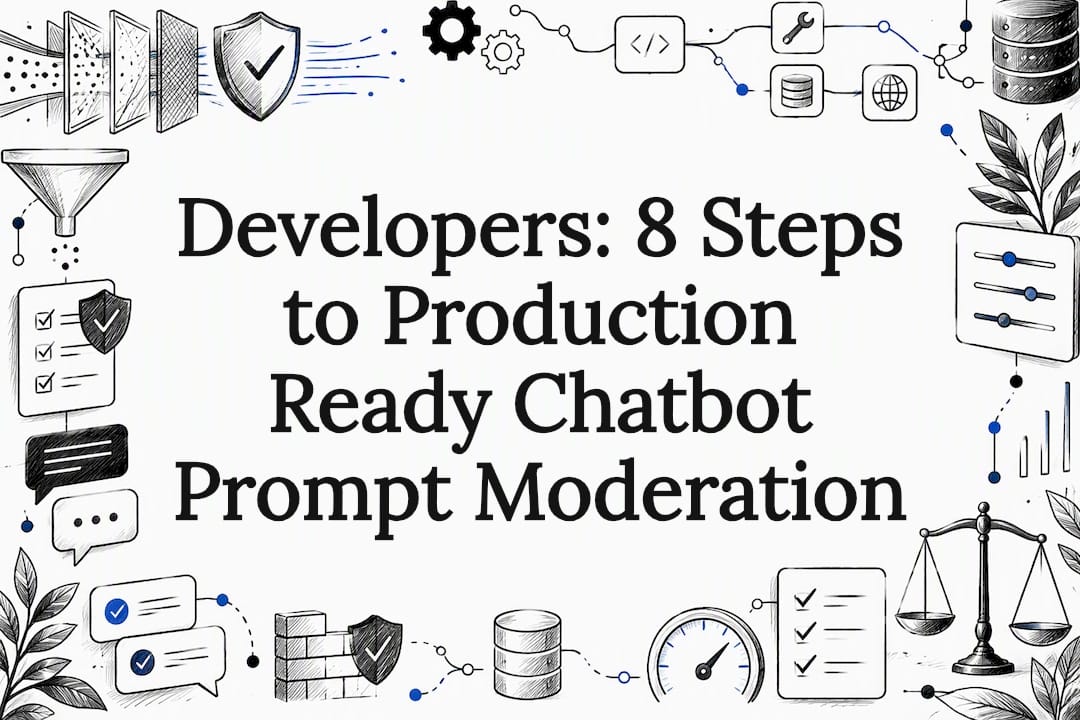
Place moderation at the input, validate every agent or tool call before it runs, and always moderate the output before it reaches the user, then route everything by risk. Ambiguous or high-impact requests go to a human reviewer instead of getting an automatic pass. This layered structure, backed by calibrated allow, review, and block thresholds, is what turns chatbot prompt moderation from a single filter into a system that actually holds up in production.
TL;DR:
Layered moderation architecture includes input normalization, model output checks, tool-call validation, and final content review to handle failures at each stage effectively.
Structured moderation prompts with clear policy definitions, labeled examples, and JSON outputs improve auditability and help reviewers quickly understand violations.
Defending against prompt injection requires separate safeguards like least-privilege access, sandboxing, human approval, and dual-model patterns, as classifiers alone are insufficient.
Calibration involves testing with adversarial and multilingual inputs, monitoring reviewer override rates, and adjusting thresholds based on real-world false positives and false negatives.
Proper logging with metadata, versioned policies, and encrypted storage creates an auditable trail that supports incident response and policy evolution.
DroxyDeploy AI Agents Across Every ChannelDroxy helps businesses provide instant, human-like customer interactions across websites, phone, WhatsApp, social media, and Shopify.Explore Droxy
Table of Contents
1. Building a Layered Architecture for Prompt Moderation
2. Designing Structured Moderator Prompts and Parseable Outputs
3. Prompt Injection Versus Content Moderation: Why They Need Different Defenses
4. Risk-Based Routing: Allow, Review, and Block in Practice
5. A Practical Implementation Sequence and Checklist
6. Testing, Calibration, and the Metrics That Matter
7. Logging, Decision Metadata, and Building an Audit Trail
8. Common Mistakes That Undermine Moderation Systems
9. Droxy’s Take on Multi-Channel Moderation
10. Where Droxy Fits if You Need This Deployed Fast
11. Authoritative Docs and Papers to Consult
Sources
1. Building a Layered Architecture for Prompt Moderation
A single moderation check anywhere in your pipeline will eventually fail. The fix is layering: input moderation, model generation, tool-call validation, and output moderation, each catching what the others miss.
Input moderation happens before your model ever sees the request. This layer normalizes text encoding, enforces size limits, checks for suspicious tokens, and runs early classifiers that catch known injection patterns before they reach your system prompt.
Model generation is where most teams assume safety lives, and it is the weakest assumption you can make. System prompts can be talked around, reframed, or buried inside seemingly innocent context, so the output still needs independent inspection regardless of how careful your instructions were.
Tool-call validation matters once your chatbot becomes an agent that can take action. Every tool call should run through argument validation, execute with least-privilege credentials, and pass a pre-execution check, ideally inside a sandbox that limits what damage a bad call can do. Our guide on AI agent versus chatbot behavior breaks down why agentic systems need this extra layer that simple chatbots do not.
Output moderation is your last checkpoint before content reaches the user, catching anything that slipped past the earlier stages or emerged only during generation.
Layering works because it assumes failure. Here is what each stage is responsible for:
Input layer: normalization, size limits, encoding checks, early injection filters.
Generation layer: produces the response but is never trusted as the final safety check.
Tool-call layer: validates arguments, enforces least-privilege access, sandboxes execution.
Output layer: re-checks the final response against policy before display.
If your classifier misses an injection at input, the tool-call layer can still block a destructive action. If that layer misses something too, output moderation is your last line of defense.
2. Designing Structured Moderator Prompts and Parseable Outputs
Free-text moderation responses are hard to automate and harder to audit. Structured outputs in JSON or XML let your routing logic, logging system, and reviewers all read the same decision the same way.
Amazon Nova’s documentation on structured moderation prompting recommends building your moderation prompt around three components:
Policy definitions written as precise, testable specifications rather than broad harm categories.
Labeled examples that show the model exactly what a violation and a non-violation look like for each category.
A strict output schema with fields like
policy_violation,category_list,scores, andexplanation, so downstream code never has to parse free text.
Amazon Nova’s guidance also notes that disabling chain-of-thought reasoning can produce faster, more reliably parseable moderation outputs when your use case does not need the model to show its work.
The explanation field deserves real design attention. A reviewer facing a queue of flagged messages needs a sentence that tells them why the flag happened, not a category name they have to guess at. Write it as a short, specific justification tied to the exact phrase or pattern that triggered the classifier.
Pro Tip: Keep one harm type per label in your schema. Combined labels like “abuse_or_spam” force reviewers to guess which condition actually fired, which slows down every appeal.
3. Prompt Injection Versus Content Moderation: Why They Need Different Defenses

Content moderation asks whether a message violates a policy. Prompt injection asks whether a message is trying to hijack your system’s instructions, and these are not the same problem.
A prompt injection attempt might look completely benign to a content classifier. Someone might embed instructions inside a document your agent is asked to summarize, or phrase a request as a hypothetical to get around a refusal, techniques that resemble social engineering more than obvious abuse, as research from OpenAI’s work on agent resistance points out.
This is why classifiers alone cannot be your only defense. You need deterministic controls that hold regardless of what a model decides in the moment:
Least-privilege access so even a successful injection cannot reach systems the agent does not need.
Action sandboxes that isolate what a tool call can actually touch.
Human approval gates for any action with real-world consequences, like sending money or deleting data.
Quarantined or dual-LLM patterns, where a privileged model never directly processes untrusted content, and a separate quarantined model handles it instead.
The OWASP prompt injection cheat sheet is explicit that no single mitigation is complete on its own, and that high-impact workflows need both monitoring and a human in the loop.
4. Risk-Based Routing: Allow, Review, and Block in Practice
Once moderation produces a signal, you need a policy that turns that signal into an action. The three-path model, allow, review, and block, is the standard pattern, but the details of how you calibrate it decide whether it actually works.
Thresholds should never be uniform across your product. A borderline message on a low-stakes support channel is not the same risk as a borderline message from a financial agent, so calibrate per category and account for channel, language, and the user’s role.
Allow covers anything below your policy threshold, no friction added.
Review routes ambiguous or medium-risk cases either synchronously, holding the response briefly, or asynchronously, letting a human check it after the fact.
Block stops clearly policy-violating content, but should still offer a soft refusal or a safe replacement rather than a dead end.
OpenAI’s moderation API documentation recommends treating category scores as signals for logging and routing decisions, not as automatic final verdicts, and calibrating thresholds against labeled data specific to your audience.
Build an appeals path from day one. Every block decision should carry enough metadata for a reviewer to reverse it quickly if it turns out to be a false positive.
Pro Tip: Log every override a human reviewer makes against the original automated decision. That override history is your best calibration dataset for the next round of threshold tuning.
5. A Practical Implementation Sequence and Checklist
Building this system in the right order saves you from retrofitting safety onto a chatbot that is already live. Work through these steps in sequence:
Define policy categories with narrow, testable examples rather than broad labels like “inappropriate.”
Normalize and limit inputs, capping size and standardizing encoding before anything else happens.
Run injection and content classifiers on the input plus a bounded window of recent context.
Generate with least-privilege tool access, so the model can never reach more than the current task requires.
Validate every tool-call argument before execution, catching malformed or suspicious parameters.
Moderate the output before it reaches the user, regardless of how clean the input looked.
Log a versioned decision object for every request, and route medium or high-risk cases to human review.
Deploy monitoring and an incident-response plan, and schedule regular policy reviews as your product changes.
The OWASP cheat sheet lays out this exact production sequence, from defining harm categories through escalating uncertain cases to human review, as a practical baseline for teams building this from scratch.
Stage | Primary responsibility | Failure mode it catches |
|---|---|---|
Input normalization | Size limits, encoding checks | Malformed or oversized payloads |
Classifier pass | Injection and content detection | Known attack patterns, policy violations |
Tool validation | Argument checks, least privilege | Unsafe or unintended actions |
Output moderation | Final content check | Violations that emerged during generation |
Human review | Judgment on ambiguous cases | False positives, novel attack patterns |
Treat this checklist as a baseline, not a finish line. Each stage should get harder to bypass as your product matures, not softer.
6. Testing, Calibration, and the Metrics That Matter
A moderation system you have not tested against adversarial input is a moderation system you have not tested. Build a labeled dataset that includes obfuscated text, split messages designed to evade single-message classifiers, and multilingual inputs, since attackers rarely stick to plain English.
Stream’s documentation on LLM-based moderation engines recommends testing specifically for split-message bypass attempts and measuring reviewer override rates as a signal of how well your thresholds are calibrated.
Metric | What it tells you |
|---|---|
Precision per category | How often a flag is a true violation |
Recall per category | How many real violations get caught |
Reviewer override rate | How often humans reverse the automated decision |
Time-to-review | How fast ambiguous cases get resolved |
The calibration workflow itself is a loop: label a representative sample, run it through your current thresholds, adjust based on where precision or recall falls short, then measure the resulting reviewer workload before you ship the change. Monitoring does not stop once thresholds are set. Language shifts, new attack patterns emerge, and your policies need scheduled reviews to keep pace with drift.
7. Logging, Decision Metadata, and Building an Audit Trail
Every moderation decision should produce a record that a reviewer, an auditor, or your future self can reconstruct without guessing. At minimum, log the request ID, policy version, category list, scores, the action taken, model versions involved, the reviewer’s outcome if one was assigned, and timestamps for each stage.
Redact PII before logs are stored, and define a retention policy that matches your compliance obligations.
Encrypt logs at rest, since moderation records often contain the most sensitive content in your entire system.
Version your policy definitions so a decision can always be traced back to the exact rules in effect when it was made.
Keep model version tags on every decision, since a threshold that worked for one model version may not hold for the next.
These logs are not just for compliance. They are your calibration dataset, your incident-response evidence, and the record you pull when a user appeals a block. The OWASP cheat sheet recommends exactly this kind of decision object, tied to policy version and requester metadata, so overrides stay auditable and policy changes stay traceable to individual decisions.
8. Common Mistakes That Undermine Moderation Systems
Most moderation failures are not exotic. They come from a handful of repeated shortcuts:
Relying on input moderation alone and assuming a clean-looking prompt guarantees a clean output.
Skipping output checks because the input already passed, ignoring that generation can introduce new problems.
Using vague harm labels like “bad content,” which produces excessive false positives and makes tuning nearly impossible.
Treating moderation scores as final truth instead of one signal among several feeding a routing decision.
Allowing agent tool calls to execute unchecked, which turns a moderation gap into a real-world action instead of just a bad message.
Each of these is fixable with the layered approach already covered, but only if you catch it before an incident forces the fix.
9. Droxy’s Take on Multi-Channel Moderation
Chatbot prompt moderation gets harder once you are running across chat, voice, and social channels at the same time, since each channel carries its own risk profile and latency expectations. Layered checks can be applied across website, phone, WhatsApp, Instagram, and Facebook channels, with human hand-off available for ambiguous or high-stakes cases. Our post on how conversational AI works covers how context windows and retrieval affect what a moderation layer actually sees.
— Elena
10. Where Droxy Fits if You Need This Deployed Fast
Building the layered system above from scratch takes real engineering time, and most product teams would rather spend that time on their core product. There are no-code solutions to deploy AI agents with moderation, human hand-off, and customization built in, across website chat, phone, WhatsApp, Instagram, and Facebook.
If your team is weighing whether to build this in-house or deploy something ready-made, here is where to start:
Check the Basic, Advanced, and Enterprise plans to see what fits your channel mix and volume.
Review the AI powered Website agent page if chat is your first channel to launch.
Look at the AI powered WhatsApp agent if your support volume already lives there.
Agencies managing multiple clients can also explore Droxy’s agency offering for white-labeled deployment across accounts.
11. Authoritative Docs and Papers to Consult
OpenAI moderation API guide
Sources
FAQ
What should you avoid discussing with a chatbot?
Avoid sharing sensitive personal identifiers, financial account details, medical information you would not want logged, and anything you would not want retained in a system’s history. Treat any chatbot conversation as recorded, since most systems log inputs and outputs for moderation and quality purposes.
What are the main types of content moderation?
Content moderation systems generally cover categories like harassment, hate speech, violence, sexual content, self-harm, and illegal activity, though exact category definitions vary by platform and policy. The OpenAI moderation API publishes its own specific category fields and scoring structure for reference.
How do you prompt a chatbot to moderate content properly?
Effective moderation prompts define policy categories as precise, testable specifications, include labeled examples of violations and non-violations, and require a structured output format like JSON with fields for category, score, and explanation. Amazon Nova’s structured prompting guidance shows this pattern in detail.
Does ChatGPT rely on human moderators?
ChatGPT uses automated moderation systems, including OpenAI’s own moderation API, to classify and flag content before and after generation. Human review exists as a broader part of OpenAI’s safety process, but real-time responses are governed primarily by automated classification and policy layers rather than a human reviewing each message.
Can prompt moderation fully stop prompt injection attacks?
No single moderation layer can fully stop prompt injection, since these attacks often resemble social engineering rather than obvious policy violations. Effective defense combines probabilistic classifiers with deterministic controls like least-privilege access and sandboxing, an approach detailed in Microsoft’s defense-in-depth research.
Recommended
Place moderation at the input, validate every agent or tool call before it runs, and always moderate the output before it reaches the user, then route everything by risk. Ambiguous or high-impact requests go to a human reviewer instead of getting an automatic pass. This layered structure, backed by calibrated allow, review, and block thresholds, is what turns chatbot prompt moderation from a single filter into a system that actually holds up in production.
TL;DR:
Layered moderation architecture includes input normalization, model output checks, tool-call validation, and final content review to handle failures at each stage effectively.
Structured moderation prompts with clear policy definitions, labeled examples, and JSON outputs improve auditability and help reviewers quickly understand violations.
Defending against prompt injection requires separate safeguards like least-privilege access, sandboxing, human approval, and dual-model patterns, as classifiers alone are insufficient.
Calibration involves testing with adversarial and multilingual inputs, monitoring reviewer override rates, and adjusting thresholds based on real-world false positives and false negatives.
Proper logging with metadata, versioned policies, and encrypted storage creates an auditable trail that supports incident response and policy evolution.
DroxyDeploy AI Agents Across Every ChannelDroxy helps businesses provide instant, human-like customer interactions across websites, phone, WhatsApp, social media, and Shopify.Explore Droxy
Table of Contents
1. Building a Layered Architecture for Prompt Moderation
2. Designing Structured Moderator Prompts and Parseable Outputs
3. Prompt Injection Versus Content Moderation: Why They Need Different Defenses
4. Risk-Based Routing: Allow, Review, and Block in Practice
5. A Practical Implementation Sequence and Checklist
6. Testing, Calibration, and the Metrics That Matter
7. Logging, Decision Metadata, and Building an Audit Trail
8. Common Mistakes That Undermine Moderation Systems
9. Droxy’s Take on Multi-Channel Moderation
10. Where Droxy Fits if You Need This Deployed Fast
11. Authoritative Docs and Papers to Consult
Sources
1. Building a Layered Architecture for Prompt Moderation
A single moderation check anywhere in your pipeline will eventually fail. The fix is layering: input moderation, model generation, tool-call validation, and output moderation, each catching what the others miss.
Input moderation happens before your model ever sees the request. This layer normalizes text encoding, enforces size limits, checks for suspicious tokens, and runs early classifiers that catch known injection patterns before they reach your system prompt.
Model generation is where most teams assume safety lives, and it is the weakest assumption you can make. System prompts can be talked around, reframed, or buried inside seemingly innocent context, so the output still needs independent inspection regardless of how careful your instructions were.
Tool-call validation matters once your chatbot becomes an agent that can take action. Every tool call should run through argument validation, execute with least-privilege credentials, and pass a pre-execution check, ideally inside a sandbox that limits what damage a bad call can do. Our guide on AI agent versus chatbot behavior breaks down why agentic systems need this extra layer that simple chatbots do not.
Output moderation is your last checkpoint before content reaches the user, catching anything that slipped past the earlier stages or emerged only during generation.
Layering works because it assumes failure. Here is what each stage is responsible for:
Input layer: normalization, size limits, encoding checks, early injection filters.
Generation layer: produces the response but is never trusted as the final safety check.
Tool-call layer: validates arguments, enforces least-privilege access, sandboxes execution.
Output layer: re-checks the final response against policy before display.
If your classifier misses an injection at input, the tool-call layer can still block a destructive action. If that layer misses something too, output moderation is your last line of defense.
2. Designing Structured Moderator Prompts and Parseable Outputs
Free-text moderation responses are hard to automate and harder to audit. Structured outputs in JSON or XML let your routing logic, logging system, and reviewers all read the same decision the same way.
Amazon Nova’s documentation on structured moderation prompting recommends building your moderation prompt around three components:
Policy definitions written as precise, testable specifications rather than broad harm categories.
Labeled examples that show the model exactly what a violation and a non-violation look like for each category.
A strict output schema with fields like
policy_violation,category_list,scores, andexplanation, so downstream code never has to parse free text.
Amazon Nova’s guidance also notes that disabling chain-of-thought reasoning can produce faster, more reliably parseable moderation outputs when your use case does not need the model to show its work.
The explanation field deserves real design attention. A reviewer facing a queue of flagged messages needs a sentence that tells them why the flag happened, not a category name they have to guess at. Write it as a short, specific justification tied to the exact phrase or pattern that triggered the classifier.
Pro Tip: Keep one harm type per label in your schema. Combined labels like “abuse_or_spam” force reviewers to guess which condition actually fired, which slows down every appeal.
3. Prompt Injection Versus Content Moderation: Why They Need Different Defenses
Content moderation asks whether a message violates a policy. Prompt injection asks whether a message is trying to hijack your system’s instructions, and these are not the same problem.
A prompt injection attempt might look completely benign to a content classifier. Someone might embed instructions inside a document your agent is asked to summarize, or phrase a request as a hypothetical to get around a refusal, techniques that resemble social engineering more than obvious abuse, as research from OpenAI’s work on agent resistance points out.
This is why classifiers alone cannot be your only defense. You need deterministic controls that hold regardless of what a model decides in the moment:
Least-privilege access so even a successful injection cannot reach systems the agent does not need.
Action sandboxes that isolate what a tool call can actually touch.
Human approval gates for any action with real-world consequences, like sending money or deleting data.
Quarantined or dual-LLM patterns, where a privileged model never directly processes untrusted content, and a separate quarantined model handles it instead.
The OWASP prompt injection cheat sheet is explicit that no single mitigation is complete on its own, and that high-impact workflows need both monitoring and a human in the loop.
4. Risk-Based Routing: Allow, Review, and Block in Practice
Once moderation produces a signal, you need a policy that turns that signal into an action. The three-path model, allow, review, and block, is the standard pattern, but the details of how you calibrate it decide whether it actually works.
Thresholds should never be uniform across your product. A borderline message on a low-stakes support channel is not the same risk as a borderline message from a financial agent, so calibrate per category and account for channel, language, and the user’s role.
Allow covers anything below your policy threshold, no friction added.
Review routes ambiguous or medium-risk cases either synchronously, holding the response briefly, or asynchronously, letting a human check it after the fact.
Block stops clearly policy-violating content, but should still offer a soft refusal or a safe replacement rather than a dead end.
OpenAI’s moderation API documentation recommends treating category scores as signals for logging and routing decisions, not as automatic final verdicts, and calibrating thresholds against labeled data specific to your audience.
Build an appeals path from day one. Every block decision should carry enough metadata for a reviewer to reverse it quickly if it turns out to be a false positive.
Pro Tip: Log every override a human reviewer makes against the original automated decision. That override history is your best calibration dataset for the next round of threshold tuning.
5. A Practical Implementation Sequence and Checklist
Building this system in the right order saves you from retrofitting safety onto a chatbot that is already live. Work through these steps in sequence:
Define policy categories with narrow, testable examples rather than broad labels like “inappropriate.”
Normalize and limit inputs, capping size and standardizing encoding before anything else happens.
Run injection and content classifiers on the input plus a bounded window of recent context.
Generate with least-privilege tool access, so the model can never reach more than the current task requires.
Validate every tool-call argument before execution, catching malformed or suspicious parameters.
Moderate the output before it reaches the user, regardless of how clean the input looked.
Log a versioned decision object for every request, and route medium or high-risk cases to human review.
Deploy monitoring and an incident-response plan, and schedule regular policy reviews as your product changes.
The OWASP cheat sheet lays out this exact production sequence, from defining harm categories through escalating uncertain cases to human review, as a practical baseline for teams building this from scratch.
Stage | Primary responsibility | Failure mode it catches |
|---|---|---|
Input normalization | Size limits, encoding checks | Malformed or oversized payloads |
Classifier pass | Injection and content detection | Known attack patterns, policy violations |
Tool validation | Argument checks, least privilege | Unsafe or unintended actions |
Output moderation | Final content check | Violations that emerged during generation |
Human review | Judgment on ambiguous cases | False positives, novel attack patterns |
Treat this checklist as a baseline, not a finish line. Each stage should get harder to bypass as your product matures, not softer.
6. Testing, Calibration, and the Metrics That Matter
A moderation system you have not tested against adversarial input is a moderation system you have not tested. Build a labeled dataset that includes obfuscated text, split messages designed to evade single-message classifiers, and multilingual inputs, since attackers rarely stick to plain English.
Stream’s documentation on LLM-based moderation engines recommends testing specifically for split-message bypass attempts and measuring reviewer override rates as a signal of how well your thresholds are calibrated.
Metric | What it tells you |
|---|---|
Precision per category | How often a flag is a true violation |
Recall per category | How many real violations get caught |
Reviewer override rate | How often humans reverse the automated decision |
Time-to-review | How fast ambiguous cases get resolved |
The calibration workflow itself is a loop: label a representative sample, run it through your current thresholds, adjust based on where precision or recall falls short, then measure the resulting reviewer workload before you ship the change. Monitoring does not stop once thresholds are set. Language shifts, new attack patterns emerge, and your policies need scheduled reviews to keep pace with drift.
7. Logging, Decision Metadata, and Building an Audit Trail
Every moderation decision should produce a record that a reviewer, an auditor, or your future self can reconstruct without guessing. At minimum, log the request ID, policy version, category list, scores, the action taken, model versions involved, the reviewer’s outcome if one was assigned, and timestamps for each stage.
Redact PII before logs are stored, and define a retention policy that matches your compliance obligations.
Encrypt logs at rest, since moderation records often contain the most sensitive content in your entire system.
Version your policy definitions so a decision can always be traced back to the exact rules in effect when it was made.
Keep model version tags on every decision, since a threshold that worked for one model version may not hold for the next.
These logs are not just for compliance. They are your calibration dataset, your incident-response evidence, and the record you pull when a user appeals a block. The OWASP cheat sheet recommends exactly this kind of decision object, tied to policy version and requester metadata, so overrides stay auditable and policy changes stay traceable to individual decisions.
8. Common Mistakes That Undermine Moderation Systems
Most moderation failures are not exotic. They come from a handful of repeated shortcuts:
Relying on input moderation alone and assuming a clean-looking prompt guarantees a clean output.
Skipping output checks because the input already passed, ignoring that generation can introduce new problems.
Using vague harm labels like “bad content,” which produces excessive false positives and makes tuning nearly impossible.
Treating moderation scores as final truth instead of one signal among several feeding a routing decision.
Allowing agent tool calls to execute unchecked, which turns a moderation gap into a real-world action instead of just a bad message.
Each of these is fixable with the layered approach already covered, but only if you catch it before an incident forces the fix.
9. Droxy’s Take on Multi-Channel Moderation
Chatbot prompt moderation gets harder once you are running across chat, voice, and social channels at the same time, since each channel carries its own risk profile and latency expectations. Layered checks can be applied across website, phone, WhatsApp, Instagram, and Facebook channels, with human hand-off available for ambiguous or high-stakes cases. Our post on how conversational AI works covers how context windows and retrieval affect what a moderation layer actually sees.
— Elena
10. Where Droxy Fits if You Need This Deployed Fast
Building the layered system above from scratch takes real engineering time, and most product teams would rather spend that time on their core product. There are no-code solutions to deploy AI agents with moderation, human hand-off, and customization built in, across website chat, phone, WhatsApp, Instagram, and Facebook.
If your team is weighing whether to build this in-house or deploy something ready-made, here is where to start:
Check the Basic, Advanced, and Enterprise plans to see what fits your channel mix and volume.
Review the AI powered Website agent page if chat is your first channel to launch.
Look at the AI powered WhatsApp agent if your support volume already lives there.
Agencies managing multiple clients can also explore Droxy’s agency offering for white-labeled deployment across accounts.
11. Authoritative Docs and Papers to Consult
OpenAI moderation API guide
Sources
FAQ
What should you avoid discussing with a chatbot?
Avoid sharing sensitive personal identifiers, financial account details, medical information you would not want logged, and anything you would not want retained in a system’s history. Treat any chatbot conversation as recorded, since most systems log inputs and outputs for moderation and quality purposes.
What are the main types of content moderation?
Content moderation systems generally cover categories like harassment, hate speech, violence, sexual content, self-harm, and illegal activity, though exact category definitions vary by platform and policy. The OpenAI moderation API publishes its own specific category fields and scoring structure for reference.
How do you prompt a chatbot to moderate content properly?
Effective moderation prompts define policy categories as precise, testable specifications, include labeled examples of violations and non-violations, and require a structured output format like JSON with fields for category, score, and explanation. Amazon Nova’s structured prompting guidance shows this pattern in detail.
Does ChatGPT rely on human moderators?
ChatGPT uses automated moderation systems, including OpenAI’s own moderation API, to classify and flag content before and after generation. Human review exists as a broader part of OpenAI’s safety process, but real-time responses are governed primarily by automated classification and policy layers rather than a human reviewing each message.
Can prompt moderation fully stop prompt injection attacks?
No single moderation layer can fully stop prompt injection, since these attacks often resemble social engineering rather than obvious policy violations. Effective defense combines probabilistic classifiers with deterministic controls like least-privilege access and sandboxing, an approach detailed in Microsoft’s defense-in-depth research.
Recommended


🚀
Powered by Droxy
Turn every interaction into a conversion
Customer facing AI agents that engage, convert, and support so you can scale what matters.
✨
Learn more
Recent posts
Insights
3 min read
Introducing Agent Memories
Improve your agents' performance with Agent Memories. Prevent agents from repeating the same mistakes by giving them feedback.
Read more

Insights
15 min read
HVAC Marketing in 2025: The Definitive Lead Gen Guide
Discover 15 proven HVAC marketing strategies, plus learn how Droxy's AI website agent converts curious visitors into qualified leads by answering their questions instantly - right when they're most interested in your services.
Read more

Insights
10 min read
10 Best AI Sales Agents in 2025: Tested & Ranked
Discover the top 10 AI sales agents of 2025, designed to enhance lead generation, personalize outreach, and ultimately, close more deals
Read more
Insights
3 min read
Introducing Agent Memories
Improve your agents' performance with Agent Memories. Prevent agents from repeating the same mistakes by giving them feedback.
Read more
Insights
15 min read
HVAC Marketing in 2025: The Definitive Lead Gen Guide
Discover 15 proven HVAC marketing strategies, plus learn how Droxy's AI website agent converts curious visitors into qualified leads by answering their questions instantly - right when they're most interested in your services.
Read more