Chatbot ROI Calculation: Put $1,000 Costs Into a Finance Case
Chatbot ROI Calculation: Put $1,000 Costs Into a Finance Case
Insights
13 min

A chatbot pays off when monthly labor savings plus incremental revenue exceed what you spend to run it. Use this: monthly ROI = (labor savings + revenue lift − monthly recurring cost − amortized implementation) ÷ total monthly cost, then multiply by 12 for the annual view. Three inputs move the result most: ticket volume, average handle time, and fully loaded cost per contact.
TL;DR:
Collect measured ticket volume, handle time, fully loaded agent cost, transfer rates, and conversion data; use seasonal periods rather than estimates.
Model each channel separately because phone contacts cost more, while website chat often handles repetitive sales and order status questions.
Include software, integration, upkeep, escalation review, and training costs, then test low, midpoint, and high automation and resolution assumptions against your hurdle rate.
Pilot a high volume flow, count only contacts resolved without an agent, track partial handling separately, and refresh the model quarterly.
Use outcomes as labeled benchmarks: DVLA chatbots answered 25% to 30% of queries without advisers, while one center with 5,000 agents cut handle time 9%.
DroxyMake Chatbot ROI Work HarderDroxy deploys customizable AI agents across chat, phone, and social channels to answer inquiries instantly and support customer engagement.Explore Droxy
Table of Contents
What formulas should you use for your chatbot ROI calculation?
Which inputs do you need to collect before you start?
How does the math work in a worked example?
What benchmark ranges are defensible when you lack internal data?
How should you present the numbers to finance and executives?
How do deployment channels change chatbot ROI?
How can you improve the accuracy of your ROI inputs?
What do real case studies show about ROI across industries?
Where we stand on chatbot ROI
Sources
What formulas should you use for your chatbot ROI calculation?
Start with the support side, then add revenue, then subtract every cost. Each variable below maps to a spreadsheet cell.
Support savings: (Tickets per month × automation share × bot resolution rate × handle time saved in hours × fully loaded hourly agent cost) − monthly recurring software and maintenance cost.
Revenue lift, ecommerce: monthly visitors × chatbot conversion lift × average order value.
Revenue lift, lead generation: leads × conversion rate × customer lifetime value.
Forrester warns that the most common mistake in a chatbot business case is choosing the wrong success metric, so build a case that covers cost savings, capacity unlocked, and revenue effects together. Then run the math in this order:
Add support savings and revenue lift to get gross monthly benefit.
Subtract monthly recurring cost and one-time implementation cost divided by the months you amortize it over.
Divide the resulting net benefit by total monthly cost to get monthly ROI.
Multiply by 12 for annual ROI.
Divide total implementation cost by monthly net benefit to get your payback period.
Which inputs do you need to collect before you start?
A model is only as good as its inputs, and finance will ask where each one came from. Pull these from your own systems:
Monthly ticket or interaction volume, split by channel
Current average handle time per channel
Fully loaded cost per agent hour: salary, benefits, and overhead
Current transfer and escalation rates
Current conversion rate and average order value
One-time implementation cost and monthly subscription cost
Use a sample that captures seasonal variation so spikes do not distort the average. Segment your highest-frequency questions, because those are the ones a bot resolves first. Export from your CRM or contact-center platform rather than relying on estimates.
Three assumptions swing the result most: automation share, bot resolution rate, and conversion lift. Treat those as ranges, not single numbers.
Pro Tip: Ask finance for the fully loaded hourly rate instead of calculating it yourself. Using base salary alone understates savings and invites questions later.
How does the math work in a worked example?
The subscription costs $1,000 per month and implementation costs $8,000, amortized over 12 months. These inputs are illustrative, not market data.
Tickets handled by the bot: 5,000 × 30% × 70% = 1,050 tickets.
Hours saved: 1,050 × 5 minutes ÷ 60 = 87.5 hours.
Monthly labor savings: 87.5 × $35 = $3,062.50.
Monthly cost: $1,000 subscription + $667 amortized implementation = $1,667.
Net monthly benefit: $3,062.50 − $1,667 = $1,395.50, so monthly ROI is about 84% and annual ROI is about 1,000% on the recurring view of net gain over cost, if the pattern holds.
Payback period: $8,000 ÷ ($3,062.50 − $1,000) = about 3.9 months.
Now consider an optimistic case: increase the assumed automation share and add a conversion lift. Recalculate hours saved, labor savings, and gross benefit against the same cost categories. The gap between scenarios shows why sensitivity testing matters.
Illustrative result: payback depends on the assumptions used, so compare conservative and optimistic scenarios.
What benchmark ranges are defensible when you lack internal data?
When you have no history, borrow conservative ranges from published cases and label them clearly in your deck.
Query deflection: the DVLA pilot reported that its chatbots answered 25% to 30% of queries without an adviser, and cut handling time on targeted flows from 8:00 to 2:30.
Efficiency savings: Breckland Council expected 30% efficiency savings by reducing inbound phone and email traffic.
Handle time: in one company with 5,000 agents, generative AI reduced handle time by 9%, according to McKinsey findings reported by NoJitter.
McKinsey estimates generative AI in customer care can lift productivity by a value of roughly 30% to 40% of current function costs.
Ranges vary because channel mix, query complexity, and design choices differ. Customers who dislike talking to a gatekeeper bot abandon more often, and smart routing with a clean fallback to a human protects satisfaction, as academic practitioner research suggests.
How should you present the numbers to finance and executives?
Package the case on one page or one slide. Lead with headline ROI and payback, then show the assumptions behind them, a three-scenario table, and a small bar chart of monthly savings against monthly costs.
Include these KPIs:
Monthly net savings and payback period
Incremental revenue
Cost per contact now versus modeled
Agent hours reallocated to higher-value work
CSAT trend after launch
For the sensitivity test, vary automation share and bot resolution rate in each direction and show the resulting ROI swing. If the case still clears your hurdle rate at the low end, it holds up. Google Cloud’s guidance on defining a generative AI use case likewise recommends tying chatbots to measurable values such as support cost decrease and first-contact resolution. Our guide to chatbot analytics KPIs covers which dashboards to build.
Scenario | Automation share | Bot resolution rate | What it tells finance |
|---|---|---|---|
Conservative | Low end of range | Low end of range | Floor for budget approval |
Base | Midpoint | Midpoint | Expected planning case |
Optimistic | High end of range | High end of range | Upside if design works |
How do deployment channels change chatbot ROI?
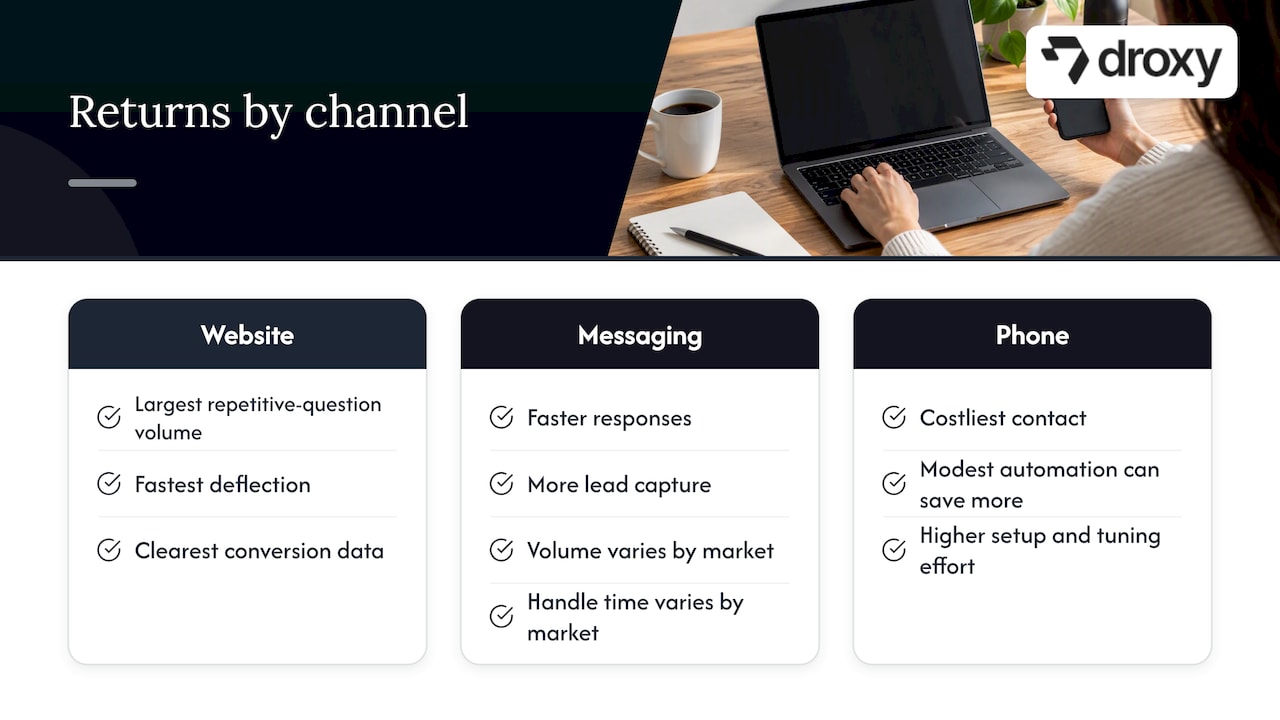
The same bot earns different returns depending on where it runs. Website chat usually carries the largest volume of repetitive pre-sales and order-status questions, so it often produces the fastest deflection and the clearest conversion data. Messaging apps such as WhatsApp, Instagram, and Facebook put you where customers already are, which tends to lift response speed and lead capture, though conversation volume and handle time differ by market.
Phone is the costliest channel per contact, so even modest automation there can move your savings line more than the same percentage on chat. It also carries higher setup and tuning effort, which belongs in your implementation cost.
Model each channel as its own row in your spreadsheet. Give it its own volume, handle time, and resolution rate, then total the results. A blended average hides the fact that one channel may carry most of your payback. If you sell online, our look at ecommerce chatbot use cases helps you size conversion lift for the retail channels. Rolling out in the order of highest volume and highest cost per contact gets you to payback sooner.
How can you improve the accuracy of your ROI inputs?
Weak inputs are the fastest way to lose credibility with finance. A few habits fix most problems.
Measure, do not estimate. Replace gut-feel handle times with exports from your helpdesk or contact-center platform. Compare a period that captures holidays and campaigns.
Classify the queries. Tag a sample of tickets by topic and mark which are repetitive and rule-based. Your realistic automation share is closer to that tagged proportion than to any vendor claim.
Include the full cost side. Software licensing is only one line. Add integration work, knowledge-base upkeep, review time for conversations the bot escalates, and training. Leaving these out is the most common way a model turns out too rosy.
Validate with a pilot. Run a high-volume flow and compare real resolution and escalation rates with your assumptions. A short pilot also keeps projects from stalling, a risk covered in this AI adoption roadmap.
Track escalations honestly. A conversation the bot starts but a human finishes is not a full resolution. Count only contacts closed without an agent, and record partial handling separately.
Refresh quarterly. Rates, volumes, and bot performance drift. Update the model on a fixed schedule and compare forecast to actuals.
What do real case studies show about ROI across industries?
Outcomes differ, and the spread is the point. In the public sector, Breckland Council expected roughly 30% efficiency savings by shifting phone and email traffic to a chatbot, and the DVLA pilot cut handling time on targeted flows from 8:00 to 2:30 while reporting about 90% satisfaction and a 15% reduction in webchat abandonment. A specialist supplier cited in the Breckland materials reported strong returns for some council clients, but that is a vendor-reported claim, so treat it cautiously rather than as a plan.
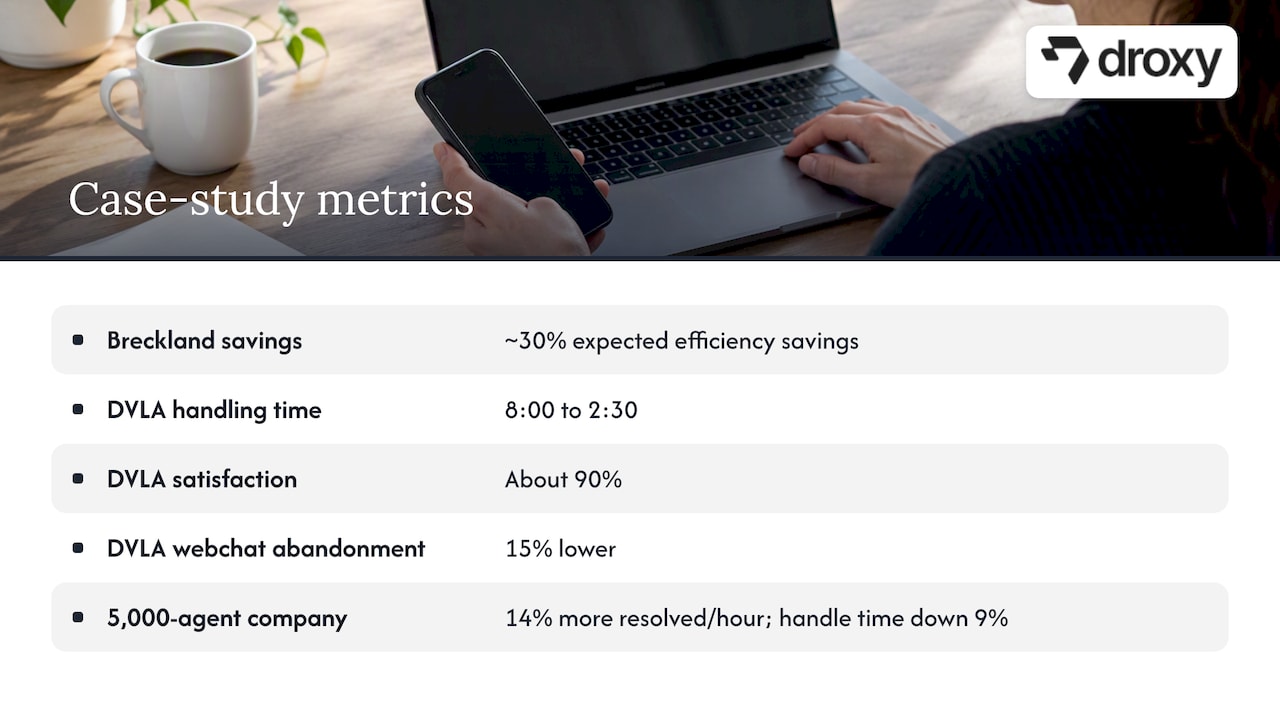
In a large contact center, the gains looked different: one company with 5,000 agents saw a 14% increase in issues resolved per hour and a 9% handle-time reduction after deploying generative AI, per the McKinsey findings in NoJitter. There, the benefit was agent productivity, not deflection.
For retail and lead-generation businesses, the return leans toward revenue: faster answers at the moment of intent, plus after-hours lead capture. Those gains are harder to isolate, so measure them against a control period.
The lesson: public-sector and high-volume support cases skew toward cost savings, while sales-led businesses skew toward revenue lift. Pick the case closest to yours and model that mix.
Where we stand on chatbot ROI
Most chatbot business cases fail for the same reason: they promise one big number instead of a defensible range. Finance leaders trust a model that shows its downside.
Droxy is a no-code platform for AI agents across website chat, phone, WhatsApp, Instagram, and Facebook, trusted by users. Businesses using it see improved engagement and faster responses. Our advice: run the worked example above with your own data, then pilot a single high-volume flow to confirm your assumptions before committing wider. When you are ready, you can compare Basic, Advanced, and Enterprise, starting from $16 per month for Basic, or start with our AI powered Website agent.
— Elena
FAQ
How is ROI calculated?
ROI is net benefit divided by cost. For a chatbot, add labor savings and revenue lift, subtract implementation and recurring costs, then divide that net figure by total cost. Multiply by 100 to express it as a percentage.
How do I calculate the percentage return on investment?
Subtract your total cost from your total benefit, divide the result by total cost to get monthly ROI.
What is ROI in AI agents?
ROI in AI agents measures the value an agent creates against what it costs to build and run. Google Cloud’s guidance on measurable business value lists support cost decrease, share of enquiries handled by the chatbot, and reduced agent hours on repetitive tasks as core measures.
How long does it take to see a return?
It depends on volume and scope. In our illustrative example, payback lands at about 3.9 months under conservative assumptions. Always pilot one flow first, then use measured results to firm up your timeline.
Sources
Recommended
A chatbot pays off when monthly labor savings plus incremental revenue exceed what you spend to run it. Use this: monthly ROI = (labor savings + revenue lift − monthly recurring cost − amortized implementation) ÷ total monthly cost, then multiply by 12 for the annual view. Three inputs move the result most: ticket volume, average handle time, and fully loaded cost per contact.
TL;DR:
Collect measured ticket volume, handle time, fully loaded agent cost, transfer rates, and conversion data; use seasonal periods rather than estimates.
Model each channel separately because phone contacts cost more, while website chat often handles repetitive sales and order status questions.
Include software, integration, upkeep, escalation review, and training costs, then test low, midpoint, and high automation and resolution assumptions against your hurdle rate.
Pilot a high volume flow, count only contacts resolved without an agent, track partial handling separately, and refresh the model quarterly.
Use outcomes as labeled benchmarks: DVLA chatbots answered 25% to 30% of queries without advisers, while one center with 5,000 agents cut handle time 9%.
DroxyMake Chatbot ROI Work HarderDroxy deploys customizable AI agents across chat, phone, and social channels to answer inquiries instantly and support customer engagement.Explore Droxy
Table of Contents
What formulas should you use for your chatbot ROI calculation?
Which inputs do you need to collect before you start?
How does the math work in a worked example?
What benchmark ranges are defensible when you lack internal data?
How should you present the numbers to finance and executives?
How do deployment channels change chatbot ROI?
How can you improve the accuracy of your ROI inputs?
What do real case studies show about ROI across industries?
Where we stand on chatbot ROI
Sources
What formulas should you use for your chatbot ROI calculation?
Start with the support side, then add revenue, then subtract every cost. Each variable below maps to a spreadsheet cell.
Support savings: (Tickets per month × automation share × bot resolution rate × handle time saved in hours × fully loaded hourly agent cost) − monthly recurring software and maintenance cost.
Revenue lift, ecommerce: monthly visitors × chatbot conversion lift × average order value.
Revenue lift, lead generation: leads × conversion rate × customer lifetime value.
Forrester warns that the most common mistake in a chatbot business case is choosing the wrong success metric, so build a case that covers cost savings, capacity unlocked, and revenue effects together. Then run the math in this order:
Add support savings and revenue lift to get gross monthly benefit.
Subtract monthly recurring cost and one-time implementation cost divided by the months you amortize it over.
Divide the resulting net benefit by total monthly cost to get monthly ROI.
Multiply by 12 for annual ROI.
Divide total implementation cost by monthly net benefit to get your payback period.
Which inputs do you need to collect before you start?
A model is only as good as its inputs, and finance will ask where each one came from. Pull these from your own systems:
Monthly ticket or interaction volume, split by channel
Current average handle time per channel
Fully loaded cost per agent hour: salary, benefits, and overhead
Current transfer and escalation rates
Current conversion rate and average order value
One-time implementation cost and monthly subscription cost
Use a sample that captures seasonal variation so spikes do not distort the average. Segment your highest-frequency questions, because those are the ones a bot resolves first. Export from your CRM or contact-center platform rather than relying on estimates.
Three assumptions swing the result most: automation share, bot resolution rate, and conversion lift. Treat those as ranges, not single numbers.
Pro Tip: Ask finance for the fully loaded hourly rate instead of calculating it yourself. Using base salary alone understates savings and invites questions later.
How does the math work in a worked example?
The subscription costs $1,000 per month and implementation costs $8,000, amortized over 12 months. These inputs are illustrative, not market data.
Tickets handled by the bot: 5,000 × 30% × 70% = 1,050 tickets.
Hours saved: 1,050 × 5 minutes ÷ 60 = 87.5 hours.
Monthly labor savings: 87.5 × $35 = $3,062.50.
Monthly cost: $1,000 subscription + $667 amortized implementation = $1,667.
Net monthly benefit: $3,062.50 − $1,667 = $1,395.50, so monthly ROI is about 84% and annual ROI is about 1,000% on the recurring view of net gain over cost, if the pattern holds.
Payback period: $8,000 ÷ ($3,062.50 − $1,000) = about 3.9 months.
Now consider an optimistic case: increase the assumed automation share and add a conversion lift. Recalculate hours saved, labor savings, and gross benefit against the same cost categories. The gap between scenarios shows why sensitivity testing matters.
Illustrative result: payback depends on the assumptions used, so compare conservative and optimistic scenarios.
What benchmark ranges are defensible when you lack internal data?
When you have no history, borrow conservative ranges from published cases and label them clearly in your deck.
Query deflection: the DVLA pilot reported that its chatbots answered 25% to 30% of queries without an adviser, and cut handling time on targeted flows from 8:00 to 2:30.
Efficiency savings: Breckland Council expected 30% efficiency savings by reducing inbound phone and email traffic.
Handle time: in one company with 5,000 agents, generative AI reduced handle time by 9%, according to McKinsey findings reported by NoJitter.
McKinsey estimates generative AI in customer care can lift productivity by a value of roughly 30% to 40% of current function costs.
Ranges vary because channel mix, query complexity, and design choices differ. Customers who dislike talking to a gatekeeper bot abandon more often, and smart routing with a clean fallback to a human protects satisfaction, as academic practitioner research suggests.
How should you present the numbers to finance and executives?
Package the case on one page or one slide. Lead with headline ROI and payback, then show the assumptions behind them, a three-scenario table, and a small bar chart of monthly savings against monthly costs.
Include these KPIs:
Monthly net savings and payback period
Incremental revenue
Cost per contact now versus modeled
Agent hours reallocated to higher-value work
CSAT trend after launch
For the sensitivity test, vary automation share and bot resolution rate in each direction and show the resulting ROI swing. If the case still clears your hurdle rate at the low end, it holds up. Google Cloud’s guidance on defining a generative AI use case likewise recommends tying chatbots to measurable values such as support cost decrease and first-contact resolution. Our guide to chatbot analytics KPIs covers which dashboards to build.
Scenario | Automation share | Bot resolution rate | What it tells finance |
|---|---|---|---|
Conservative | Low end of range | Low end of range | Floor for budget approval |
Base | Midpoint | Midpoint | Expected planning case |
Optimistic | High end of range | High end of range | Upside if design works |
How do deployment channels change chatbot ROI?
The same bot earns different returns depending on where it runs. Website chat usually carries the largest volume of repetitive pre-sales and order-status questions, so it often produces the fastest deflection and the clearest conversion data. Messaging apps such as WhatsApp, Instagram, and Facebook put you where customers already are, which tends to lift response speed and lead capture, though conversation volume and handle time differ by market.
Phone is the costliest channel per contact, so even modest automation there can move your savings line more than the same percentage on chat. It also carries higher setup and tuning effort, which belongs in your implementation cost.
Model each channel as its own row in your spreadsheet. Give it its own volume, handle time, and resolution rate, then total the results. A blended average hides the fact that one channel may carry most of your payback. If you sell online, our look at ecommerce chatbot use cases helps you size conversion lift for the retail channels. Rolling out in the order of highest volume and highest cost per contact gets you to payback sooner.
How can you improve the accuracy of your ROI inputs?
Weak inputs are the fastest way to lose credibility with finance. A few habits fix most problems.
Measure, do not estimate. Replace gut-feel handle times with exports from your helpdesk or contact-center platform. Compare a period that captures holidays and campaigns.
Classify the queries. Tag a sample of tickets by topic and mark which are repetitive and rule-based. Your realistic automation share is closer to that tagged proportion than to any vendor claim.
Include the full cost side. Software licensing is only one line. Add integration work, knowledge-base upkeep, review time for conversations the bot escalates, and training. Leaving these out is the most common way a model turns out too rosy.
Validate with a pilot. Run a high-volume flow and compare real resolution and escalation rates with your assumptions. A short pilot also keeps projects from stalling, a risk covered in this AI adoption roadmap.
Track escalations honestly. A conversation the bot starts but a human finishes is not a full resolution. Count only contacts closed without an agent, and record partial handling separately.
Refresh quarterly. Rates, volumes, and bot performance drift. Update the model on a fixed schedule and compare forecast to actuals.
What do real case studies show about ROI across industries?
Outcomes differ, and the spread is the point. In the public sector, Breckland Council expected roughly 30% efficiency savings by shifting phone and email traffic to a chatbot, and the DVLA pilot cut handling time on targeted flows from 8:00 to 2:30 while reporting about 90% satisfaction and a 15% reduction in webchat abandonment. A specialist supplier cited in the Breckland materials reported strong returns for some council clients, but that is a vendor-reported claim, so treat it cautiously rather than as a plan.
In a large contact center, the gains looked different: one company with 5,000 agents saw a 14% increase in issues resolved per hour and a 9% handle-time reduction after deploying generative AI, per the McKinsey findings in NoJitter. There, the benefit was agent productivity, not deflection.
For retail and lead-generation businesses, the return leans toward revenue: faster answers at the moment of intent, plus after-hours lead capture. Those gains are harder to isolate, so measure them against a control period.
The lesson: public-sector and high-volume support cases skew toward cost savings, while sales-led businesses skew toward revenue lift. Pick the case closest to yours and model that mix.
Where we stand on chatbot ROI
Most chatbot business cases fail for the same reason: they promise one big number instead of a defensible range. Finance leaders trust a model that shows its downside.
Droxy is a no-code platform for AI agents across website chat, phone, WhatsApp, Instagram, and Facebook, trusted by users. Businesses using it see improved engagement and faster responses. Our advice: run the worked example above with your own data, then pilot a single high-volume flow to confirm your assumptions before committing wider. When you are ready, you can compare Basic, Advanced, and Enterprise, starting from $16 per month for Basic, or start with our AI powered Website agent.
— Elena
FAQ
How is ROI calculated?
ROI is net benefit divided by cost. For a chatbot, add labor savings and revenue lift, subtract implementation and recurring costs, then divide that net figure by total cost. Multiply by 100 to express it as a percentage.
How do I calculate the percentage return on investment?
Subtract your total cost from your total benefit, divide the result by total cost to get monthly ROI.
What is ROI in AI agents?
ROI in AI agents measures the value an agent creates against what it costs to build and run. Google Cloud’s guidance on measurable business value lists support cost decrease, share of enquiries handled by the chatbot, and reduced agent hours on repetitive tasks as core measures.
How long does it take to see a return?
It depends on volume and scope. In our illustrative example, payback lands at about 3.9 months under conservative assumptions. Always pilot one flow first, then use measured results to firm up your timeline.
Sources
Recommended


🚀
Powered by Droxy
Turn every interaction into a conversion
Customer facing AI agents that engage, convert, and support so you can scale what matters.
✨
Learn more
Recent posts
Insights
3 min read
Introducing Agent Memories
Improve your agents' performance with Agent Memories. Prevent agents from repeating the same mistakes by giving them feedback.
Read more

Insights
15 min read
HVAC Marketing in 2025: The Definitive Lead Gen Guide
Discover 15 proven HVAC marketing strategies, plus learn how Droxy's AI website agent converts curious visitors into qualified leads by answering their questions instantly - right when they're most interested in your services.
Read more
Insights
10 min read
10 Best AI Sales Agents in 2025: Tested & Ranked
Discover the top 10 AI sales agents of 2025, designed to enhance lead generation, personalize outreach, and ultimately, close more deals
Read more
Insights
3 min read
Introducing Agent Memories
Improve your agents' performance with Agent Memories. Prevent agents from repeating the same mistakes by giving them feedback.
Read more
Insights
15 min read
HVAC Marketing in 2025: The Definitive Lead Gen Guide
Discover 15 proven HVAC marketing strategies, plus learn how Droxy's AI website agent converts curious visitors into qualified leads by answering their questions instantly - right when they're most interested in your services.
Read more