Chatbot Routing Rules: How to Design, Test and Improve Them
Chatbot Routing Rules: How to Design, Test and Improve Them
Insights
18 min

Chatbot routing rules are the if-then logic that decides where each incoming conversation goes: to the bot, to a specific flow, to a team queue or straight to a person. Good rules look at what the customer wants (intent), where they are writing from (channel), how urgent it is and what information is still missing. Then they pick the fastest path to a correct answer. This guide shows you how to write those rules, what to do when the bot is unsure, and how to measure whether your routing actually works.
DroxyRoute Inquiries Without the WaitDroxy deploys customizable AI agents across chat, phone, messaging, and Shopify to answer customer inquiries instantly, around the clock.Explore Droxy
TL;DR
Define a closed list of intents, plus an “other” bucket, so the bot can admit a request fits nothing instead of guessing.
Write each rule as condition, action and priority: for example, intent is “complaint” means hand off to a human, no matter what else matches.
Treat missing information, channel and urgency as routing inputs, not afterthoughts.
Start rule-based for high-stakes paths, add confidence scoring for the gray areas, and send low-confidence cases to a person.
Build a test set from real conversations that went wrong, then re-measure after every rule change.
Table of Contents
What chatbot routing rules actually do
The building blocks: intents, conditions and priorities
Account for context, channel, urgency and missing information
Handling ambiguity, unmatched requests and human handoff
Rule-based, machine-learning or hybrid routing
Routing examples by industry
How to test and improve your routing
Our perspective: routing is a customer promise
Put your routing rules to work with Droxy
A simple rule template you can copy
Sources
What chatbot routing rules actually do
Every conversation that reaches your business has to land somewhere. A routing rule is a small decision: “If this is true, send the conversation there.” Stack enough of them in the right order and you have a system that answers simple questions instantly, collects details for bookings and leads, and passes the hard cases to your team with the context they need.
Rules usually route to one of four destinations:
The bot itself, answering from your knowledge sources (FAQs, product data, policies).
A guided flow, such as booking an appointment, capturing a lead or checking an order.
A human queue or team, chosen by skill, department or language.
A fallback, such as asking a clarifying question or offering a callback when nothing fits.
The point is not to keep people away from your staff. It is to make sure your staff only spend time on conversations where a person adds value, and that everyone else gets an answer in seconds, day or night.
The building blocks: intents, conditions and priorities
If your routing feels messy, the cause is almost always one of three things: vague intents, conditions that overlap, or no clear order of priority. Fix those first.
Define intents as a closed set
An intent is the reason someone is writing: “track my order,” “book a viewing,” “cancel my appointment,” “I want a refund.” Keep the list short enough that a new team member could memorize it, and make each intent distinct.
The documentation for intent routing in Dcision describes this well: a choice is a closed set where the answer is always one of the defined intents, and a reserved “other” option lets the engine say a request fits no intent instead of forcing the least wrong one. That fallback then triggers a defined action. Copy that habit. An “other” bucket protects you from confidently wrong answers.
If you want a deeper walkthrough of how to build and measure intent detection, our guide to three-tier intent detection for routing KPIs covers it step by step.

Write conditions that can be checked
A condition is the test attached to an intent. Make each one something the system can actually evaluate:
Intent: is it “pricing question” or “complaint”?
Channel: website chat, phone, WhatsApp, Instagram or Facebook?
Customer status: new lead, existing customer, VIP?
Time: inside or outside business hours?
Language: which team or knowledge source can serve it?
Completeness: do we have the order number, date or address we need?
Set priorities so rules never collide
When two rules match, the higher priority wins. Decide that order on purpose. A practical ranking looks like this:
Safety, legal and billing-dispute rules (always to a human).
Escalation rules for complaints and frustrated customers.
High-value paths, such as booking and lead capture.
Routine self-service answers.
Fallback.
Write the rule, its priority and the reason it exists in one shared document. Six months from now, you will be glad you recorded why “refund” outranks “order status.”
Account for context, channel, urgency and missing information
Real conversations are rarely one tidy message. Researchers working on conversational agents point out that conversations are multi-turn and users often leave out information that the chatbot must collect before it can act, and that people naturally switch between intents mid-conversation. Your rules need to expect both.
Missing information
Create a “slot-filling” step before routing to any action. If someone says “I need to reschedule,” the rule should not fire until the bot has the booking reference or name and the preferred new time. Ask for one missing item at a time, and keep what the customer has already told you.
Channel
The same intent may deserve different handling by channel. A phone call has no typing delay and little patience for long menus, so rules should be short and confirm details by voice. Social messages from Instagram or Facebook often start with a casual comment, so the first job is to work out the intent. WhatsApp customers expect a conversation they can return to later. Your rules can branch on channel while sharing the same intents and knowledge underneath.
Urgency and priority signals
Urgency comes from words (“burst pipe,” “locked out,” “chest pain”), from sentiment, and from account facts. DigitalOcean’s tutorial on fallback routing for a customer support agent (July 9, 2026) lists signals for scoring confidence, including retrieval confidence, customer sentiment and business priority factors such as VIP status, enterprise accounts or payment issues. You can turn the business-side ones into plain rules today: “payment failed” plus “existing customer” goes to the billing queue first.
If you want to track how customers feel as conversations unfold, see our sentiment analysis chatbot pilot guide.
Interruptions and intent switches
A customer asking about shipping may suddenly say, “Actually, I want to cancel.” Let the highest-priority intent win at any point in the conversation, and keep the context so the person or flow that takes over does not start from zero.
Handling ambiguity, unmatched requests and human handoff
This is where routing earns its keep. A bot that answers every question confidently is not good routing. A bot that knows when to stop is.
Three escalation rule patterns
The Dcision documentation gives three escalation policy examples worth borrowing:
Escalate if the intent equals “complaint.”
Escalate if the intent is “technical_issue” and the complexity level is at or above 2.5.
Escalate if confidence about complexity is below 0.5, which means that when the system cannot tell how hard a request is, it should not automate it.
You do not need those exact numbers. The pattern is what matters: some intents always escalate, some escalate by difficulty, and uncertainty itself is a trigger.
Rules for ambiguous requests
When two intents score close together, do not pick one at random. Use a short clarifying question with two or three options: “Do you want to change your booking or cancel it?” If the second attempt still fails, route to a person. Two tries is a reasonable ceiling before frustration builds.
What a good handoff includes
The handoff itself is a rule set, not a single switch. A complete one covers when to transfer, which queue or skill group receives the conversation, what context travels with it (history, customer details, intent and any form data), what the customer is told about timing, and how you review transfers later. When a person picks up a chat and has to ask the customer to repeat everything, the routing has failed even if the transfer technically worked.

For trigger lists and policy templates, read our guides on chatbot escalation policies and on human handoff speed.
Rule-based, machine-learning or hybrid routing
You do not have to choose one approach for the whole system.
Approach | Best for | Watch for |
|---|---|---|
Rule-based (keywords, buttons, fixed conditions) | Compliance paths, billing, safety, simple menus | Breaks when customers phrase things unexpectedly |
Model-based (intent classification with confidence) | Free-text questions, many phrasings, multiple languages | Needs review so wrong guesses are caught |
Hybrid | Most real businesses | Needs a clear order: rules first, model second, human last |
A hybrid setup is the practical default. The DigitalOcean tutorial describes a support agent built from six parts: input channels, an intent classifier, a retrieval layer over company knowledge, a router, a confidence checker, and a final decision to answer, escalate to a stronger model, ask for clarification or transfer to a human. If you want to see how those pieces fit, the core components of a support chatbot are a good overview to pair with your own rule map.
A simple hybrid order looks like this:
Hard rules fire first. Safety words, legal requests and payment disputes go to a person.
The classifier picks an intent for everything else.
A confidence check decides the path: high confidence answers or runs the flow, medium confidence asks a clarifying question, low confidence goes to a human.
Routing examples by industry
The rules below are illustrative starting points. Adjust the intents and thresholds to your own business.
Ecommerce
Intent “where is my order” with an order number provided: answer from order data.
Intent “return or refund” on an order older than your policy window: hand off to a person with the order attached.
Intent “product recommendation”: run a short question flow, then show matching products.
Failed payment mentioned: billing queue, high priority.
Hospitality
Intent “availability” or “book a table or room”: booking flow with date, party size and contact details collected first.
Intent “change or cancel”: confirm the booking reference, then act or escalate if it falls inside a restricted window.
Group or event inquiries: route to the events manager.
Messages after hours: capture the request and promise a response time.
Home services
Words that signal an emergency (no heat, active leak, no power): immediate human call-back, with address and phone number captured first.
Intent “quote”: collect service type, address and photos if possible, then book an estimate.
Intent “reschedule”: handle in the bot with calendar access.
Existing-customer complaint: route to the owner or dispatcher.
Real estate
Intent “schedule a showing”: booking flow for the specific listing.
High-intent signals (pre-approved, ready to offer): alert the agent right away.
Intent “general neighborhood or listing question”: answer from listing data.
Rental versus sales inquiries: separate queues.
Healthcare practices
Intent “book, move or cancel an appointment”: automated flow.
Any mention of urgent symptoms: do not let the bot triage. Display a message directing the person to call emergency services (911 in the US) or the practice’s urgent line, and alert staff.
Prescription, billing and insurance questions: route to the right staff queue.
Anything clinical: always a human, with the conversation context attached.
Agencies and consultants
Rules are built per client, so keep a template of shared intents and swap in each client’s knowledge, hours and escalation contacts.
Route each client’s conversations to that client’s own team, never a shared inbox.
Review analytics per client so you can show results under your own brand.
How to test and improve your routing
Routing rules are never finished. Customers invent new phrasings, products change, and an innocent edit can break a path that worked last week.
Build a test set from real failures
Zen Business describes a process for improving AI router accuracy that you can adapt: build a golden dataset from production failures, write an evaluation script with clear metrics, iterate using the results, review changes manually and validate again after deployment. In their case, accuracy rose from 84.5% to 88.9% over 12 rounds. Accuracy there is simply correct selections divided by total examples.
You can run a small version of this without engineers:
Export 100 to 200 recent conversations, including ones that were escalated or abandoned.
Label what the correct destination should have been for each.
Compare with where the bot actually sent them.
Fix the rule or intent causing the largest group of misses.
Re-run the same set, then add new failures to it.
Metrics worth tracking
Routing accuracy: correct destination divided by total conversations in your test set.
Escalation rate and escalation correctness: are the right conversations reaching people, and are any avoidable?
Fallback rate: how often the “other” bucket fires. A rising number means new customer needs you have not covered.
Time to human for conversations that need one.
Resolution and satisfaction by intent, not just overall.
Break results down by intent, channel and language. Averages hide problems on rare but costly intents like cancellations or complaints. For help choosing and reading measures, see our overview of AI chatbot benchmarks for buyers.
Keep a change log
Every rule edit gets a date, a reason and a before-and-after test result. It sounds tedious, and it saves hours the first time something regresses.
Our perspective: routing is a customer promise
We see routing rules as a promise to the customer: you will get an answer fast, and if the bot is not the right one to give it, you will reach a person without repeating yourself.
That is why we built Droxy around smart routing, human hand-off and deep customization, not around a single “deflect everything” switch. You decide which intents the agent handles, which it passes on, and how the agent sounds while doing it, so conversations stay human-like and on-brand.
We also think the same rules should work across every channel your customers use. A question that starts on Instagram and continues on WhatsApp should not need a new rulebook. With one platform covering website chat, phone, WhatsApp, Instagram, Facebook and Shopify, you maintain one set of intents and one knowledge base, and you read one set of analytics.
Start small: five intents, three escalation rules, one fallback. Measure for two weeks, then expand. Teams that grow their rules from real conversations end up with routing that fits their customers instead of a generic template.
Elena
Put your routing rules to work with Droxy
Droxy is a no-code platform for deploying AI agents that answer customers on your website, by phone, and on WhatsApp, Instagram and Facebook. You set up smart routing, lead capture, appointment booking and human hand-off without writing code, connect your own knowledge sources, and watch the results in analytics. Agencies can also white-label agents for their own clients.
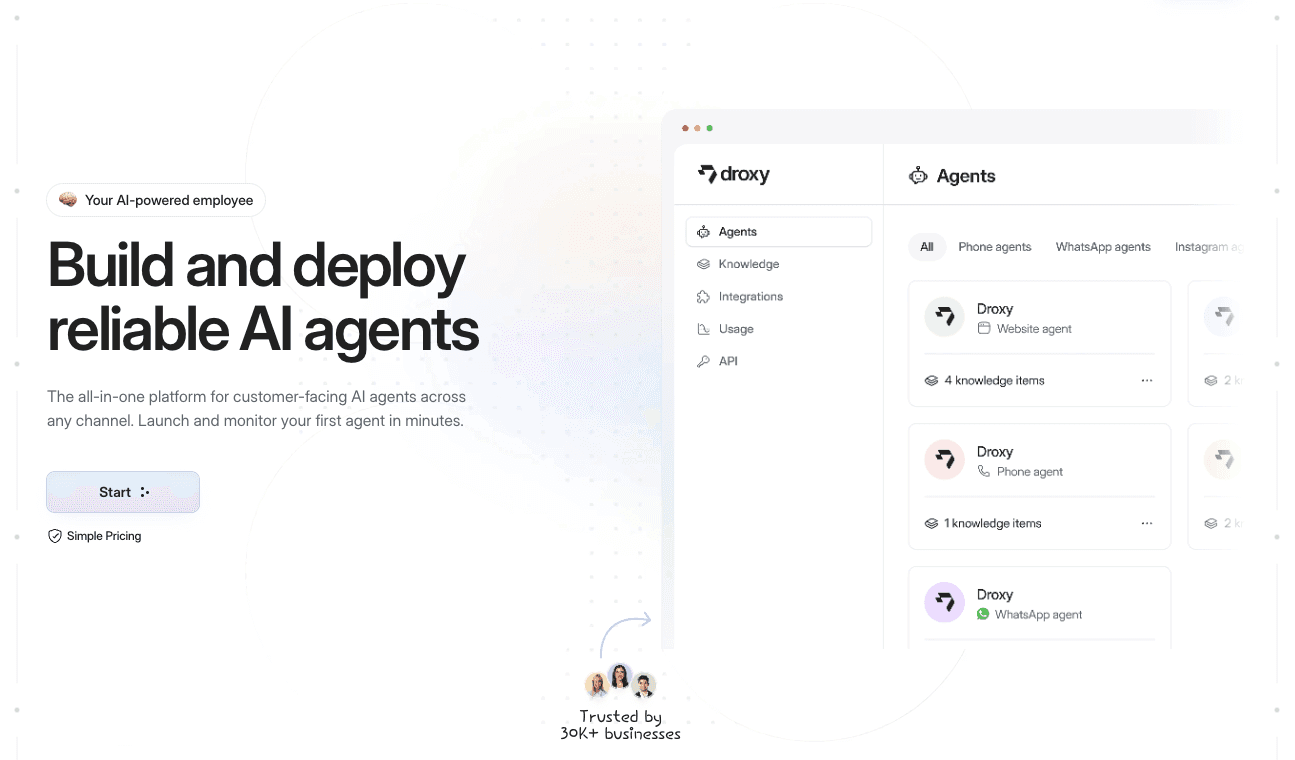
Plans start at $16 per month for Basic, $80 for Advanced and $240 for Enterprise. To see routing on a specific channel, explore the website agent or the WhatsApp agent, or start at droxy.ai.
A simple rule template you can copy
Use this one-line format for every rule in your system:
When [intent] and [conditions] then [destination] with [context passed] at priority [number].
Example: When intent is “cancel appointment” and the booking reference is confirmed, then run the cancellation flow, passing name and date, at priority 3. If the reference cannot be confirmed after two attempts, send to the front-desk queue at priority 2.
Writing rules this way forces you to name the destination and the context every time, which are the two things that most often go missing.
FAQ
What is the difference between routing rules and escalation rules?
Routing rules decide where every conversation goes, including to the bot, a flow or a team. Escalation rules are a subset that decide when the bot should stop and hand the conversation to a person. Most businesses write escalation rules first because they protect the customer experience on the riskiest conversations.
How many intents should a chatbot have?
Start with the five to ten reasons customers contact you most, plus an “other” intent for everything else. Add a new intent only when the fallback bucket shows a repeated, distinct need. A shorter list is easier to keep accurate and easier to test.
Should I use keywords or AI to route conversations?
Use both. Keywords and fixed conditions are dependable for safety, billing and compliance paths. AI intent detection handles the many ways customers phrase everyday questions. Run the fixed rules first, then the AI, then send low-confidence cases to a person.
How often should I review my routing rules?
Review them every few weeks at the beginning, then monthly once results stabilize. Also review after any change to your products, prices, hours or policies. Each review should include a fresh sample of real conversations, especially escalated ones.
Can I set different routing rules for each channel?
Yes, and you often should. Share the same intents and knowledge across channels, then adjust conditions such as response length, hand-off method and business hours for each one. A phone call and an Instagram message do not need identical handling.
Sources
Real-Time Customer Support Agent with Fallback Routing, DigitalOcean
Systemic approach to improving AI router accuracy, Zen Business
Recommended
Chatbot routing rules are the if-then logic that decides where each incoming conversation goes: to the bot, to a specific flow, to a team queue or straight to a person. Good rules look at what the customer wants (intent), where they are writing from (channel), how urgent it is and what information is still missing. Then they pick the fastest path to a correct answer. This guide shows you how to write those rules, what to do when the bot is unsure, and how to measure whether your routing actually works.
DroxyRoute Inquiries Without the WaitDroxy deploys customizable AI agents across chat, phone, messaging, and Shopify to answer customer inquiries instantly, around the clock.Explore Droxy
TL;DR
Define a closed list of intents, plus an “other” bucket, so the bot can admit a request fits nothing instead of guessing.
Write each rule as condition, action and priority: for example, intent is “complaint” means hand off to a human, no matter what else matches.
Treat missing information, channel and urgency as routing inputs, not afterthoughts.
Start rule-based for high-stakes paths, add confidence scoring for the gray areas, and send low-confidence cases to a person.
Build a test set from real conversations that went wrong, then re-measure after every rule change.
Table of Contents
What chatbot routing rules actually do
The building blocks: intents, conditions and priorities
Account for context, channel, urgency and missing information
Handling ambiguity, unmatched requests and human handoff
Rule-based, machine-learning or hybrid routing
Routing examples by industry
How to test and improve your routing
Our perspective: routing is a customer promise
Put your routing rules to work with Droxy
A simple rule template you can copy
Sources
What chatbot routing rules actually do
Every conversation that reaches your business has to land somewhere. A routing rule is a small decision: “If this is true, send the conversation there.” Stack enough of them in the right order and you have a system that answers simple questions instantly, collects details for bookings and leads, and passes the hard cases to your team with the context they need.
Rules usually route to one of four destinations:
The bot itself, answering from your knowledge sources (FAQs, product data, policies).
A guided flow, such as booking an appointment, capturing a lead or checking an order.
A human queue or team, chosen by skill, department or language.
A fallback, such as asking a clarifying question or offering a callback when nothing fits.
The point is not to keep people away from your staff. It is to make sure your staff only spend time on conversations where a person adds value, and that everyone else gets an answer in seconds, day or night.
The building blocks: intents, conditions and priorities
If your routing feels messy, the cause is almost always one of three things: vague intents, conditions that overlap, or no clear order of priority. Fix those first.
Define intents as a closed set
An intent is the reason someone is writing: “track my order,” “book a viewing,” “cancel my appointment,” “I want a refund.” Keep the list short enough that a new team member could memorize it, and make each intent distinct.
The documentation for intent routing in Dcision describes this well: a choice is a closed set where the answer is always one of the defined intents, and a reserved “other” option lets the engine say a request fits no intent instead of forcing the least wrong one. That fallback then triggers a defined action. Copy that habit. An “other” bucket protects you from confidently wrong answers.
If you want a deeper walkthrough of how to build and measure intent detection, our guide to three-tier intent detection for routing KPIs covers it step by step.
Write conditions that can be checked
A condition is the test attached to an intent. Make each one something the system can actually evaluate:
Intent: is it “pricing question” or “complaint”?
Channel: website chat, phone, WhatsApp, Instagram or Facebook?
Customer status: new lead, existing customer, VIP?
Time: inside or outside business hours?
Language: which team or knowledge source can serve it?
Completeness: do we have the order number, date or address we need?
Set priorities so rules never collide
When two rules match, the higher priority wins. Decide that order on purpose. A practical ranking looks like this:
Safety, legal and billing-dispute rules (always to a human).
Escalation rules for complaints and frustrated customers.
High-value paths, such as booking and lead capture.
Routine self-service answers.
Fallback.
Write the rule, its priority and the reason it exists in one shared document. Six months from now, you will be glad you recorded why “refund” outranks “order status.”
Account for context, channel, urgency and missing information
Real conversations are rarely one tidy message. Researchers working on conversational agents point out that conversations are multi-turn and users often leave out information that the chatbot must collect before it can act, and that people naturally switch between intents mid-conversation. Your rules need to expect both.
Missing information
Create a “slot-filling” step before routing to any action. If someone says “I need to reschedule,” the rule should not fire until the bot has the booking reference or name and the preferred new time. Ask for one missing item at a time, and keep what the customer has already told you.
Channel
The same intent may deserve different handling by channel. A phone call has no typing delay and little patience for long menus, so rules should be short and confirm details by voice. Social messages from Instagram or Facebook often start with a casual comment, so the first job is to work out the intent. WhatsApp customers expect a conversation they can return to later. Your rules can branch on channel while sharing the same intents and knowledge underneath.
Urgency and priority signals
Urgency comes from words (“burst pipe,” “locked out,” “chest pain”), from sentiment, and from account facts. DigitalOcean’s tutorial on fallback routing for a customer support agent (July 9, 2026) lists signals for scoring confidence, including retrieval confidence, customer sentiment and business priority factors such as VIP status, enterprise accounts or payment issues. You can turn the business-side ones into plain rules today: “payment failed” plus “existing customer” goes to the billing queue first.
If you want to track how customers feel as conversations unfold, see our sentiment analysis chatbot pilot guide.
Interruptions and intent switches
A customer asking about shipping may suddenly say, “Actually, I want to cancel.” Let the highest-priority intent win at any point in the conversation, and keep the context so the person or flow that takes over does not start from zero.
Handling ambiguity, unmatched requests and human handoff
This is where routing earns its keep. A bot that answers every question confidently is not good routing. A bot that knows when to stop is.
Three escalation rule patterns
The Dcision documentation gives three escalation policy examples worth borrowing:
Escalate if the intent equals “complaint.”
Escalate if the intent is “technical_issue” and the complexity level is at or above 2.5.
Escalate if confidence about complexity is below 0.5, which means that when the system cannot tell how hard a request is, it should not automate it.
You do not need those exact numbers. The pattern is what matters: some intents always escalate, some escalate by difficulty, and uncertainty itself is a trigger.
Rules for ambiguous requests
When two intents score close together, do not pick one at random. Use a short clarifying question with two or three options: “Do you want to change your booking or cancel it?” If the second attempt still fails, route to a person. Two tries is a reasonable ceiling before frustration builds.
What a good handoff includes
The handoff itself is a rule set, not a single switch. A complete one covers when to transfer, which queue or skill group receives the conversation, what context travels with it (history, customer details, intent and any form data), what the customer is told about timing, and how you review transfers later. When a person picks up a chat and has to ask the customer to repeat everything, the routing has failed even if the transfer technically worked.
For trigger lists and policy templates, read our guides on chatbot escalation policies and on human handoff speed.
Rule-based, machine-learning or hybrid routing
You do not have to choose one approach for the whole system.
Approach | Best for | Watch for |
|---|---|---|
Rule-based (keywords, buttons, fixed conditions) | Compliance paths, billing, safety, simple menus | Breaks when customers phrase things unexpectedly |
Model-based (intent classification with confidence) | Free-text questions, many phrasings, multiple languages | Needs review so wrong guesses are caught |
Hybrid | Most real businesses | Needs a clear order: rules first, model second, human last |
A hybrid setup is the practical default. The DigitalOcean tutorial describes a support agent built from six parts: input channels, an intent classifier, a retrieval layer over company knowledge, a router, a confidence checker, and a final decision to answer, escalate to a stronger model, ask for clarification or transfer to a human. If you want to see how those pieces fit, the core components of a support chatbot are a good overview to pair with your own rule map.
A simple hybrid order looks like this:
Hard rules fire first. Safety words, legal requests and payment disputes go to a person.
The classifier picks an intent for everything else.
A confidence check decides the path: high confidence answers or runs the flow, medium confidence asks a clarifying question, low confidence goes to a human.
Routing examples by industry
The rules below are illustrative starting points. Adjust the intents and thresholds to your own business.
Ecommerce
Intent “where is my order” with an order number provided: answer from order data.
Intent “return or refund” on an order older than your policy window: hand off to a person with the order attached.
Intent “product recommendation”: run a short question flow, then show matching products.
Failed payment mentioned: billing queue, high priority.
Hospitality
Intent “availability” or “book a table or room”: booking flow with date, party size and contact details collected first.
Intent “change or cancel”: confirm the booking reference, then act or escalate if it falls inside a restricted window.
Group or event inquiries: route to the events manager.
Messages after hours: capture the request and promise a response time.
Home services
Words that signal an emergency (no heat, active leak, no power): immediate human call-back, with address and phone number captured first.
Intent “quote”: collect service type, address and photos if possible, then book an estimate.
Intent “reschedule”: handle in the bot with calendar access.
Existing-customer complaint: route to the owner or dispatcher.
Real estate
Intent “schedule a showing”: booking flow for the specific listing.
High-intent signals (pre-approved, ready to offer): alert the agent right away.
Intent “general neighborhood or listing question”: answer from listing data.
Rental versus sales inquiries: separate queues.
Healthcare practices
Intent “book, move or cancel an appointment”: automated flow.
Any mention of urgent symptoms: do not let the bot triage. Display a message directing the person to call emergency services (911 in the US) or the practice’s urgent line, and alert staff.
Prescription, billing and insurance questions: route to the right staff queue.
Anything clinical: always a human, with the conversation context attached.
Agencies and consultants
Rules are built per client, so keep a template of shared intents and swap in each client’s knowledge, hours and escalation contacts.
Route each client’s conversations to that client’s own team, never a shared inbox.
Review analytics per client so you can show results under your own brand.
How to test and improve your routing
Routing rules are never finished. Customers invent new phrasings, products change, and an innocent edit can break a path that worked last week.
Build a test set from real failures
Zen Business describes a process for improving AI router accuracy that you can adapt: build a golden dataset from production failures, write an evaluation script with clear metrics, iterate using the results, review changes manually and validate again after deployment. In their case, accuracy rose from 84.5% to 88.9% over 12 rounds. Accuracy there is simply correct selections divided by total examples.
You can run a small version of this without engineers:
Export 100 to 200 recent conversations, including ones that were escalated or abandoned.
Label what the correct destination should have been for each.
Compare with where the bot actually sent them.
Fix the rule or intent causing the largest group of misses.
Re-run the same set, then add new failures to it.
Metrics worth tracking
Routing accuracy: correct destination divided by total conversations in your test set.
Escalation rate and escalation correctness: are the right conversations reaching people, and are any avoidable?
Fallback rate: how often the “other” bucket fires. A rising number means new customer needs you have not covered.
Time to human for conversations that need one.
Resolution and satisfaction by intent, not just overall.
Break results down by intent, channel and language. Averages hide problems on rare but costly intents like cancellations or complaints. For help choosing and reading measures, see our overview of AI chatbot benchmarks for buyers.
Keep a change log
Every rule edit gets a date, a reason and a before-and-after test result. It sounds tedious, and it saves hours the first time something regresses.
Our perspective: routing is a customer promise
We see routing rules as a promise to the customer: you will get an answer fast, and if the bot is not the right one to give it, you will reach a person without repeating yourself.
That is why we built Droxy around smart routing, human hand-off and deep customization, not around a single “deflect everything” switch. You decide which intents the agent handles, which it passes on, and how the agent sounds while doing it, so conversations stay human-like and on-brand.
We also think the same rules should work across every channel your customers use. A question that starts on Instagram and continues on WhatsApp should not need a new rulebook. With one platform covering website chat, phone, WhatsApp, Instagram, Facebook and Shopify, you maintain one set of intents and one knowledge base, and you read one set of analytics.
Start small: five intents, three escalation rules, one fallback. Measure for two weeks, then expand. Teams that grow their rules from real conversations end up with routing that fits their customers instead of a generic template.
Elena
Put your routing rules to work with Droxy
Droxy is a no-code platform for deploying AI agents that answer customers on your website, by phone, and on WhatsApp, Instagram and Facebook. You set up smart routing, lead capture, appointment booking and human hand-off without writing code, connect your own knowledge sources, and watch the results in analytics. Agencies can also white-label agents for their own clients.
Plans start at $16 per month for Basic, $80 for Advanced and $240 for Enterprise. To see routing on a specific channel, explore the website agent or the WhatsApp agent, or start at droxy.ai.
A simple rule template you can copy
Use this one-line format for every rule in your system:
When [intent] and [conditions] then [destination] with [context passed] at priority [number].
Example: When intent is “cancel appointment” and the booking reference is confirmed, then run the cancellation flow, passing name and date, at priority 3. If the reference cannot be confirmed after two attempts, send to the front-desk queue at priority 2.
Writing rules this way forces you to name the destination and the context every time, which are the two things that most often go missing.
FAQ
What is the difference between routing rules and escalation rules?
Routing rules decide where every conversation goes, including to the bot, a flow or a team. Escalation rules are a subset that decide when the bot should stop and hand the conversation to a person. Most businesses write escalation rules first because they protect the customer experience on the riskiest conversations.
How many intents should a chatbot have?
Start with the five to ten reasons customers contact you most, plus an “other” intent for everything else. Add a new intent only when the fallback bucket shows a repeated, distinct need. A shorter list is easier to keep accurate and easier to test.
Should I use keywords or AI to route conversations?
Use both. Keywords and fixed conditions are dependable for safety, billing and compliance paths. AI intent detection handles the many ways customers phrase everyday questions. Run the fixed rules first, then the AI, then send low-confidence cases to a person.
How often should I review my routing rules?
Review them every few weeks at the beginning, then monthly once results stabilize. Also review after any change to your products, prices, hours or policies. Each review should include a fresh sample of real conversations, especially escalated ones.
Can I set different routing rules for each channel?
Yes, and you often should. Share the same intents and knowledge across channels, then adjust conditions such as response length, hand-off method and business hours for each one. A phone call and an Instagram message do not need identical handling.
Sources
Real-Time Customer Support Agent with Fallback Routing, DigitalOcean
Systemic approach to improving AI router accuracy, Zen Business
Recommended


🚀
Powered by Droxy
Turn every interaction into a conversion
Customer facing AI agents that engage, convert, and support so you can scale what matters.
✨
Learn more
Recent posts
Insights
3 min read
Introducing Agent Memories
Improve your agents' performance with Agent Memories. Prevent agents from repeating the same mistakes by giving them feedback.
Read more

Insights
15 min read
HVAC Marketing in 2025: The Definitive Lead Gen Guide
Discover 15 proven HVAC marketing strategies, plus learn how Droxy's AI website agent converts curious visitors into qualified leads by answering their questions instantly - right when they're most interested in your services.
Read more
Insights
10 min read
10 Best AI Sales Agents in 2025: Tested & Ranked
Discover the top 10 AI sales agents of 2025, designed to enhance lead generation, personalize outreach, and ultimately, close more deals
Read more
Insights
3 min read
Introducing Agent Memories
Improve your agents' performance with Agent Memories. Prevent agents from repeating the same mistakes by giving them feedback.
Read more
Insights
15 min read
HVAC Marketing in 2025: The Definitive Lead Gen Guide
Discover 15 proven HVAC marketing strategies, plus learn how Droxy's AI website agent converts curious visitors into qualified leads by answering their questions instantly - right when they're most interested in your services.
Read more