Two week pilot: UX backed test if chatbots beat forms for leads
Two week pilot: UX backed test if chatbots beat forms for leads
Insights
13 min
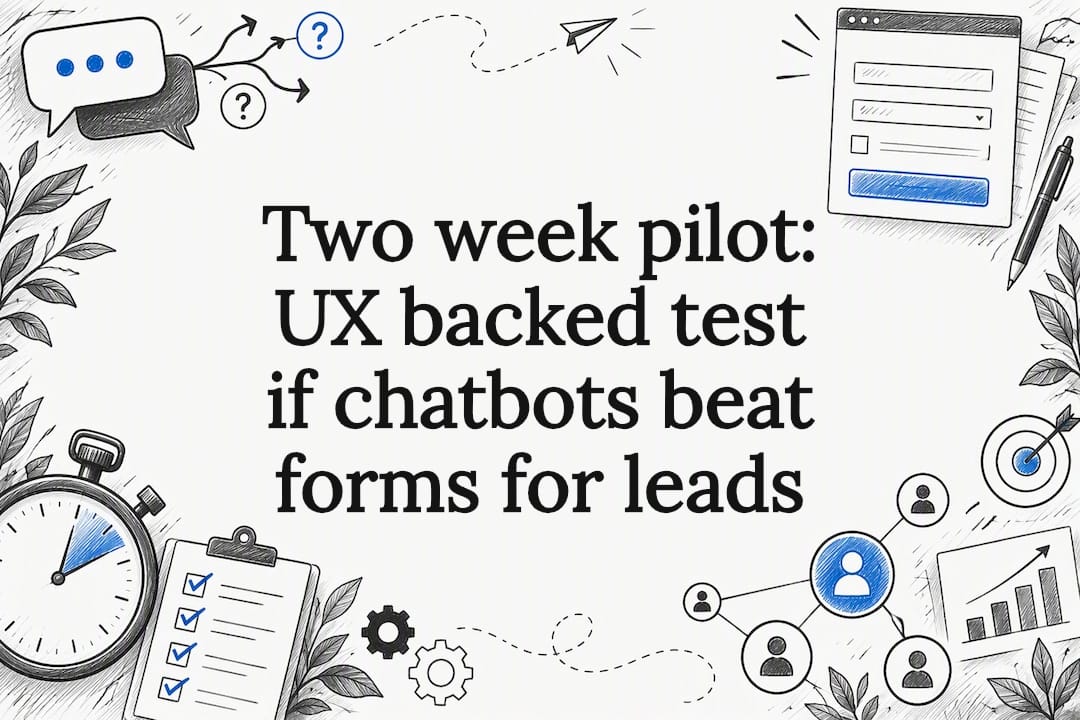
Choose a chatbot when your goal is conversational qualification, support triage, or cross-channel reach, and choose a form when you need fast, high-accuracy capture of several structured fields. Chatbots tend to win on engagement and perceived speed, while forms usually produce cleaner, more complete data with less setup work. If you are unsure, pilot both for two weeks on the same traffic and let completion rate and downstream conversion settle the argument.
TL;DR:
Well-designed forms consistently produce more accurate, structured data and require less ongoing maintenance compared to poorly validated chatbots.
Chatbots generally boost engagement and perceived efficiency but need deliberate design, validation, and transparency to earn trust and ensure high-quality responses.
Success depends more on matching the tool to the specific task and ensuring proper implementation than on choosing between chatbot or form based on trends or aesthetics.
Piloting both channels simultaneously for at least two weeks, with sessions segmented by traffic source, provides the best insight into which option performs best for your goals.
The primary performance metric should be downstream conversion, like qualified leads or completed sales, rather than just completion rate or user satisfaction.
Droxydroxy.aiTurn More Conversations Into LeadsDeploy a customized AI agent across your website and other channels to answer inquiries instantly and support stronger lead conversion.Explore Droxy
Table of Contents
Chatbots vs forms: pros and cons compared
What UX research says about chatbots and forms
Best-fit use cases and a quick decision checklist
How to pilot the decision and measure what matters
Why practitioner experience still matters here
Our take: stop picking sides before you test
If chatbots fit, here’s where to start
Sources
Chatbots vs forms: pros and cons compared
Both channels do the same basic job, collecting information from a visitor, but they get there differently, and that difference shows up in your metrics.
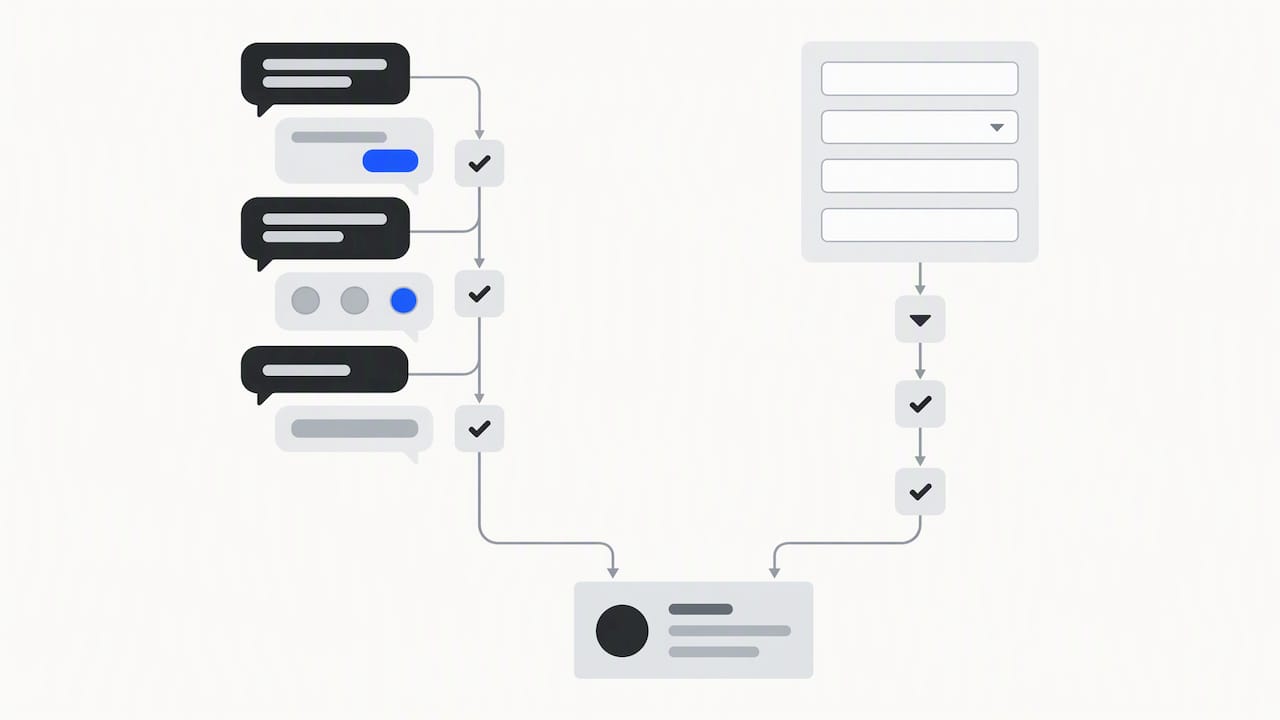
Chatbots tend to pull ahead on engagement. A conversational interface invites a response the way a static field never does, and that back-and-forth often means more clicks and longer time on page. Forms, by contrast, win on raw speed for visitors who already know what they want to say. Autocomplete, tab-key navigation, and a visible end point let a motivated user finish in seconds without typing a single sentence.
Data quality tends to split the other way. Forms enforce structure by default: a dropdown cannot return a typo, and a required field cannot be skipped. Chatbots need deliberate design, validation rules, scripted prompts, and fallback logic, to reach the same reliability, and without that structure they can produce messier, less usable responses.
Cost follows a similar pattern. Forms are close to “set and forget” once built. Chatbots need ongoing governance: monitoring conversations, updating scripts, and training the system on new scenarios.
Trust cuts both ways too. For sensitive inputs like payment or health details, a form’s static, predictable layout can feel more secure. A chatbot earns that same trust only when it is transparent about what it is and when it hands off to a human.
Engagement: chatbots generally draw more interaction and follow-up clicks than static fields.
Speed: forms are faster for users who already know what they want to submit.
Data quality: forms default to clean structure; chatbots need validation rules to match it.
Maintenance: forms are largely set-and-forget; chatbots require ongoing governance and updates.
Trust: forms can feel safer for sensitive data; chatbots need disclosure and a clear human handoff.
What UX research says about chatbots and forms
The strongest case against picking a channel on instinct comes from the research itself: the tool matters less than how well it is built for the specific job.
A comparative review of chat-based and form-based interfaces found that outcomes depend heavily on the “job to be done,” and that a well-designed interface, whether chat or form, often outperforms a poorly designed one regardless of channel. The same review recommends tracking downstream conversion, like qualified opportunities or closed deals, rather than raw completion rate, since a chatbot that qualifies harder may collect fewer submissions but better leads.
A JMIS experiment comparing review collection methods found that chatbots improved perceived efficiency but did not consistently raise satisfaction, and unstructured chatbot collection produced shorter, lower-quality responses than forms. That gap closed once the chatbot added structured, validated prompts, though some of the conversational feel was lost in the process.
Nielsen Norman Group’s chatbot design guidelines point to the same conclusion from a different angle. Small design choices, disclosure of AI status, suggested prompts, continuity across pages, and a clear path to a human, had large effects on whether users trusted a chatbot enough to return to it. Without that clarity, even a capable chatbot gets ignored.
Three findings worth carrying into any internal debate:
Channel choice matters less than design quality; a strong form can beat a weak chatbot every time.
Chatbots raise perceived efficiency but not automatically satisfaction or response quality.
Discovery and trust signals, not conversational polish, decide whether a chatbot gets used at all.
Best-fit use cases and a quick decision checklist
Match the tool to the task rather than to whatever feels more modern.
Chatbots tend to fit lead qualification and conversational sales best, especially when you need two-way questions, scheduling, or follow-up across channels like WhatsApp or Instagram. Customer support benefits too, with a chatbot handling common issues and escalating anything complex to a human. Forms still win for long intake, surveys, and compliance-related capture, where every field needs to be accurate and auditable.
Define intent. Is the visitor exploring or ready to transact?
Estimate completion time. Short tasks favor chat; long multi-field tasks favor forms.
Weigh data sensitivity. Sensitive or regulated data often favors a form’s predictability.
Check integration needs. Confirm the channel can push data cleanly into your CRM.
Consider discoverability. A chatbot only helps if visitors notice and trust it.
Account for traffic volume. High volume with varied questions favors chat; steady, predictable fields favor a form.
Pro Tip: Run your highest-traffic landing page as a chatbot and your checkout or compliance flow as a form, then compare results before touching anything else.
A marketing landing page usually wants a chatbot to qualify interest early. A checkout flow wants a form for speed and accuracy. A post-purchase feedback request can go either way, but a short chat prompt that links out to a longer form often captures the best of both.
How to pilot the decision and measure what matters
Treat this as a testable question, not a branding choice.
Track completion rate, time to complete, and downstream conversion, like sales-qualified leads or purchases, as your primary KPIs. Cost per lead matters here too, since a chatbot that costs more to maintain needs to earn that cost back in lead quality. Secondary KPIs worth watching include satisfaction score, re-contact rate, and how often a user needs clarification before finishing.
NN/g’s research on site chatbot design found that users approach site chat the way they approach search: they want a concise, answer-first response before anything else. That single finding should shape your first chatbot reply, regardless of what you are testing it against.
For the pilot itself:
Run the test for at least two weeks to smooth out day-of-week traffic swings.
Keep the form as your control and the chatbot flow as the variant, not the reverse.
Segment results by traffic source, since paid and organic visitors often behave differently.
Confirm your CRM mapping, consent capture, and analytics tagging before launch, not after.
Check accessibility compliance on both versions; a chatbot without keyboard navigation will skew your results.
Enterprise chatbot guidance from IBM notes that governance, integration depth, and the ability to escalate to a human at volume are what justify the added investment for larger organizations. If your pilot can’t show that payoff within a few weeks, a hybrid pattern, a short chat prompt that links to a full form, is the lower-risk next step.
Why practitioner experience still matters here
Research gives you the pattern; running the pilot yourself tells you whether it holds for your traffic and your offer. That gap is why this guide leans on peer-reviewed evidence and NN/g’s design research first, and treats vendor claims as a secondary input.
Droxy is a no-code platform that lets businesses deploy AI agents for customer interaction across website chat, phone, WhatsApp, Instagram, and Facebook.
Droxy agents provide instant, 24/7 answers designed to address response times and inquiries, with integration into existing systems and customization to align with a brand’s voice.
Many users rely on Droxy to power their customer service, reporting improvements in engagement, response speed, and lead conversion.
Our take: stop picking sides before you test
The honest conclusion from the research is less exciting than most vendors would like: design quality beats channel choice almost every time. A chatbot built without structure, disclosure, or a human handoff will lose to a clean three-field form, and a form with twelve required fields will lose to a chatbot that asks one good question at a time.
Where conventional advice falls short is treating this as a philosophical choice, chatbots feel modern, forms feel dated, rather than an operational one. That framing pushes teams toward whichever tool is trendier instead of whichever tool fits the job.
What we would prioritize first: pick the use case, define the one metric that proves success, then test. Everything else, tone, personality, visual polish, matters only after the core mechanics are right.
— Elena
If chatbots fit, here’s where to start
We built Droxy as a no-code way to deploy AI agents across website chat, phone, WhatsApp, Instagram, and Facebook without writing code or hiring a dev team. Setup stays simple while the agent handles qualification, scheduling, and handoff to a human when a conversation needs one.
If chatbots came out ahead in your pilot, start small: launch a short chatflow on your highest-traffic page and measure it against your current form for two weeks. Our pricing page breaks down the Basic, Advanced, and Enterprise plans so you can match the investment to the scale of what you are testing.
FAQ
What are the four types of chatbots?
Chatbots are commonly grouped by capability: rule-based (scripted decision trees), retrieval-based (pulling answers from a knowledge base), generative AI-based (producing original responses), and hybrid models that combine scripted flows with generative responses for flexibility.
Are chatbots a form of AI?
Many chatbots use AI, particularly natural language processing and generative models, but not all do. Simple rule-based chatbots follow fixed scripts with no AI involved, while more advanced ones rely on machine learning to interpret open-ended input.
What shouldn’t you share with ChatGPT?
Avoid entering sensitive personal data, financial account details, medical records, passwords, or confidential business information into any general-purpose AI chat tool. EU transparency rules also require clear disclosure when users are interacting with AI rather than a human in certain jurisdictions.
How do I choose between a chatbot and a form for lead capture?
Favor a chatbot when you need two-way qualification, scheduling, or cross-channel follow-up, and favor a form when you need fast, structured capture of several fields at once. Our guide to automated lead qualification walks through the practical setup either way.
Does adding a chatbot always increase conversions?
No. Research comparing chat and form-based collection found that chatbots improve perceived efficiency but do not automatically raise satisfaction or data quality unless the flow is deliberately structured. A well-designed form can outperform a poorly designed chatbot on the same page.
Sources
Collecting reviews with chatbots vs forms (JMIS experiments)
Comparative usability and outcomes for chat-based vs form-based interfaces (PMC study)
Recommended
Choose a chatbot when your goal is conversational qualification, support triage, or cross-channel reach, and choose a form when you need fast, high-accuracy capture of several structured fields. Chatbots tend to win on engagement and perceived speed, while forms usually produce cleaner, more complete data with less setup work. If you are unsure, pilot both for two weeks on the same traffic and let completion rate and downstream conversion settle the argument.
TL;DR:
Well-designed forms consistently produce more accurate, structured data and require less ongoing maintenance compared to poorly validated chatbots.
Chatbots generally boost engagement and perceived efficiency but need deliberate design, validation, and transparency to earn trust and ensure high-quality responses.
Success depends more on matching the tool to the specific task and ensuring proper implementation than on choosing between chatbot or form based on trends or aesthetics.
Piloting both channels simultaneously for at least two weeks, with sessions segmented by traffic source, provides the best insight into which option performs best for your goals.
The primary performance metric should be downstream conversion, like qualified leads or completed sales, rather than just completion rate or user satisfaction.
Droxydroxy.aiTurn More Conversations Into LeadsDeploy a customized AI agent across your website and other channels to answer inquiries instantly and support stronger lead conversion.Explore Droxy
Table of Contents
Chatbots vs forms: pros and cons compared
What UX research says about chatbots and forms
Best-fit use cases and a quick decision checklist
How to pilot the decision and measure what matters
Why practitioner experience still matters here
Our take: stop picking sides before you test
If chatbots fit, here’s where to start
Sources
Chatbots vs forms: pros and cons compared
Both channels do the same basic job, collecting information from a visitor, but they get there differently, and that difference shows up in your metrics.
Chatbots tend to pull ahead on engagement. A conversational interface invites a response the way a static field never does, and that back-and-forth often means more clicks and longer time on page. Forms, by contrast, win on raw speed for visitors who already know what they want to say. Autocomplete, tab-key navigation, and a visible end point let a motivated user finish in seconds without typing a single sentence.
Data quality tends to split the other way. Forms enforce structure by default: a dropdown cannot return a typo, and a required field cannot be skipped. Chatbots need deliberate design, validation rules, scripted prompts, and fallback logic, to reach the same reliability, and without that structure they can produce messier, less usable responses.
Cost follows a similar pattern. Forms are close to “set and forget” once built. Chatbots need ongoing governance: monitoring conversations, updating scripts, and training the system on new scenarios.
Trust cuts both ways too. For sensitive inputs like payment or health details, a form’s static, predictable layout can feel more secure. A chatbot earns that same trust only when it is transparent about what it is and when it hands off to a human.
Engagement: chatbots generally draw more interaction and follow-up clicks than static fields.
Speed: forms are faster for users who already know what they want to submit.
Data quality: forms default to clean structure; chatbots need validation rules to match it.
Maintenance: forms are largely set-and-forget; chatbots require ongoing governance and updates.
Trust: forms can feel safer for sensitive data; chatbots need disclosure and a clear human handoff.
What UX research says about chatbots and forms
The strongest case against picking a channel on instinct comes from the research itself: the tool matters less than how well it is built for the specific job.
A comparative review of chat-based and form-based interfaces found that outcomes depend heavily on the “job to be done,” and that a well-designed interface, whether chat or form, often outperforms a poorly designed one regardless of channel. The same review recommends tracking downstream conversion, like qualified opportunities or closed deals, rather than raw completion rate, since a chatbot that qualifies harder may collect fewer submissions but better leads.
A JMIS experiment comparing review collection methods found that chatbots improved perceived efficiency but did not consistently raise satisfaction, and unstructured chatbot collection produced shorter, lower-quality responses than forms. That gap closed once the chatbot added structured, validated prompts, though some of the conversational feel was lost in the process.
Nielsen Norman Group’s chatbot design guidelines point to the same conclusion from a different angle. Small design choices, disclosure of AI status, suggested prompts, continuity across pages, and a clear path to a human, had large effects on whether users trusted a chatbot enough to return to it. Without that clarity, even a capable chatbot gets ignored.
Three findings worth carrying into any internal debate:
Channel choice matters less than design quality; a strong form can beat a weak chatbot every time.
Chatbots raise perceived efficiency but not automatically satisfaction or response quality.
Discovery and trust signals, not conversational polish, decide whether a chatbot gets used at all.
Best-fit use cases and a quick decision checklist
Match the tool to the task rather than to whatever feels more modern.
Chatbots tend to fit lead qualification and conversational sales best, especially when you need two-way questions, scheduling, or follow-up across channels like WhatsApp or Instagram. Customer support benefits too, with a chatbot handling common issues and escalating anything complex to a human. Forms still win for long intake, surveys, and compliance-related capture, where every field needs to be accurate and auditable.
Define intent. Is the visitor exploring or ready to transact?
Estimate completion time. Short tasks favor chat; long multi-field tasks favor forms.
Weigh data sensitivity. Sensitive or regulated data often favors a form’s predictability.
Check integration needs. Confirm the channel can push data cleanly into your CRM.
Consider discoverability. A chatbot only helps if visitors notice and trust it.
Account for traffic volume. High volume with varied questions favors chat; steady, predictable fields favor a form.
Pro Tip: Run your highest-traffic landing page as a chatbot and your checkout or compliance flow as a form, then compare results before touching anything else.
A marketing landing page usually wants a chatbot to qualify interest early. A checkout flow wants a form for speed and accuracy. A post-purchase feedback request can go either way, but a short chat prompt that links out to a longer form often captures the best of both.
How to pilot the decision and measure what matters
Treat this as a testable question, not a branding choice.
Track completion rate, time to complete, and downstream conversion, like sales-qualified leads or purchases, as your primary KPIs. Cost per lead matters here too, since a chatbot that costs more to maintain needs to earn that cost back in lead quality. Secondary KPIs worth watching include satisfaction score, re-contact rate, and how often a user needs clarification before finishing.
NN/g’s research on site chatbot design found that users approach site chat the way they approach search: they want a concise, answer-first response before anything else. That single finding should shape your first chatbot reply, regardless of what you are testing it against.
For the pilot itself:
Run the test for at least two weeks to smooth out day-of-week traffic swings.
Keep the form as your control and the chatbot flow as the variant, not the reverse.
Segment results by traffic source, since paid and organic visitors often behave differently.
Confirm your CRM mapping, consent capture, and analytics tagging before launch, not after.
Check accessibility compliance on both versions; a chatbot without keyboard navigation will skew your results.
Enterprise chatbot guidance from IBM notes that governance, integration depth, and the ability to escalate to a human at volume are what justify the added investment for larger organizations. If your pilot can’t show that payoff within a few weeks, a hybrid pattern, a short chat prompt that links to a full form, is the lower-risk next step.
Why practitioner experience still matters here
Research gives you the pattern; running the pilot yourself tells you whether it holds for your traffic and your offer. That gap is why this guide leans on peer-reviewed evidence and NN/g’s design research first, and treats vendor claims as a secondary input.
Droxy is a no-code platform that lets businesses deploy AI agents for customer interaction across website chat, phone, WhatsApp, Instagram, and Facebook.
Droxy agents provide instant, 24/7 answers designed to address response times and inquiries, with integration into existing systems and customization to align with a brand’s voice.
Many users rely on Droxy to power their customer service, reporting improvements in engagement, response speed, and lead conversion.
Our take: stop picking sides before you test
The honest conclusion from the research is less exciting than most vendors would like: design quality beats channel choice almost every time. A chatbot built without structure, disclosure, or a human handoff will lose to a clean three-field form, and a form with twelve required fields will lose to a chatbot that asks one good question at a time.
Where conventional advice falls short is treating this as a philosophical choice, chatbots feel modern, forms feel dated, rather than an operational one. That framing pushes teams toward whichever tool is trendier instead of whichever tool fits the job.
What we would prioritize first: pick the use case, define the one metric that proves success, then test. Everything else, tone, personality, visual polish, matters only after the core mechanics are right.
— Elena
If chatbots fit, here’s where to start
We built Droxy as a no-code way to deploy AI agents across website chat, phone, WhatsApp, Instagram, and Facebook without writing code or hiring a dev team. Setup stays simple while the agent handles qualification, scheduling, and handoff to a human when a conversation needs one.
If chatbots came out ahead in your pilot, start small: launch a short chatflow on your highest-traffic page and measure it against your current form for two weeks. Our pricing page breaks down the Basic, Advanced, and Enterprise plans so you can match the investment to the scale of what you are testing.
FAQ
What are the four types of chatbots?
Chatbots are commonly grouped by capability: rule-based (scripted decision trees), retrieval-based (pulling answers from a knowledge base), generative AI-based (producing original responses), and hybrid models that combine scripted flows with generative responses for flexibility.
Are chatbots a form of AI?
Many chatbots use AI, particularly natural language processing and generative models, but not all do. Simple rule-based chatbots follow fixed scripts with no AI involved, while more advanced ones rely on machine learning to interpret open-ended input.
What shouldn’t you share with ChatGPT?
Avoid entering sensitive personal data, financial account details, medical records, passwords, or confidential business information into any general-purpose AI chat tool. EU transparency rules also require clear disclosure when users are interacting with AI rather than a human in certain jurisdictions.
How do I choose between a chatbot and a form for lead capture?
Favor a chatbot when you need two-way qualification, scheduling, or cross-channel follow-up, and favor a form when you need fast, structured capture of several fields at once. Our guide to automated lead qualification walks through the practical setup either way.
Does adding a chatbot always increase conversions?
No. Research comparing chat and form-based collection found that chatbots improve perceived efficiency but do not automatically raise satisfaction or data quality unless the flow is deliberately structured. A well-designed form can outperform a poorly designed chatbot on the same page.
Sources
Collecting reviews with chatbots vs forms (JMIS experiments)
Comparative usability and outcomes for chat-based vs form-based interfaces (PMC study)
Recommended


🚀
Powered by Droxy
Turn every interaction into a conversion
Customer facing AI agents that engage, convert, and support so you can scale what matters.
✨
Learn more
Recent posts
Insights
3 min read
Introducing Agent Memories
Improve your agents' performance with Agent Memories. Prevent agents from repeating the same mistakes by giving them feedback.
Read more

Insights
15 min read
HVAC Marketing in 2025: The Definitive Lead Gen Guide
Discover 15 proven HVAC marketing strategies, plus learn how Droxy's AI website agent converts curious visitors into qualified leads by answering their questions instantly - right when they're most interested in your services.
Read more
Insights
10 min read
10 Best AI Sales Agents in 2025: Tested & Ranked
Discover the top 10 AI sales agents of 2025, designed to enhance lead generation, personalize outreach, and ultimately, close more deals
Read more
Insights
3 min read
Introducing Agent Memories
Improve your agents' performance with Agent Memories. Prevent agents from repeating the same mistakes by giving them feedback.
Read more
Insights
15 min read
HVAC Marketing in 2025: The Definitive Lead Gen Guide
Discover 15 proven HVAC marketing strategies, plus learn how Droxy's AI website agent converts curious visitors into qualified leads by answering their questions instantly - right when they're most interested in your services.
Read more