Vendor Checklist: Chatbots vs Live Chat for Support Managers
Vendor Checklist: Chatbots vs Live Chat for Support Managers
Insights
17 min
Use chatbots for high-volume, predictable questions like order status or password resets. Use live chat for complex, emotional, or high-stakes conversations where a customer needs a human to actually listen. Most support teams get the best results from a hybrid setup with clear hand-off rules, and platforms like Droxy exist specifically to make that hybrid model easy to deploy without a development team.
TL;DR:
Chatbots excel at handling high-volume, routine questions but often struggle with complex or emotionally charged issues that require human judgment.
The most effective support combines automated chatbot functions with live chat, using clear hand-off rules to preserve customer context and improve experience.
Properly scoped and monitored AI automation can significantly reduce contact volume, but failures in escalation or resolution tracking can lead to increased costs.
Full cost and performance measurement should include resolution rates, escalation quality, and repeat contacts to avoid misleading deflection metrics.
A hybrid support model using no-code platforms allows flexible deployment across multiple channels, matching tools to task complexity and customer needs.
DroxyDeploy Hybrid Support Without CodeDroxy helps businesses answer customers instantly across channels while keeping interactions customized to their brand voice.Explore Droxy
Table of Contents
Chatbots vs Live Chat: The Real Difference Starts With Capability
What Live Chat Actually Looks Like Now
Response Time, Cost, and Complexity: A Direct Comparison
The Real ROI Formula (and the Vendor Traps Hiding Inside It)
Matching the Approach to the Actual Support Pattern
How to Design a Hand-Off That Doesn’t Lose Context
What to Ask Vendors Before You Sign Anything
Why Betting Everything on One Channel Always Backfires
Deploy the Hybrid Model Without Writing Code
Sources
Chatbots vs Live Chat: The Real Difference Starts With Capability
The phrase “chatbot” covers three very different technologies, and confusing them is why so many support teams pick the wrong tool. A rule-based chatbot follows a decision tree: if the customer types “refund,” it shows a refund policy link. It cannot improvise. An NLP or AI chatbot understands intent and phrasing variation, so “I want my money back” and “can I get a refund” both trigger the same flow. The newest tier, agentic AI agents, can actually take action: checking an order in your system, updating a CRM record, or completing a booking without a human touching it.
IBM’s breakdown of enterprise chatbot tiers confirms this range, noting that enterprise-grade bots integrate with CRM and ERP systems and can maintain context across a workflow instead of resetting with every message. That integration depth is what separates a bot that answers questions from one that resolves them.
Here’s what today’s chatbots handle well, and where they still break:
FAQ resolution: shipping windows, return policies, store hours, account basics.
Lead capture: collecting contact details and qualifying intent before a human ever gets involved.
Simple transactions: rebooking an appointment, applying a discount code, tracking a package.
Channel coverage: the same bot logic can run on a website, WhatsApp, Instagram, or Facebook simultaneously.
Context loss: many bots still forget details a customer mentioned two messages earlier.
Hallucination risk: AI chatbots can generate a confident, wrong answer if the knowledge base is thin or outdated.
Maintenance load: every policy change means someone has to update the bot’s source material, or it starts giving stale answers.
The gap between “chatbot” and “AI agent” is not marketing fluff. It’s the difference between a system that talks and one that acts, and that distinction drives almost every cost calculation later in this guide.
What Live Chat Actually Looks Like Now
Live chat in 2026 rarely means a human typing from scratch anymore. It means a human agent working alongside AI tools that draft responses, summarize a customer’s history, and route conversations to the right specialist. The agent still owns the judgment calls. The AI just removes the busywork around them.
That combination matters because pure human chat has real limits. An agent can typically handle only a handful of concurrent conversations before quality drops, and live chat is bound by staffing hours unless a company pays for round-the-clock coverage across time zones. Training a new agent to represent your brand voice and product knowledge accurately takes weeks, not minutes, and quality varies from one agent to the next in ways that automated systems simply don’t.
Modern live chat setups typically include:
AI-generated summaries that catch an agent up on a customer’s history in seconds instead of scrolling through a transcript.
Smart routing that sends a billing question to billing specialists and a technical issue to technical staff.
Canned response suggestions the agent can accept, edit, or ignore, which speeds typing without removing human judgment.
Concurrency caps, because even skilled agents lose accuracy past three or four simultaneous chats.
Coverage gaps outside business hours unless the company invests in shift coverage or overflow staffing.
Live chat’s core value is empathy paired with flexible reasoning. No bot yet reliably de-escalates an angry customer the way a trained human can, and that’s exactly why live chat still earns its place in the stack.
Response Time, Cost, and Complexity: A Direct Comparison
The decision between chatbots vs live chat usually comes down to seven variables, and most vendor pitches only talk about one or two of them. Here’s the full picture.
Response time. Chatbots reply in seconds, every time, regardless of volume. Live chat response time depends on staffing levels and queue depth, and it degrades fast during traffic spikes, exactly when customers are most impatient.
Availability. Chatbots run 24/7 across every connected channel without additional staffing cost. Live chat availability is capped by your team’s working hours unless you pay for extended shifts or outsourced overnight coverage.
Cost and staffing implications. A chatbot’s marginal cost per additional conversation is near zero once built. Every additional live chat conversation requires either more agent hours or accepted wait times, which is why cost scales roughly linearly with volume for human support and barely at all for automated support.
Complexity and accuracy. Chatbots excel at narrow, well-documented questions and struggle with ambiguous or emotionally charged ones. Live agents handle nuance, exceptions, and multi-part problems that don’t fit a script.
Scalability. A chatbot absorbs a traffic spike without missing a beat. A live chat team hits a wall the moment concurrent conversations exceed available agents, and quality drops sharply past that point.
Integration and actionability. The real dividing line isn’t “bot vs. human” anymore, it’s whether the system can perform an action or only answer a question. A basic bot tells a customer your refund policy. An AI agent integrated with your order system can actually process the refund. IBM’s research on chatbot benefits points to this integration depth as the main driver of measurable speed and scale gains.
Customer experience and empathy. Chatbots deliver consistency. Live chat delivers warmth and adaptability. Neither fully substitutes for the other, which is exactly why Mailchimp’s comparison of chatbots and live chat recommends most businesses use both rather than picking a side.
A governed rollout changes the math entirely. Gartner has predicted that conversational AI will meaningfully cut contact center volume as routine interactions get automated, but that reduction only materializes when the automation is properly scoped and monitored, not bolted on and left alone.
The capability gap costs more than people assume. When a chatbot fails to resolve an issue and the customer has to repeat their entire problem to a live agent, you’ve paid twice: once for the bot interaction and again for the human one, while the customer’s patience burns down in the middle. That repeat-contact tax is the single most underestimated cost in customer service budgeting, and it’s the reason a narrow “automation rate” metric can be dangerously misleading on its own.
The Real ROI Formula (and the Vendor Traps Hiding Inside It)
Most vendor pitches quote a cost-per-conversation number and stop there. That number is almost always incomplete, and using it alone to justify a purchase is how support budgets quietly balloon a year later.
Start with the full cost picture, not just the subscription fee:
Upfront costs: setup and configuration, knowledge-base creation, and initial staff training on any new tool.
Recurring costs: the software subscription, ongoing knowledge-base maintenance as policies change, and QA review time.
Human-hours for escalations: every conversation a bot cannot resolve still needs an agent, and that agent needs the bot’s full context to avoid asking the customer to repeat themselves.
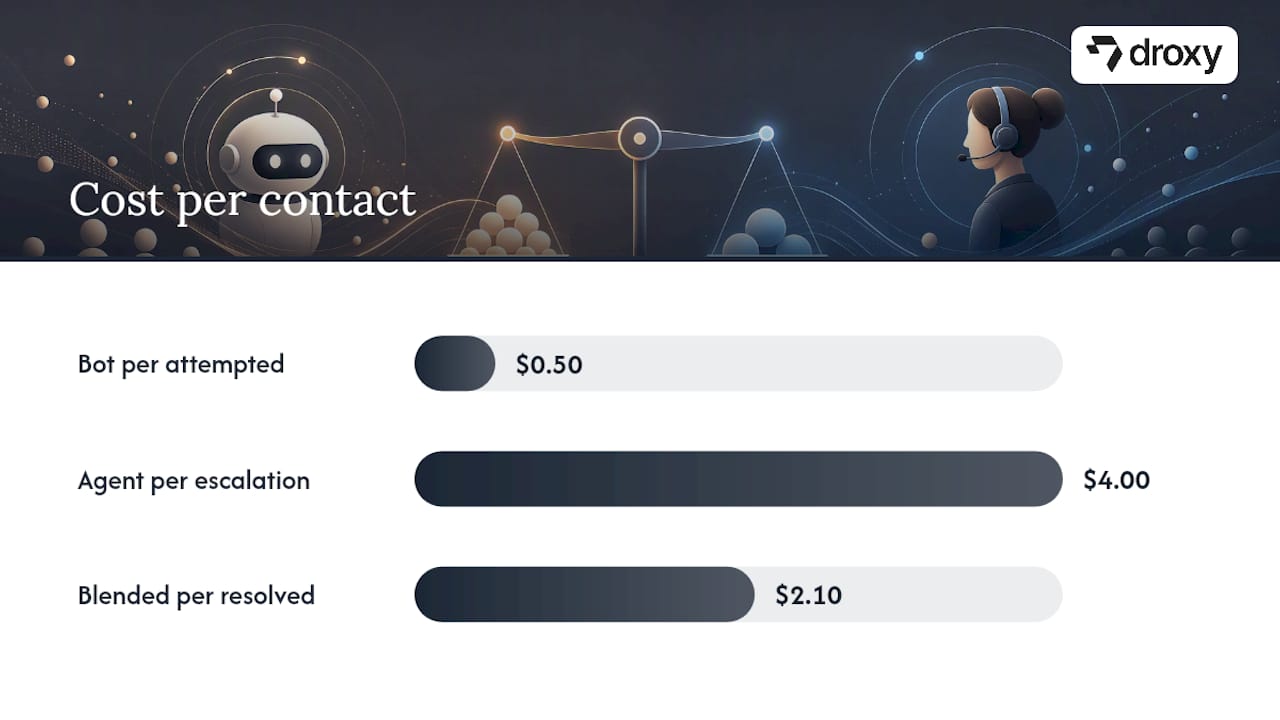
The formula that actually matters is cost per resolved contact, not cost per contact attempted. If a bot handles 1,000 conversations at $0.50 each but only resolves 600 of them, while the other 400 escalate to an agent costing $4 in labor per resolution, your blended cost per resolved contact is roughly $2.10, not $0.50. Vendors that quote “deflection rate” without pairing it with true resolution rate are hiding exactly this math.
Pro Tip: Ask any vendor for their resolution rate, not just their deflection rate. Deflection only means the bot answered first. Resolution means the customer didn’t come back.
Watch for two common vendor traps. First, metrics that count a conversation as “handled” the moment a bot replies, even if the customer abandons the chat frustrated and calls your phone line an hour later. Second, narrow deflection-only claims that never mention repeat-contact rates, because a high deflection rate paired with a high repeat rate is often worse for your customers than no automation at all. Real user feedback on platforms like G2’s chatbot reviews consistently flags configuration difficulty and maintenance overhead as the gap between a vendor’s demo and its day-to-day reality. Our own breakdown of live chat vs. chatbot costs walks through staffing math in more detail if you’re building a budget proposal.
Matching the Approach to the Actual Support Pattern
The right channel depends less on your industry and more on the shape of the problem itself: how often it repeats and how much emotion is attached to it.
High-volume, predictable tasks belong with bot-first automation. These are questions with one correct answer that doesn’t change conversation to conversation:
Order status and shipping updates.
Basic return and exchange initiation.
Store hours, location details, and account balance lookups.
Appointment rescheduling within standard policy limits.
Complex, high-empathy tasks belong with live-chat-first routing, because these situations reward judgment over speed:
Billing disputes involving unusual circumstances.
Technical troubleshooting with multiple possible root causes.
Any regulated conversation where wording carries legal weight, such as healthcare or financial services.
A visibly frustrated or upset customer, regardless of the topic.
Channel and industry constraints shift the calculus further. A healthcare provider handling patient scheduling has to be far more careful about what a bot says unsupervised than a retailer answering shipping questions. Messaging channels like WhatsApp tend to favor bot-first flows because customers there expect quick, asynchronous answers rather than a live back-and-forth. Our comparison of AI agents versus traditional chatbots goes deeper into how channel behavior should shape your bot design decisions.
How to Design a Hand-Off That Doesn’t Lose Context
Most automation failures aren’t really bot failures. They’re hand-off failures, where a customer repeats their entire problem to a human because the system dropped everything the bot already knew.
A hand-off pattern that actually works follows three steps:
Bot-first triage. Let the bot identify the customer, collect the basic problem details, and attempt resolution on anything within its scope.
Context-preserving escalation. When the bot can’t resolve the issue, it hands off to a human agent with the full transcript, customer identity, and intent already attached, so the agent starts mid-conversation instead of at zero.
Signal-based routing. Use intent confidence thresholds, sentiment flags, and SLA timers to decide when a conversation escalates automatically rather than waiting for the customer to ask for a human.
Pro Tip: Set your bot’s confidence threshold conservatively at first. A bot that escalates a little too often costs you a few extra agent minutes. A bot that guesses wrong on a sensitive question costs you a customer.
Monitoring closes the loop. Review transcripts regularly to spot where the bot is guessing instead of knowing, feed those gaps back into the knowledge base, and track escalation rates by topic so you know exactly which categories need better bot training versus which ones should route to humans permanently. Our chatbot integration guide covers the technical side of wiring this hand-off logic into existing help desk software.
What to Ask Vendors Before You Sign Anything
A pilot is only as good as the questions you ask before it starts. Bring this checklist into any vendor demo.
Confirm these essentials before evaluating anything else:
Does it integrate with your existing CRM, helpdesk, and order management system?
What data can the bot actually access, and what stays walled off?
How does escalation behavior work, and does the agent receive full context automatically?
Does it support the languages your customers actually speak?
What analytics come standard, and can you see true resolution rate, not just deflection?
What security certifications and data handling policies apply to customer conversations?
Then run these live during the demo, not just in a slide deck:
Ask the vendor to demonstrate a full end-to-end scenario that includes an action, like processing a refund or booking an appointment, not just answering a question about one.
Ask what happens when the bot doesn’t know the answer, and watch whether it hallucinates or escalates cleanly.
Ask for a sample analytics dashboard from an existing customer to see what you’ll actually be able to measure.
Set your pilot success metrics before day one: true resolution rate, average handle time on escalated chats, and customer satisfaction score by channel. A vendor who can’t show you resolution rate data, only deflection rate, is a red flag worth taking seriously.
Why Betting Everything on One Channel Always Backfires
The teams that get burned worst are the ones that treat this as a binary choice: replace agents with a bot, or reject automation entirely and staff up. Neither bet holds up once you’re running at real volume. The businesses seeing the best numbers scope their pilots narrowly, measure actual resolution instead of surface-level deflection, and put governance around what the automation is allowed to do without a human sign-off.
The framing of “chatbots vs live chat” is itself a little outdated. The better question is how much of your volume can be handled by a system that both answers and acts, and where you draw the line for human judgment. Forrester’s research on customer service gaps makes the case plainly: the businesses winning on experience aren’t the ones with the most channels, they’re the ones that closed the gap between what customers expect and what actually gets delivered. That’s the standard worth building toward, whichever tools get you there.
— Elena
Deploy the Hybrid Model Without Writing Code
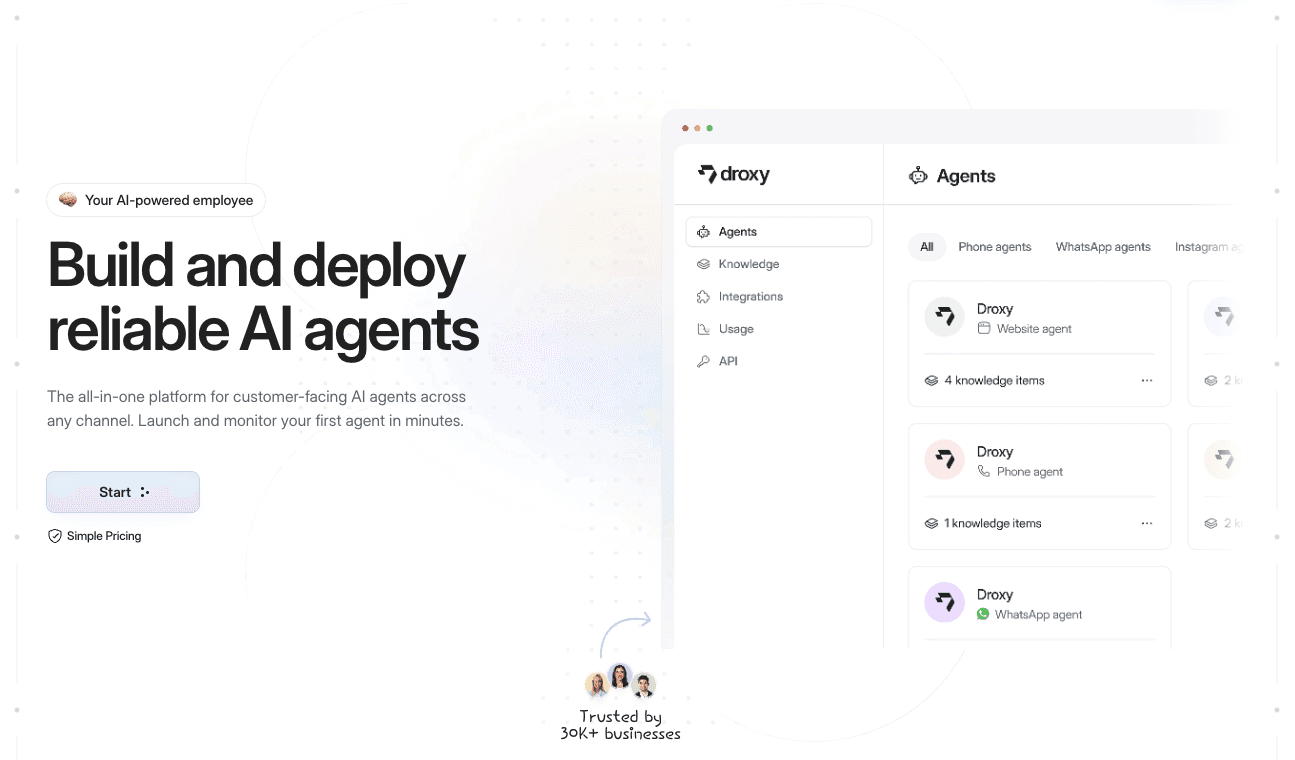
A no-code platform can help you reach that experience-first hybrid faster than piecing together separate bot and live chat tools, by handling both the automated triage and the human hand-off across multiple customer channels. You can deploy an AI agent on your website, phone line, WhatsApp, Instagram, Facebook, and Shopify from a single dashboard, with deep customization so the agent’s tone matches your brand instead of sounding like a generic script.
Agencies managing this for multiple clients can white-label the entire setup under their own brand. If ROI modeling is part of your evaluation process, this breakdown of AI productivity gains for agencies is worth a look alongside your own numbers. Droxy already powers customer interactions for more than 60,000 users, with smart routing and human hand-off built in so context never gets lost between bot and agent. Check pricing plans to see how quickly a pilot comes together.
Sources
Forrester: Consumer expectations for customer service don’t match what companies deliver
Gartner press release on conversational AI reducing contact volume
Chatbot vs. Live Chat: Pros and Cons for Businesses | Mailchimp
Recommended
Use chatbots for high-volume, predictable questions like order status or password resets. Use live chat for complex, emotional, or high-stakes conversations where a customer needs a human to actually listen. Most support teams get the best results from a hybrid setup with clear hand-off rules, and platforms like Droxy exist specifically to make that hybrid model easy to deploy without a development team.
TL;DR:
Chatbots excel at handling high-volume, routine questions but often struggle with complex or emotionally charged issues that require human judgment.
The most effective support combines automated chatbot functions with live chat, using clear hand-off rules to preserve customer context and improve experience.
Properly scoped and monitored AI automation can significantly reduce contact volume, but failures in escalation or resolution tracking can lead to increased costs.
Full cost and performance measurement should include resolution rates, escalation quality, and repeat contacts to avoid misleading deflection metrics.
A hybrid support model using no-code platforms allows flexible deployment across multiple channels, matching tools to task complexity and customer needs.
DroxyDeploy Hybrid Support Without CodeDroxy helps businesses answer customers instantly across channels while keeping interactions customized to their brand voice.Explore Droxy
Table of Contents
Chatbots vs Live Chat: The Real Difference Starts With Capability
What Live Chat Actually Looks Like Now
Response Time, Cost, and Complexity: A Direct Comparison
The Real ROI Formula (and the Vendor Traps Hiding Inside It)
Matching the Approach to the Actual Support Pattern
How to Design a Hand-Off That Doesn’t Lose Context
What to Ask Vendors Before You Sign Anything
Why Betting Everything on One Channel Always Backfires
Deploy the Hybrid Model Without Writing Code
Sources
Chatbots vs Live Chat: The Real Difference Starts With Capability
The phrase “chatbot” covers three very different technologies, and confusing them is why so many support teams pick the wrong tool. A rule-based chatbot follows a decision tree: if the customer types “refund,” it shows a refund policy link. It cannot improvise. An NLP or AI chatbot understands intent and phrasing variation, so “I want my money back” and “can I get a refund” both trigger the same flow. The newest tier, agentic AI agents, can actually take action: checking an order in your system, updating a CRM record, or completing a booking without a human touching it.
IBM’s breakdown of enterprise chatbot tiers confirms this range, noting that enterprise-grade bots integrate with CRM and ERP systems and can maintain context across a workflow instead of resetting with every message. That integration depth is what separates a bot that answers questions from one that resolves them.
Here’s what today’s chatbots handle well, and where they still break:
FAQ resolution: shipping windows, return policies, store hours, account basics.
Lead capture: collecting contact details and qualifying intent before a human ever gets involved.
Simple transactions: rebooking an appointment, applying a discount code, tracking a package.
Channel coverage: the same bot logic can run on a website, WhatsApp, Instagram, or Facebook simultaneously.
Context loss: many bots still forget details a customer mentioned two messages earlier.
Hallucination risk: AI chatbots can generate a confident, wrong answer if the knowledge base is thin or outdated.
Maintenance load: every policy change means someone has to update the bot’s source material, or it starts giving stale answers.
The gap between “chatbot” and “AI agent” is not marketing fluff. It’s the difference between a system that talks and one that acts, and that distinction drives almost every cost calculation later in this guide.
What Live Chat Actually Looks Like Now
Live chat in 2026 rarely means a human typing from scratch anymore. It means a human agent working alongside AI tools that draft responses, summarize a customer’s history, and route conversations to the right specialist. The agent still owns the judgment calls. The AI just removes the busywork around them.
That combination matters because pure human chat has real limits. An agent can typically handle only a handful of concurrent conversations before quality drops, and live chat is bound by staffing hours unless a company pays for round-the-clock coverage across time zones. Training a new agent to represent your brand voice and product knowledge accurately takes weeks, not minutes, and quality varies from one agent to the next in ways that automated systems simply don’t.
Modern live chat setups typically include:
AI-generated summaries that catch an agent up on a customer’s history in seconds instead of scrolling through a transcript.
Smart routing that sends a billing question to billing specialists and a technical issue to technical staff.
Canned response suggestions the agent can accept, edit, or ignore, which speeds typing without removing human judgment.
Concurrency caps, because even skilled agents lose accuracy past three or four simultaneous chats.
Coverage gaps outside business hours unless the company invests in shift coverage or overflow staffing.
Live chat’s core value is empathy paired with flexible reasoning. No bot yet reliably de-escalates an angry customer the way a trained human can, and that’s exactly why live chat still earns its place in the stack.
Response Time, Cost, and Complexity: A Direct Comparison
The decision between chatbots vs live chat usually comes down to seven variables, and most vendor pitches only talk about one or two of them. Here’s the full picture.
Response time. Chatbots reply in seconds, every time, regardless of volume. Live chat response time depends on staffing levels and queue depth, and it degrades fast during traffic spikes, exactly when customers are most impatient.
Availability. Chatbots run 24/7 across every connected channel without additional staffing cost. Live chat availability is capped by your team’s working hours unless you pay for extended shifts or outsourced overnight coverage.
Cost and staffing implications. A chatbot’s marginal cost per additional conversation is near zero once built. Every additional live chat conversation requires either more agent hours or accepted wait times, which is why cost scales roughly linearly with volume for human support and barely at all for automated support.
Complexity and accuracy. Chatbots excel at narrow, well-documented questions and struggle with ambiguous or emotionally charged ones. Live agents handle nuance, exceptions, and multi-part problems that don’t fit a script.
Scalability. A chatbot absorbs a traffic spike without missing a beat. A live chat team hits a wall the moment concurrent conversations exceed available agents, and quality drops sharply past that point.
Integration and actionability. The real dividing line isn’t “bot vs. human” anymore, it’s whether the system can perform an action or only answer a question. A basic bot tells a customer your refund policy. An AI agent integrated with your order system can actually process the refund. IBM’s research on chatbot benefits points to this integration depth as the main driver of measurable speed and scale gains.
Customer experience and empathy. Chatbots deliver consistency. Live chat delivers warmth and adaptability. Neither fully substitutes for the other, which is exactly why Mailchimp’s comparison of chatbots and live chat recommends most businesses use both rather than picking a side.
A governed rollout changes the math entirely. Gartner has predicted that conversational AI will meaningfully cut contact center volume as routine interactions get automated, but that reduction only materializes when the automation is properly scoped and monitored, not bolted on and left alone.
The capability gap costs more than people assume. When a chatbot fails to resolve an issue and the customer has to repeat their entire problem to a live agent, you’ve paid twice: once for the bot interaction and again for the human one, while the customer’s patience burns down in the middle. That repeat-contact tax is the single most underestimated cost in customer service budgeting, and it’s the reason a narrow “automation rate” metric can be dangerously misleading on its own.
The Real ROI Formula (and the Vendor Traps Hiding Inside It)
Most vendor pitches quote a cost-per-conversation number and stop there. That number is almost always incomplete, and using it alone to justify a purchase is how support budgets quietly balloon a year later.
Start with the full cost picture, not just the subscription fee:
Upfront costs: setup and configuration, knowledge-base creation, and initial staff training on any new tool.
Recurring costs: the software subscription, ongoing knowledge-base maintenance as policies change, and QA review time.
Human-hours for escalations: every conversation a bot cannot resolve still needs an agent, and that agent needs the bot’s full context to avoid asking the customer to repeat themselves.
The formula that actually matters is cost per resolved contact, not cost per contact attempted. If a bot handles 1,000 conversations at $0.50 each but only resolves 600 of them, while the other 400 escalate to an agent costing $4 in labor per resolution, your blended cost per resolved contact is roughly $2.10, not $0.50. Vendors that quote “deflection rate” without pairing it with true resolution rate are hiding exactly this math.
Pro Tip: Ask any vendor for their resolution rate, not just their deflection rate. Deflection only means the bot answered first. Resolution means the customer didn’t come back.
Watch for two common vendor traps. First, metrics that count a conversation as “handled” the moment a bot replies, even if the customer abandons the chat frustrated and calls your phone line an hour later. Second, narrow deflection-only claims that never mention repeat-contact rates, because a high deflection rate paired with a high repeat rate is often worse for your customers than no automation at all. Real user feedback on platforms like G2’s chatbot reviews consistently flags configuration difficulty and maintenance overhead as the gap between a vendor’s demo and its day-to-day reality. Our own breakdown of live chat vs. chatbot costs walks through staffing math in more detail if you’re building a budget proposal.
Matching the Approach to the Actual Support Pattern
The right channel depends less on your industry and more on the shape of the problem itself: how often it repeats and how much emotion is attached to it.
High-volume, predictable tasks belong with bot-first automation. These are questions with one correct answer that doesn’t change conversation to conversation:
Order status and shipping updates.
Basic return and exchange initiation.
Store hours, location details, and account balance lookups.
Appointment rescheduling within standard policy limits.
Complex, high-empathy tasks belong with live-chat-first routing, because these situations reward judgment over speed:
Billing disputes involving unusual circumstances.
Technical troubleshooting with multiple possible root causes.
Any regulated conversation where wording carries legal weight, such as healthcare or financial services.
A visibly frustrated or upset customer, regardless of the topic.
Channel and industry constraints shift the calculus further. A healthcare provider handling patient scheduling has to be far more careful about what a bot says unsupervised than a retailer answering shipping questions. Messaging channels like WhatsApp tend to favor bot-first flows because customers there expect quick, asynchronous answers rather than a live back-and-forth. Our comparison of AI agents versus traditional chatbots goes deeper into how channel behavior should shape your bot design decisions.
How to Design a Hand-Off That Doesn’t Lose Context
Most automation failures aren’t really bot failures. They’re hand-off failures, where a customer repeats their entire problem to a human because the system dropped everything the bot already knew.
A hand-off pattern that actually works follows three steps:
Bot-first triage. Let the bot identify the customer, collect the basic problem details, and attempt resolution on anything within its scope.
Context-preserving escalation. When the bot can’t resolve the issue, it hands off to a human agent with the full transcript, customer identity, and intent already attached, so the agent starts mid-conversation instead of at zero.
Signal-based routing. Use intent confidence thresholds, sentiment flags, and SLA timers to decide when a conversation escalates automatically rather than waiting for the customer to ask for a human.
Pro Tip: Set your bot’s confidence threshold conservatively at first. A bot that escalates a little too often costs you a few extra agent minutes. A bot that guesses wrong on a sensitive question costs you a customer.
Monitoring closes the loop. Review transcripts regularly to spot where the bot is guessing instead of knowing, feed those gaps back into the knowledge base, and track escalation rates by topic so you know exactly which categories need better bot training versus which ones should route to humans permanently. Our chatbot integration guide covers the technical side of wiring this hand-off logic into existing help desk software.
What to Ask Vendors Before You Sign Anything
A pilot is only as good as the questions you ask before it starts. Bring this checklist into any vendor demo.
Confirm these essentials before evaluating anything else:
Does it integrate with your existing CRM, helpdesk, and order management system?
What data can the bot actually access, and what stays walled off?
How does escalation behavior work, and does the agent receive full context automatically?
Does it support the languages your customers actually speak?
What analytics come standard, and can you see true resolution rate, not just deflection?
What security certifications and data handling policies apply to customer conversations?
Then run these live during the demo, not just in a slide deck:
Ask the vendor to demonstrate a full end-to-end scenario that includes an action, like processing a refund or booking an appointment, not just answering a question about one.
Ask what happens when the bot doesn’t know the answer, and watch whether it hallucinates or escalates cleanly.
Ask for a sample analytics dashboard from an existing customer to see what you’ll actually be able to measure.
Set your pilot success metrics before day one: true resolution rate, average handle time on escalated chats, and customer satisfaction score by channel. A vendor who can’t show you resolution rate data, only deflection rate, is a red flag worth taking seriously.
Why Betting Everything on One Channel Always Backfires
The teams that get burned worst are the ones that treat this as a binary choice: replace agents with a bot, or reject automation entirely and staff up. Neither bet holds up once you’re running at real volume. The businesses seeing the best numbers scope their pilots narrowly, measure actual resolution instead of surface-level deflection, and put governance around what the automation is allowed to do without a human sign-off.
The framing of “chatbots vs live chat” is itself a little outdated. The better question is how much of your volume can be handled by a system that both answers and acts, and where you draw the line for human judgment. Forrester’s research on customer service gaps makes the case plainly: the businesses winning on experience aren’t the ones with the most channels, they’re the ones that closed the gap between what customers expect and what actually gets delivered. That’s the standard worth building toward, whichever tools get you there.
— Elena
Deploy the Hybrid Model Without Writing Code
A no-code platform can help you reach that experience-first hybrid faster than piecing together separate bot and live chat tools, by handling both the automated triage and the human hand-off across multiple customer channels. You can deploy an AI agent on your website, phone line, WhatsApp, Instagram, Facebook, and Shopify from a single dashboard, with deep customization so the agent’s tone matches your brand instead of sounding like a generic script.
Agencies managing this for multiple clients can white-label the entire setup under their own brand. If ROI modeling is part of your evaluation process, this breakdown of AI productivity gains for agencies is worth a look alongside your own numbers. Droxy already powers customer interactions for more than 60,000 users, with smart routing and human hand-off built in so context never gets lost between bot and agent. Check pricing plans to see how quickly a pilot comes together.
Sources
Forrester: Consumer expectations for customer service don’t match what companies deliver
Gartner press release on conversational AI reducing contact volume
Chatbot vs. Live Chat: Pros and Cons for Businesses | Mailchimp
Recommended


🚀
Powered by Droxy
Turn every interaction into a conversion
Customer facing AI agents that engage, convert, and support so you can scale what matters.
✨
Learn more
Recent posts
Insights
3 min read
Introducing Agent Memories
Improve your agents' performance with Agent Memories. Prevent agents from repeating the same mistakes by giving them feedback.
Read more

Insights
15 min read
HVAC Marketing in 2025: The Definitive Lead Gen Guide
Discover 15 proven HVAC marketing strategies, plus learn how Droxy's AI website agent converts curious visitors into qualified leads by answering their questions instantly - right when they're most interested in your services.
Read more
Insights
10 min read
10 Best AI Sales Agents in 2025: Tested & Ranked
Discover the top 10 AI sales agents of 2025, designed to enhance lead generation, personalize outreach, and ultimately, close more deals
Read more
Insights
3 min read
Introducing Agent Memories
Improve your agents' performance with Agent Memories. Prevent agents from repeating the same mistakes by giving them feedback.
Read more
Insights
15 min read
HVAC Marketing in 2025: The Definitive Lead Gen Guide
Discover 15 proven HVAC marketing strategies, plus learn how Droxy's AI website agent converts curious visitors into qualified leads by answering their questions instantly - right when they're most interested in your services.
Read more