Launch Conversational Commerce in Four Weeks for Ecommerce Teams
Launch Conversational Commerce in Four Weeks for Ecommerce Teams
Insights
23 min

The tactics that move revenue right now are simple to name and harder to skip: run one AI-first agent on your highest-traffic channel, back it with a hybrid human fallback for anything sensitive, and wire that agent directly into your catalog, CRM, and payment system so it can close a sale in the same thread. Tools like Droxy make this kind of setup possible without a developer team. Done well, this combination shortens response times and lifts conversion, because customers get answers and a checkout link in one place instead of bouncing between channels.
TL;DR:
Running one AI-first agent on your highest-traffic channel with a human fallback can significantly increase conversion rates by providing instant, relevant answers and checkout links.
Integrating the agent with your catalog, CRM, and payment system is essential to enable it to resolve questions, recommend products, and close sales within the chat.
Starting with a single channel and a high-impact use case, then gradually expanding while measuring conversation-level attribution, helps prevent overcomplexity and proves ROI.
Proper handover practices, including full conversation transcripts and context sharing, are critical for maintaining customer trust during escalations to human agents.
Using no-code platforms like Droxy allows rapid, scalable deployment of conversational commerce agents across multiple channels without requiring engineering support.
DroxyStart Conversational Commerce FasterDeploy a no-code AI agent across your preferred customer channels, with instant answers that help ecommerce shoppers move toward purchase.Explore Droxy
Table of Contents
What conversational commerce is and why ecommerce teams should care
Benefits and high-impact use cases mapped to funnel stages
Channels and agent types: where to run conversational commerce
Step-by-step implementation tactics: a prioritized playbook
Conversation design and bot to human handover best practices
Measurement and KPIs: how to attribute revenue and prove ROI
Common mistakes and how to avoid them
How a no-code multi-channel agent like Droxy fits the playbook
Handling multilingual and multicultural customer interactions
Where conversational commerce tactics should evolve in 2026
Get your conversational commerce pilot running faster
Sources
What conversational commerce is and why ecommerce teams should care
Conversational commerce is real-time messaging, powered by AI and human agents working together, that carries a shopper from discovery through checkout and into post-purchase support without forcing them to leave the conversation. According to Mastercard’s conversational commerce guide, this approach blends personalization with practical commerce flows like order tracking, product discovery, and payment support inside a single chat thread.
This matters for your business because the metrics you already track (conversion rate, average order value, retention) all respond to faster, more relevant answers. A shopper who gets a confident answer about sizing or shipping in thirty seconds is far more likely to buy than one who waits on an email reply.
Conversational commerce differs from two things it often gets confused with:
Social commerce is about discovering and buying products inside a social feed; conversational commerce is about the ongoing dialogue that can happen on any channel, including social ones.
Traditional support chat answers questions after a purchase problem arises. Conversational commerce agents are built to sell, recommend, and resolve at every stage, not just fix issues.
The distinction matters because a support-only mindset caps what your chat channel can do. Teams that treat conversation as a revenue channel, not a cost center, build flows that qualify leads, recommend products, and generate checkout links in the same breath they answer a question.
Benefits and high-impact use cases mapped to funnel stages
The mechanisms behind conversational commerce are straightforward: instant engagement keeps a shopper from abandoning a session, contextual recommendations replace generic upsell banners, and in-chat checkout removes the friction of a separate cart page. Proactive, behavior-triggered chat that engages a shopper at the right moment produces materially higher engagement and conversion than a passive chat widget sitting in the corner of a page, according to Rep AI’s 2025 e-Commerce Shopper Behavior Report.
Here is where these mechanisms show up across the funnel:
Pre-purchase product qualification. A shopper asks about fit, compatibility, or use case, and the agent narrows the catalog to two or three relevant options instead of pointing to a search bar.
Cart and checkout recovery. When a shopper stalls at checkout, a proactive message with a direct payment link recovers sales that would otherwise sit in an abandoned cart.
In-chat objection handling. Questions about return policy, shipping cost, or delivery windows get answered immediately, removing the last-minute doubt that kills a sale.
Post-purchase upsell and retention. A follow-up message about a complementary product, sent after delivery confirmation, keeps the brand in the conversation without feeling like spam.
Warranty and reorder prompts. For consumables or subscription-style products, a well-timed check-in message drives repeat purchases without a separate marketing campaign.
Each of these depends on the agent having live access to inventory, pricing, and order status. Our overview of ecommerce chatbot use cases breaks down several of these patterns in more detail if you want a closer look at how they play out in practice.
Channels and agent types: where to run conversational commerce
Picking a channel is not about chasing every platform at once. It is about matching where your customers already message you with an agent model your team can actually support.
Website chat works best when you have consistent traffic to a product catalog and want to capture intent at the moment of highest interest.
WhatsApp suits markets where it is already the default messaging app; a warm transfer to a human agent matters more here because customers expect a personal touch once they have opened a thread.
Instagram DM fits visually driven categories like fashion, beauty, and home goods, where a shopper messages after seeing a product in a post or story.
Voice is worth prioritizing for older or less digitally native audiences, or for categories where a phone call is still the trusted way to confirm a big purchase.
On the agent-model side, you have three options. An AI-first model handles the majority of conversations autonomously and is the fastest to launch. A hybrid model routes routine questions to AI and escalates anything sensitive, refunds, complaints, high-value orders, to a person. A human-first model keeps AI in a supporting role, useful for luxury or high-touch categories where every interaction needs a human voice.
For most ecommerce teams starting out, a hybrid model on one primary channel is the safer bet. It lets you capture the speed benefits of automation while keeping a person available for the moments that actually require judgment.
Step-by-step implementation tactics: a prioritized playbook
Launching conversational commerce well is less about picking software and more about sequencing the work correctly. Skip a step here and you end up with a bot that cannot answer basic questions or a checkout flow that breaks under real traffic.
Choose one channel and one use case. Resist the urge to launch on five channels simultaneously. Pick the channel with your highest volume and one high-impact use case: cart recovery, product qualification, or post-purchase nurture. Get that working well before adding a second.
Prepare your data. Before any agent goes live, gather your product catalog feed, shipping rules, returns policy, pricing tiers, common FAQs, and a sample of historical support conversations. This is the material your agent will draw on to answer correctly instead of guessing.
Connect your integrations. Wire the agent into your ecommerce platform, your payment provider for in-chat checkout, your inventory system, your CRM, and your analytics stack. According to the Wharton AI & Analytics Initiative’s blueprint on effective chatbots, agents integrated with inventory and CRM data can actually resolve issues and make recommendations, while agents without that access can only mimic conversational style without solving anything real.
Build your core flow templates. At minimum, you need a welcome and qualification flow to identify what the shopper wants, a contextual recommendation flow tied to catalog data, a checkout link generation flow, an order confirmation flow, and a post-purchase nurture flow. The Periscale guide to conversational commerce in 2026 frames this as a five-beat journey: capture, qualify, checkout, confirm, and follow-up, supported by a unified memory layer that keeps context consistent across the whole conversation.
Set your operational rules. Define who staffs the human fallback and when, what signals trigger an escalation, what your service-level agreement is for a human response once a conversation is handed off, how often your team reviews and retrains the agent’s answers, and how you will keep the knowledge base current as your catalog changes.
Run a pilot before a full rollout. Launch to a subset of traffic or a limited product category first. Watch conversion rate, resolution rate, and customer feedback closely before expanding to your full audience.
Review and iterate on a fixed schedule. Set a weekly or biweekly cadence to check conversation transcripts, spot repeated failure points, and update the agent’s knowledge base or flow logic accordingly.
Pro Tip: Start with your highest-volume, lowest-complexity use case, like order status or shipping questions, so your agent builds a track record of accurate answers before you hand it anything revenue-critical.
Integration depth is the single factor that separates a conversational commerce pilot that works from one that stalls. An agent that can only answer from a static FAQ document will frustrate shoppers the moment they ask something specific to their order or their location. An agent connected to live inventory and order data can tell a shopper their package shipped yesterday, recommend a complementary product based on what is actually in stock, and generate a checkout link without the shopper ever leaving the chat window. If you want more detail on how that connection works technically, our piece on how conversational AI works walks through the mechanics.
The pacing of your rollout matters as much as the technology. Teams that try to launch on every channel with every flow type in month one tend to end up with a tangle of half-configured automations that nobody fully understands six months later. A tighter, sequenced rollout, one channel, one use case, then expand, gives your team time to learn what your customers actually ask and to fix the gaps before they become a pattern of poor experiences.

Conversation design and bot to human handover best practices
The moment a conversation needs a human, how you handle that transfer determines whether the customer feels taken care of or bounced around. Get this wrong and you lose the trust you built in the automated part of the conversation.
Escalate to a human when you see any of these signals:
The agent fails to understand the customer’s question after two attempts.
Sentiment analysis flags frustration or negative language.
The customer explicitly asks to speak with a person.
The conversation touches a high-stakes intent like a payment dispute, refund, or cancellation.
Best-practice handover design relies on exactly these four triggers, repeated comprehension failure, negative sentiment, explicit human request, and high-stakes intent, paired with an automatic handoff that always includes the full conversation transcript, according to a guide on chatbot-to-human handover best practices.
A handover that works well passes four things to the human agent automatically: the full transcript, a one-line summary of the customer’s intent, the customer’s identity and order context, and the sentiment detected during the conversation. Without this, the customer ends up repeating themselves, which erases whatever goodwill the bot built up.
On the user experience side, keep the transfer inside the same channel rather than redirecting to email or a phone call, show the customer their queue position or an estimated wait time, and route based on the skill the issue requires rather than the next available agent. When it comes to upselling during a handover or resolution, weave the recommendation into the answer itself, “since you’re getting the jacket in a size medium, the matching gloves are also in stock,” rather than interrupting the resolution with a separate pitch.
Best-practice handover design uses four defined escalation triggers and always passes a concise intent summary alongside the full transcript, which keeps repeat-context frustration from undoing the value of the automated part of the conversation, per the same handover best-practices guide.
Measurement and KPIs: how to attribute revenue and prove ROI
If you cannot tie a conversation to a sale, conversational commerce will always look like a cost center on your budget sheet instead of the revenue channel it actually is.
Track these core metrics from the start:
Conversation-to-purchase conversion rate, the share of conversations that end in a completed order.
Autonomous resolution rate, the percentage of conversations the AI handles fully without a human touch.
Response time, both first response and average time to resolution.
Revenue attributed to conversations, tracked at the individual conversation level, not just channel-level totals.
Customer satisfaction (CSAT), measured separately for AI-only and human-handled conversations.
Cost per conversation, to compare against your previous support or sales cost structure.
The attribution piece is where most teams fall short. Instrumenting a conversation ID that carries through into your checkout flow lets you connect a specific chat to a specific order, rather than guessing at correlation. Industry reporting on this topic consistently flags that channels without conversation-level tagging tend to get under-invested, simply because nobody can prove what they are worth, according to a market analysis on conversational commerce. Pairing that conversation ID with UTM parameters and revenue-event tagging gives you a multi-touch view when a customer moves between chat, email, and a later purchase.
For reporting, a simple weekly dashboard showing conversion rate, resolution rate, and revenue attributed by channel gives your team enough signal to decide where to invest next, without drowning in metrics nobody acts on.
Common mistakes and how to avoid them
Most conversational commerce pilots underperform for the same handful of avoidable reasons.
Treating it as support-only. If your flows only answer questions and never offer a checkout link or a qualification path, you are leaving revenue on the table. Rewire your flows to include commerce actions, not just answers.
Over-automating without a clear human path. A bot that cannot recognize when it is stuck frustrates customers badly. Define escalation signals and a service-level agreement for human response before you launch, not after complaints start.
Spreading across channels without shared memory. Running separate, disconnected bots on website chat, WhatsApp, and Instagram means a customer has to repeat themselves every time they switch channels. Consolidate into one inbox with a shared memory layer before you add a second or third channel.
Skipping revenue measurement. Launching without conversation-level attribution means you will never be able to justify further investment, because you cannot show what the channel actually earned.
Each of these mistakes is fixable before launch with a bit of planning, but expensive to unwind once a channel is live and customers have formed habits around it.
How a no-code multi-channel agent like Droxy fits the playbook
Everything in this playbook, one channel first, commerce integrations, a hybrid handover model, revenue attribution, gets faster to execute with a no-code platform, because your team is not waiting on engineering cycles to wire each connection.
A no-code platform lets businesses deploy AI agents for customer interaction across website chat, phone, WhatsApp, Instagram, Facebook, and Shopify. It solves slow response times and missed inquiries with instant, 24/7 answers, and integrates into existing systems so catalog, CRM, and order data stay connected without custom development work.
A basic four-week pilot could look like this:
Week 1: Connect your catalog and order data, and load your FAQs and return policy into the agent’s knowledge base.
Week 2: Build your welcome, qualification, and checkout link flows on your one chosen channel.
Week 3: Set escalation rules and train your human fallback team on the handover payload they will receive.
Week 4: Launch to a subset of traffic and track conversation-to-purchase conversion, resolution rate, and CSAT before expanding further.
Handling multilingual and multicultural customer interactions
Selling across borders means your conversational agent needs to do more than translate words. A shopper in one country may expect a formal tone and detailed shipping disclaimers, while a shopper elsewhere expects a quick, casual exchange and immediate pricing. Your agent’s flows should account for these differences rather than applying one script everywhere.
Practical steps that matter here: make sure your product catalog data, pricing, and shipping rules are localized for each market the agent serves, not just the conversation language. Keep currency, sizing conventions, and delivery timelines specific to the customer’s region rather than defaulting to your home market’s assumptions. Route conversations that touch culturally sensitive topics, like religious holidays affecting delivery windows or region-specific return laws, to a human who understands the local context.
Language coverage should extend to your human fallback team as well. An agent that answers fluently in a customer’s language but hands off to a support team that cannot continue in that language undoes the trust you built. If your team cannot staff every language you serve, prioritize human coverage for your highest-volume non-English markets first, and let the AI agent continue handling routine questions in the languages where you do not yet have human coverage.
Where conversational commerce tactics should evolve in 2026
The teams that pull ahead this year will be the ones who treat their conversational agent as something that can act, not just answer. Agentic AI paired with a real memory layer, one that remembers a customer’s past orders, preferences, and open tickets across every channel, is what separates a genuinely useful agent from a scripted FAQ bot. That kind of integration depth is worth prioritizing over adding a fourth or fifth channel.
Start smaller than feels comfortable, and instrument revenue attribution from day one so you can justify the next round of investment with numbers instead of anecdotes. Automation should free your human team to handle the judgment calls, VIP accounts, disputes, emotionally loaded conversations, not replace the empathy those moments require.
— Elena
Get your conversational commerce pilot running faster
You do not need an engineering team to put this playbook into practice. Droxy lets you deploy an AI agent across website chat, WhatsApp, Instagram, Facebook, or phone without writing code, connecting your catalog, CRM, and order data through existing integrations so the agent can actually resolve questions and generate checkout links, not just repeat a script.
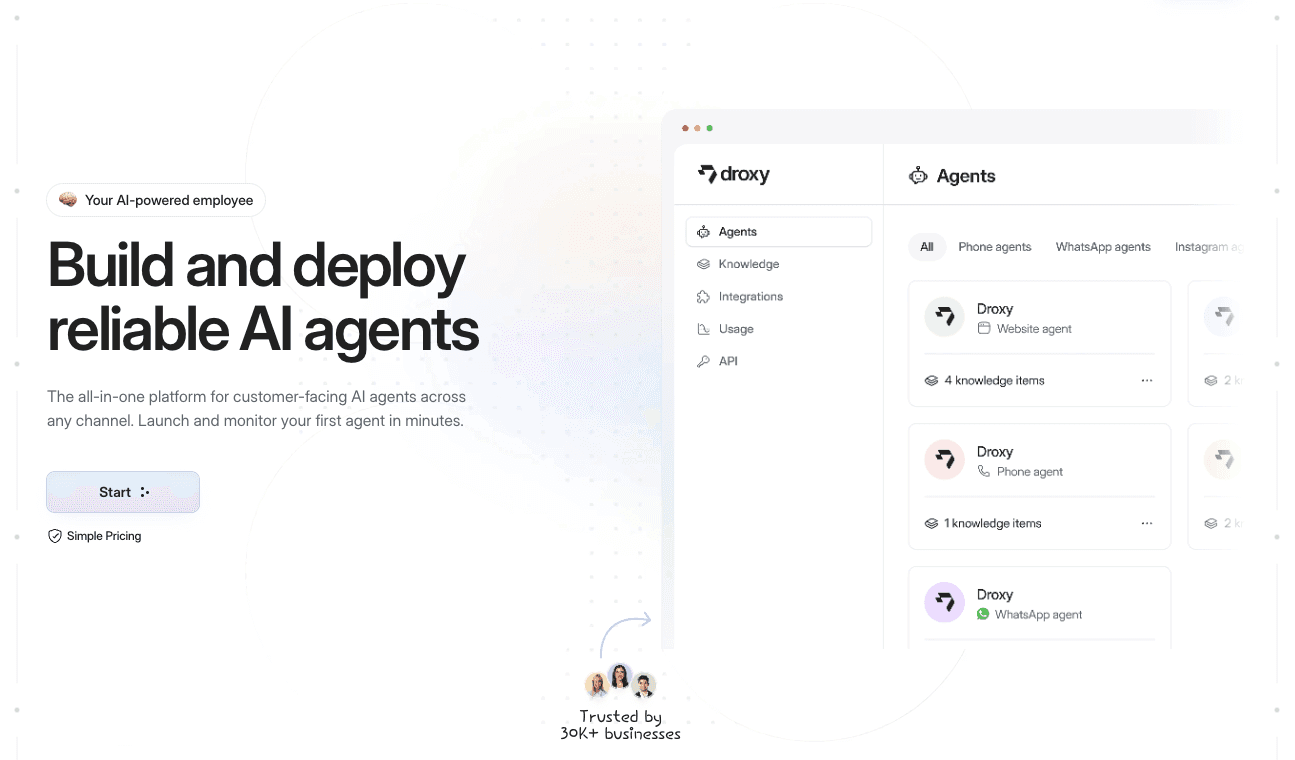
Build and customize an agent that matches your brand’s voice across the channel your customers already use.
Route sensitive conversations to your human team automatically, with full context passed along.
Choose from Basic, Advanced, and Enterprise plans, detailed on our pricing page, depending on the scale you need.
If you want to see how the setup fits your catalog and channel mix, start with the AI powered Website agent or explore the WhatsApp agent if that is where your customers already message you.
Sources
This article draws on the Wharton blueprint on effective AI chatbots, Mastercard’s conversational commerce guide, the GII Research market report, the Rep AI shopper behavior report, and Periscale’s 2026 guide. For a look at how conversational visibility extends into AI-driven search, see this guide on optimizing for ChatGPT.
Conversational commerce: Your guide to this market-shifting technology — Mastercard
Conversational Commerce in 2026: The Definitive Guide — Periscale
FAQ
Can you give me an example of conversational commerce?
A common example is a shopper messaging a brand’s website chat or WhatsApp agent to ask about product fit, receiving a recommendation based on live inventory, and completing checkout through a payment link inside the same conversation. Mastercard’s guide describes this kind of messaging-driven flow as central to how brands now support commerce across discovery, checkout, and post-purchase.
What are the 7 C’s of e-commerce?
Definitions of the “7 C’s” vary across marketing sources, so there is no single agreed framework to point to here. Rather than repeat an inconsistent list, focus on the fundamentals this article covers: catalog data, checkout integration, CRM connection, and conversation design, since those are the elements that actually determine whether a conversational channel converts.
What does conversational commerce mean?
Conversational commerce means using real-time messaging, powered by AI and human agents together, to guide a customer from product discovery through checkout and into post-purchase support within one ongoing conversation. It differs from traditional support chat because it is built to sell and recommend, not just resolve problems after the fact.
What are the four types of chatbots?
Chatbots generally fall into four categories: rule-based bots that follow fixed decision trees, AI-powered bots that use natural language understanding to interpret varied requests, hybrid bots that combine automation with human handoff for complex cases, and voice-based bots that handle spoken conversations over phone or smart speaker channels. Most ecommerce teams get the best results starting with an AI-powered or hybrid model on one channel before expanding further.
How do I measure ROI from conversational commerce?
Track conversation-to-purchase conversion, autonomous resolution rate, and revenue attributed at the individual conversation level rather than just channel totals. Tagging each conversation with a unique ID that carries through your checkout flow lets you connect specific chats to completed orders, which is the clearest way to prove the channel’s value.
Recommended
The tactics that move revenue right now are simple to name and harder to skip: run one AI-first agent on your highest-traffic channel, back it with a hybrid human fallback for anything sensitive, and wire that agent directly into your catalog, CRM, and payment system so it can close a sale in the same thread. Tools like Droxy make this kind of setup possible without a developer team. Done well, this combination shortens response times and lifts conversion, because customers get answers and a checkout link in one place instead of bouncing between channels.
TL;DR:
Running one AI-first agent on your highest-traffic channel with a human fallback can significantly increase conversion rates by providing instant, relevant answers and checkout links.
Integrating the agent with your catalog, CRM, and payment system is essential to enable it to resolve questions, recommend products, and close sales within the chat.
Starting with a single channel and a high-impact use case, then gradually expanding while measuring conversation-level attribution, helps prevent overcomplexity and proves ROI.
Proper handover practices, including full conversation transcripts and context sharing, are critical for maintaining customer trust during escalations to human agents.
Using no-code platforms like Droxy allows rapid, scalable deployment of conversational commerce agents across multiple channels without requiring engineering support.
DroxyStart Conversational Commerce FasterDeploy a no-code AI agent across your preferred customer channels, with instant answers that help ecommerce shoppers move toward purchase.Explore Droxy
Table of Contents
What conversational commerce is and why ecommerce teams should care
Benefits and high-impact use cases mapped to funnel stages
Channels and agent types: where to run conversational commerce
Step-by-step implementation tactics: a prioritized playbook
Conversation design and bot to human handover best practices
Measurement and KPIs: how to attribute revenue and prove ROI
Common mistakes and how to avoid them
How a no-code multi-channel agent like Droxy fits the playbook
Handling multilingual and multicultural customer interactions
Where conversational commerce tactics should evolve in 2026
Get your conversational commerce pilot running faster
Sources
What conversational commerce is and why ecommerce teams should care
Conversational commerce is real-time messaging, powered by AI and human agents working together, that carries a shopper from discovery through checkout and into post-purchase support without forcing them to leave the conversation. According to Mastercard’s conversational commerce guide, this approach blends personalization with practical commerce flows like order tracking, product discovery, and payment support inside a single chat thread.
This matters for your business because the metrics you already track (conversion rate, average order value, retention) all respond to faster, more relevant answers. A shopper who gets a confident answer about sizing or shipping in thirty seconds is far more likely to buy than one who waits on an email reply.
Conversational commerce differs from two things it often gets confused with:
Social commerce is about discovering and buying products inside a social feed; conversational commerce is about the ongoing dialogue that can happen on any channel, including social ones.
Traditional support chat answers questions after a purchase problem arises. Conversational commerce agents are built to sell, recommend, and resolve at every stage, not just fix issues.
The distinction matters because a support-only mindset caps what your chat channel can do. Teams that treat conversation as a revenue channel, not a cost center, build flows that qualify leads, recommend products, and generate checkout links in the same breath they answer a question.
Benefits and high-impact use cases mapped to funnel stages
The mechanisms behind conversational commerce are straightforward: instant engagement keeps a shopper from abandoning a session, contextual recommendations replace generic upsell banners, and in-chat checkout removes the friction of a separate cart page. Proactive, behavior-triggered chat that engages a shopper at the right moment produces materially higher engagement and conversion than a passive chat widget sitting in the corner of a page, according to Rep AI’s 2025 e-Commerce Shopper Behavior Report.
Here is where these mechanisms show up across the funnel:
Pre-purchase product qualification. A shopper asks about fit, compatibility, or use case, and the agent narrows the catalog to two or three relevant options instead of pointing to a search bar.
Cart and checkout recovery. When a shopper stalls at checkout, a proactive message with a direct payment link recovers sales that would otherwise sit in an abandoned cart.
In-chat objection handling. Questions about return policy, shipping cost, or delivery windows get answered immediately, removing the last-minute doubt that kills a sale.
Post-purchase upsell and retention. A follow-up message about a complementary product, sent after delivery confirmation, keeps the brand in the conversation without feeling like spam.
Warranty and reorder prompts. For consumables or subscription-style products, a well-timed check-in message drives repeat purchases without a separate marketing campaign.
Each of these depends on the agent having live access to inventory, pricing, and order status. Our overview of ecommerce chatbot use cases breaks down several of these patterns in more detail if you want a closer look at how they play out in practice.
Channels and agent types: where to run conversational commerce
Picking a channel is not about chasing every platform at once. It is about matching where your customers already message you with an agent model your team can actually support.
Website chat works best when you have consistent traffic to a product catalog and want to capture intent at the moment of highest interest.
WhatsApp suits markets where it is already the default messaging app; a warm transfer to a human agent matters more here because customers expect a personal touch once they have opened a thread.
Instagram DM fits visually driven categories like fashion, beauty, and home goods, where a shopper messages after seeing a product in a post or story.
Voice is worth prioritizing for older or less digitally native audiences, or for categories where a phone call is still the trusted way to confirm a big purchase.
On the agent-model side, you have three options. An AI-first model handles the majority of conversations autonomously and is the fastest to launch. A hybrid model routes routine questions to AI and escalates anything sensitive, refunds, complaints, high-value orders, to a person. A human-first model keeps AI in a supporting role, useful for luxury or high-touch categories where every interaction needs a human voice.
For most ecommerce teams starting out, a hybrid model on one primary channel is the safer bet. It lets you capture the speed benefits of automation while keeping a person available for the moments that actually require judgment.
Step-by-step implementation tactics: a prioritized playbook
Launching conversational commerce well is less about picking software and more about sequencing the work correctly. Skip a step here and you end up with a bot that cannot answer basic questions or a checkout flow that breaks under real traffic.
Choose one channel and one use case. Resist the urge to launch on five channels simultaneously. Pick the channel with your highest volume and one high-impact use case: cart recovery, product qualification, or post-purchase nurture. Get that working well before adding a second.
Prepare your data. Before any agent goes live, gather your product catalog feed, shipping rules, returns policy, pricing tiers, common FAQs, and a sample of historical support conversations. This is the material your agent will draw on to answer correctly instead of guessing.
Connect your integrations. Wire the agent into your ecommerce platform, your payment provider for in-chat checkout, your inventory system, your CRM, and your analytics stack. According to the Wharton AI & Analytics Initiative’s blueprint on effective chatbots, agents integrated with inventory and CRM data can actually resolve issues and make recommendations, while agents without that access can only mimic conversational style without solving anything real.
Build your core flow templates. At minimum, you need a welcome and qualification flow to identify what the shopper wants, a contextual recommendation flow tied to catalog data, a checkout link generation flow, an order confirmation flow, and a post-purchase nurture flow. The Periscale guide to conversational commerce in 2026 frames this as a five-beat journey: capture, qualify, checkout, confirm, and follow-up, supported by a unified memory layer that keeps context consistent across the whole conversation.
Set your operational rules. Define who staffs the human fallback and when, what signals trigger an escalation, what your service-level agreement is for a human response once a conversation is handed off, how often your team reviews and retrains the agent’s answers, and how you will keep the knowledge base current as your catalog changes.
Run a pilot before a full rollout. Launch to a subset of traffic or a limited product category first. Watch conversion rate, resolution rate, and customer feedback closely before expanding to your full audience.
Review and iterate on a fixed schedule. Set a weekly or biweekly cadence to check conversation transcripts, spot repeated failure points, and update the agent’s knowledge base or flow logic accordingly.
Pro Tip: Start with your highest-volume, lowest-complexity use case, like order status or shipping questions, so your agent builds a track record of accurate answers before you hand it anything revenue-critical.
Integration depth is the single factor that separates a conversational commerce pilot that works from one that stalls. An agent that can only answer from a static FAQ document will frustrate shoppers the moment they ask something specific to their order or their location. An agent connected to live inventory and order data can tell a shopper their package shipped yesterday, recommend a complementary product based on what is actually in stock, and generate a checkout link without the shopper ever leaving the chat window. If you want more detail on how that connection works technically, our piece on how conversational AI works walks through the mechanics.
The pacing of your rollout matters as much as the technology. Teams that try to launch on every channel with every flow type in month one tend to end up with a tangle of half-configured automations that nobody fully understands six months later. A tighter, sequenced rollout, one channel, one use case, then expand, gives your team time to learn what your customers actually ask and to fix the gaps before they become a pattern of poor experiences.
Conversation design and bot to human handover best practices
The moment a conversation needs a human, how you handle that transfer determines whether the customer feels taken care of or bounced around. Get this wrong and you lose the trust you built in the automated part of the conversation.
Escalate to a human when you see any of these signals:
The agent fails to understand the customer’s question after two attempts.
Sentiment analysis flags frustration or negative language.
The customer explicitly asks to speak with a person.
The conversation touches a high-stakes intent like a payment dispute, refund, or cancellation.
Best-practice handover design relies on exactly these four triggers, repeated comprehension failure, negative sentiment, explicit human request, and high-stakes intent, paired with an automatic handoff that always includes the full conversation transcript, according to a guide on chatbot-to-human handover best practices.
A handover that works well passes four things to the human agent automatically: the full transcript, a one-line summary of the customer’s intent, the customer’s identity and order context, and the sentiment detected during the conversation. Without this, the customer ends up repeating themselves, which erases whatever goodwill the bot built up.
On the user experience side, keep the transfer inside the same channel rather than redirecting to email or a phone call, show the customer their queue position or an estimated wait time, and route based on the skill the issue requires rather than the next available agent. When it comes to upselling during a handover or resolution, weave the recommendation into the answer itself, “since you’re getting the jacket in a size medium, the matching gloves are also in stock,” rather than interrupting the resolution with a separate pitch.
Best-practice handover design uses four defined escalation triggers and always passes a concise intent summary alongside the full transcript, which keeps repeat-context frustration from undoing the value of the automated part of the conversation, per the same handover best-practices guide.
Measurement and KPIs: how to attribute revenue and prove ROI
If you cannot tie a conversation to a sale, conversational commerce will always look like a cost center on your budget sheet instead of the revenue channel it actually is.
Track these core metrics from the start:
Conversation-to-purchase conversion rate, the share of conversations that end in a completed order.
Autonomous resolution rate, the percentage of conversations the AI handles fully without a human touch.
Response time, both first response and average time to resolution.
Revenue attributed to conversations, tracked at the individual conversation level, not just channel-level totals.
Customer satisfaction (CSAT), measured separately for AI-only and human-handled conversations.
Cost per conversation, to compare against your previous support or sales cost structure.
The attribution piece is where most teams fall short. Instrumenting a conversation ID that carries through into your checkout flow lets you connect a specific chat to a specific order, rather than guessing at correlation. Industry reporting on this topic consistently flags that channels without conversation-level tagging tend to get under-invested, simply because nobody can prove what they are worth, according to a market analysis on conversational commerce. Pairing that conversation ID with UTM parameters and revenue-event tagging gives you a multi-touch view when a customer moves between chat, email, and a later purchase.
For reporting, a simple weekly dashboard showing conversion rate, resolution rate, and revenue attributed by channel gives your team enough signal to decide where to invest next, without drowning in metrics nobody acts on.
Common mistakes and how to avoid them
Most conversational commerce pilots underperform for the same handful of avoidable reasons.
Treating it as support-only. If your flows only answer questions and never offer a checkout link or a qualification path, you are leaving revenue on the table. Rewire your flows to include commerce actions, not just answers.
Over-automating without a clear human path. A bot that cannot recognize when it is stuck frustrates customers badly. Define escalation signals and a service-level agreement for human response before you launch, not after complaints start.
Spreading across channels without shared memory. Running separate, disconnected bots on website chat, WhatsApp, and Instagram means a customer has to repeat themselves every time they switch channels. Consolidate into one inbox with a shared memory layer before you add a second or third channel.
Skipping revenue measurement. Launching without conversation-level attribution means you will never be able to justify further investment, because you cannot show what the channel actually earned.
Each of these mistakes is fixable before launch with a bit of planning, but expensive to unwind once a channel is live and customers have formed habits around it.
How a no-code multi-channel agent like Droxy fits the playbook
Everything in this playbook, one channel first, commerce integrations, a hybrid handover model, revenue attribution, gets faster to execute with a no-code platform, because your team is not waiting on engineering cycles to wire each connection.
A no-code platform lets businesses deploy AI agents for customer interaction across website chat, phone, WhatsApp, Instagram, Facebook, and Shopify. It solves slow response times and missed inquiries with instant, 24/7 answers, and integrates into existing systems so catalog, CRM, and order data stay connected without custom development work.
A basic four-week pilot could look like this:
Week 1: Connect your catalog and order data, and load your FAQs and return policy into the agent’s knowledge base.
Week 2: Build your welcome, qualification, and checkout link flows on your one chosen channel.
Week 3: Set escalation rules and train your human fallback team on the handover payload they will receive.
Week 4: Launch to a subset of traffic and track conversation-to-purchase conversion, resolution rate, and CSAT before expanding further.
Handling multilingual and multicultural customer interactions
Selling across borders means your conversational agent needs to do more than translate words. A shopper in one country may expect a formal tone and detailed shipping disclaimers, while a shopper elsewhere expects a quick, casual exchange and immediate pricing. Your agent’s flows should account for these differences rather than applying one script everywhere.
Practical steps that matter here: make sure your product catalog data, pricing, and shipping rules are localized for each market the agent serves, not just the conversation language. Keep currency, sizing conventions, and delivery timelines specific to the customer’s region rather than defaulting to your home market’s assumptions. Route conversations that touch culturally sensitive topics, like religious holidays affecting delivery windows or region-specific return laws, to a human who understands the local context.
Language coverage should extend to your human fallback team as well. An agent that answers fluently in a customer’s language but hands off to a support team that cannot continue in that language undoes the trust you built. If your team cannot staff every language you serve, prioritize human coverage for your highest-volume non-English markets first, and let the AI agent continue handling routine questions in the languages where you do not yet have human coverage.
Where conversational commerce tactics should evolve in 2026
The teams that pull ahead this year will be the ones who treat their conversational agent as something that can act, not just answer. Agentic AI paired with a real memory layer, one that remembers a customer’s past orders, preferences, and open tickets across every channel, is what separates a genuinely useful agent from a scripted FAQ bot. That kind of integration depth is worth prioritizing over adding a fourth or fifth channel.
Start smaller than feels comfortable, and instrument revenue attribution from day one so you can justify the next round of investment with numbers instead of anecdotes. Automation should free your human team to handle the judgment calls, VIP accounts, disputes, emotionally loaded conversations, not replace the empathy those moments require.
— Elena
Get your conversational commerce pilot running faster
You do not need an engineering team to put this playbook into practice. Droxy lets you deploy an AI agent across website chat, WhatsApp, Instagram, Facebook, or phone without writing code, connecting your catalog, CRM, and order data through existing integrations so the agent can actually resolve questions and generate checkout links, not just repeat a script.
Build and customize an agent that matches your brand’s voice across the channel your customers already use.
Route sensitive conversations to your human team automatically, with full context passed along.
Choose from Basic, Advanced, and Enterprise plans, detailed on our pricing page, depending on the scale you need.
If you want to see how the setup fits your catalog and channel mix, start with the AI powered Website agent or explore the WhatsApp agent if that is where your customers already message you.
Sources
This article draws on the Wharton blueprint on effective AI chatbots, Mastercard’s conversational commerce guide, the GII Research market report, the Rep AI shopper behavior report, and Periscale’s 2026 guide. For a look at how conversational visibility extends into AI-driven search, see this guide on optimizing for ChatGPT.
Conversational commerce: Your guide to this market-shifting technology — Mastercard
Conversational Commerce in 2026: The Definitive Guide — Periscale
FAQ
Can you give me an example of conversational commerce?
A common example is a shopper messaging a brand’s website chat or WhatsApp agent to ask about product fit, receiving a recommendation based on live inventory, and completing checkout through a payment link inside the same conversation. Mastercard’s guide describes this kind of messaging-driven flow as central to how brands now support commerce across discovery, checkout, and post-purchase.
What are the 7 C’s of e-commerce?
Definitions of the “7 C’s” vary across marketing sources, so there is no single agreed framework to point to here. Rather than repeat an inconsistent list, focus on the fundamentals this article covers: catalog data, checkout integration, CRM connection, and conversation design, since those are the elements that actually determine whether a conversational channel converts.
What does conversational commerce mean?
Conversational commerce means using real-time messaging, powered by AI and human agents together, to guide a customer from product discovery through checkout and into post-purchase support within one ongoing conversation. It differs from traditional support chat because it is built to sell and recommend, not just resolve problems after the fact.
What are the four types of chatbots?
Chatbots generally fall into four categories: rule-based bots that follow fixed decision trees, AI-powered bots that use natural language understanding to interpret varied requests, hybrid bots that combine automation with human handoff for complex cases, and voice-based bots that handle spoken conversations over phone or smart speaker channels. Most ecommerce teams get the best results starting with an AI-powered or hybrid model on one channel before expanding further.
How do I measure ROI from conversational commerce?
Track conversation-to-purchase conversion, autonomous resolution rate, and revenue attributed at the individual conversation level rather than just channel totals. Tagging each conversation with a unique ID that carries through your checkout flow lets you connect specific chats to completed orders, which is the clearest way to prove the channel’s value.
Recommended


🚀
Powered by Droxy
Turn every interaction into a conversion
Customer facing AI agents that engage, convert, and support so you can scale what matters.
✨
Learn more
Recent posts
Insights
3 min read
Introducing Agent Memories
Improve your agents' performance with Agent Memories. Prevent agents from repeating the same mistakes by giving them feedback.
Read more

Insights
15 min read
HVAC Marketing in 2025: The Definitive Lead Gen Guide
Discover 15 proven HVAC marketing strategies, plus learn how Droxy's AI website agent converts curious visitors into qualified leads by answering their questions instantly - right when they're most interested in your services.
Read more
Insights
10 min read
10 Best AI Sales Agents in 2025: Tested & Ranked
Discover the top 10 AI sales agents of 2025, designed to enhance lead generation, personalize outreach, and ultimately, close more deals
Read more
Insights
3 min read
Introducing Agent Memories
Improve your agents' performance with Agent Memories. Prevent agents from repeating the same mistakes by giving them feedback.
Read more
Insights
15 min read
HVAC Marketing in 2025: The Definitive Lead Gen Guide
Discover 15 proven HVAC marketing strategies, plus learn how Droxy's AI website agent converts curious visitors into qualified leads by answering their questions instantly - right when they're most interested in your services.
Read more