Buyers: Conversational Forms That Trace Answers in Under 60 Seconds
Buyers: Conversational Forms That Trace Answers in Under 60 Seconds
Insights
11 min

Conversational forms are AI agents that capture leads and resolve support questions through natural dialogue across chat, phone, and messaging apps, replacing static intake screens with a system that actually talks back. The business case is simple: faster responses, 24/7 coverage, and a measurable lift in lead conversion because prospects get answered before they lose interest. Over 60,000 users already run this kind of setup through Droxy, which suggests the model has moved well past experimental.
TL;DR:
Omnichannel systems share a unified knowledge base, ensuring consistent responses and context carryover across channels, which improves conversion and satisfaction.
The effectiveness of conversational AI hinges on a governed knowledge foundation, not just the choice of channels or the chatbot’s tone.
Vendors should be thoroughly vetted by their integration capabilities, source document traceability, escalation procedures, and compliance support, rather than on demo polish alone.
A staged rollout starting with one high-volume channel allows teams to audit their knowledge sources and refine escalation rules before scaling across multiple platforms.
Poor deployment often results from unowned, outdated, and untraceable knowledge bases; fixed governance and shared knowledge infrastructure prevent ongoing support issues.
Table of Contents
What Are Conversational Forms and How Do They Work?
Why Omnichannel Matters More Than Multichannel
What Should You Check Before Signing a Contract?
How Do You Roll Out Conversational Forms Without Breaking Support?
What Actually Breaks Deployments (And How to Avoid It)
The Real Priority Buyers Get Backward
Why Droxy Fits This Checklist Without the Agency Overhead
Sources
What Are Conversational Forms and How Do They Work?
Every conversational form runs the same basic loop, whether it’s answering a Shopify shopper at 2 a.m. or fielding a phone call about appointment availability. A request comes in, the system detects intent, it retrieves the relevant answer from a knowledge source, it responds or takes an action (booking a slot, tagging a lead), and if it can’t resolve the issue confidently, it escalates to a human.
Chat, voice, and messaging channels differ in how they capture input. Voice needs speech-to-text and tone handling; WhatsApp needs message threading; web chat needs session persistence. But underneath all three, the retrieval layer that pulls answers from your knowledge base should be identical. That consistency is what conversational AI actually depends on to feel coherent across channels rather than like three separate bots wearing the same logo.
Three failure modes show up constantly during evaluation:
Duplicate knowledge: the same policy lives in two documents with slightly different wording, and the AI picks whichever it finds first.
Outdated policies: a refund window changed three months ago, but the source document didn’t.
Missing provenance: nobody can trace which document generated a specific answer, so fixing a wrong response becomes guesswork.
Why Omnichannel Matters More Than Multichannel
Multichannel means you’re reachable on several platforms. Omnichannel means those platforms share one memory. That distinction decides whether a customer who starts on WhatsApp and switches to a phone call has to repeat themselves, or whether the agent already knows what they asked ten minutes ago.
A unified AI brain that stores conversation history under one customer record preserves that context during handoffs, and continuity like that tends to raise both conversion and satisfaction, since nobody enjoys explaining their problem twice.
The knowledge layer underneath all of it matters just as much as the channel strategy. Buyer guidance consistently flags that a governed knowledge foundation is what actually prevents inconsistent or hallucinated answers, not which channel you launch first. Teams often pick channels before auditing knowledge sources, and that order tends to bite them later.
What a governed layer buys you in practice:
One approved source of truth per policy, not five versions floating in different folders.
A visible answer trail so you can check exactly what document produced a given response.
Fewer contradictions between what your phone agent says and what your chat agent says.
Stat check: Industry reporting on AI-assisted service ties automation of routine queries to measurable drops in first reply time and handling time, alongside CSAT gains, when the rollout includes real governance and measurement, not just a chatbot bolted onto a website.
What Should You Check Before Signing a Contract?
A demo will always look smooth. What separates a platform that scales from one that stalls after month two is what happens under the hood once your knowledge base gets messy and your channel list grows. Run through this before you commit:
Integration depth. Confirm the platform connects natively to your CRM, Shopify or ecommerce stack, telephony provider, calendar or booking tool, and analytics setup, not just a generic webhook that someone on your team has to maintain.
Observability and provenance. Ask to see the exact source document behind a sample response. If the vendor can’t show you that trail, you won’t be able to audit or fix wrong answers later.
Escalation logic. Get specifics on how routing works, what context transfers to the human agent, and what SLA the vendor commits to for handoff speed.
Localization, security, and compliance. Confirm multilingual support if you serve international customers, and ask directly how customer data is stored, encrypted, and handled under regulations like GDPR.
Support and SLA terms. Know who you call when something breaks at scale, not just during onboarding.
Ask every vendor for the same three numbers: containment rate (queries resolved without a human), average handling time reduction, and lead conversion uplift. If a vendor can’t produce those figures from existing deployments, that’s worth noting.
Pro Tip: Request a live trace of one real conversation during the demo, not a scripted one. Watch where the AI pulled its answer from. That single request tells you more about platform maturity than any feature list.
How Do You Roll Out Conversational Forms Without Breaking Support?
Deploying across five channels on day one is how support teams end up firefighting five different fires at once. A staged rollout keeps risk contained and gives you a feedback loop before you scale.
Audit your knowledge sources first. Find duplicate policies, flag anything outdated, and consolidate before the AI ever sees a live customer.
Launch on one high-value channel. Phone or WhatsApp usually carries the most volume, so start there and stabilize for two to four weeks before adding anything else.
Define escalation rules up front. Decide exactly which query types route to a human, and build a QA process to review flagged conversations weekly.
Connect events to your CRM and analytics. Define what counts as a conversion (booked call, completed form, closed ticket) and set a benchmark before you launch, not after.
Add channels progressively. Once the first channel is stable, layer in the next one and specifically test handoffs between WhatsApp, phone, and email to confirm context actually carries over.
Skipping the audit step is the most common shortcut teams take, and it’s the one that causes the most rework. A clean, well-structured knowledge base before launch saves far more time than fixing bad answers after customers already hit them.
What Actually Breaks Deployments (And How to Avoid It)
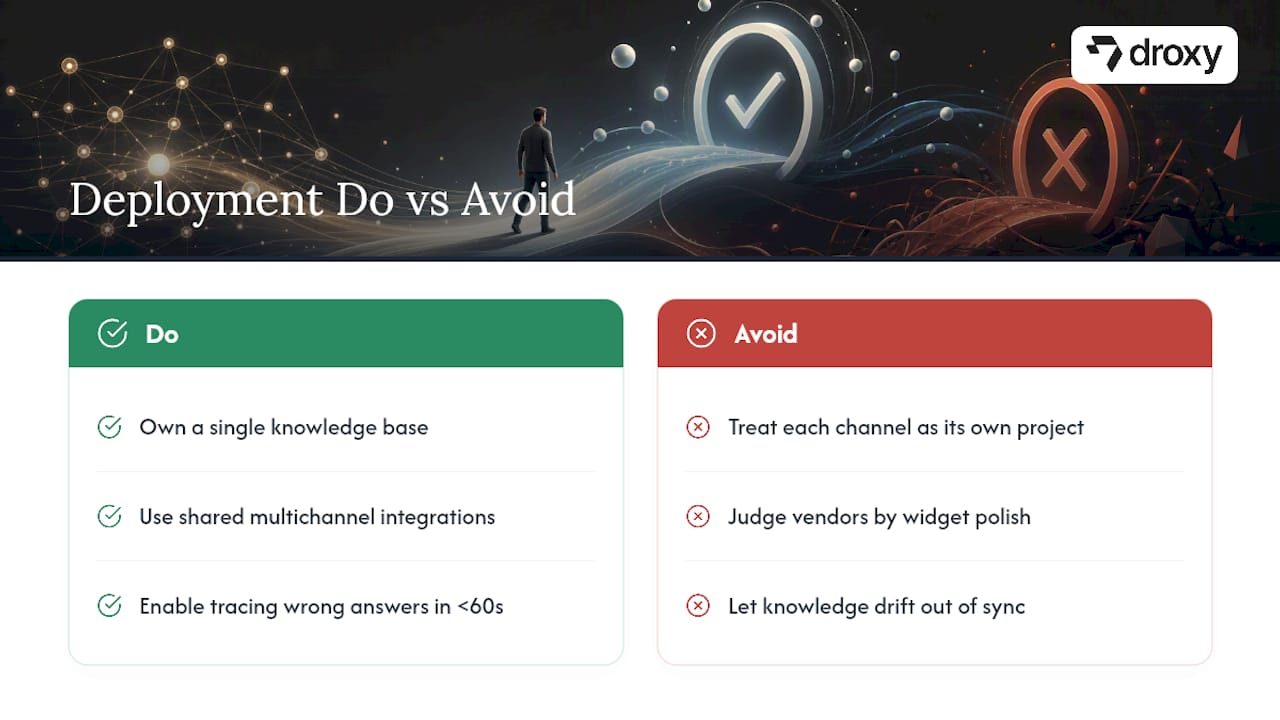
Governed knowledge and observability aren’t nice extras. They’re the difference between a rollout that scales cleanly and one that generates a support ticket about the support bot itself. The deployments that struggle almost always share one root cause: nobody owned the knowledge base, so it drifted out of sync with reality within weeks.
The other recurring issue is treating each channel like its own project. A phone agent trained separately from a WhatsApp agent means your customer gets two different personalities and two different answer qualities depending on how they reach you. No-code platforms with multichannel integrations built on shared knowledge cut the time-to-value here dramatically, because your team configures one knowledge layer instead of maintaining five parallel bots.
What I’d tell any team starting this: don’t evaluate vendors on how polished the chat widget looks. Evaluate them on whether you can trace a wrong answer back to its source in under sixty seconds. That capability predicts long-term reliability far better than any demo script.
The Real Priority Buyers Get Backward
Most buyers evaluate conversational forms the way they’d evaluate a chatbot widget: by how natural the conversation sounds. That’s the wrong first filter. Tone can be fixed in an afternoon. A fragmented, ungoverned knowledge base cannot, and it’s the thing that actually determines whether the AI tells your customers the truth six months from now.
The conventional advice, pick your channels, then find a tool, has the sequence backward. Channel choice is reversible. A knowledge foundation built on duplicate, outdated, or untraceable content is not something you patch with a better prompt.
If there’s one thing this article’s evidence supports clearly, it’s that observability should sit above feature checklists in your evaluation. A platform that can show you exactly which document generated a specific answer gives you something a slick demo never will: the ability to fix mistakes before they compound across every channel you add. Start there, then worry about how warm the greeting sounds.
— Elena
Why Droxy Fits This Checklist Without the Agency Overhead
Everything in that evaluation checklist, integrations, observability, escalation rules, multilingual coverage, map directly onto how Droxy is built. It’s a no-code platform, so your team configures the knowledge layer and channel rollout yourselves instead of waiting on a developer sprint or an agency retainer for every change.
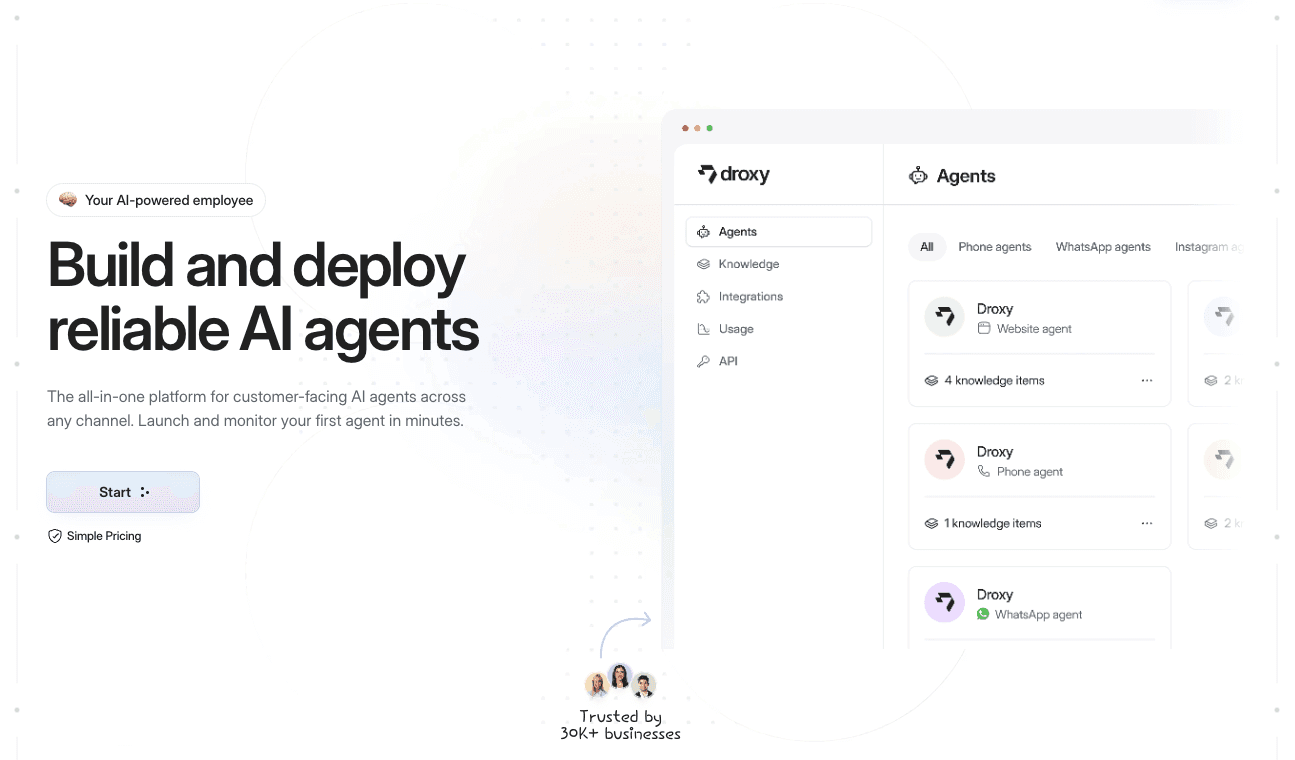
The platform deploys governed knowledge across multiple channels, with human handoff and source-level observability built in rather than bolted on. Agencies managing multiple client accounts can run it under white-label deployment, and over 60,000 users are already running some version of this setup across their own support and sales channels.
If you’re planning to start with WhatsApp, there’s a dedicated WhatsApp agent built for exactly that channel-first approach. Check current plans and pricing and start a trial to see how your own knowledge base performs before you commit to a full rollout.
Sources
Recommended
Conversational forms are AI agents that capture leads and resolve support questions through natural dialogue across chat, phone, and messaging apps, replacing static intake screens with a system that actually talks back. The business case is simple: faster responses, 24/7 coverage, and a measurable lift in lead conversion because prospects get answered before they lose interest. Over 60,000 users already run this kind of setup through Droxy, which suggests the model has moved well past experimental.
TL;DR:
Omnichannel systems share a unified knowledge base, ensuring consistent responses and context carryover across channels, which improves conversion and satisfaction.
The effectiveness of conversational AI hinges on a governed knowledge foundation, not just the choice of channels or the chatbot’s tone.
Vendors should be thoroughly vetted by their integration capabilities, source document traceability, escalation procedures, and compliance support, rather than on demo polish alone.
A staged rollout starting with one high-volume channel allows teams to audit their knowledge sources and refine escalation rules before scaling across multiple platforms.
Poor deployment often results from unowned, outdated, and untraceable knowledge bases; fixed governance and shared knowledge infrastructure prevent ongoing support issues.
Table of Contents
What Are Conversational Forms and How Do They Work?
Why Omnichannel Matters More Than Multichannel
What Should You Check Before Signing a Contract?
How Do You Roll Out Conversational Forms Without Breaking Support?
What Actually Breaks Deployments (And How to Avoid It)
The Real Priority Buyers Get Backward
Why Droxy Fits This Checklist Without the Agency Overhead
Sources
What Are Conversational Forms and How Do They Work?
Every conversational form runs the same basic loop, whether it’s answering a Shopify shopper at 2 a.m. or fielding a phone call about appointment availability. A request comes in, the system detects intent, it retrieves the relevant answer from a knowledge source, it responds or takes an action (booking a slot, tagging a lead), and if it can’t resolve the issue confidently, it escalates to a human.
Chat, voice, and messaging channels differ in how they capture input. Voice needs speech-to-text and tone handling; WhatsApp needs message threading; web chat needs session persistence. But underneath all three, the retrieval layer that pulls answers from your knowledge base should be identical. That consistency is what conversational AI actually depends on to feel coherent across channels rather than like three separate bots wearing the same logo.
Three failure modes show up constantly during evaluation:
Duplicate knowledge: the same policy lives in two documents with slightly different wording, and the AI picks whichever it finds first.
Outdated policies: a refund window changed three months ago, but the source document didn’t.
Missing provenance: nobody can trace which document generated a specific answer, so fixing a wrong response becomes guesswork.
Why Omnichannel Matters More Than Multichannel
Multichannel means you’re reachable on several platforms. Omnichannel means those platforms share one memory. That distinction decides whether a customer who starts on WhatsApp and switches to a phone call has to repeat themselves, or whether the agent already knows what they asked ten minutes ago.
A unified AI brain that stores conversation history under one customer record preserves that context during handoffs, and continuity like that tends to raise both conversion and satisfaction, since nobody enjoys explaining their problem twice.
The knowledge layer underneath all of it matters just as much as the channel strategy. Buyer guidance consistently flags that a governed knowledge foundation is what actually prevents inconsistent or hallucinated answers, not which channel you launch first. Teams often pick channels before auditing knowledge sources, and that order tends to bite them later.
What a governed layer buys you in practice:
One approved source of truth per policy, not five versions floating in different folders.
A visible answer trail so you can check exactly what document produced a given response.
Fewer contradictions between what your phone agent says and what your chat agent says.
Stat check: Industry reporting on AI-assisted service ties automation of routine queries to measurable drops in first reply time and handling time, alongside CSAT gains, when the rollout includes real governance and measurement, not just a chatbot bolted onto a website.
What Should You Check Before Signing a Contract?
A demo will always look smooth. What separates a platform that scales from one that stalls after month two is what happens under the hood once your knowledge base gets messy and your channel list grows. Run through this before you commit:
Integration depth. Confirm the platform connects natively to your CRM, Shopify or ecommerce stack, telephony provider, calendar or booking tool, and analytics setup, not just a generic webhook that someone on your team has to maintain.
Observability and provenance. Ask to see the exact source document behind a sample response. If the vendor can’t show you that trail, you won’t be able to audit or fix wrong answers later.
Escalation logic. Get specifics on how routing works, what context transfers to the human agent, and what SLA the vendor commits to for handoff speed.
Localization, security, and compliance. Confirm multilingual support if you serve international customers, and ask directly how customer data is stored, encrypted, and handled under regulations like GDPR.
Support and SLA terms. Know who you call when something breaks at scale, not just during onboarding.
Ask every vendor for the same three numbers: containment rate (queries resolved without a human), average handling time reduction, and lead conversion uplift. If a vendor can’t produce those figures from existing deployments, that’s worth noting.
Pro Tip: Request a live trace of one real conversation during the demo, not a scripted one. Watch where the AI pulled its answer from. That single request tells you more about platform maturity than any feature list.
How Do You Roll Out Conversational Forms Without Breaking Support?
Deploying across five channels on day one is how support teams end up firefighting five different fires at once. A staged rollout keeps risk contained and gives you a feedback loop before you scale.
Audit your knowledge sources first. Find duplicate policies, flag anything outdated, and consolidate before the AI ever sees a live customer.
Launch on one high-value channel. Phone or WhatsApp usually carries the most volume, so start there and stabilize for two to four weeks before adding anything else.
Define escalation rules up front. Decide exactly which query types route to a human, and build a QA process to review flagged conversations weekly.
Connect events to your CRM and analytics. Define what counts as a conversion (booked call, completed form, closed ticket) and set a benchmark before you launch, not after.
Add channels progressively. Once the first channel is stable, layer in the next one and specifically test handoffs between WhatsApp, phone, and email to confirm context actually carries over.
Skipping the audit step is the most common shortcut teams take, and it’s the one that causes the most rework. A clean, well-structured knowledge base before launch saves far more time than fixing bad answers after customers already hit them.
What Actually Breaks Deployments (And How to Avoid It)
Governed knowledge and observability aren’t nice extras. They’re the difference between a rollout that scales cleanly and one that generates a support ticket about the support bot itself. The deployments that struggle almost always share one root cause: nobody owned the knowledge base, so it drifted out of sync with reality within weeks.
The other recurring issue is treating each channel like its own project. A phone agent trained separately from a WhatsApp agent means your customer gets two different personalities and two different answer qualities depending on how they reach you. No-code platforms with multichannel integrations built on shared knowledge cut the time-to-value here dramatically, because your team configures one knowledge layer instead of maintaining five parallel bots.
What I’d tell any team starting this: don’t evaluate vendors on how polished the chat widget looks. Evaluate them on whether you can trace a wrong answer back to its source in under sixty seconds. That capability predicts long-term reliability far better than any demo script.
The Real Priority Buyers Get Backward
Most buyers evaluate conversational forms the way they’d evaluate a chatbot widget: by how natural the conversation sounds. That’s the wrong first filter. Tone can be fixed in an afternoon. A fragmented, ungoverned knowledge base cannot, and it’s the thing that actually determines whether the AI tells your customers the truth six months from now.
The conventional advice, pick your channels, then find a tool, has the sequence backward. Channel choice is reversible. A knowledge foundation built on duplicate, outdated, or untraceable content is not something you patch with a better prompt.
If there’s one thing this article’s evidence supports clearly, it’s that observability should sit above feature checklists in your evaluation. A platform that can show you exactly which document generated a specific answer gives you something a slick demo never will: the ability to fix mistakes before they compound across every channel you add. Start there, then worry about how warm the greeting sounds.
— Elena
Why Droxy Fits This Checklist Without the Agency Overhead
Everything in that evaluation checklist, integrations, observability, escalation rules, multilingual coverage, map directly onto how Droxy is built. It’s a no-code platform, so your team configures the knowledge layer and channel rollout yourselves instead of waiting on a developer sprint or an agency retainer for every change.
The platform deploys governed knowledge across multiple channels, with human handoff and source-level observability built in rather than bolted on. Agencies managing multiple client accounts can run it under white-label deployment, and over 60,000 users are already running some version of this setup across their own support and sales channels.
If you’re planning to start with WhatsApp, there’s a dedicated WhatsApp agent built for exactly that channel-first approach. Check current plans and pricing and start a trial to see how your own knowledge base performs before you commit to a full rollout.
Sources
Recommended


🚀
Powered by Droxy
Turn every interaction into a conversion
Customer facing AI agents that engage, convert, and support so you can scale what matters.
✨
Learn more
Recent posts
Insights
3 min read
Introducing Agent Memories
Improve your agents' performance with Agent Memories. Prevent agents from repeating the same mistakes by giving them feedback.
Read more

Insights
15 min read
HVAC Marketing in 2025: The Definitive Lead Gen Guide
Discover 15 proven HVAC marketing strategies, plus learn how Droxy's AI website agent converts curious visitors into qualified leads by answering their questions instantly - right when they're most interested in your services.
Read more
Insights
10 min read
10 Best AI Sales Agents in 2025: Tested & Ranked
Discover the top 10 AI sales agents of 2025, designed to enhance lead generation, personalize outreach, and ultimately, close more deals
Read more
Insights
3 min read
Introducing Agent Memories
Improve your agents' performance with Agent Memories. Prevent agents from repeating the same mistakes by giving them feedback.
Read more
Insights
15 min read
HVAC Marketing in 2025: The Definitive Lead Gen Guide
Discover 15 proven HVAC marketing strategies, plus learn how Droxy's AI website agent converts curious visitors into qualified leads by answering their questions instantly - right when they're most interested in your services.
Read more