Multilingual Ecommerce Support: A Practical Guide for 2026
Multilingual Ecommerce Support: A Practical Guide for 2026
Insights
15 min

Multilingual ecommerce support means answering shoppers in their own language at every step, from the first product question to the return request. The most workable setup for a growing store is a mix: AI agents that reply instantly in the shopper’s language, built on one approved knowledge base, with a clear hand-off to a person for sensitive cases. This guide shows you how to build that, step by step.
DroxyAnswer Shoppers Across More ChannelsDroxy lets ecommerce businesses deploy AI agents for instant customer interaction across website chat, phone, WhatsApp, Instagram, Facebook, and Shopify.Explore Droxy
TL;DR
Multilingual support covers every touchpoint (chat, email, social, phone, order updates), not just a translated help page.
Shoppers say they favor it: 76% prefer product information in their native language, and 75% are more likely to keep buying from a brand that offers after-sales support in their language.
Accuracy comes from one source of truth for policies, shipping, and product data, which every language draws from.
AI agents cover the high-volume questions around the clock, and people handle the complex or emotional ones.
Measure it by language: first response time, resolution rate, hand-off rate, satisfaction, and conversion.
Table of Contents
What multilingual ecommerce support actually includes
Why it matters to your revenue
Translation versus localization in support
Four ways to deliver support in several languages
Where your shoppers actually write to you
How to keep answers accurate and consistent in every language
Measuring quality and business impact
Our perspective
Put multilingual support to work with Droxy
Sources
What multilingual ecommerce support actually includes
It is customer service delivered to every customer group, at every touchpoint, in their native language. That is how Lokalise describes multilingual customer support for ecommerce, and it matters most when you enter markets where the local language differs from yours. The same guide notes that more than 350 languages are spoken in the United States, so you do not need to ship abroad to need this.
In practice, a store’s support surface usually includes:
Pre-purchase questions: sizing, compatibility, stock, shipping times.
Order status and delivery updates.
Returns, exchanges, and refunds.
Post-purchase emails and help-center articles.
Social messages on Instagram, Facebook, and WhatsApp.
Phone calls for higher-value or urgent issues.
Smartling’s guide gives similar examples: post-purchase emails to global shoppers, local call centers with native speakers, and real-time troubleshooting with multilingual AI chatbots. Each is a legitimate method. The right mix depends on your volume per language and your budget.
Why it matters to your revenue
Language is a trust signal. When a shopper can ask a question and get a clear answer in the language they think in, hesitation drops. The numbers behind that are consistent across several surveys:
76% of online shoppers prefer buying products with information in their native language, and 40% will never buy from websites in other languages, according to CSA Research.
In the same research, 75% of consumers are more likely to repurchase from a brand that offers post-sales support in their language. Even 60% of those most confident reading English prefer customer care in their own language.
Lokalise reports that only 20% of the world’s population speaks English and that 13% of customers would switch to a store translated into their native language.
Linguidoor’s 2026 localization guide reports that 70% of consumers prefer brands with native-language support, and 62% are more forgiving of product issues when they can communicate in their own language.
A CSA Research survey cited by Bromberg & Associates found a 55% increase in conversions for multi-language websites compared with English-only ones.
These are survey results from different publishers and years, so treat them as direction rather than a forecast for your store. The direction is clear, though: language support touches both the first sale and the second.
There is a softer benefit too. Writing in Forbes Business Council, Salvador Ordorica argues that comfort in a native language builds a sense of value and mutual trust, which can lead to loyalty, repeat business, and referrals.
Translation versus localization in support
Translation converts words. Localization adapts the experience. Transphere’s guide frames translation as aiming for linguistic equivalence and localization as aiming for cultural resonance, down to idioms, date formats, and local regulations. Its tailoring analogy is useful: translation is the off-the-rack suit, localization is the fitted one.
For support, localization shows up in details like these:
Currency, tax display, and delivery promises that match the shopper’s country.
Returns wording that reflects local expectations and rules.
Measurement units and size guides.
Tone: how formal, how brief, how warm.
Payment methods that the shopper actually uses.
Modilingua’s 2026 guide lists support articles and email templates among the elements to localize, alongside product pages and checkout copy. It also makes a point worth remembering: a buying journey runs from discovery through returns and support, and localization has to cover the whole path. A perfectly translated homepage does little if the return policy raises doubt.
Four ways to deliver support in several languages
Most stores combine these. Here is how they compare.
Method | Best for | Strength | Watch-out |
|---|---|---|---|
Native-speaking agents | High-volume markets, complex cases | Nuance and empathy | Cost and coverage across time zones |
Translation tools layered on one team | Low-volume languages | Quick to start | Tone can feel flat without review |
Self-service help center in each language | Repeat questions | Scales cheaply | Needs ongoing upkeep |
AI agents answering in the shopper’s language | Instant, 24/7 first response | Speed and consistency | Needs a good knowledge base and a hand-off path |
Human contact still matters. A 2025 Bitkom survey of 1,006 German internet users found that 62% of online shoppers prefer a quickly reachable human contact for order problems, while 36% prefer chatbots, and 86% of those who dealt with a human agent were satisfied. That is a German sample, but it points to a design principle: let AI be fast on routine questions, and make it easy to reach a person. A CSA Research survey cited by Bromberg & Associates likewise found that 79% of customers prefer live support in their language or through an interpreter over automated translation tools.
The lesson is not that automation fails. It is that automation works best when it is built to be human-like in the shopper’s language and backed by a real person when the situation calls for it. If you are weighing the two approaches, our comparison of live chat versus chatbot walks through the trade-offs, and our explainer on how an AI agent differs from a chatbot shows why modern agents can handle far more than scripted flows.
Where your shoppers actually write to you
Language preference often follows channel preference. A shopper in one market may favor WhatsApp, another Instagram direct messages, another your website chat. Supporting several languages on a single channel while ignoring the others leaves gaps.
Plan by channel:
Website chat. The most visible touchpoint, and the easiest place to start. The agent should greet shoppers in their language, answer product and policy questions, and capture leads.
WhatsApp. Often the preferred channel for order updates and quick questions in many regions.
Instagram and Facebook. Social shoppers ask about products and availability in comments and direct messages, and expect fast replies.
Phone. Valuable for higher-value orders and urgent problems, where a voice agent can answer first and route to a person when needed.
Email. Still the backbone for post-purchase communication, so templates should be localized too.
Our guide on omnichannel voice and chat agents covers how to keep the experience consistent across them.
How to keep answers accurate and consistent in every language
The biggest risk in multilingual support is not translation quality alone. It is drift: the English page says returns take 30 days, the Spanish chat says 14, and the German email says nothing. Shoppers notice, and so do your agents. Here is a process that prevents it.
Start with one source of truth
Write your policies, shipping rules, product specs, and sizing guidance once, in a single master set. Every language version, every AI agent, and every human agent should draw from it. When a policy changes, you update the master and everything downstream follows.
Build a glossary and a tone guide
List the terms that must stay fixed: product names, plan or collection names, and legal phrases. Then define the voice for each market: formal or casual, short or detailed, emoji or none. A short style note per language saves a lot of rework.
Connect the knowledge your agent needs
An AI agent is only as good as what it can read. Bring in your help center, product catalog, policy pages, and past support answers. Our guide to implementing chatbots for ecommerce customer service covers how to organize that material before you launch.
Define hand-off rules
Decide in advance what goes to a person: refund disputes, damaged goods, angry messages, anything involving payment details or legal questions. Write the triggers down. Make sure the hand-off carries the conversation history so the shopper never has to repeat themselves.

Review a sample every week
Read a handful of real conversations in each language. Ask a native speaker, a teammate, a contractor, or a trusted customer, to flag awkward phrasing or wrong assumptions. Fix the source material first, then the wording.
Expand one language at a time
Launch in the language that brings you the most orders or the most unanswered messages. Get that right, then add the next. This keeps quality under control and gives you a clean before-and-after comparison.
If you also publish content for international search, multilingual SEO content can bring shoppers in their own language to your store, so your support is ready for them when they arrive.
Measuring quality and business impact
Track the same metrics for every language, so you can see where one market lags. A practical scorecard:
Metric | What it tells you |
|---|---|
First response time | Whether shoppers in each language get answers quickly |
Resolution rate without hand-off | How much the AI agent handles on its own |
Hand-off rate and reasons | Which topics need better knowledge or a human |
Customer satisfaction score | Whether the answers feel right, per language |
Repeat contact rate | Whether the first answer solved the problem |
Conversion rate of chat sessions | Whether support turns questions into orders |
Support ticket volume per order | Whether instant answers reduce your workload |
Compare each language against your English baseline, and compare before and after launch. Look at transcripts as well as numbers: a low score often traces to one unclear policy or a missing product detail. Review monthly, and use the findings to update your master knowledge set.
Connect support data to revenue where you can. Questions answered before checkout, leads captured after hours, and carts recovered after a sizing question are all signals that language support is working.
Our perspective
Most stores treat languages as a translation project. We see it as a service-level promise: a shopper writing in Portuguese at 2 a.m. deserves the same quality of answer as one writing in English at noon.
That is why we built Droxy around AI agents you can customize deeply, so interactions stay human-like and match your brand voice in every language. One agent can work across website chat, phone, WhatsApp, Instagram, Facebook, and Shopify, connect to your existing systems, and hand the conversation to a person when it matters.
Our advice is to start with the questions that repeat most, give your agent a single trusted knowledge base, and let the analytics show you where to improve. Small stores get instant coverage. Growing stores get consistency without hiring a team for every language.
Elena
Put multilingual support to work with Droxy
Droxy is a no-code platform for deploying AI agents that answer customers instantly, 24/7, with multilingual support, automated lead capture, appointment booking, product recommendations, smart routing, and human hand-off. You can connect knowledge from multiple sources and integrate with your existing systems through API or Zapier.
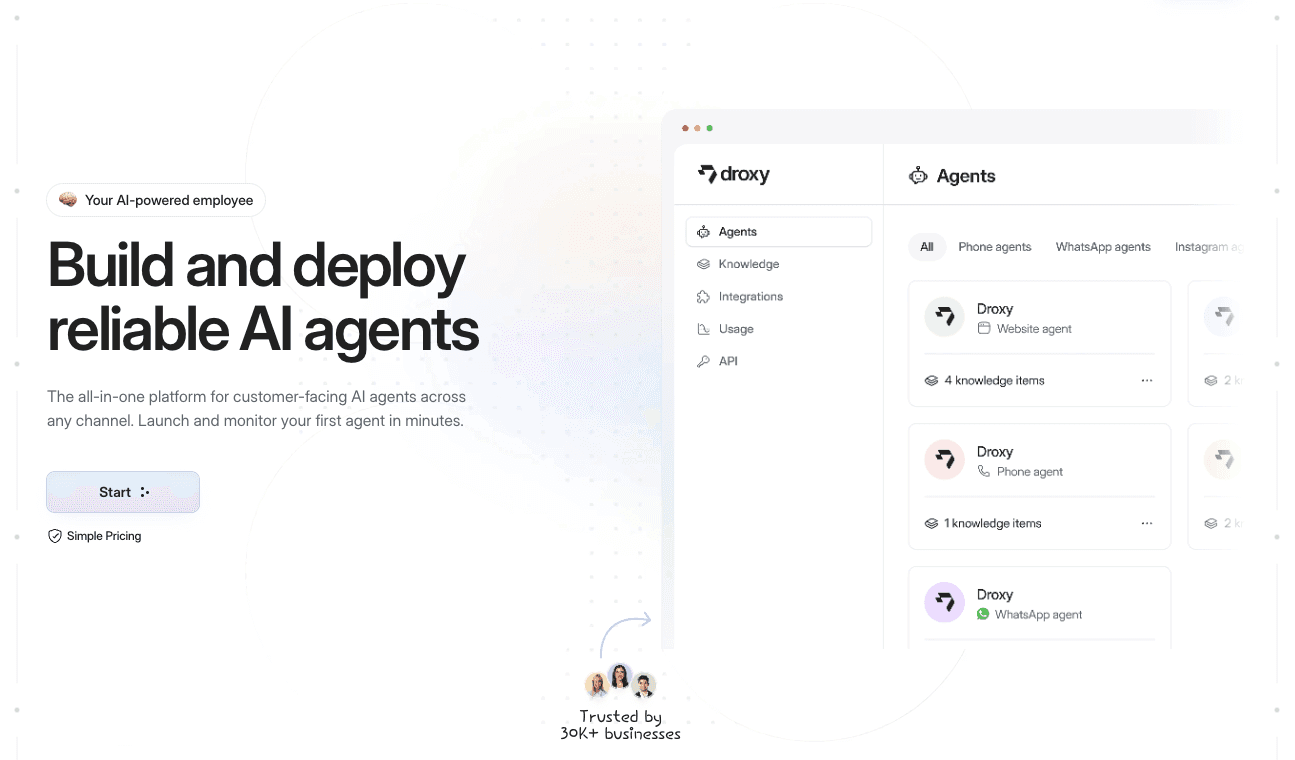
Plans start at $16 per month on the Basic plan, with Advanced from $80 per month and Enterprise from $240 per month. A good first step is the website agent, and from there you can add WhatsApp as your volume grows. For a deeper look at language setup, read our guide to a multilingual chatbot without a dev team.
FAQ
How many languages should an ecommerce store support?
Start with the languages your current shoppers already use, which you can see in chat transcripts, order data, and analytics. Add a new language when you see steady demand or unanswered messages. Quality in three languages beats thin coverage in ten.
Is machine translation good enough for customer support?
It works well for routine questions when it draws on approved policies and product data. For sensitive topics such as refunds, damaged items, or complaints, offer a hand-off to a person. Reviewing sample conversations with a native speaker keeps tone and accuracy on track.
Can one AI agent handle several languages and channels?
Yes. With Droxy, a single agent can serve website chat, phone, WhatsApp, Instagram, Facebook, and Shopify, with multilingual support and customization to match your brand voice. You keep one knowledge base, so answers stay consistent everywhere.
How do I know multilingual support is paying off?
Track first response time, resolution rate, satisfaction, and chat-to-order conversion for each language, and compare them with your baseline. Falling ticket volume and more after-hours leads captured are early signs it is working.
Sources
Multilingual customer support: Definition, tips, and best practices (Smartling)
The Complete Guide to Ecommerce Localization 2026 (Linguidoor)
The Impact of Multilingual Customer Support on Customer Satisfaction (Forbes Business Council)
The Ultimate Guide to Multilingual Content Localization (Transphere)
E-Commerce Localization: The Checkout Is Only the Final Test (Modilingua)
Kundenservice beim Online-Shopping: Mensch schlägt Chatbot (Bitkom)
Recommended
Multilingual ecommerce support means answering shoppers in their own language at every step, from the first product question to the return request. The most workable setup for a growing store is a mix: AI agents that reply instantly in the shopper’s language, built on one approved knowledge base, with a clear hand-off to a person for sensitive cases. This guide shows you how to build that, step by step.
DroxyAnswer Shoppers Across More ChannelsDroxy lets ecommerce businesses deploy AI agents for instant customer interaction across website chat, phone, WhatsApp, Instagram, Facebook, and Shopify.Explore Droxy
TL;DR
Multilingual support covers every touchpoint (chat, email, social, phone, order updates), not just a translated help page.
Shoppers say they favor it: 76% prefer product information in their native language, and 75% are more likely to keep buying from a brand that offers after-sales support in their language.
Accuracy comes from one source of truth for policies, shipping, and product data, which every language draws from.
AI agents cover the high-volume questions around the clock, and people handle the complex or emotional ones.
Measure it by language: first response time, resolution rate, hand-off rate, satisfaction, and conversion.
Table of Contents
What multilingual ecommerce support actually includes
Why it matters to your revenue
Translation versus localization in support
Four ways to deliver support in several languages
Where your shoppers actually write to you
How to keep answers accurate and consistent in every language
Measuring quality and business impact
Our perspective
Put multilingual support to work with Droxy
Sources
What multilingual ecommerce support actually includes
It is customer service delivered to every customer group, at every touchpoint, in their native language. That is how Lokalise describes multilingual customer support for ecommerce, and it matters most when you enter markets where the local language differs from yours. The same guide notes that more than 350 languages are spoken in the United States, so you do not need to ship abroad to need this.
In practice, a store’s support surface usually includes:
Pre-purchase questions: sizing, compatibility, stock, shipping times.
Order status and delivery updates.
Returns, exchanges, and refunds.
Post-purchase emails and help-center articles.
Social messages on Instagram, Facebook, and WhatsApp.
Phone calls for higher-value or urgent issues.
Smartling’s guide gives similar examples: post-purchase emails to global shoppers, local call centers with native speakers, and real-time troubleshooting with multilingual AI chatbots. Each is a legitimate method. The right mix depends on your volume per language and your budget.
Why it matters to your revenue
Language is a trust signal. When a shopper can ask a question and get a clear answer in the language they think in, hesitation drops. The numbers behind that are consistent across several surveys:
76% of online shoppers prefer buying products with information in their native language, and 40% will never buy from websites in other languages, according to CSA Research.
In the same research, 75% of consumers are more likely to repurchase from a brand that offers post-sales support in their language. Even 60% of those most confident reading English prefer customer care in their own language.
Lokalise reports that only 20% of the world’s population speaks English and that 13% of customers would switch to a store translated into their native language.
Linguidoor’s 2026 localization guide reports that 70% of consumers prefer brands with native-language support, and 62% are more forgiving of product issues when they can communicate in their own language.
A CSA Research survey cited by Bromberg & Associates found a 55% increase in conversions for multi-language websites compared with English-only ones.
These are survey results from different publishers and years, so treat them as direction rather than a forecast for your store. The direction is clear, though: language support touches both the first sale and the second.
There is a softer benefit too. Writing in Forbes Business Council, Salvador Ordorica argues that comfort in a native language builds a sense of value and mutual trust, which can lead to loyalty, repeat business, and referrals.
Translation versus localization in support
Translation converts words. Localization adapts the experience. Transphere’s guide frames translation as aiming for linguistic equivalence and localization as aiming for cultural resonance, down to idioms, date formats, and local regulations. Its tailoring analogy is useful: translation is the off-the-rack suit, localization is the fitted one.
For support, localization shows up in details like these:
Currency, tax display, and delivery promises that match the shopper’s country.
Returns wording that reflects local expectations and rules.
Measurement units and size guides.
Tone: how formal, how brief, how warm.
Payment methods that the shopper actually uses.
Modilingua’s 2026 guide lists support articles and email templates among the elements to localize, alongside product pages and checkout copy. It also makes a point worth remembering: a buying journey runs from discovery through returns and support, and localization has to cover the whole path. A perfectly translated homepage does little if the return policy raises doubt.
Four ways to deliver support in several languages
Most stores combine these. Here is how they compare.
Method | Best for | Strength | Watch-out |
|---|---|---|---|
Native-speaking agents | High-volume markets, complex cases | Nuance and empathy | Cost and coverage across time zones |
Translation tools layered on one team | Low-volume languages | Quick to start | Tone can feel flat without review |
Self-service help center in each language | Repeat questions | Scales cheaply | Needs ongoing upkeep |
AI agents answering in the shopper’s language | Instant, 24/7 first response | Speed and consistency | Needs a good knowledge base and a hand-off path |
Human contact still matters. A 2025 Bitkom survey of 1,006 German internet users found that 62% of online shoppers prefer a quickly reachable human contact for order problems, while 36% prefer chatbots, and 86% of those who dealt with a human agent were satisfied. That is a German sample, but it points to a design principle: let AI be fast on routine questions, and make it easy to reach a person. A CSA Research survey cited by Bromberg & Associates likewise found that 79% of customers prefer live support in their language or through an interpreter over automated translation tools.
The lesson is not that automation fails. It is that automation works best when it is built to be human-like in the shopper’s language and backed by a real person when the situation calls for it. If you are weighing the two approaches, our comparison of live chat versus chatbot walks through the trade-offs, and our explainer on how an AI agent differs from a chatbot shows why modern agents can handle far more than scripted flows.
Where your shoppers actually write to you
Language preference often follows channel preference. A shopper in one market may favor WhatsApp, another Instagram direct messages, another your website chat. Supporting several languages on a single channel while ignoring the others leaves gaps.
Plan by channel:
Website chat. The most visible touchpoint, and the easiest place to start. The agent should greet shoppers in their language, answer product and policy questions, and capture leads.
WhatsApp. Often the preferred channel for order updates and quick questions in many regions.
Instagram and Facebook. Social shoppers ask about products and availability in comments and direct messages, and expect fast replies.
Phone. Valuable for higher-value orders and urgent problems, where a voice agent can answer first and route to a person when needed.
Email. Still the backbone for post-purchase communication, so templates should be localized too.
Our guide on omnichannel voice and chat agents covers how to keep the experience consistent across them.
How to keep answers accurate and consistent in every language
The biggest risk in multilingual support is not translation quality alone. It is drift: the English page says returns take 30 days, the Spanish chat says 14, and the German email says nothing. Shoppers notice, and so do your agents. Here is a process that prevents it.
Start with one source of truth
Write your policies, shipping rules, product specs, and sizing guidance once, in a single master set. Every language version, every AI agent, and every human agent should draw from it. When a policy changes, you update the master and everything downstream follows.
Build a glossary and a tone guide
List the terms that must stay fixed: product names, plan or collection names, and legal phrases. Then define the voice for each market: formal or casual, short or detailed, emoji or none. A short style note per language saves a lot of rework.
Connect the knowledge your agent needs
An AI agent is only as good as what it can read. Bring in your help center, product catalog, policy pages, and past support answers. Our guide to implementing chatbots for ecommerce customer service covers how to organize that material before you launch.
Define hand-off rules
Decide in advance what goes to a person: refund disputes, damaged goods, angry messages, anything involving payment details or legal questions. Write the triggers down. Make sure the hand-off carries the conversation history so the shopper never has to repeat themselves.
Review a sample every week
Read a handful of real conversations in each language. Ask a native speaker, a teammate, a contractor, or a trusted customer, to flag awkward phrasing or wrong assumptions. Fix the source material first, then the wording.
Expand one language at a time
Launch in the language that brings you the most orders or the most unanswered messages. Get that right, then add the next. This keeps quality under control and gives you a clean before-and-after comparison.
If you also publish content for international search, multilingual SEO content can bring shoppers in their own language to your store, so your support is ready for them when they arrive.
Measuring quality and business impact
Track the same metrics for every language, so you can see where one market lags. A practical scorecard:
Metric | What it tells you |
|---|---|
First response time | Whether shoppers in each language get answers quickly |
Resolution rate without hand-off | How much the AI agent handles on its own |
Hand-off rate and reasons | Which topics need better knowledge or a human |
Customer satisfaction score | Whether the answers feel right, per language |
Repeat contact rate | Whether the first answer solved the problem |
Conversion rate of chat sessions | Whether support turns questions into orders |
Support ticket volume per order | Whether instant answers reduce your workload |
Compare each language against your English baseline, and compare before and after launch. Look at transcripts as well as numbers: a low score often traces to one unclear policy or a missing product detail. Review monthly, and use the findings to update your master knowledge set.
Connect support data to revenue where you can. Questions answered before checkout, leads captured after hours, and carts recovered after a sizing question are all signals that language support is working.
Our perspective
Most stores treat languages as a translation project. We see it as a service-level promise: a shopper writing in Portuguese at 2 a.m. deserves the same quality of answer as one writing in English at noon.
That is why we built Droxy around AI agents you can customize deeply, so interactions stay human-like and match your brand voice in every language. One agent can work across website chat, phone, WhatsApp, Instagram, Facebook, and Shopify, connect to your existing systems, and hand the conversation to a person when it matters.
Our advice is to start with the questions that repeat most, give your agent a single trusted knowledge base, and let the analytics show you where to improve. Small stores get instant coverage. Growing stores get consistency without hiring a team for every language.
Elena
Put multilingual support to work with Droxy
Droxy is a no-code platform for deploying AI agents that answer customers instantly, 24/7, with multilingual support, automated lead capture, appointment booking, product recommendations, smart routing, and human hand-off. You can connect knowledge from multiple sources and integrate with your existing systems through API or Zapier.
Plans start at $16 per month on the Basic plan, with Advanced from $80 per month and Enterprise from $240 per month. A good first step is the website agent, and from there you can add WhatsApp as your volume grows. For a deeper look at language setup, read our guide to a multilingual chatbot without a dev team.
FAQ
How many languages should an ecommerce store support?
Start with the languages your current shoppers already use, which you can see in chat transcripts, order data, and analytics. Add a new language when you see steady demand or unanswered messages. Quality in three languages beats thin coverage in ten.
Is machine translation good enough for customer support?
It works well for routine questions when it draws on approved policies and product data. For sensitive topics such as refunds, damaged items, or complaints, offer a hand-off to a person. Reviewing sample conversations with a native speaker keeps tone and accuracy on track.
Can one AI agent handle several languages and channels?
Yes. With Droxy, a single agent can serve website chat, phone, WhatsApp, Instagram, Facebook, and Shopify, with multilingual support and customization to match your brand voice. You keep one knowledge base, so answers stay consistent everywhere.
How do I know multilingual support is paying off?
Track first response time, resolution rate, satisfaction, and chat-to-order conversion for each language, and compare them with your baseline. Falling ticket volume and more after-hours leads captured are early signs it is working.
Sources
Multilingual customer support: Definition, tips, and best practices (Smartling)
The Complete Guide to Ecommerce Localization 2026 (Linguidoor)
The Impact of Multilingual Customer Support on Customer Satisfaction (Forbes Business Council)
The Ultimate Guide to Multilingual Content Localization (Transphere)
E-Commerce Localization: The Checkout Is Only the Final Test (Modilingua)
Kundenservice beim Online-Shopping: Mensch schlägt Chatbot (Bitkom)
Recommended


🚀
Powered by Droxy
Turn every interaction into a conversion
Customer facing AI agents that engage, convert, and support so you can scale what matters.
✨
Learn more
Recent posts
Insights
3 min read
Introducing Agent Memories
Improve your agents' performance with Agent Memories. Prevent agents from repeating the same mistakes by giving them feedback.
Read more

Insights
15 min read
HVAC Marketing in 2025: The Definitive Lead Gen Guide
Discover 15 proven HVAC marketing strategies, plus learn how Droxy's AI website agent converts curious visitors into qualified leads by answering their questions instantly - right when they're most interested in your services.
Read more
Insights
10 min read
10 Best AI Sales Agents in 2025: Tested & Ranked
Discover the top 10 AI sales agents of 2025, designed to enhance lead generation, personalize outreach, and ultimately, close more deals
Read more
Insights
3 min read
Introducing Agent Memories
Improve your agents' performance with Agent Memories. Prevent agents from repeating the same mistakes by giving them feedback.
Read more
Insights
15 min read
HVAC Marketing in 2025: The Definitive Lead Gen Guide
Discover 15 proven HVAC marketing strategies, plus learn how Droxy's AI website agent converts curious visitors into qualified leads by answering their questions instantly - right when they're most interested in your services.
Read more