Production RAG Chatbots: Hybrid Retrieval, Metadata, Confidence Gate
Production RAG Chatbots: Hybrid Retrieval, Metadata, Confidence Gate
Insights
19 min
RAG, or retrieval-augmented generation, lets a chatbot pull relevant facts from your own data at the moment someone asks a question, then hands those facts to the language model as context before it answers. That grounding is what cuts hallucinations and lets you point to a real source behind every claim. Use RAG when your knowledge base is large, changes often, or contains private data. Skip it if you have fewer than 50 documents or the task is really about calling structured tools, not answering questions.
TL;DR:
RAG is most effective when managing large, frequently changing, or private data sources, especially with more than 50 documents.
Combining vector search with BM25 keyword matching improves retrieval accuracy for exact codes, IDs, and recency-sensitive information.
Proper chunking, metadata tagging, and filtering at ingestion are crucial to ensure retrieval accuracy and prevent sensitive data exposure.
Maintaining evaluation metrics like faithfulness, relevance, and recall through CI processes helps detect and prevent answer drift over time.
Using a hybrid approach, including fine-tuning and retrieval-only layers, can optimize cost, accuracy, and adaptability for specific domains.
Table of Contents
Why RAG Matters for Production Chatbots
RAG Architecture, Component by Component
Hybrid Retrieval and Metadata Filtering: The Production Case for Vectors Plus BM25
Ingestion and Chunking: Practical Rules to Maximize Retrievability
Grounding, Citations, and the Confidence Gate
Evaluation and Monitoring: The Metrics and CI Harness to Catch Drift
Concrete Tech Choices and Patterns You’ll Actually Use
RAG vs. Fine-Tuning vs. Retrieval-Only: Choosing the Right Approach
Security and Privacy Considerations When Using RAG With Sensitive Data
Best Practices for Updating and Maintaining the Knowledge Base
Challenges and Limitations of RAG in Chatbots
Droxy’s Take: Operationalizing RAG for Multi-Channel Customer Support
How to Get Started With Droxy
Sources
Why RAG Matters for Production Chatbots
RAG works in four moves: your documents get ingested and chunked, converted into vectors, retrieved when a question comes in, and passed to the model with instructions to answer using only that retrieved context. Each stage adds a decision point, and each decision point is where teams either build something reliable or build something that quietly drifts into wrong answers.
The business case is straightforward. RAG lets you keep the chatbot current without retraining a model every time a policy changes, ground answers in documents you actually own, and produce responses you can audit because every claim traces back to a retrieved passage. That auditability matters more than most teams realize until the first time a customer disputes what the bot told them.
The trade-offs are real too:
Latency: each additional retrieval or reranking step adds milliseconds to seconds of response time.
Cost: embedding, vector storage, and reranker calls all add up per query, especially at scale.
Complexity: you’re now maintaining a pipeline, not just a prompt.
None of these trade-offs are reasons to avoid RAG. They’re reasons to design the architecture deliberately instead of bolting a vector database onto a chatbot and hoping.
RAG Architecture, Component by Component
A production RAG chatbot architecture has six moving parts, and weak ingestion is the most common reason pilots fail before they ever reach production.
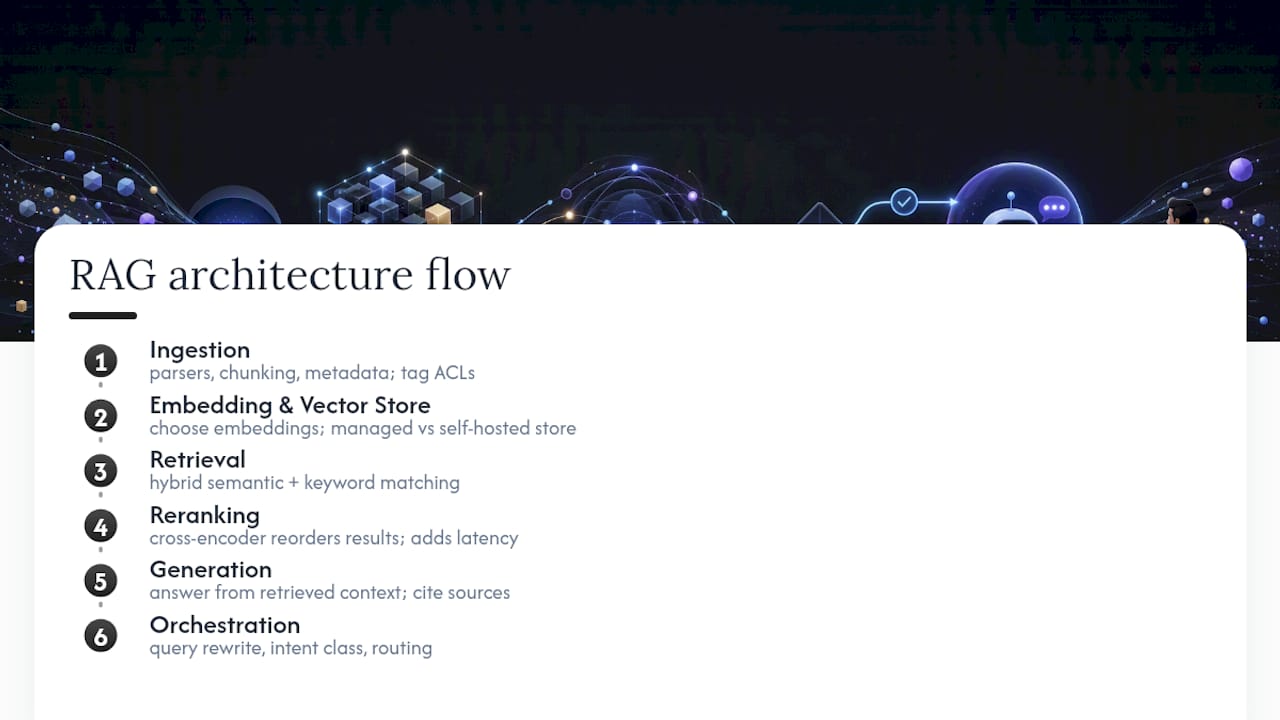
Ingestion comes first: parsers extract text from PDFs, HTML, transcripts, and spreadsheets, chunking splits that text into retrievable units, and enrichment attaches metadata like source, date, and access permissions. Skipping ACL tagging here is how sensitive documents end up surfaced to the wrong user later.
Embedding and vector storage come next. Your embedding model choice affects retrieval quality more than most teams budget time for. General-purpose embeddings work fine for broad content; domain-specific fine-tuned embeddings pay off when your corpus is full of jargon a generic model was never trained on. Vector store choice (managed versus self-hosted) is mostly an operations decision at this stage, not an accuracy one.
Retrieval should combine semantic search with keyword matching rather than relying on vectors alone, since hybrid retrieval catches exact tokens and acronyms that pure embeddings tend to miss.
Reranking reorders the retrieved candidates using a cross-encoder model that scores relevance more precisely than the initial retrieval step. It costs latency, so measure whether it actually moves your recall numbers before shipping it.
Generation assembles a prompt that instructs the model to answer only from retrieved context and cite its sources inline.
Orchestration ties it together: query rewriting, intent classification, and routing decide whether a query even needs retrieval at all.
Pro Tip: Classify intent before retrieval runs. Chit-chat and small talk don’t need a vector search, and skipping it on those turns saves latency and cost across your whole traffic volume.
Hybrid Retrieval and Metadata Filtering: The Production Case for Vectors Plus BM25
Pure semantic search fails in predictable ways. It struggles with exact product IDs, order numbers, and SKUs because embeddings capture meaning, not literal strings. It also has no built-in sense of recency, so a semantically similar but outdated document can outrank the current one. Vector-only retrieval for a chatbot handling account numbers or ticket IDs will frustrate users fast.
BM25, the classic keyword-matching algorithm, catches exactly the queries embeddings miss: exact codes, acronyms, precise phrases. Combining it with vector search through a fusion method like Reciprocal Rank Fusion (RRF) gives you both conceptual recall and lexical precision. A HYBRID_ALPHA parameter typically controls the weighting between the two, and most teams start around 0.5 and tune from there based on eval results.
Metadata filtering has to happen before this fusion step, not after. Filtering before retrieval keeps documents a user lacks permission to see out of the search entirely, rather than retrieving them and hoping the model ignores them.
A few practical defaults worth starting from:
Retrieve a pool of 20 to 50 candidates before reranking narrows it to the top 3 to 5.
Tag every chunk with tenant ID, access level, and source date at ingest time, not after.
Re-run your
HYBRID_ALPHAtuning whenever you add a new content type to the corpus.
Ingestion and Chunking: Practical Rules to Maximize Retrievability
Chunking decisions determine whether retrieval finds the right passage or a fragment that’s technically related but useless. Chunking strategy should follow the natural structure of the source rather than splitting text into fixed-size blocks blindly.
Chunk by semantic boundaries. Split on headings, numbered steps, or procedure boundaries instead of a fixed character count. Use an overlap of roughly 10% to 20% of chunk length so context doesn’t get severed mid-thought.
Adjust by format. PDFs need table-aware extraction so numbers don’t get scrambled across columns. Transcripts chunk better by speaker turn than by arbitrary word count. Code should chunk by function or class. CSVs often work best summarized row-by-row into natural language rather than dumped raw.
Capture metadata that supports filtering later: source name, document date, department owner, and access tier. This is what lets your retriever apply permissions and recency boosts without touching the embedding itself.
Set a refresh cadence. Static policy documents might reindex weekly; live inventory or pricing data needs near-real-time incremental updates, not a full reindex, to stay affordable at scale.
Getting this stage right prevents most of the downstream accuracy problems teams try to solve with bigger models later.
Grounding, Citations, and the Confidence Gate
A grounded chatbot cites its sources inline and refuses to answer when the evidence underneath it is thin. Both behaviors need to be engineered deliberately, not assumed.
Prompt contracts should instruct the model explicitly: answer only using the retrieved context, cite the source for each claim, and say it doesn’t know rather than guess when the context doesn’t cover the question. Models will still guess if you don’t forbid it plainly.
The confidence gate is what makes refusal reliable instead of arbitrary. A gate combining average cosine similarity, a minimum top-K chunk count, and a semantic drift check gives you a deterministic, testable refusal policy rather than a vague “if unsure” instruction buried in a prompt.
If average similarity falls below your threshold, refuse rather than answer.
If fewer than your minimum chunk count is retrieved, treat the query as out of scope.
For high-stakes domains (medical, legal, financial), add a verifier pass or route straight to a human.
Refusal phrasing matters for user experience. “I don’t have enough information to answer that confidently, let me connect you with our team” performs far better than a flat error message, because it keeps the interaction moving instead of dead-ending the user.
Evaluation and Monitoring: The Metrics and CI Harness to Catch Drift
Four metrics form the core of a RAG evaluation harness: faithfulness (does the answer actually match the retrieved context), answer relevancy (does it address the question asked), context precision (how much of what’s retrieved is actually useful), and context recall (did retrieval find all relevant content).
Build an eval set of representative queries pulled from real user questions.
Gate deployments in CI: block a release if faithfulness or recall drops below your baseline on that eval set.
Instrument production with traces, human feedback capture on flagged answers, and dashboards tracking latency and cost per query.
Only add expensive steps like reranking or a verifier pass once eval results show retrieval precision is the actual bottleneck, not a guess.
Without this loop, drift is invisible until customers notice it first.
Concrete Tech Choices and Patterns You’ll Actually Use
A typical 2026 stack pairs an embedding model with a vector store (Qdrant, FAISS, or pgvector), a BM25 layer for sparse search, a cross-encoder reranker, and an LLM for generation, orchestrated through LangChain or LlamaIndex.
Use LangChain or LlamaIndex for orchestration, but avoid the anti-pattern of chaining five agent calls when a single well-prompted retrieval step would do.
Cache embeddings for static content and stream generation output so users see progress instead of a blank pause.
Cross-encoder rerankers earn their latency cost mainly when your recall@5 is below target. If retrieval is already strong, skip it and save the milliseconds.
Prefer managed vector databases early in a pilot; migrate to self-hosted once query volume justifies the operational overhead.
RAG vs. Fine-Tuning vs. Retrieval-Only: Choosing the Right Approach
RAG, end-to-end fine-tuning, and retrieval-only search solve different problems, and conflating them is where a lot of chatbot training data gets wasted.
Fine-tuning bakes knowledge into model weights. It works well for teaching a model a consistent tone, format, or reasoning pattern, but it’s a poor fit for facts that change weekly, because every update means retraining. It’s also opaque: you can’t point to which training example produced a given answer, which makes auditing nearly impossible.
Retrieval-only systems, the search-and-return approach without generation, skip hallucination risk entirely because they never write new sentences. But they hand the user a list of documents instead of a direct answer, which is a worse experience for anything beyond a knowledge-base search bar.
RAG sits between the two: it gets the freshness and auditability of retrieval with the natural conversational fluency of generation. For a customer support chatbot answering questions from policies, product catalogs, or support tickets, that combination usually wins over either extreme. The exception is narrow, stable domains where fine-tuning a smaller model on a fixed set of intents can be cheaper to run at scale, once the knowledge truly stops changing.
Most production teams end up combining approaches: a fine-tuned model for tone and format, RAG for facts, and a thin retrieval-only layer for edge cases where a document link genuinely beats a generated summary.
Security and Privacy Considerations When Using RAG With Sensitive Data
A RAG pipeline that retrieves from private data is only as secure as its weakest filtering step, and that step is almost always metadata enforcement.
Access control needs to live at the retrieval layer, not the generation layer. If a document a user shouldn’t see gets retrieved and handed to the model, trusting the model to withhold it is a bad bet. Tenant ID, access tier, and document sensitivity should be first-class metadata fields set at ingest time, filtered before the search runs, not after.
For regulated data (health records, financial details, personal identifiers), consider whether the raw text needs to enter the vector store at all. Redaction or tokenization before embedding reduces exposure if the vector database itself is ever compromised.
Logging is another blind spot. Retrieval traces and generated answers often get logged for debugging, and those logs can leak the same sensitive content the ACL was designed to protect. Apply the same access rules to your logs and traces that you apply to the retriever.
Finally, treat your embedding provider as part of your data supply chain. If you’re sending document chunks to a third-party embedding API, understand what that provider retains and for how long. For genuinely sensitive corpora, a self-hosted embedding model removes that question entirely, at the cost of infrastructure you now have to maintain yourself.
None of this is exotic security work. It’s the same principle of least privilege applied to a new kind of index, and skipping it is how a helpful chatbot becomes a data breach.
Best Practices for Updating and Maintaining the Knowledge Base
A knowledge base that isn’t maintained decays quietly. The chatbot keeps answering confidently; it just starts answering from outdated information nobody flagged.
Set an explicit refresh cadence tied to how often each content type actually changes. Pricing and inventory need near-real-time updates. Policy documents might refresh weekly. Historical reference material might never need touching again. Treating all content with the same reindex schedule wastes compute on stable content and under-serves the volatile parts.
Version your index. When you update a document, don’t just overwrite the old chunks; track which version a given answer’s citation pointed to, so a support dispute can be traced back to what the bot actually saw at the time.
Build a feedback loop from real usage. Flagged or low-confidence answers from your confidence gate are a direct signal about which parts of the knowledge base are thin or contradictory. Route those flags to whoever owns the source content, not just to an engineering backlog.
Retire stale content deliberately. An old promotion or a deprecated product page sitting in your vector store is a live hazard, since it can still get retrieved and cited months after it stopped being true. Deletion and expiration policies deserve the same rigor as ingestion policies.
Finally, re-run your evaluation set after every meaningful knowledge base update. A single new document set can shift retrieval behavior across unrelated queries in ways that aren’t obvious until you measure them.
Challenges and Limitations of RAG in Chatbots
RAG solves hallucination from missing knowledge, but it introduces its own failure modes that teams underestimate going in.
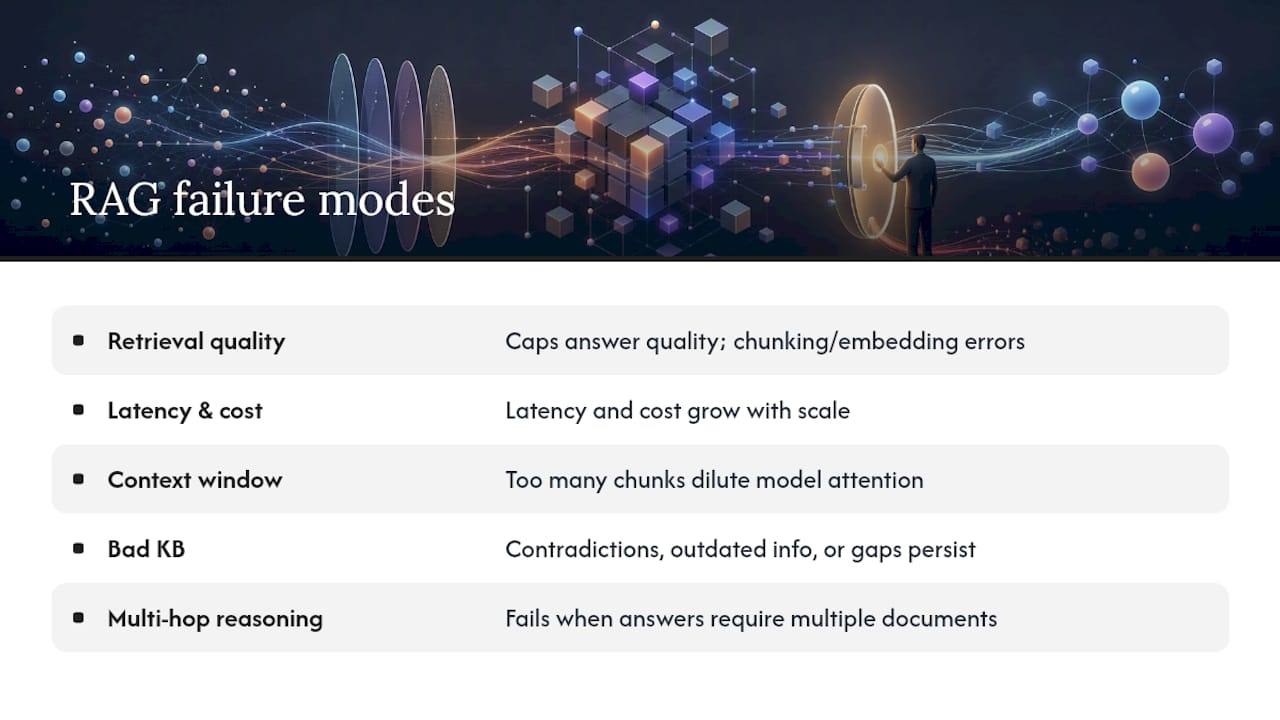
Retrieval quality caps answer quality. If the right document exists but chunking split it awkwardly, or the embedding model missed the semantic connection, the generator never gets a chance to answer well, no matter how capable the underlying model is. Debugging this requires tracing retrieval separately from generation, which most teams don’t set up until after their first embarrassing failure.
Latency stacks up. Query rewriting, hybrid search, reranking, and generation each add time, and a chain that feels fast in a demo with ten documents can feel sluggish at ten million. Cost follows the same curve, since every retrieval and rerank call has a price attached.
Context window limits still matter even with larger models. Stuffing too many retrieved chunks into a prompt to be safe often backfires, diluting the model’s attention and making it harder to find the actually relevant passage buried among near-duplicates.
RAG also doesn’t fix a genuinely bad knowledge base. Contradictory documents, outdated policies, or gaps in coverage will surface as inconsistent or wrong answers no matter how good the retrieval pipeline is. RAG can only ground answers in what’s actually there.
And multi-hop reasoning, where an answer requires connecting facts across several separate documents, remains a weak point. Standard retrieval finds documents similar to the query, not documents that together answer a question none of them fully addresses alone.
Droxy’s Take: Operationalizing RAG for Multi-Channel Customer Support
Most teams get the RAG pipeline right and still fail on the last mile: deploying it consistently across web chat, WhatsApp, Instagram, and phone without rebuilding grounding logic for each channel. That’s the gap Droxy’s knowledge integration and human handoff features are built to close, letting one grounded knowledge base power every channel a business actually uses. A solid pilot checklist starts small: one channel, one confidence threshold, real conversation logs reviewed weekly before expanding further.
— Droxy
How to Get Started With Droxy
Building and maintaining the RAG pipeline described here, ingestion, hybrid retrieval, confidence gating, evaluation loops, is real engineering work. Droxy gives you that architecture without the build. It connects to your existing documents, product catalogs, and support history, then deploys the same grounded agent across website chat, phone, WhatsApp, Instagram, Facebook, and Shopify from one dashboard instead of six separate integrations.
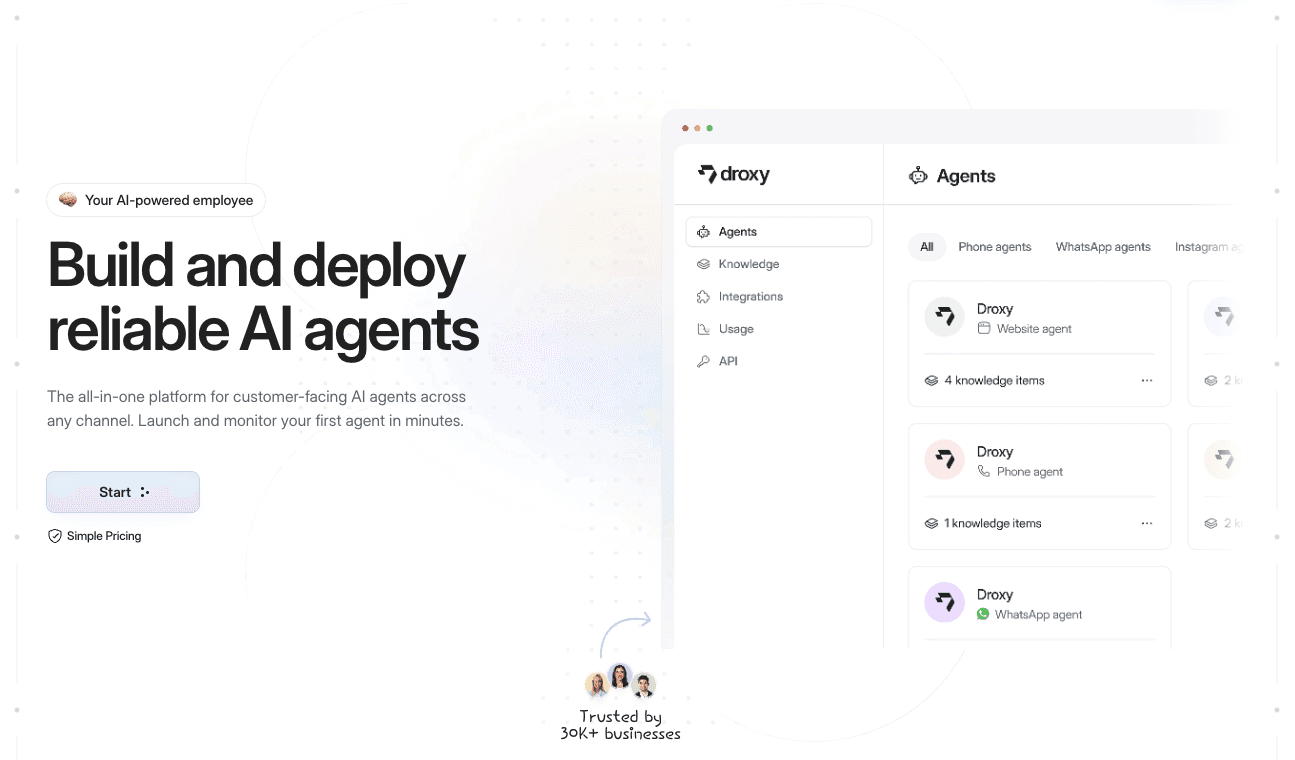
A demo walks through how Droxy handles knowledge ingestion from your actual sources, how human handoff triggers when the confidence gate comes up short, and what the analytics dashboard shows once conversations start flowing. Agencies managing this for multiple clients can also review the white-label partnership option built specifically for that use case.
If you’re ready to see what a grounded, multi-channel agent looks like running on your own content, check the plan options and get started today.
Sources
How to use metadata in RAG for better contextual results — Unstructured
RAG Chatbot Architecture: What production actually looks like — CloudNSite
Recommended
RAG, or retrieval-augmented generation, lets a chatbot pull relevant facts from your own data at the moment someone asks a question, then hands those facts to the language model as context before it answers. That grounding is what cuts hallucinations and lets you point to a real source behind every claim. Use RAG when your knowledge base is large, changes often, or contains private data. Skip it if you have fewer than 50 documents or the task is really about calling structured tools, not answering questions.
TL;DR:
RAG is most effective when managing large, frequently changing, or private data sources, especially with more than 50 documents.
Combining vector search with BM25 keyword matching improves retrieval accuracy for exact codes, IDs, and recency-sensitive information.
Proper chunking, metadata tagging, and filtering at ingestion are crucial to ensure retrieval accuracy and prevent sensitive data exposure.
Maintaining evaluation metrics like faithfulness, relevance, and recall through CI processes helps detect and prevent answer drift over time.
Using a hybrid approach, including fine-tuning and retrieval-only layers, can optimize cost, accuracy, and adaptability for specific domains.
Table of Contents
Why RAG Matters for Production Chatbots
RAG Architecture, Component by Component
Hybrid Retrieval and Metadata Filtering: The Production Case for Vectors Plus BM25
Ingestion and Chunking: Practical Rules to Maximize Retrievability
Grounding, Citations, and the Confidence Gate
Evaluation and Monitoring: The Metrics and CI Harness to Catch Drift
Concrete Tech Choices and Patterns You’ll Actually Use
RAG vs. Fine-Tuning vs. Retrieval-Only: Choosing the Right Approach
Security and Privacy Considerations When Using RAG With Sensitive Data
Best Practices for Updating and Maintaining the Knowledge Base
Challenges and Limitations of RAG in Chatbots
Droxy’s Take: Operationalizing RAG for Multi-Channel Customer Support
How to Get Started With Droxy
Sources
Why RAG Matters for Production Chatbots
RAG works in four moves: your documents get ingested and chunked, converted into vectors, retrieved when a question comes in, and passed to the model with instructions to answer using only that retrieved context. Each stage adds a decision point, and each decision point is where teams either build something reliable or build something that quietly drifts into wrong answers.
The business case is straightforward. RAG lets you keep the chatbot current without retraining a model every time a policy changes, ground answers in documents you actually own, and produce responses you can audit because every claim traces back to a retrieved passage. That auditability matters more than most teams realize until the first time a customer disputes what the bot told them.
The trade-offs are real too:
Latency: each additional retrieval or reranking step adds milliseconds to seconds of response time.
Cost: embedding, vector storage, and reranker calls all add up per query, especially at scale.
Complexity: you’re now maintaining a pipeline, not just a prompt.
None of these trade-offs are reasons to avoid RAG. They’re reasons to design the architecture deliberately instead of bolting a vector database onto a chatbot and hoping.
RAG Architecture, Component by Component
A production RAG chatbot architecture has six moving parts, and weak ingestion is the most common reason pilots fail before they ever reach production.
Ingestion comes first: parsers extract text from PDFs, HTML, transcripts, and spreadsheets, chunking splits that text into retrievable units, and enrichment attaches metadata like source, date, and access permissions. Skipping ACL tagging here is how sensitive documents end up surfaced to the wrong user later.
Embedding and vector storage come next. Your embedding model choice affects retrieval quality more than most teams budget time for. General-purpose embeddings work fine for broad content; domain-specific fine-tuned embeddings pay off when your corpus is full of jargon a generic model was never trained on. Vector store choice (managed versus self-hosted) is mostly an operations decision at this stage, not an accuracy one.
Retrieval should combine semantic search with keyword matching rather than relying on vectors alone, since hybrid retrieval catches exact tokens and acronyms that pure embeddings tend to miss.
Reranking reorders the retrieved candidates using a cross-encoder model that scores relevance more precisely than the initial retrieval step. It costs latency, so measure whether it actually moves your recall numbers before shipping it.
Generation assembles a prompt that instructs the model to answer only from retrieved context and cite its sources inline.
Orchestration ties it together: query rewriting, intent classification, and routing decide whether a query even needs retrieval at all.
Pro Tip: Classify intent before retrieval runs. Chit-chat and small talk don’t need a vector search, and skipping it on those turns saves latency and cost across your whole traffic volume.
Hybrid Retrieval and Metadata Filtering: The Production Case for Vectors Plus BM25
Pure semantic search fails in predictable ways. It struggles with exact product IDs, order numbers, and SKUs because embeddings capture meaning, not literal strings. It also has no built-in sense of recency, so a semantically similar but outdated document can outrank the current one. Vector-only retrieval for a chatbot handling account numbers or ticket IDs will frustrate users fast.
BM25, the classic keyword-matching algorithm, catches exactly the queries embeddings miss: exact codes, acronyms, precise phrases. Combining it with vector search through a fusion method like Reciprocal Rank Fusion (RRF) gives you both conceptual recall and lexical precision. A HYBRID_ALPHA parameter typically controls the weighting between the two, and most teams start around 0.5 and tune from there based on eval results.
Metadata filtering has to happen before this fusion step, not after. Filtering before retrieval keeps documents a user lacks permission to see out of the search entirely, rather than retrieving them and hoping the model ignores them.
A few practical defaults worth starting from:
Retrieve a pool of 20 to 50 candidates before reranking narrows it to the top 3 to 5.
Tag every chunk with tenant ID, access level, and source date at ingest time, not after.
Re-run your
HYBRID_ALPHAtuning whenever you add a new content type to the corpus.
Ingestion and Chunking: Practical Rules to Maximize Retrievability
Chunking decisions determine whether retrieval finds the right passage or a fragment that’s technically related but useless. Chunking strategy should follow the natural structure of the source rather than splitting text into fixed-size blocks blindly.
Chunk by semantic boundaries. Split on headings, numbered steps, or procedure boundaries instead of a fixed character count. Use an overlap of roughly 10% to 20% of chunk length so context doesn’t get severed mid-thought.
Adjust by format. PDFs need table-aware extraction so numbers don’t get scrambled across columns. Transcripts chunk better by speaker turn than by arbitrary word count. Code should chunk by function or class. CSVs often work best summarized row-by-row into natural language rather than dumped raw.
Capture metadata that supports filtering later: source name, document date, department owner, and access tier. This is what lets your retriever apply permissions and recency boosts without touching the embedding itself.
Set a refresh cadence. Static policy documents might reindex weekly; live inventory or pricing data needs near-real-time incremental updates, not a full reindex, to stay affordable at scale.
Getting this stage right prevents most of the downstream accuracy problems teams try to solve with bigger models later.
Grounding, Citations, and the Confidence Gate
A grounded chatbot cites its sources inline and refuses to answer when the evidence underneath it is thin. Both behaviors need to be engineered deliberately, not assumed.
Prompt contracts should instruct the model explicitly: answer only using the retrieved context, cite the source for each claim, and say it doesn’t know rather than guess when the context doesn’t cover the question. Models will still guess if you don’t forbid it plainly.
The confidence gate is what makes refusal reliable instead of arbitrary. A gate combining average cosine similarity, a minimum top-K chunk count, and a semantic drift check gives you a deterministic, testable refusal policy rather than a vague “if unsure” instruction buried in a prompt.
If average similarity falls below your threshold, refuse rather than answer.
If fewer than your minimum chunk count is retrieved, treat the query as out of scope.
For high-stakes domains (medical, legal, financial), add a verifier pass or route straight to a human.
Refusal phrasing matters for user experience. “I don’t have enough information to answer that confidently, let me connect you with our team” performs far better than a flat error message, because it keeps the interaction moving instead of dead-ending the user.
Evaluation and Monitoring: The Metrics and CI Harness to Catch Drift
Four metrics form the core of a RAG evaluation harness: faithfulness (does the answer actually match the retrieved context), answer relevancy (does it address the question asked), context precision (how much of what’s retrieved is actually useful), and context recall (did retrieval find all relevant content).
Build an eval set of representative queries pulled from real user questions.
Gate deployments in CI: block a release if faithfulness or recall drops below your baseline on that eval set.
Instrument production with traces, human feedback capture on flagged answers, and dashboards tracking latency and cost per query.
Only add expensive steps like reranking or a verifier pass once eval results show retrieval precision is the actual bottleneck, not a guess.
Without this loop, drift is invisible until customers notice it first.
Concrete Tech Choices and Patterns You’ll Actually Use
A typical 2026 stack pairs an embedding model with a vector store (Qdrant, FAISS, or pgvector), a BM25 layer for sparse search, a cross-encoder reranker, and an LLM for generation, orchestrated through LangChain or LlamaIndex.
Use LangChain or LlamaIndex for orchestration, but avoid the anti-pattern of chaining five agent calls when a single well-prompted retrieval step would do.
Cache embeddings for static content and stream generation output so users see progress instead of a blank pause.
Cross-encoder rerankers earn their latency cost mainly when your recall@5 is below target. If retrieval is already strong, skip it and save the milliseconds.
Prefer managed vector databases early in a pilot; migrate to self-hosted once query volume justifies the operational overhead.
RAG vs. Fine-Tuning vs. Retrieval-Only: Choosing the Right Approach
RAG, end-to-end fine-tuning, and retrieval-only search solve different problems, and conflating them is where a lot of chatbot training data gets wasted.
Fine-tuning bakes knowledge into model weights. It works well for teaching a model a consistent tone, format, or reasoning pattern, but it’s a poor fit for facts that change weekly, because every update means retraining. It’s also opaque: you can’t point to which training example produced a given answer, which makes auditing nearly impossible.
Retrieval-only systems, the search-and-return approach without generation, skip hallucination risk entirely because they never write new sentences. But they hand the user a list of documents instead of a direct answer, which is a worse experience for anything beyond a knowledge-base search bar.
RAG sits between the two: it gets the freshness and auditability of retrieval with the natural conversational fluency of generation. For a customer support chatbot answering questions from policies, product catalogs, or support tickets, that combination usually wins over either extreme. The exception is narrow, stable domains where fine-tuning a smaller model on a fixed set of intents can be cheaper to run at scale, once the knowledge truly stops changing.
Most production teams end up combining approaches: a fine-tuned model for tone and format, RAG for facts, and a thin retrieval-only layer for edge cases where a document link genuinely beats a generated summary.
Security and Privacy Considerations When Using RAG With Sensitive Data
A RAG pipeline that retrieves from private data is only as secure as its weakest filtering step, and that step is almost always metadata enforcement.
Access control needs to live at the retrieval layer, not the generation layer. If a document a user shouldn’t see gets retrieved and handed to the model, trusting the model to withhold it is a bad bet. Tenant ID, access tier, and document sensitivity should be first-class metadata fields set at ingest time, filtered before the search runs, not after.
For regulated data (health records, financial details, personal identifiers), consider whether the raw text needs to enter the vector store at all. Redaction or tokenization before embedding reduces exposure if the vector database itself is ever compromised.
Logging is another blind spot. Retrieval traces and generated answers often get logged for debugging, and those logs can leak the same sensitive content the ACL was designed to protect. Apply the same access rules to your logs and traces that you apply to the retriever.
Finally, treat your embedding provider as part of your data supply chain. If you’re sending document chunks to a third-party embedding API, understand what that provider retains and for how long. For genuinely sensitive corpora, a self-hosted embedding model removes that question entirely, at the cost of infrastructure you now have to maintain yourself.
None of this is exotic security work. It’s the same principle of least privilege applied to a new kind of index, and skipping it is how a helpful chatbot becomes a data breach.
Best Practices for Updating and Maintaining the Knowledge Base
A knowledge base that isn’t maintained decays quietly. The chatbot keeps answering confidently; it just starts answering from outdated information nobody flagged.
Set an explicit refresh cadence tied to how often each content type actually changes. Pricing and inventory need near-real-time updates. Policy documents might refresh weekly. Historical reference material might never need touching again. Treating all content with the same reindex schedule wastes compute on stable content and under-serves the volatile parts.
Version your index. When you update a document, don’t just overwrite the old chunks; track which version a given answer’s citation pointed to, so a support dispute can be traced back to what the bot actually saw at the time.
Build a feedback loop from real usage. Flagged or low-confidence answers from your confidence gate are a direct signal about which parts of the knowledge base are thin or contradictory. Route those flags to whoever owns the source content, not just to an engineering backlog.
Retire stale content deliberately. An old promotion or a deprecated product page sitting in your vector store is a live hazard, since it can still get retrieved and cited months after it stopped being true. Deletion and expiration policies deserve the same rigor as ingestion policies.
Finally, re-run your evaluation set after every meaningful knowledge base update. A single new document set can shift retrieval behavior across unrelated queries in ways that aren’t obvious until you measure them.
Challenges and Limitations of RAG in Chatbots
RAG solves hallucination from missing knowledge, but it introduces its own failure modes that teams underestimate going in.
Retrieval quality caps answer quality. If the right document exists but chunking split it awkwardly, or the embedding model missed the semantic connection, the generator never gets a chance to answer well, no matter how capable the underlying model is. Debugging this requires tracing retrieval separately from generation, which most teams don’t set up until after their first embarrassing failure.
Latency stacks up. Query rewriting, hybrid search, reranking, and generation each add time, and a chain that feels fast in a demo with ten documents can feel sluggish at ten million. Cost follows the same curve, since every retrieval and rerank call has a price attached.
Context window limits still matter even with larger models. Stuffing too many retrieved chunks into a prompt to be safe often backfires, diluting the model’s attention and making it harder to find the actually relevant passage buried among near-duplicates.
RAG also doesn’t fix a genuinely bad knowledge base. Contradictory documents, outdated policies, or gaps in coverage will surface as inconsistent or wrong answers no matter how good the retrieval pipeline is. RAG can only ground answers in what’s actually there.
And multi-hop reasoning, where an answer requires connecting facts across several separate documents, remains a weak point. Standard retrieval finds documents similar to the query, not documents that together answer a question none of them fully addresses alone.
Droxy’s Take: Operationalizing RAG for Multi-Channel Customer Support
Most teams get the RAG pipeline right and still fail on the last mile: deploying it consistently across web chat, WhatsApp, Instagram, and phone without rebuilding grounding logic for each channel. That’s the gap Droxy’s knowledge integration and human handoff features are built to close, letting one grounded knowledge base power every channel a business actually uses. A solid pilot checklist starts small: one channel, one confidence threshold, real conversation logs reviewed weekly before expanding further.
— Droxy
How to Get Started With Droxy
Building and maintaining the RAG pipeline described here, ingestion, hybrid retrieval, confidence gating, evaluation loops, is real engineering work. Droxy gives you that architecture without the build. It connects to your existing documents, product catalogs, and support history, then deploys the same grounded agent across website chat, phone, WhatsApp, Instagram, Facebook, and Shopify from one dashboard instead of six separate integrations.
A demo walks through how Droxy handles knowledge ingestion from your actual sources, how human handoff triggers when the confidence gate comes up short, and what the analytics dashboard shows once conversations start flowing. Agencies managing this for multiple clients can also review the white-label partnership option built specifically for that use case.
If you’re ready to see what a grounded, multi-channel agent looks like running on your own content, check the plan options and get started today.
Sources
How to use metadata in RAG for better contextual results — Unstructured
RAG Chatbot Architecture: What production actually looks like — CloudNSite
Recommended


🚀
Powered by Droxy
Turn every interaction into a conversion
Customer facing AI agents that engage, convert, and support so you can scale what matters.
✨
Learn more
Recent posts
Insights
3 min read
Introducing Agent Memories
Improve your agents' performance with Agent Memories. Prevent agents from repeating the same mistakes by giving them feedback.
Read more

Insights
15 min read
HVAC Marketing in 2025: The Definitive Lead Gen Guide
Discover 15 proven HVAC marketing strategies, plus learn how Droxy's AI website agent converts curious visitors into qualified leads by answering their questions instantly - right when they're most interested in your services.
Read more
Insights
10 min read
10 Best AI Sales Agents in 2025: Tested & Ranked
Discover the top 10 AI sales agents of 2025, designed to enhance lead generation, personalize outreach, and ultimately, close more deals
Read more
Insights
3 min read
Introducing Agent Memories
Improve your agents' performance with Agent Memories. Prevent agents from repeating the same mistakes by giving them feedback.
Read more
Insights
15 min read
HVAC Marketing in 2025: The Definitive Lead Gen Guide
Discover 15 proven HVAC marketing strategies, plus learn how Droxy's AI website agent converts curious visitors into qualified leads by answering their questions instantly - right when they're most interested in your services.
Read more