How to Reduce Chat Abandonment and Keep Customers Talking
How to Reduce Chat Abandonment and Keep Customers Talking
Insights
15 min

To reduce chat abandonment, answer faster, ask less before you help, route each chat by what the customer needs, and make a human one click away. Customers rarely leave a chat because they dislike chat. They leave because the first useful reply took too long or never came. This guide shows you how to measure the problem, fix its main causes and prove the fix worked.
DroxyKeep Customers Talking With Faster AnswersDroxy deploys AI agents that answer customer questions 24/7 across website chat and other channels, helping reduce wait times and missed inquiries.Explore Droxy
TL;DR
Chat abandonment rate is abandoned chats divided by chats started, times 100. Track it weekly, by channel and by hour.
Slow first replies and long “setup loops” of repeated questions push people out before they get help.
Instant answers to routine questions, 24/7, plus a clear hand-off to a person for complex ones, cover most of the gap.
Route by customer intent, not by vague department names, and test one change at a time.
Each industry loses chats at different moments: ecommerce at checkout, healthcare after hours, real estate on new inquiries.
Table of Contents
What chat abandonment is and how to calculate it
Why customers abandon chats before they get help
Eight fixes that lower your abandonment rate
What to change first in your industry
Our perspective
How to measure whether your changes worked
Where to start with Droxy
Sources
What chat abandonment is and how to calculate it
Chat abandonment is the share of started chats that end before the customer gets an answer or reaches a person. A visitor opens the widget, types a question or just looks at it, waits, and leaves. That is one abandoned chat, and usually one lost sale, booking or lead.
The formula is simple. Count Technologies defines it as abandoned conversations divided by total initiated conversations, multiplied by 100.
A worked example from KPI Tree makes it concrete: if 1,000 people open a chat in a week and 220 close the window or stop replying without getting an answer or being connected to support, the abandonment rate is 22%.
Before you set targets, decide three things so the number stays honest:
What counts as started. A chat where the visitor typed at least one message is cleaner than one where they only opened the widget.
What counts as abandoned. Pick a silence window, for example 5 minutes after the last customer message with no resolution, and keep it the same every week.
How you segment. Split by channel (website, WhatsApp, Instagram, Facebook), by hour of day, by page and by topic. A single blended number hides the real leak.
Why customers abandon chats before they get help
Most abandonment comes from four causes. You can fix each of them.
Waiting for the first reply
A chat is a promise of speed. When the window says someone is here and nobody answers for minutes, the visitor assumes the answer is no. Evenings, weekends and lunch rushes are the usual weak spots, because that is when small teams are busy or offline.
Too many questions before the first answer
Automation can create abandonment when it interrogates people. Conviva research reported by Reuters found that consumer-facing AI agents spend an average of 2 minutes 32 seconds gathering basic context before addressing the request, and that this setup loop drives 8.5% of shoppers to abandon the session before receiving help.
The lesson is not to avoid automation. It is to design it so the agent already knows what it needs, or answers first and asks second. The role chatbots play in business success depends on exactly this: a bot that makes people repeat themselves loses them.

Wrong answers and dead ends
Generic replies, loops of “I did not understand that” and transfers to the wrong team all end the same way. The customer closes the tab. Accuracy comes from the knowledge behind the agent, not from the widget design.
No way to reach a person
Some questions need judgment: a refund exception, an upset customer, a medical concern, a large order. If the customer cannot find a path to a human, they leave rather than fight the bot.
Eight fixes that lower your abandonment rate
1. Make the first response instant
The fastest single change is removing the wait. An AI agent answers in seconds, at 2 p.m. or 2 a.m., on a holiday or during your busiest hour. That is the core of what Droxy is built for: instant, 24/7 answers so inquiries are not missed while your team is offline or busy.
Start by listing the ten questions your team answers most often: hours, shipping, pricing ranges, availability, service areas, return rules. Those are documented, repeatable answers, and they make up the bulk of most chat volume.
2. Answer first, then ask
If someone types “Do you ship to Canada?”, the reply should say yes or no, then offer to help with the order. Do not open with a form asking for name, email and order number. Collect details when they are needed for the next step, such as booking an appointment or sending a quote.
A good test: count the messages between the customer’s first question and the first useful answer. If it is more than one, shorten it.
3. Feed the agent real knowledge
An agent that answers correctly keeps people in the chat. Droxy lets you bring in knowledge from multiple sources, so answers reflect your actual policies, catalog and services rather than generic text. Keep that material current: when a price, a policy or an opening time changes, update the source the same day. Our guide on how to train a chatbot walks through the process step by step.
4. Route by intent, not by department
When a chat does need a person, send it to the right one the first time. Routing guidance favors mapping chats to specific issue intents such as payment failure, login trouble, onboarding help or a bug report, rather than broad team names, because it cuts misrouted transfers and makes reporting clearer. For home services that might be “emergency repair,” “quote request” and “reschedule.” For a clinic: “new patient,” “prescription refill question,” “billing.”
If you want the technical detail, see our piece on three-tier intent detection for routing.
5. Make the human hand-off obvious and warm
Automation should handle the routine and pass the rest on with the conversation attached, so the customer never repeats themselves. Good triggers include a customer asking for a person, repeated confusion, negative sentiment, high order value and sensitive topics. Write the hand-off message in your brand voice and say what happens next: who is coming, and roughly when.
We cover rules and triggers in detail in chatbot escalation policies.
6. Set honest wait-time messages
If a person is needed and the team is busy, say so, and give the customer a choice: wait, leave an email or phone number, or book a time. A visible, truthful message beats a spinning indicator. When your team is offline, let the agent capture the lead and promise a specific follow-up window you can keep.
7. Meet customers on the channel they chose
A shopper who starts on Instagram does not want to be sent to a web form. A guest who texts on WhatsApp expects replies there. Covering every channel with the same knowledge and tone prevents handoffs that drop the conversation. Droxy deploys agents on website chat, phone, WhatsApp, Instagram and Facebook, plus Shopify, so a customer finds the same helpful answer wherever they ask.
8. Sound like your business
People abandon replies that feel robotic. Customize the agent’s tone, greeting and phrasing to match how your staff would speak. Short sentences, plain words and a named, friendly opening do more than any widget color. Our prompt engineering guide for chatbots shows how to shape that voice reliably.
What to change first in your industry
The same fixes apply everywhere, but the leak is in a different place for each business.
Industry | Where chats are lost | First fix to try |
|---|---|---|
Ecommerce | Pre-purchase questions on product, shipping and returns pages | Instant answers on policy questions, product recommendations in chat |
Hospitality | Availability and booking questions, often late at night | 24/7 replies with booking help, multilingual answers for guests |
Home services | Urgent quote requests outside office hours | Automated lead capture, appointment booking, clear hand-off for emergencies |
Real estate | New listing inquiries that go cold within hours | Immediate reply, qualifying questions, viewing scheduling |
Healthcare practices | After-hours questions from patients | Routine answers on hours and services, fast escalation to staff for anything clinical |
A few notes on each:
Ecommerce. Shoppers ask about shipping cost and return rules right before paying. If chat answers in seconds, the question stops being a reason to leave. Keep a human path for order problems and high-value carts.
Hospitality. Travelers ask at all hours and in many languages. Multilingual support and booking help keep the conversation alive while your front desk is busy.
Home services. Someone with a leaking pipe contacts several companies and often hires the first one that answers. Capture the job details and book the visit while you are on the roof.
Real estate. Leads decay quickly. An instant answer with a viewing option beats a perfect reply tomorrow.
Healthcare. Let automation handle logistics such as hours, locations and appointment requests. Anything about symptoms or medication should go to your clinical staff, and your agent should say so plainly and point urgent cases to emergency services. Keep patient data handling in line with your own compliance obligations.
Our perspective
We built Droxy around a simple idea: a customer who asks a question deserves an answer in seconds, not a ticket number. Most abandoned chats are not hard cases. They are routine questions that arrived when nobody was free to answer.
That is why we put speed and tone first. An agent that replies instantly, sounds like your team and knows your actual policies removes the biggest reason people leave. Then the human hand-off does the rest: when a question needs judgment, your person steps in with the whole conversation in front of them.
We also think the old choice between a bot and a person is a false one. The best support setups use both, each where it is strongest. Automation covers every hour and every channel. Your people spend their time on the conversations that build loyalty.
If you start anywhere, start with your ten most common questions. Get those answered instantly and correctly, and watch your abandonment rate respond.
Elena
How to measure whether your changes worked
A lower number only matters if customers are better off. Track a small set of metrics together.
Chat abandonment rate, using the formula above, weekly and by channel.
Time to first response. If this falls and abandonment falls with it, speed was your leak.
Resolution rate without a human. It shows how many routine chats the agent closes on its own.
Hand-off rate and hand-off wait. Too high means the agent lacks knowledge. Too long means staffing or routing needs work.
Conversion from chat. Leads captured, bookings made and orders placed per 100 chats.
Customer satisfaction after chat, a one-tap rating at the end.
Run clean tests
Change one thing at a time and give each change at least two full weeks, so weekday and weekend patterns both show up. Good first tests:
Answer-first greeting versus a greeting that asks for contact details.
Agent online only during business hours versus 24/7.
Hand-off button visible from the first message versus after two exchanges.
Write the baseline down before you start. For example, if your rate is 22% on 1,000 weekly chats and a change brings it to 17%, you keep 50 more conversations alive every week. Multiply that by your average order or lead value to see what it is worth.
Watch the hours, too. If most abandonment happens between 6 p.m. and 8 a.m., coverage is the problem. If it happens mid-afternoon, look at your queue and routing.
Where to start with Droxy

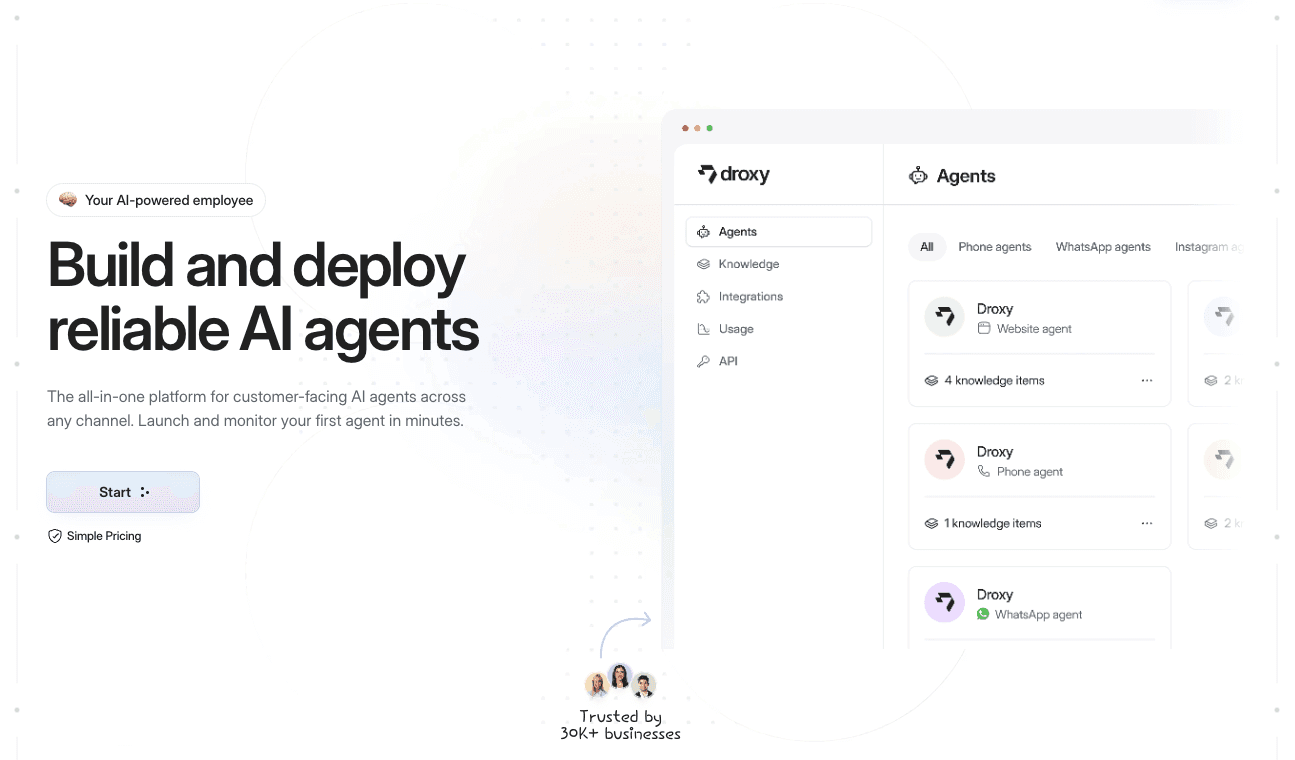
Droxy is a no-code platform, so you can build an agent trained on your own content, set its voice, connect it to your existing systems through API or Zapier, and publish it on the channels your customers already use. It handles lead capture, appointment booking, smart routing and human hand-off, and its analytics show you where conversations succeed or stall.
Plans start at $16 per month for Basic, $80 for Advanced and $240 for Enterprise. Agencies and consultants can also white-label agents for their own clients.
If your goal is to cut abandoned chats on your site first, begin with the website agent and add channels as you see results. You can also start from the Droxy homepage to see how it fits your business.
FAQ
What is a good chat abandonment rate?
There is no single number that fits every business, because it depends on your industry, traffic and how you define an abandoned chat. Set your own baseline for a few weeks, then aim to lower it steadily. Compare like with like: the same channel, the same silence window and the same hours.
Does a chatbot reduce chat abandonment or increase it?
It depends on the design. Agents that answer instantly and know your content keep people in the conversation. Agents that ask many questions before helping can push people out, as the Conviva findings on setup loops show. Answer first, ask only what you need, and offer a person when the question calls for one.
How fast should the first response be?
As fast as you can make it. An AI agent replies in seconds, which removes the wait that causes most early exits. If a person must answer, tell the customer when to expect them and offer a way to leave contact details.
Should every chat go to a human eventually?
No. Routine, documented questions such as hours, shipping, pricing ranges and availability can be fully handled by the agent. Send complex, emotional or high-stakes conversations to a person with the conversation history attached, so the customer does not repeat themselves.
How do I know which channel loses the most chats?
Segment your abandonment rate by channel and by hour, then compare. Website chat, WhatsApp, Instagram and Facebook often behave differently, so a blended number hides the leak. Fix the worst channel first, then roll the same knowledge and tone out to the rest.
Sources
Recommended
To reduce chat abandonment, answer faster, ask less before you help, route each chat by what the customer needs, and make a human one click away. Customers rarely leave a chat because they dislike chat. They leave because the first useful reply took too long or never came. This guide shows you how to measure the problem, fix its main causes and prove the fix worked.
DroxyKeep Customers Talking With Faster AnswersDroxy deploys AI agents that answer customer questions 24/7 across website chat and other channels, helping reduce wait times and missed inquiries.Explore Droxy
TL;DR
Chat abandonment rate is abandoned chats divided by chats started, times 100. Track it weekly, by channel and by hour.
Slow first replies and long “setup loops” of repeated questions push people out before they get help.
Instant answers to routine questions, 24/7, plus a clear hand-off to a person for complex ones, cover most of the gap.
Route by customer intent, not by vague department names, and test one change at a time.
Each industry loses chats at different moments: ecommerce at checkout, healthcare after hours, real estate on new inquiries.
Table of Contents
What chat abandonment is and how to calculate it
Why customers abandon chats before they get help
Eight fixes that lower your abandonment rate
What to change first in your industry
Our perspective
How to measure whether your changes worked
Where to start with Droxy
Sources
What chat abandonment is and how to calculate it
Chat abandonment is the share of started chats that end before the customer gets an answer or reaches a person. A visitor opens the widget, types a question or just looks at it, waits, and leaves. That is one abandoned chat, and usually one lost sale, booking or lead.
The formula is simple. Count Technologies defines it as abandoned conversations divided by total initiated conversations, multiplied by 100.
A worked example from KPI Tree makes it concrete: if 1,000 people open a chat in a week and 220 close the window or stop replying without getting an answer or being connected to support, the abandonment rate is 22%.
Before you set targets, decide three things so the number stays honest:
What counts as started. A chat where the visitor typed at least one message is cleaner than one where they only opened the widget.
What counts as abandoned. Pick a silence window, for example 5 minutes after the last customer message with no resolution, and keep it the same every week.
How you segment. Split by channel (website, WhatsApp, Instagram, Facebook), by hour of day, by page and by topic. A single blended number hides the real leak.
Why customers abandon chats before they get help
Most abandonment comes from four causes. You can fix each of them.
Waiting for the first reply
A chat is a promise of speed. When the window says someone is here and nobody answers for minutes, the visitor assumes the answer is no. Evenings, weekends and lunch rushes are the usual weak spots, because that is when small teams are busy or offline.
Too many questions before the first answer
Automation can create abandonment when it interrogates people. Conviva research reported by Reuters found that consumer-facing AI agents spend an average of 2 minutes 32 seconds gathering basic context before addressing the request, and that this setup loop drives 8.5% of shoppers to abandon the session before receiving help.
The lesson is not to avoid automation. It is to design it so the agent already knows what it needs, or answers first and asks second. The role chatbots play in business success depends on exactly this: a bot that makes people repeat themselves loses them.
Wrong answers and dead ends
Generic replies, loops of “I did not understand that” and transfers to the wrong team all end the same way. The customer closes the tab. Accuracy comes from the knowledge behind the agent, not from the widget design.
No way to reach a person
Some questions need judgment: a refund exception, an upset customer, a medical concern, a large order. If the customer cannot find a path to a human, they leave rather than fight the bot.
Eight fixes that lower your abandonment rate
1. Make the first response instant
The fastest single change is removing the wait. An AI agent answers in seconds, at 2 p.m. or 2 a.m., on a holiday or during your busiest hour. That is the core of what Droxy is built for: instant, 24/7 answers so inquiries are not missed while your team is offline or busy.
Start by listing the ten questions your team answers most often: hours, shipping, pricing ranges, availability, service areas, return rules. Those are documented, repeatable answers, and they make up the bulk of most chat volume.
2. Answer first, then ask
If someone types “Do you ship to Canada?”, the reply should say yes or no, then offer to help with the order. Do not open with a form asking for name, email and order number. Collect details when they are needed for the next step, such as booking an appointment or sending a quote.
A good test: count the messages between the customer’s first question and the first useful answer. If it is more than one, shorten it.
3. Feed the agent real knowledge
An agent that answers correctly keeps people in the chat. Droxy lets you bring in knowledge from multiple sources, so answers reflect your actual policies, catalog and services rather than generic text. Keep that material current: when a price, a policy or an opening time changes, update the source the same day. Our guide on how to train a chatbot walks through the process step by step.
4. Route by intent, not by department
When a chat does need a person, send it to the right one the first time. Routing guidance favors mapping chats to specific issue intents such as payment failure, login trouble, onboarding help or a bug report, rather than broad team names, because it cuts misrouted transfers and makes reporting clearer. For home services that might be “emergency repair,” “quote request” and “reschedule.” For a clinic: “new patient,” “prescription refill question,” “billing.”
If you want the technical detail, see our piece on three-tier intent detection for routing.
5. Make the human hand-off obvious and warm
Automation should handle the routine and pass the rest on with the conversation attached, so the customer never repeats themselves. Good triggers include a customer asking for a person, repeated confusion, negative sentiment, high order value and sensitive topics. Write the hand-off message in your brand voice and say what happens next: who is coming, and roughly when.
We cover rules and triggers in detail in chatbot escalation policies.
6. Set honest wait-time messages
If a person is needed and the team is busy, say so, and give the customer a choice: wait, leave an email or phone number, or book a time. A visible, truthful message beats a spinning indicator. When your team is offline, let the agent capture the lead and promise a specific follow-up window you can keep.
7. Meet customers on the channel they chose
A shopper who starts on Instagram does not want to be sent to a web form. A guest who texts on WhatsApp expects replies there. Covering every channel with the same knowledge and tone prevents handoffs that drop the conversation. Droxy deploys agents on website chat, phone, WhatsApp, Instagram and Facebook, plus Shopify, so a customer finds the same helpful answer wherever they ask.
8. Sound like your business
People abandon replies that feel robotic. Customize the agent’s tone, greeting and phrasing to match how your staff would speak. Short sentences, plain words and a named, friendly opening do more than any widget color. Our prompt engineering guide for chatbots shows how to shape that voice reliably.
What to change first in your industry
The same fixes apply everywhere, but the leak is in a different place for each business.
Industry | Where chats are lost | First fix to try |
|---|---|---|
Ecommerce | Pre-purchase questions on product, shipping and returns pages | Instant answers on policy questions, product recommendations in chat |
Hospitality | Availability and booking questions, often late at night | 24/7 replies with booking help, multilingual answers for guests |
Home services | Urgent quote requests outside office hours | Automated lead capture, appointment booking, clear hand-off for emergencies |
Real estate | New listing inquiries that go cold within hours | Immediate reply, qualifying questions, viewing scheduling |
Healthcare practices | After-hours questions from patients | Routine answers on hours and services, fast escalation to staff for anything clinical |
A few notes on each:
Ecommerce. Shoppers ask about shipping cost and return rules right before paying. If chat answers in seconds, the question stops being a reason to leave. Keep a human path for order problems and high-value carts.
Hospitality. Travelers ask at all hours and in many languages. Multilingual support and booking help keep the conversation alive while your front desk is busy.
Home services. Someone with a leaking pipe contacts several companies and often hires the first one that answers. Capture the job details and book the visit while you are on the roof.
Real estate. Leads decay quickly. An instant answer with a viewing option beats a perfect reply tomorrow.
Healthcare. Let automation handle logistics such as hours, locations and appointment requests. Anything about symptoms or medication should go to your clinical staff, and your agent should say so plainly and point urgent cases to emergency services. Keep patient data handling in line with your own compliance obligations.
Our perspective
We built Droxy around a simple idea: a customer who asks a question deserves an answer in seconds, not a ticket number. Most abandoned chats are not hard cases. They are routine questions that arrived when nobody was free to answer.
That is why we put speed and tone first. An agent that replies instantly, sounds like your team and knows your actual policies removes the biggest reason people leave. Then the human hand-off does the rest: when a question needs judgment, your person steps in with the whole conversation in front of them.
We also think the old choice between a bot and a person is a false one. The best support setups use both, each where it is strongest. Automation covers every hour and every channel. Your people spend their time on the conversations that build loyalty.
If you start anywhere, start with your ten most common questions. Get those answered instantly and correctly, and watch your abandonment rate respond.
Elena
How to measure whether your changes worked
A lower number only matters if customers are better off. Track a small set of metrics together.
Chat abandonment rate, using the formula above, weekly and by channel.
Time to first response. If this falls and abandonment falls with it, speed was your leak.
Resolution rate without a human. It shows how many routine chats the agent closes on its own.
Hand-off rate and hand-off wait. Too high means the agent lacks knowledge. Too long means staffing or routing needs work.
Conversion from chat. Leads captured, bookings made and orders placed per 100 chats.
Customer satisfaction after chat, a one-tap rating at the end.
Run clean tests
Change one thing at a time and give each change at least two full weeks, so weekday and weekend patterns both show up. Good first tests:
Answer-first greeting versus a greeting that asks for contact details.
Agent online only during business hours versus 24/7.
Hand-off button visible from the first message versus after two exchanges.
Write the baseline down before you start. For example, if your rate is 22% on 1,000 weekly chats and a change brings it to 17%, you keep 50 more conversations alive every week. Multiply that by your average order or lead value to see what it is worth.
Watch the hours, too. If most abandonment happens between 6 p.m. and 8 a.m., coverage is the problem. If it happens mid-afternoon, look at your queue and routing.
Where to start with Droxy
Droxy is a no-code platform, so you can build an agent trained on your own content, set its voice, connect it to your existing systems through API or Zapier, and publish it on the channels your customers already use. It handles lead capture, appointment booking, smart routing and human hand-off, and its analytics show you where conversations succeed or stall.
Plans start at $16 per month for Basic, $80 for Advanced and $240 for Enterprise. Agencies and consultants can also white-label agents for their own clients.
If your goal is to cut abandoned chats on your site first, begin with the website agent and add channels as you see results. You can also start from the Droxy homepage to see how it fits your business.
FAQ
What is a good chat abandonment rate?
There is no single number that fits every business, because it depends on your industry, traffic and how you define an abandoned chat. Set your own baseline for a few weeks, then aim to lower it steadily. Compare like with like: the same channel, the same silence window and the same hours.
Does a chatbot reduce chat abandonment or increase it?
It depends on the design. Agents that answer instantly and know your content keep people in the conversation. Agents that ask many questions before helping can push people out, as the Conviva findings on setup loops show. Answer first, ask only what you need, and offer a person when the question calls for one.
How fast should the first response be?
As fast as you can make it. An AI agent replies in seconds, which removes the wait that causes most early exits. If a person must answer, tell the customer when to expect them and offer a way to leave contact details.
Should every chat go to a human eventually?
No. Routine, documented questions such as hours, shipping, pricing ranges and availability can be fully handled by the agent. Send complex, emotional or high-stakes conversations to a person with the conversation history attached, so the customer does not repeat themselves.
How do I know which channel loses the most chats?
Segment your abandonment rate by channel and by hour, then compare. Website chat, WhatsApp, Instagram and Facebook often behave differently, so a blended number hides the leak. Fix the worst channel first, then roll the same knowledge and tone out to the rest.
Sources
Recommended


🚀
Powered by Droxy
Turn every interaction into a conversion
Customer facing AI agents that engage, convert, and support so you can scale what matters.
✨
Learn more
Recent posts
Insights
3 min read
Introducing Agent Memories
Improve your agents' performance with Agent Memories. Prevent agents from repeating the same mistakes by giving them feedback.
Read more

Insights
15 min read
HVAC Marketing in 2025: The Definitive Lead Gen Guide
Discover 15 proven HVAC marketing strategies, plus learn how Droxy's AI website agent converts curious visitors into qualified leads by answering their questions instantly - right when they're most interested in your services.
Read more
Insights
10 min read
10 Best AI Sales Agents in 2025: Tested & Ranked
Discover the top 10 AI sales agents of 2025, designed to enhance lead generation, personalize outreach, and ultimately, close more deals
Read more
Insights
3 min read
Introducing Agent Memories
Improve your agents' performance with Agent Memories. Prevent agents from repeating the same mistakes by giving them feedback.
Read more
Insights
15 min read
HVAC Marketing in 2025: The Definitive Lead Gen Guide
Discover 15 proven HVAC marketing strategies, plus learn how Droxy's AI website agent converts curious visitors into qualified leads by answering their questions instantly - right when they're most interested in your services.
Read more