2–4 Week Pilot: Sentiment Analysis Chatbot for Support & Product Teams
2–4 Week Pilot: Sentiment Analysis Chatbot for Support & Product Teams
Insights
17 min
2–4 Week Pilot: Sentiment Analysis Chatbot for Support & Product Teams
Add sentiment analysis to your chatbot when support volume is high enough that agents cannot manually triage every angry message, and you want faster escalation, better CSAT, and fewer customers slipping away unnoticed. The system scores each message with a polarity label, an emotion category, and a confidence value, then your chatbot uses that output to route, apologize, or hand off before a frustrated customer ever asks for a human.
TL;DR:
Sentiment analysis enhances chatbot escalation by accurately routing angry or frustrated customers based on emotion and polarity scores.
Transformer-based models offer higher nuance but increase latency and require more training, impacting real-time response quality.
Proper implementation involves validating models with real customer conversations and setting conservative confidence thresholds to reduce false triggers.
Negative sentiment signals should be integrated into response triggers and escalation workflows to improve customer satisfaction and resolution speed.
Pilot projects should start small, focus on high-impact channels like WhatsApp, and avoid broad deployment until model performance stabilizes.
DroxyKeep Customer Conversations MovingDroxy helps businesses provide instant, human-like answers across chat, phone, WhatsApp, social channels, and Shopify.Explore Droxy
Table of Contents
What Is a Sentiment Analysis Chatbot and How Does It Work?
How Does Sentiment Detection Fit Into a Chatbot Pipeline?
Step-by-Step Implementation Checklist: Prototype to Production
Wiring Sentiment Into Flow: Triggers, Thresholds, and Response Patterns
Evaluation and Validation: Metrics and Workflows to Trust the Signals
Operational Workflows and Reporting That Turn Sentiment Into Outcomes
What Are the Common Pitfalls in Chatbot Sentiment Analysis?
How Droxy Helps You Deploy Sentiment-Aware Agents Across Channels
What I’ve Learned Watching These Rollouts Play Out
Ready to Pilot Sentiment-Aware Support?
Sources
What Is a Sentiment Analysis Chatbot and How Does It Work?
A sentiment analysis chatbot reads the emotional tone of a customer’s message and adjusts its response or routing based on that reading. It is not one algorithm. It is a category of approaches, each with different costs and blind spots.
Polarity scoring sorts text into positive, negative, or neutral. Emotion classification goes further, tagging specific states like anger, joy, sadness, or frustration. The second approach gives your chatbot richer context, but it needs more training data and tends to run slower.
Four technical approaches dominate production systems today:
Lexicon-based models score words against a predefined dictionary of sentiment values. Fast and cheap, but blind to context and sarcasm.
Classical machine learning (Naive Bayes, SVM) trains on labeled examples using features like TF-IDF. Better than lexicons, still limited on nuance.
Transformer-based models (RoBERTa, BERT variants) understand context and word order, catching tone shifts lexicons miss.
Hybrid and multimodal systems combine text with signals like response speed or punctuation intensity for a fuller emotional picture.
The trade-off is consistent across all four: more accuracy usually means more latency and less explainability. A lexicon model tells you exactly why it flagged a message. A transformer model gives you a confidence score and a black box.
How Does Sentiment Detection Fit Into a Chatbot Pipeline?
Sentiment analysis is not a bolt-on feature. It sits inside the same pipeline that handles intent recognition and response generation, and it needs clean input to work.
Preprocessing. Normalize text, expand contractions, handle negations (“not happy” reads very differently from “happy”), and account for emojis and slang. Skip this step and your accuracy drops fast, especially on mobile-first channels like WhatsApp where shorthand is common.
Feature extraction. Older systems used TF-IDF or word2vec. Modern pipelines favor contextual embeddings from transformer models. Projects like EmoBot v2 fine-tune XLM-RoBERTa on the GoEmotions dataset, which covers 28 distinct emotion labels rather than a simple three-way split.
Model choice. Decide between an API call to a hosted sentiment service or a self-hosted, fine-tuned model. APIs get you running in days; self-hosted models cost more engineering time but give you control over latency and domain accuracy.
Confidence reading. Every prediction comes with a confidence score. Treat low-confidence outputs (typically below 70%) as “unknown” rather than forcing a decision.
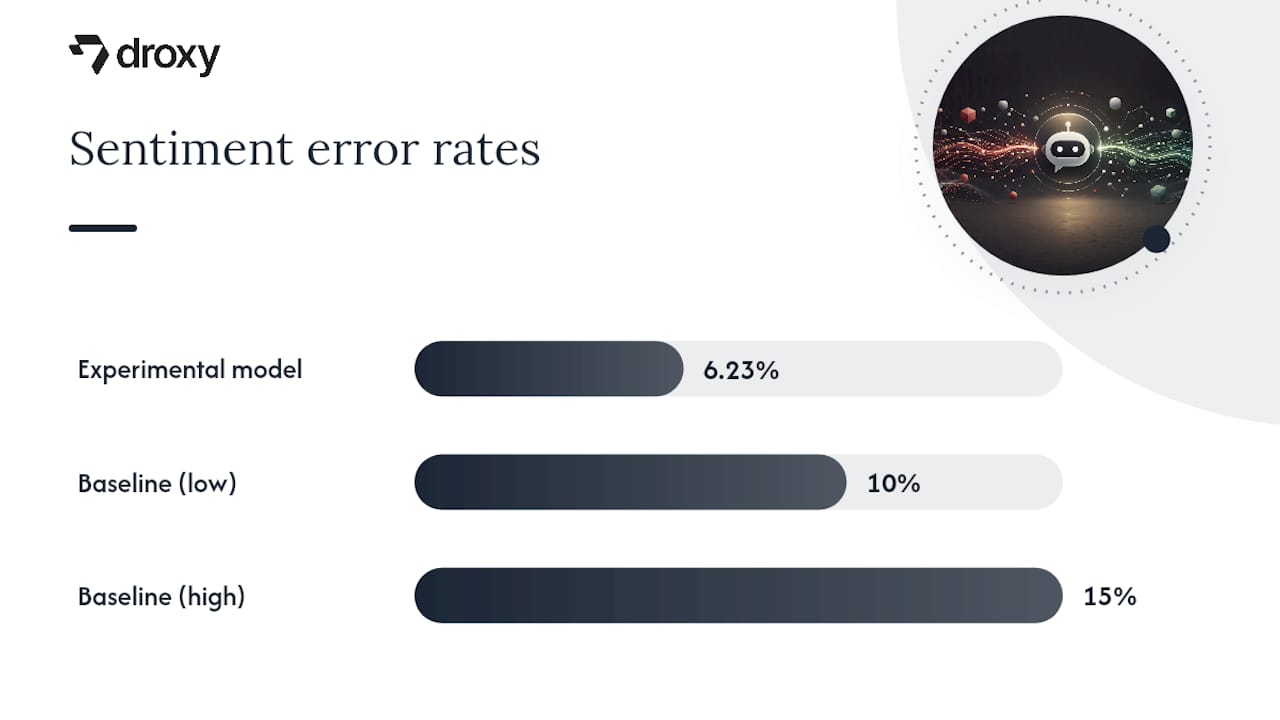
Statistic to know: one experimental model built on a deep k-nearest-neighbors architecture reported an error rate of 6.23%, compared with 10 to 15% for RoBERTa and other baseline approaches in lab testing. That gap is real, but lab conditions rarely match the messy, multilingual, slang-heavy traffic your chatbot actually sees. Treat published benchmarks as a ceiling, not a guarantee.
Latency matters as much as accuracy here. If sentiment scoring adds more than a few hundred milliseconds to response time, customers notice the lag before they notice the empathy.
Step-by-Step Implementation Checklist: Prototype to Production
Building this out of order is the single biggest reason sentiment projects stall. Follow this sequence instead.
Define scope and success metrics first. Decide what a “useful signal” looks like. Is it flagging the top 10% most negative conversations for review? Reducing escalation time by a set margin? Write the metric down before choosing any technology.
Pick your technique based on your constraints, not hype. A hosted API suits teams without ML engineers. Fine-tuning a transformer suits teams with domain-specific language (medical, legal, technical support) where general models misfire. A lightweight lexicon hybrid suits low-volume use cases where speed matters more than nuance.
Label a validation set. Pull 200 to 500 real conversations and have two or more people label sentiment independently. Target roughly 80 to 85% agreement between human labelers and the model before you trust it with live traffic.
Run a blind agreement test. Show labelers the same transcripts the model scored, without revealing the model’s output, then compare. Disagreement clusters usually point to sarcasm, mixed sentiment, or domain jargon the model was never trained on.
Prototype the decision logic. Map specific sentiment outputs to specific actions before writing a single line of production code. What happens at a negative score with high confidence? What happens at neutral with low confidence?
Roll out monitored, not blind. Launch to a small channel or segment first, watch the false-positive rate for two to three weeks, then expand.
Pro Tip: Start your validation set with the conversations your team already flags as “difficult.” Models trained and tested only on average traffic tend to fail exactly where you need them most.
Wiring Sentiment Into Flow: Triggers, Thresholds, and Response Patterns
Sentiment scoring only matters if it changes what the chatbot does next. That means deciding, in advance, where in the conversation you check sentiment and what each result triggers.

Common checkpoints include the opening message (does the customer arrive already upset?), any repeated request (a sign of unresolved frustration), and specific keyword hits (“cancel,” “refund,” “unacceptable”).
Action mappings typically follow a pattern like this:
Mild negative, high confidence: the bot clarifies and offers a direct solution path.
Strong negative, high confidence: the bot apologizes explicitly and escalates to a human agent.
Negative, low confidence: the bot asks a clarifying question rather than guessing.
Repeated negative across multiple turns: triggers proactive outreach, even if the customer hasn’t asked for a human yet.
Confidence gating matters more than most teams realize. A model that’s only 55% confident in a negative reading and escalates anyway will flood your agents with false alarms.
When handoff happens, pass sentiment context with the transcript, not just the raw messages. A payload that includes the sentiment label, confidence score, and the specific message that triggered escalation saves the agent from re-reading the whole conversation cold.
Evaluation and Validation: Metrics and Workflows to Trust the Signals
Three layers of metrics matter, and teams that only track one tend to miss the point of the whole exercise.
Technical metrics are accuracy, precision, recall, and F1 score. Accuracy alone is misleading if negative messages are rare in your traffic. F1 balances precision and recall and gives you a more honest picture.
Operational metrics track how the system behaves in production: latency per message, the percentage of conversations that trigger escalation, and average resolution time after a sentiment-driven handoff.
Business metrics are what leadership actually cares about: CSAT movement, escalation rate reduction, and early churn indicators surfaced by clustering negative sentiment by topic.
Metric type | Example measure | Target range |
|---|---|---|
Technical | F1 score | Model and domain dependent |
Technical | Human agreement rate | 80 to 85% |
Operational | Added latency per message | Low, real-time threshold |
Business | CSAT change post-rollout | Tracked over 30 days |
An IEEE conference paper on sentiment analysis in chatbot service encounters offers one of the more rigorous frameworks for connecting sentiment scoring directly to measured satisfaction outcomes, rather than assuming the connection exists. Run your blind human-labeling test on a rolling basis, not just once at launch. Language drifts, slang changes, and a model validated in January can quietly degrade by summer.
Operational Workflows and Reporting That Turn Sentiment Into Outcomes
Raw sentiment scores are useless sitting in a database. They need to surface somewhere a human acts on them.
Dashboards should show sentiment distribution over time, topic-level negative trends (is “shipping delays” spiking this week?), and workflow performance by escalation type.
Agent runbooks need explicit instructions for handling sentiment context at handoff: acknowledge the emotion first, reference the specific trigger, then solve.
Automation can extend beyond the initial conversation. Proactive follow-up sequences for customers who scored negative but didn’t escalate, priority routing that skips queues for high-negative-confidence tickets, and summary agents that compress long threads for a human reviewer all build directly on the same sentiment output.
Data governance deserves real attention here. Sentiment data often reveals more about a customer’s emotional state than any other data point you collect, so retention limits and anonymization for analytics use matter as much as the model itself.
Wiring sentiment signals directly into escalation and follow-up workflows is where most of the CSAT and NPS gains actually show up, not in the classifier’s raw accuracy number.
What Are the Common Pitfalls in Chatbot Sentiment Analysis?
Sarcasm remains the hardest problem in the field. “Great, another delay” reads as positive to a lexicon model and often confuses even transformer models without domain-specific fine-tuning. Mixed sentiment within a single message (“the product is great but your support is terrible”) also trips up simple polarity scoring, since a single label can’t capture two opposing signals in one sentence.
Domain jargon is another consistent failure point. General-purpose models trained on social media or product reviews often misread technical support language or industry-specific complaints.
Practical mitigations:
Use ensembles that combine a general model with a domain-fine-tuned one for higher-stakes flags.
Keep a human in the loop for any conversation flagged as strongly negative with high confidence.
Build fallback policies for low-confidence or unsupported-language inputs rather than forcing a guess.
Fine-tune on your own historical support transcripts, not just public datasets.
GoEmotions-based classifiers in particular tend to need domain adaptation before they perform reliably outside the dataset they were trained on.
Pro Tip: Never let a bot fully automate a decision on a customer flagged as extremely negative and high-value. Route it to a human every time, even if the model is confident. The cost of being wrong there is much higher than the cost of a manual review.
How Droxy Helps You Deploy Sentiment-Aware Agents Across Channels
Building this pipeline from scratch means stitching together preprocessing, model hosting, routing logic, and dashboards separately. Droxy’s no-code platform lets you deploy an AI agent across website chat, phone, WhatsApp, Instagram, Facebook, and Shopify without managing that infrastructure yourself, while still customizing tone and escalation rules to match how your brand actually talks to customers.
The built-in analytics give you visibility into conversation trends and handoff patterns, which is exactly the reporting layer a sentiment-aware workflow needs. A practical pilot path looks like this: label a small sample of real conversations, run a single channel like WhatsApp for two to four weeks, then measure the shift in CSAT and how often conversations that should have escalated actually did.
What I’ve Learned Watching These Rollouts Play Out
Two lessons keep repeating. First, teams that launch sentiment scoring across every channel at once almost always regret it. Pilot narrow with a small conversation sample, then expand once you trust the numbers. Second, expecting near-perfect accuracy out of the box sets you up for disappointment. Even strong lab models degrade on your specific traffic.
A workable pilot checklist: pick one narrow scope, hand-label a sample of your own conversations, set conservative confidence thresholds, then watch outcomes for 30 days before expanding. Adjust based on what the data actually show, not on how confident the model claims to be.
— Elena
Ready to Pilot Sentiment-Aware Support?
Droxy gets you from idea to live pilot faster than building a custom sentiment pipeline, because the multichannel deployment, tone customization, and analytics you need are already built into one platform instead of scattered across three vendors. Rather than spending weeks wiring APIs together, you connect your knowledge base, set your escalation rules, and launch.
A smart way to start: run a two to four week pilot on a single channel where negative sentiment shows up most, like WhatsApp support conversations, and track two numbers against your own human review, agreement rate on flagged conversations and the change in CSAT. Agencies managing this for multiple clients can explore Droxy’s white-label agency option to run the same pilot structure across accounts. When you’re ready to compare plans and pick the right tier for your volume, check Droxy’s pricing or start directly at App.
Sources
Sentiment aware interactive Chatbot AI using multi agent processing model
Sentiment Analysis for Assessing Customer Satisfaction in Chatbot Service Encounters | IEEE Xplore
FAQ
Can ChatGPT do sentiment analysis?
Yes, general-purpose language models like ChatGPT can classify sentiment reasonably well on straightforward text, but they aren’t purpose-built classifiers and typically lack the confidence scoring and fine-tuning control a dedicated sentiment model or chatbot platform offers for production use.
Which AI tool is best for sentiment analysis?
There’s no single best tool. It depends on your constraints: hosted APIs suit fast deployment, fine-tuned transformer models like RoBERTa suit domain-specific accuracy needs, and a platform like Droxy suits teams that want sentiment-aware routing built directly into a multichannel customer service agent without custom engineering.
Can AI be used for sentiment analysis?
Yes. AI models, from simple lexicon-based scoring to transformer architectures like RoBERTa and BERT, are the standard approach to sentiment analysis today, and they power most production sentiment analysis chatbot deployments.
Is there a free API for sentiment analysis?
Several open-source models and libraries offer free sentiment classification for prototyping, including projects built on the GoEmotions dataset, though free tiers usually come with rate limits or reduced accuracy compared with paid, fine-tuned options at scale.
Recommended
2–4 Week Pilot: Sentiment Analysis Chatbot for Support & Product Teams
Add sentiment analysis to your chatbot when support volume is high enough that agents cannot manually triage every angry message, and you want faster escalation, better CSAT, and fewer customers slipping away unnoticed. The system scores each message with a polarity label, an emotion category, and a confidence value, then your chatbot uses that output to route, apologize, or hand off before a frustrated customer ever asks for a human.
TL;DR:
Sentiment analysis enhances chatbot escalation by accurately routing angry or frustrated customers based on emotion and polarity scores.
Transformer-based models offer higher nuance but increase latency and require more training, impacting real-time response quality.
Proper implementation involves validating models with real customer conversations and setting conservative confidence thresholds to reduce false triggers.
Negative sentiment signals should be integrated into response triggers and escalation workflows to improve customer satisfaction and resolution speed.
Pilot projects should start small, focus on high-impact channels like WhatsApp, and avoid broad deployment until model performance stabilizes.
DroxyKeep Customer Conversations MovingDroxy helps businesses provide instant, human-like answers across chat, phone, WhatsApp, social channels, and Shopify.Explore Droxy
Table of Contents
What Is a Sentiment Analysis Chatbot and How Does It Work?
How Does Sentiment Detection Fit Into a Chatbot Pipeline?
Step-by-Step Implementation Checklist: Prototype to Production
Wiring Sentiment Into Flow: Triggers, Thresholds, and Response Patterns
Evaluation and Validation: Metrics and Workflows to Trust the Signals
Operational Workflows and Reporting That Turn Sentiment Into Outcomes
What Are the Common Pitfalls in Chatbot Sentiment Analysis?
How Droxy Helps You Deploy Sentiment-Aware Agents Across Channels
What I’ve Learned Watching These Rollouts Play Out
Ready to Pilot Sentiment-Aware Support?
Sources
What Is a Sentiment Analysis Chatbot and How Does It Work?
A sentiment analysis chatbot reads the emotional tone of a customer’s message and adjusts its response or routing based on that reading. It is not one algorithm. It is a category of approaches, each with different costs and blind spots.
Polarity scoring sorts text into positive, negative, or neutral. Emotion classification goes further, tagging specific states like anger, joy, sadness, or frustration. The second approach gives your chatbot richer context, but it needs more training data and tends to run slower.
Four technical approaches dominate production systems today:
Lexicon-based models score words against a predefined dictionary of sentiment values. Fast and cheap, but blind to context and sarcasm.
Classical machine learning (Naive Bayes, SVM) trains on labeled examples using features like TF-IDF. Better than lexicons, still limited on nuance.
Transformer-based models (RoBERTa, BERT variants) understand context and word order, catching tone shifts lexicons miss.
Hybrid and multimodal systems combine text with signals like response speed or punctuation intensity for a fuller emotional picture.
The trade-off is consistent across all four: more accuracy usually means more latency and less explainability. A lexicon model tells you exactly why it flagged a message. A transformer model gives you a confidence score and a black box.
How Does Sentiment Detection Fit Into a Chatbot Pipeline?
Sentiment analysis is not a bolt-on feature. It sits inside the same pipeline that handles intent recognition and response generation, and it needs clean input to work.
Preprocessing. Normalize text, expand contractions, handle negations (“not happy” reads very differently from “happy”), and account for emojis and slang. Skip this step and your accuracy drops fast, especially on mobile-first channels like WhatsApp where shorthand is common.
Feature extraction. Older systems used TF-IDF or word2vec. Modern pipelines favor contextual embeddings from transformer models. Projects like EmoBot v2 fine-tune XLM-RoBERTa on the GoEmotions dataset, which covers 28 distinct emotion labels rather than a simple three-way split.
Model choice. Decide between an API call to a hosted sentiment service or a self-hosted, fine-tuned model. APIs get you running in days; self-hosted models cost more engineering time but give you control over latency and domain accuracy.
Confidence reading. Every prediction comes with a confidence score. Treat low-confidence outputs (typically below 70%) as “unknown” rather than forcing a decision.
Statistic to know: one experimental model built on a deep k-nearest-neighbors architecture reported an error rate of 6.23%, compared with 10 to 15% for RoBERTa and other baseline approaches in lab testing. That gap is real, but lab conditions rarely match the messy, multilingual, slang-heavy traffic your chatbot actually sees. Treat published benchmarks as a ceiling, not a guarantee.
Latency matters as much as accuracy here. If sentiment scoring adds more than a few hundred milliseconds to response time, customers notice the lag before they notice the empathy.
Step-by-Step Implementation Checklist: Prototype to Production
Building this out of order is the single biggest reason sentiment projects stall. Follow this sequence instead.
Define scope and success metrics first. Decide what a “useful signal” looks like. Is it flagging the top 10% most negative conversations for review? Reducing escalation time by a set margin? Write the metric down before choosing any technology.
Pick your technique based on your constraints, not hype. A hosted API suits teams without ML engineers. Fine-tuning a transformer suits teams with domain-specific language (medical, legal, technical support) where general models misfire. A lightweight lexicon hybrid suits low-volume use cases where speed matters more than nuance.
Label a validation set. Pull 200 to 500 real conversations and have two or more people label sentiment independently. Target roughly 80 to 85% agreement between human labelers and the model before you trust it with live traffic.
Run a blind agreement test. Show labelers the same transcripts the model scored, without revealing the model’s output, then compare. Disagreement clusters usually point to sarcasm, mixed sentiment, or domain jargon the model was never trained on.
Prototype the decision logic. Map specific sentiment outputs to specific actions before writing a single line of production code. What happens at a negative score with high confidence? What happens at neutral with low confidence?
Roll out monitored, not blind. Launch to a small channel or segment first, watch the false-positive rate for two to three weeks, then expand.
Pro Tip: Start your validation set with the conversations your team already flags as “difficult.” Models trained and tested only on average traffic tend to fail exactly where you need them most.
Wiring Sentiment Into Flow: Triggers, Thresholds, and Response Patterns
Sentiment scoring only matters if it changes what the chatbot does next. That means deciding, in advance, where in the conversation you check sentiment and what each result triggers.
Common checkpoints include the opening message (does the customer arrive already upset?), any repeated request (a sign of unresolved frustration), and specific keyword hits (“cancel,” “refund,” “unacceptable”).
Action mappings typically follow a pattern like this:
Mild negative, high confidence: the bot clarifies and offers a direct solution path.
Strong negative, high confidence: the bot apologizes explicitly and escalates to a human agent.
Negative, low confidence: the bot asks a clarifying question rather than guessing.
Repeated negative across multiple turns: triggers proactive outreach, even if the customer hasn’t asked for a human yet.
Confidence gating matters more than most teams realize. A model that’s only 55% confident in a negative reading and escalates anyway will flood your agents with false alarms.
When handoff happens, pass sentiment context with the transcript, not just the raw messages. A payload that includes the sentiment label, confidence score, and the specific message that triggered escalation saves the agent from re-reading the whole conversation cold.
Evaluation and Validation: Metrics and Workflows to Trust the Signals
Three layers of metrics matter, and teams that only track one tend to miss the point of the whole exercise.
Technical metrics are accuracy, precision, recall, and F1 score. Accuracy alone is misleading if negative messages are rare in your traffic. F1 balances precision and recall and gives you a more honest picture.
Operational metrics track how the system behaves in production: latency per message, the percentage of conversations that trigger escalation, and average resolution time after a sentiment-driven handoff.
Business metrics are what leadership actually cares about: CSAT movement, escalation rate reduction, and early churn indicators surfaced by clustering negative sentiment by topic.
Metric type | Example measure | Target range |
|---|---|---|
Technical | F1 score | Model and domain dependent |
Technical | Human agreement rate | 80 to 85% |
Operational | Added latency per message | Low, real-time threshold |
Business | CSAT change post-rollout | Tracked over 30 days |
An IEEE conference paper on sentiment analysis in chatbot service encounters offers one of the more rigorous frameworks for connecting sentiment scoring directly to measured satisfaction outcomes, rather than assuming the connection exists. Run your blind human-labeling test on a rolling basis, not just once at launch. Language drifts, slang changes, and a model validated in January can quietly degrade by summer.
Operational Workflows and Reporting That Turn Sentiment Into Outcomes
Raw sentiment scores are useless sitting in a database. They need to surface somewhere a human acts on them.
Dashboards should show sentiment distribution over time, topic-level negative trends (is “shipping delays” spiking this week?), and workflow performance by escalation type.
Agent runbooks need explicit instructions for handling sentiment context at handoff: acknowledge the emotion first, reference the specific trigger, then solve.
Automation can extend beyond the initial conversation. Proactive follow-up sequences for customers who scored negative but didn’t escalate, priority routing that skips queues for high-negative-confidence tickets, and summary agents that compress long threads for a human reviewer all build directly on the same sentiment output.
Data governance deserves real attention here. Sentiment data often reveals more about a customer’s emotional state than any other data point you collect, so retention limits and anonymization for analytics use matter as much as the model itself.
Wiring sentiment signals directly into escalation and follow-up workflows is where most of the CSAT and NPS gains actually show up, not in the classifier’s raw accuracy number.
What Are the Common Pitfalls in Chatbot Sentiment Analysis?
Sarcasm remains the hardest problem in the field. “Great, another delay” reads as positive to a lexicon model and often confuses even transformer models without domain-specific fine-tuning. Mixed sentiment within a single message (“the product is great but your support is terrible”) also trips up simple polarity scoring, since a single label can’t capture two opposing signals in one sentence.
Domain jargon is another consistent failure point. General-purpose models trained on social media or product reviews often misread technical support language or industry-specific complaints.
Practical mitigations:
Use ensembles that combine a general model with a domain-fine-tuned one for higher-stakes flags.
Keep a human in the loop for any conversation flagged as strongly negative with high confidence.
Build fallback policies for low-confidence or unsupported-language inputs rather than forcing a guess.
Fine-tune on your own historical support transcripts, not just public datasets.
GoEmotions-based classifiers in particular tend to need domain adaptation before they perform reliably outside the dataset they were trained on.
Pro Tip: Never let a bot fully automate a decision on a customer flagged as extremely negative and high-value. Route it to a human every time, even if the model is confident. The cost of being wrong there is much higher than the cost of a manual review.
How Droxy Helps You Deploy Sentiment-Aware Agents Across Channels
Building this pipeline from scratch means stitching together preprocessing, model hosting, routing logic, and dashboards separately. Droxy’s no-code platform lets you deploy an AI agent across website chat, phone, WhatsApp, Instagram, Facebook, and Shopify without managing that infrastructure yourself, while still customizing tone and escalation rules to match how your brand actually talks to customers.
The built-in analytics give you visibility into conversation trends and handoff patterns, which is exactly the reporting layer a sentiment-aware workflow needs. A practical pilot path looks like this: label a small sample of real conversations, run a single channel like WhatsApp for two to four weeks, then measure the shift in CSAT and how often conversations that should have escalated actually did.
What I’ve Learned Watching These Rollouts Play Out
Two lessons keep repeating. First, teams that launch sentiment scoring across every channel at once almost always regret it. Pilot narrow with a small conversation sample, then expand once you trust the numbers. Second, expecting near-perfect accuracy out of the box sets you up for disappointment. Even strong lab models degrade on your specific traffic.
A workable pilot checklist: pick one narrow scope, hand-label a sample of your own conversations, set conservative confidence thresholds, then watch outcomes for 30 days before expanding. Adjust based on what the data actually show, not on how confident the model claims to be.
— Elena
Ready to Pilot Sentiment-Aware Support?
Droxy gets you from idea to live pilot faster than building a custom sentiment pipeline, because the multichannel deployment, tone customization, and analytics you need are already built into one platform instead of scattered across three vendors. Rather than spending weeks wiring APIs together, you connect your knowledge base, set your escalation rules, and launch.
A smart way to start: run a two to four week pilot on a single channel where negative sentiment shows up most, like WhatsApp support conversations, and track two numbers against your own human review, agreement rate on flagged conversations and the change in CSAT. Agencies managing this for multiple clients can explore Droxy’s white-label agency option to run the same pilot structure across accounts. When you’re ready to compare plans and pick the right tier for your volume, check Droxy’s pricing or start directly at App.
Sources
Sentiment aware interactive Chatbot AI using multi agent processing model
Sentiment Analysis for Assessing Customer Satisfaction in Chatbot Service Encounters | IEEE Xplore
FAQ
Can ChatGPT do sentiment analysis?
Yes, general-purpose language models like ChatGPT can classify sentiment reasonably well on straightforward text, but they aren’t purpose-built classifiers and typically lack the confidence scoring and fine-tuning control a dedicated sentiment model or chatbot platform offers for production use.
Which AI tool is best for sentiment analysis?
There’s no single best tool. It depends on your constraints: hosted APIs suit fast deployment, fine-tuned transformer models like RoBERTa suit domain-specific accuracy needs, and a platform like Droxy suits teams that want sentiment-aware routing built directly into a multichannel customer service agent without custom engineering.
Can AI be used for sentiment analysis?
Yes. AI models, from simple lexicon-based scoring to transformer architectures like RoBERTa and BERT, are the standard approach to sentiment analysis today, and they power most production sentiment analysis chatbot deployments.
Is there a free API for sentiment analysis?
Several open-source models and libraries offer free sentiment classification for prototyping, including projects built on the GoEmotions dataset, though free tiers usually come with rate limits or reduced accuracy compared with paid, fine-tuned options at scale.
Recommended


🚀
Powered by Droxy
Turn every interaction into a conversion
Customer facing AI agents that engage, convert, and support so you can scale what matters.
✨
Learn more
Recent posts
Insights
3 min read
Introducing Agent Memories
Improve your agents' performance with Agent Memories. Prevent agents from repeating the same mistakes by giving them feedback.
Read more

Insights
15 min read
HVAC Marketing in 2025: The Definitive Lead Gen Guide
Discover 15 proven HVAC marketing strategies, plus learn how Droxy's AI website agent converts curious visitors into qualified leads by answering their questions instantly - right when they're most interested in your services.
Read more

Insights
10 min read
10 Best AI Sales Agents in 2025: Tested & Ranked
Discover the top 10 AI sales agents of 2025, designed to enhance lead generation, personalize outreach, and ultimately, close more deals
Read more
Insights
3 min read
Introducing Agent Memories
Improve your agents' performance with Agent Memories. Prevent agents from repeating the same mistakes by giving them feedback.
Read more
Insights
15 min read
HVAC Marketing in 2025: The Definitive Lead Gen Guide
Discover 15 proven HVAC marketing strategies, plus learn how Droxy's AI website agent converts curious visitors into qualified leads by answering their questions instantly - right when they're most interested in your services.
Read more