Fix Lead Latency: B2B Speed to Lead Automation & KPIs
Fix Lead Latency: B2B Speed to Lead Automation & KPIs
Insights
20 min

Aim for a two-second automated acknowledgment and a first meaningful human or AI touch inside five minutes for high-intent leads, with a sub-60-second bar for many verticals where competitors move fast. Getting there consistently is not a staffing problem. It’s an architecture problem, solved by event-driven automation that fuses capture, enrichment, scoring, and routing into one uninterrupted chain instead of a series of manual handoffs. This guide covers how to measure it, which channels carry the load, how to roll it out in phases, and where a platform like Droxy fits.
TL;DR:
Response times under 60 seconds markedly increase lead qualification and conversion rates, especially in high-intent channels like chat and form submissions.
Structural delays, such as CRM batch imports and manual research, are the main obstacles to fast response, not sales team performance.
Implementing event-driven automation with real-time triggers and inline enrichment reduces response times to seconds and improves ROI.
Different channels serve distinct roles: SMS and WhatsApp are best for immediate action, while email suits detailed follow-ups.
A phased rollout focusing on high-volume sources first helps identify and fix bottlenecks before expanding automation across all channels.
Table of Contents
What Speed to Lead Actually Measures
Why Speed to Lead Drives Conversion and ROI
Where the Minutes Actually Disappear
The Automation Architecture That Actually Works
Matching Channels to Moments in the Cadence
Setting SLAs That Actually Hold Up
Rolling It Out Without Breaking What Already Works
How Droxy Fits the Event-Driven Model
Implementation Cautions and What to Prioritize First
Get Your First-Touch Response Under a Minute
Sources
What Speed to Lead Actually Measures
Speed to lead is the elapsed time between the moment a lead signals interest, filling a form, starting a chat, calling in, and the first meaningful outbound touch that responds to that specific person’s intent. An automated “thanks, we got your message” ping doesn’t count. That’s an auto-acknowledgment, and while it buys you goodwill in the first few seconds, it isn’t contact. The clock only stops when a human rep or a capable AI agent engages with something relevant to what the lead actually asked for.
This distinction trips up more sales teams than any tooling gap. A CRM dashboard showing a two-minute “response time” often just reflects an autoresponder firing off a template. Track auto-ack and first meaningful touch as two separate metrics, or your reporting will tell you a story that isn’t true.
The evidence for urgency is old and consistent. Foundational Harvard Business Review research on contact and qualification rates established the rapid decay pattern that still holds today: the odds of reaching and qualifying a lead fall off within minutes of the inbound signal, not hours. More recent industry analysis confirms the same pattern, with responses inside roughly five minutes dramatically outperforming anything measured in hours.
The benchmark that matters: teams responding within five minutes are roughly 21 times more likely to qualify a lead than teams responding after thirty minutes. Sub-60-second automated responses push qualification rates even higher in verticals where buyers are actively comparing options in real time.
Here’s how the commonly cited response buckets translate into practical targets:
Response Window | Typical Outcome | Recommended Use |
|---|---|---|
0 to 60 seconds | Highest qualification lift, best for high-intent web and chat leads | Automated first touch, always |
1 to 5 minutes | Still strong; the “golden window” cited across industry benchmarks | Automated touch plus human alert |
5 minutes | Qualification odds drop sharply | Escalation and fallback only |
30 minutes or more | Lead often self-serves elsewhere or goes cold | Recovery sequence, not primary response |
Averages hide the real problem, so measure both the median and the 90th percentile. A median of four minutes sounds fine until you learn your 90th percentile is forty. That gap usually lives in one segment: a specific lead source, an after-hours window, or one rep’s queue. Segment by source, hour of day, and owner before you draw conclusions about overall performance.
Why Speed to Lead Drives Conversion and ROI
The business case isn’t theoretical. It shows up directly in cost per acquisition. Every lead that goes cold because nobody reached it fast enough is a lead you already paid for and now have to replace, which means paying for a fresh one on top of the wasted spend.
Foundational research shows the first vendor to make contact tends to have a dramatic and lasting advantage in the buyer’s evaluation process, and more recent studies quantify it directly: five-minute response puts qualification odds roughly 21 times higher than a thirty-minute response.
That multiplier plays out differently by vertical:
B2B SaaS. Demo requests decay fast because buyers are usually evaluating two or three vendors simultaneously; the vendor who books the call first often sets the evaluation frame for the rest of the cycle.
Home services. Emergency and quote requests (HVAC, plumbing, roofing) are won or lost inside the first callback; a same-hour competitor response typically means the deal is gone.
E-commerce and high-consideration retail. Cart abandonment and product-inquiry chats convert at much higher rates when a chat agent answers immediately instead of routing to a next-day email queue.
The ROI math is straightforward even without precise multipliers for your specific business: if your average cost per lead is fixed and your close rate on fast-contacted leads is meaningfully higher, speed doesn’t just win more deals, it lowers your effective cost per customer. You stop needing to buy replacement leads to hit the same revenue number, and that saved acquisition spend becomes budget you can redirect toward scaling the channels that already work.
Speed also compounds with pipeline velocity. Deals that start with a fast, relevant first touch tend to move through later stages faster too, because the buyer’s urgency at the moment of inquiry rarely fades cleanly. Wait too long, and you’re not just losing the deal, you’re often restarting a colder version of the same conversation days later.
Where the Minutes Actually Disappear
Sales leaders love to blame slow reps. The data tells a different story. Most delay lives in the machinery between the lead’s signal and the point a human even knows the lead exists, and the largest hidden delays are structural, not personal.
Batch syncs and scheduled CRM imports. Plenty of stacks still pull new leads from a form tool into the CRM on a fifteen or thirty-minute cron job. That single design choice puts a hard floor on your fastest possible response, no matter how quick your reps are.
Manual enrichment and research delays. If a rep has to open five tabs to figure out who this lead is, what company they’re from, and whether they’re worth prioritizing, that lookup alone can burn ten minutes before the first message goes out.
Misrouting, unassigned leads, and notification blind spots. Round-robin logic that’s misconfigured, a rep who’s out sick with no fallback, or a Slack alert buried under fifty other messages, all park a lead in limbo with nobody actively responsible for it.
After-hours arrivals and weekend aging. A lead who fills out a form at 9 p.m. Friday often waits until Monday morning, by which point they’ve likely already gotten a same-day answer from a competitor.
None of these are really about how fast your salespeople dial. They’re about the plumbing that decides when, or whether, a human ever gets the signal in a usable form. Fix the plumbing first. It’s cheaper than hiring more reps to sprint against a broken pipe.
The Automation Architecture That Actually Works
Batch processing is the enemy of speed to lead, full stop; adopting CRM automation with event-driven triggers provides the architecture needed to eliminate delays and respond instantly. If your system checks for new leads every fifteen minutes, your best-case response time is capped by that interval no matter how good your team is. Event-driven automation flips the model: the moment a lead action fires, capture, enrichment, scoring, and routing all execute inline, in the same second, before a notification ever reaches a human. That shift from scheduled polling to real-time triggers is what makes sub-minute response possible at all.
Capture means treating every meaningful lead action as a trigger the moment it happens: form submission, chat message, missed call, calendar-page visit. Enrich means pulling company size, source, and prior interaction history into that event automatically, so whoever or whatever responds next has context instantly instead of hunting for it. Score applies simple rules (title, company size, page visited, stated urgency) to decide which pre-built play fires. Route sends the lead, and full context, to the right rep, queue, or AI agent with zero manual lookup required.
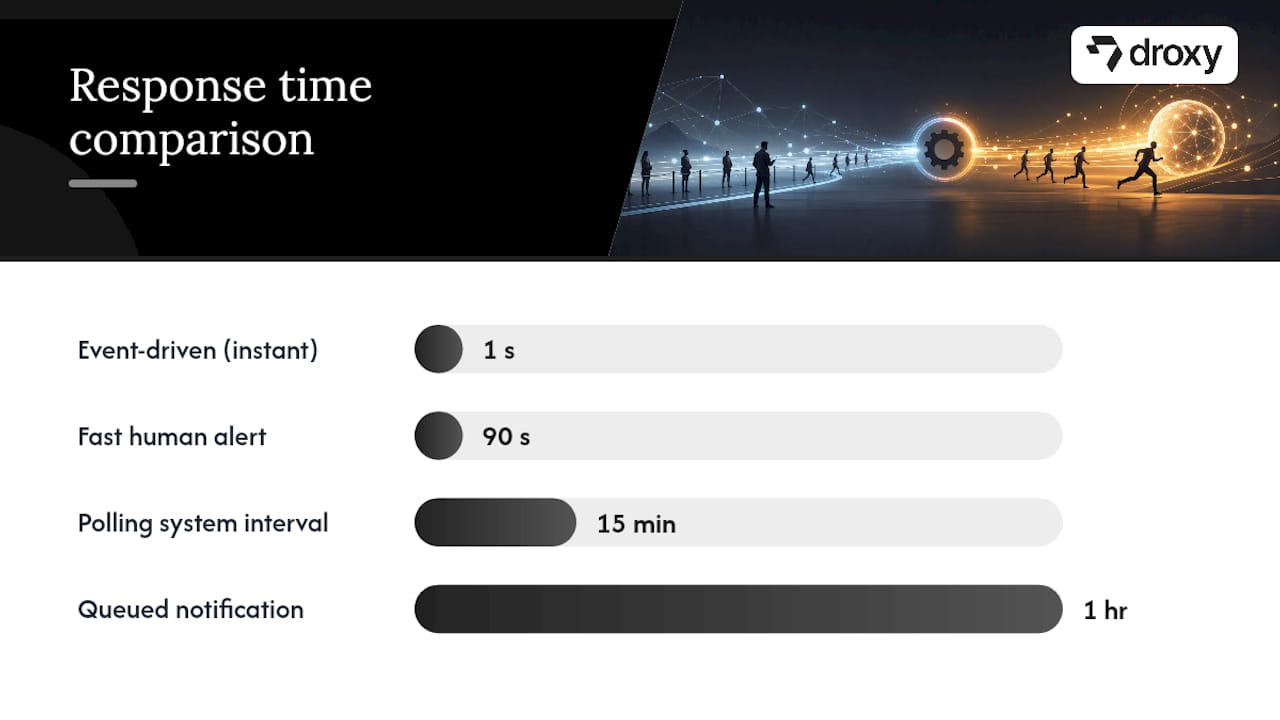
The practical payoff of doing this well is that every alert a human receives already has an answer attached, not just a name. That’s the difference between a notification that gets acted on in ninety seconds and one that sits in a queue for an hour.
Build guardrails into the automation from day one, or it starts to feel like spam instead of service:
Match the message to the actual signal. A demo request and a pricing-page visit deserve different first touches, not the same template.
Keep the first automated ask proportional. “Want to grab 15 minutes Thursday?” works. A five-question qualification form as the very first reply does not.
Set explicit hand-off triggers. If a lead replies with a complex or emotionally charged question, route to a human immediately rather than looping them through more automation.
Cap automated follow-up frequency. Two or three automated touches before a human takes over is usually the ceiling before it reads as robotic.
Pro Tip: Build one pre-decided play per signal type before you build anything else. A demo request, a pricing-page chat, and a missed call each need their own scripted first move; trying to write one generic “fast response” template for all of them is why most rushed automation projects feel impersonal.
Matching Channels to Moments in the Cadence
Different channels do different jobs in the first hour after a lead arrives, and treating them as interchangeable is a common mistake. A workable default cadence looks like this: instant automated acknowledgment on the channel the lead used, a substantive automated follow-up around the five-minute mark, and a human rep alert by fifteen minutes if the lead hasn’t converted to a booked meeting or a qualified reply.
SMS and WhatsApp carry the highest open rates in the first few minutes and work best for short, action-oriented messages, “Thanks for reaching out, want to grab 15 minutes this week?”, paired with a booking link.
Site chat should never sit unanswered; an AI agent that can answer a real question immediately, not just collect an email, keeps the lead engaged instead of tab-switching to a competitor.
Automated voice calls work well for high-intent leads who called or requested a callback; even a short automated confirmation call bridging to a live transfer beats silence.
Email is the slowest channel for urgency but the best for detail. Use it for the substantive follow-up, not the first touch.
Calendar links belong in the first or second touch when the lead’s intent is already clear (a demo request, a quote request). Ask for a reply instead when intent is still ambiguous and you need one more data point before booking.
If SMS is part of your stack in the United States, 10DLC registration through your carrier or platform is not optional; unregistered traffic gets throttled or blocked outright, which quietly guts your speed advantage right when you need it most. Personalize with the lead’s actual stated interest, not just their first name. A message referencing the specific page or product they looked at converts noticeably better than a generic “thanks for your interest.”
Automated reminders carry weight beyond the first contact, too. In clinical and appointment-based settings, automated SMS reminders and online scheduling measurably reduce no-shows, a pattern that translates directly to any business fighting booked-but-unattended appointments in a sales pipeline.
Setting SLAs That Actually Hold Up
You cannot manage what you measure inconsistently, and speed to lead is measured inconsistently more often than any other sales metric. Fix that before you fix anything else.
Track these KPIs separately, not as one blended number:
Auto-acknowledgment time (should be seconds, not minutes)
First meaningful touch time, measured apart from the auto-ack
Median response time
90th percentile response time
Contact rate and qualification rate by response-time bucket
Segmenting by source, hour of day, and owner is what actually reveals where the failures live. A source-level cut might show your paid search leads get instant AI responses while your referral leads sit in a shared inbox nobody owns. An hour-level cut exposes the after-hours cliff every team has and few teams measure honestly.
Lead Tier | Auto-Ack Target | First Meaningful Touch Target |
|---|---|---|
High-intent (demo request, quote request) | Under 10 seconds | Under 5 minutes |
Medium-intent (content download, chat inquiry) | Under 60 seconds | Under 5 minutes |
Low-intent (newsletter signup, early research) | Under 5 minutes | Same business day |
Run a quarterly audit: pull a random sample of fifty leads across sources, trace the timestamp trail from signal to first human contact, and flag every gap over your SLA. Half the time, the pattern that emerges is one broken integration or one under-resourced queue, not a broad performance problem.
Rolling It Out Without Breaking What Already Works
Trying to automate everything in one sprint is how most speed-to-lead projects stall. A phased rollout keeps risk low and gives you real data at each step.
Phase 0: Baseline and target-setting. Measure your current median and 90th percentile before changing anything. You need a “before” number to prove the “after.”
Phase 1: Event capture and instant auto-ack. Wire up real-time triggers on your highest-volume lead source first, and get an automated acknowledgment firing in seconds.
Phase 2: Enrichment, scoring, and simple automated plays. Add inline data pulls and one or two pre-decided first-touch scripts for your top lead types.
Phase 3: Full routing, escalation, and multi-channel cadence. Layer in SMS, chat, and voice touches with defined hand-off triggers to human reps.
Testing and compliance. Confirm 10DLC registration if using SMS, run A/B tests on message copy, and check that hand-off triggers actually fire when they should before scaling volume.
Stakeholder training. Reps need to trust the routing logic and know exactly when a lead lands in their queue with full context attached, or they’ll default back to old habits.
Pro Tip: Roll out Phase 1 on one lead source for two weeks before touching anything else. A clean before-and-after comparison on a single channel gives you the data you need to get budget for Phases 2 and 3, and it catches integration bugs before they touch your whole pipeline.
How Droxy Fits the Event-Driven Model
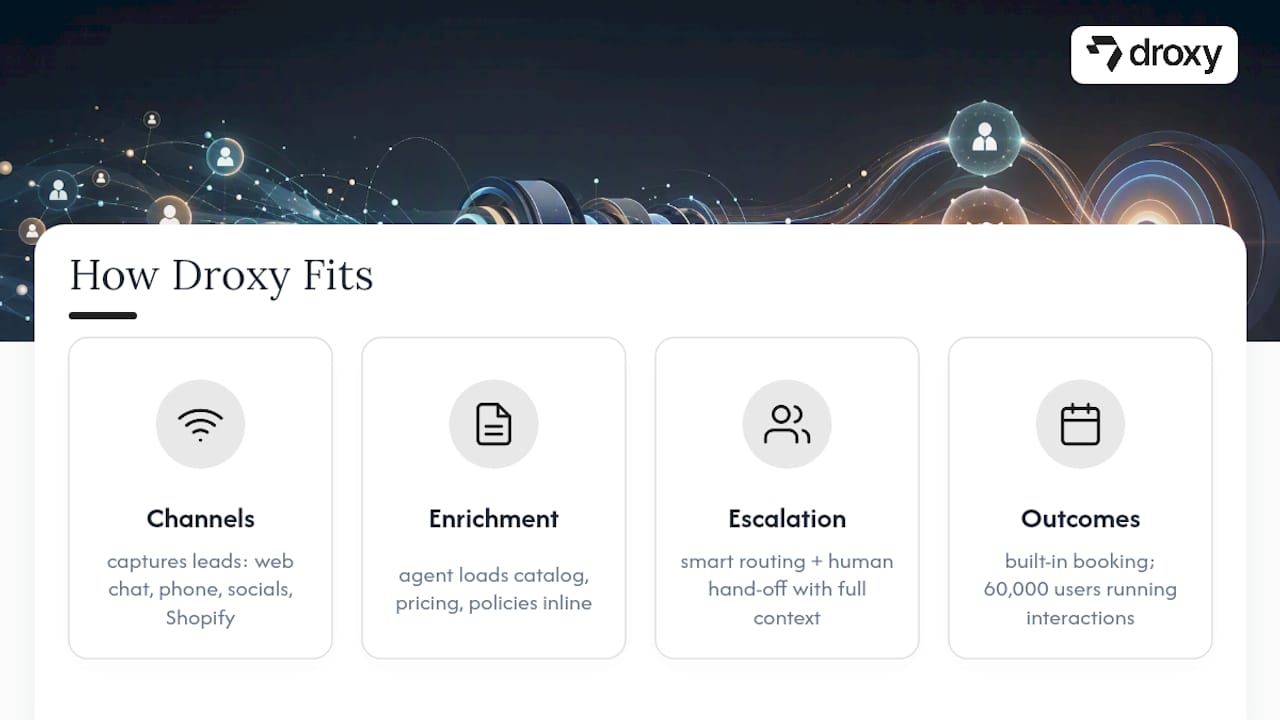
Droxy maps directly onto the architecture this guide recommends, without requiring your team to stitch together five separate tools. It captures leads the moment they arrive across website chat, phone, WhatsApp, Instagram, Facebook, and Shopify, and responds instantly instead of queuing the interaction for later review.
Because Droxy agents pull from your existing knowledge base and integrate with your systems through API or Zapier, the enrichment step happens inline: the agent already knows your product catalog, pricing, and policies before it answers, so the first message is substantive rather than a placeholder. Smart routing and human hand-off triggers cover the escalation guardrails described earlier, ambiguous or high-stakes conversations get passed to a live rep with full context instead of bouncing the lead between systems. Built-in appointment booking closes the loop between first touch and a calendar hold in a single conversation. Over 60,000 users currently run their customer interaction through Droxy, using it to cut wait times and lift lead conversion across the channels covered above.
The buy-versus-build decision usually comes down to three factors: how fast you need to move, how much custom integration your stack requires, and how much ongoing engineering time you can dedicate to maintaining a homegrown system. A no-code platform wins on the first two almost every time, and deep customization options mean you’re not sacrificing brand voice to get there.
Implementation Cautions and What to Prioritize First
Speed to lead isn’t a universal rule applied identically to every deal. For enterprise or high-ticket sales with long evaluation cycles, a rushed automated response can read as impersonal if it isn’t backed by genuine competence on the follow-up call. In those cases, favor a fast acknowledgment paired with a well-prepared human touch over pure automated speed alone.
Three mistakes show up constantly: treating auto-ack as the finish line instead of the starting gun, building automation before fixing the routing logic underneath it, and skipping the audit step until months after launch when bad habits are already baked in.
Start smaller than feels comfortable. Baseline your current numbers this week, fix your highest-volume source first, and resist the urge to automate every channel before you’ve proven one works.
— Elena
Get Your First-Touch Response Under a Minute
Most of the delay this guide describes isn’t a staffing gap, it’s a missing always-on layer between the moment a lead arrives and the moment someone capable actually answers them. Droxy closes that gap directly: its AI agents deploy across website chat, phone, WhatsApp, Instagram, Facebook, and Shopify, and respond the instant a lead reaches out, day or night, with answers pulled from your actual product and policy knowledge instead of a generic script.
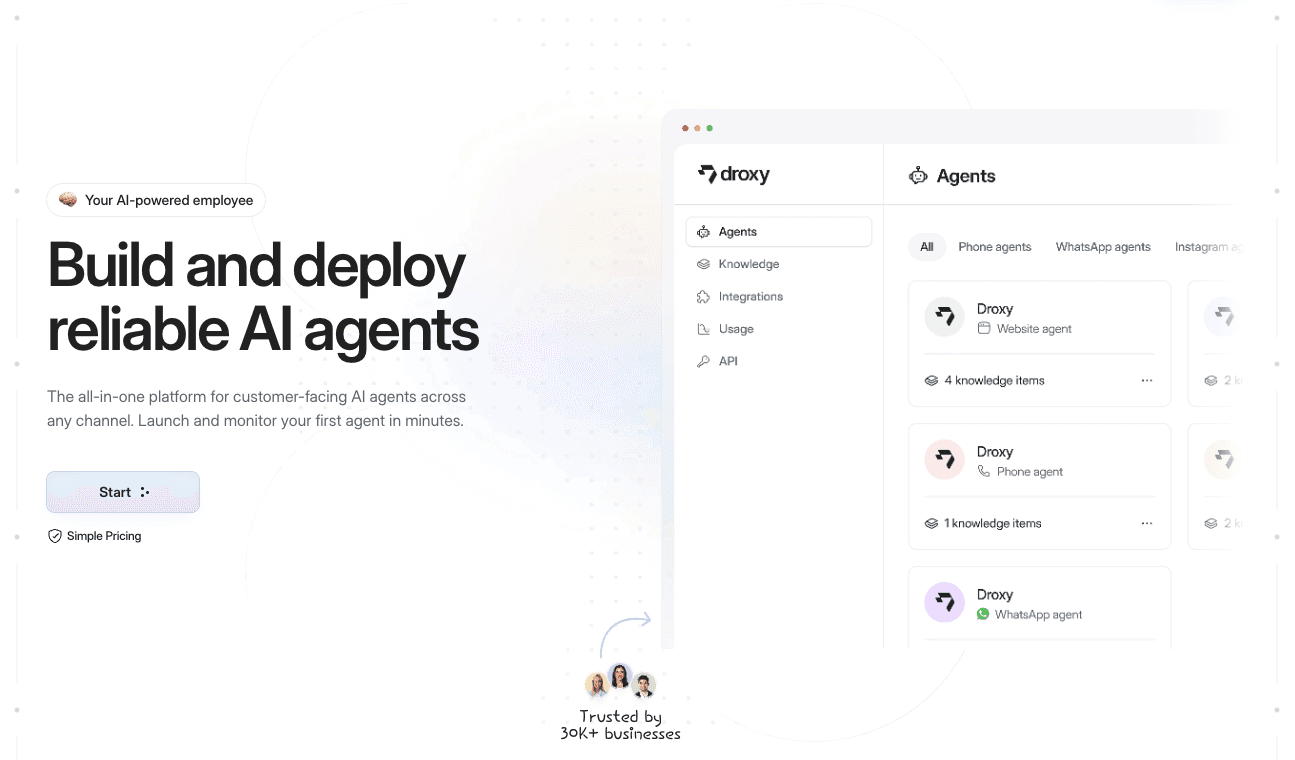
Setup requires no code, and deep customization keeps the agent’s tone matched to your brand instead of sounding like a stock bot. For agencies managing this across multiple clients, Droxy’s agency plans support white-labeling so you can resell the same speed-to-lead advantage under your own name. If you run a home services, e-commerce, or professional services operation and want to see the sub-minute response benchmark in action, check the available plans and get an agent live on your highest-traffic channel this week.
Sources
The response-time benchmarks and qualification multipliers in this guide draw on the foundational Harvard Business Review study on online sales lead decay, the practical benchmark breakdowns in BusinessMCP’s speed-to-lead guide, and the qualification-rate math published by Automation Labz. Structural delay analysis comes from Rework’s lead response time research, while appointment-reminder impact data comes from the Frontiers in Digital Health study on scheduling and no-show reduction. For SMS compliance groundwork, review your carrier’s 10DLC registration requirements before scaling automated text campaigns.
Recommended
Aim for a two-second automated acknowledgment and a first meaningful human or AI touch inside five minutes for high-intent leads, with a sub-60-second bar for many verticals where competitors move fast. Getting there consistently is not a staffing problem. It’s an architecture problem, solved by event-driven automation that fuses capture, enrichment, scoring, and routing into one uninterrupted chain instead of a series of manual handoffs. This guide covers how to measure it, which channels carry the load, how to roll it out in phases, and where a platform like Droxy fits.
TL;DR:
Response times under 60 seconds markedly increase lead qualification and conversion rates, especially in high-intent channels like chat and form submissions.
Structural delays, such as CRM batch imports and manual research, are the main obstacles to fast response, not sales team performance.
Implementing event-driven automation with real-time triggers and inline enrichment reduces response times to seconds and improves ROI.
Different channels serve distinct roles: SMS and WhatsApp are best for immediate action, while email suits detailed follow-ups.
A phased rollout focusing on high-volume sources first helps identify and fix bottlenecks before expanding automation across all channels.
Table of Contents
What Speed to Lead Actually Measures
Why Speed to Lead Drives Conversion and ROI
Where the Minutes Actually Disappear
The Automation Architecture That Actually Works
Matching Channels to Moments in the Cadence
Setting SLAs That Actually Hold Up
Rolling It Out Without Breaking What Already Works
How Droxy Fits the Event-Driven Model
Implementation Cautions and What to Prioritize First
Get Your First-Touch Response Under a Minute
Sources
What Speed to Lead Actually Measures
Speed to lead is the elapsed time between the moment a lead signals interest, filling a form, starting a chat, calling in, and the first meaningful outbound touch that responds to that specific person’s intent. An automated “thanks, we got your message” ping doesn’t count. That’s an auto-acknowledgment, and while it buys you goodwill in the first few seconds, it isn’t contact. The clock only stops when a human rep or a capable AI agent engages with something relevant to what the lead actually asked for.
This distinction trips up more sales teams than any tooling gap. A CRM dashboard showing a two-minute “response time” often just reflects an autoresponder firing off a template. Track auto-ack and first meaningful touch as two separate metrics, or your reporting will tell you a story that isn’t true.
The evidence for urgency is old and consistent. Foundational Harvard Business Review research on contact and qualification rates established the rapid decay pattern that still holds today: the odds of reaching and qualifying a lead fall off within minutes of the inbound signal, not hours. More recent industry analysis confirms the same pattern, with responses inside roughly five minutes dramatically outperforming anything measured in hours.
The benchmark that matters: teams responding within five minutes are roughly 21 times more likely to qualify a lead than teams responding after thirty minutes. Sub-60-second automated responses push qualification rates even higher in verticals where buyers are actively comparing options in real time.
Here’s how the commonly cited response buckets translate into practical targets:
Response Window | Typical Outcome | Recommended Use |
|---|---|---|
0 to 60 seconds | Highest qualification lift, best for high-intent web and chat leads | Automated first touch, always |
1 to 5 minutes | Still strong; the “golden window” cited across industry benchmarks | Automated touch plus human alert |
5 minutes | Qualification odds drop sharply | Escalation and fallback only |
30 minutes or more | Lead often self-serves elsewhere or goes cold | Recovery sequence, not primary response |
Averages hide the real problem, so measure both the median and the 90th percentile. A median of four minutes sounds fine until you learn your 90th percentile is forty. That gap usually lives in one segment: a specific lead source, an after-hours window, or one rep’s queue. Segment by source, hour of day, and owner before you draw conclusions about overall performance.
Why Speed to Lead Drives Conversion and ROI
The business case isn’t theoretical. It shows up directly in cost per acquisition. Every lead that goes cold because nobody reached it fast enough is a lead you already paid for and now have to replace, which means paying for a fresh one on top of the wasted spend.
Foundational research shows the first vendor to make contact tends to have a dramatic and lasting advantage in the buyer’s evaluation process, and more recent studies quantify it directly: five-minute response puts qualification odds roughly 21 times higher than a thirty-minute response.
That multiplier plays out differently by vertical:
B2B SaaS. Demo requests decay fast because buyers are usually evaluating two or three vendors simultaneously; the vendor who books the call first often sets the evaluation frame for the rest of the cycle.
Home services. Emergency and quote requests (HVAC, plumbing, roofing) are won or lost inside the first callback; a same-hour competitor response typically means the deal is gone.
E-commerce and high-consideration retail. Cart abandonment and product-inquiry chats convert at much higher rates when a chat agent answers immediately instead of routing to a next-day email queue.
The ROI math is straightforward even without precise multipliers for your specific business: if your average cost per lead is fixed and your close rate on fast-contacted leads is meaningfully higher, speed doesn’t just win more deals, it lowers your effective cost per customer. You stop needing to buy replacement leads to hit the same revenue number, and that saved acquisition spend becomes budget you can redirect toward scaling the channels that already work.
Speed also compounds with pipeline velocity. Deals that start with a fast, relevant first touch tend to move through later stages faster too, because the buyer’s urgency at the moment of inquiry rarely fades cleanly. Wait too long, and you’re not just losing the deal, you’re often restarting a colder version of the same conversation days later.
Where the Minutes Actually Disappear
Sales leaders love to blame slow reps. The data tells a different story. Most delay lives in the machinery between the lead’s signal and the point a human even knows the lead exists, and the largest hidden delays are structural, not personal.
Batch syncs and scheduled CRM imports. Plenty of stacks still pull new leads from a form tool into the CRM on a fifteen or thirty-minute cron job. That single design choice puts a hard floor on your fastest possible response, no matter how quick your reps are.
Manual enrichment and research delays. If a rep has to open five tabs to figure out who this lead is, what company they’re from, and whether they’re worth prioritizing, that lookup alone can burn ten minutes before the first message goes out.
Misrouting, unassigned leads, and notification blind spots. Round-robin logic that’s misconfigured, a rep who’s out sick with no fallback, or a Slack alert buried under fifty other messages, all park a lead in limbo with nobody actively responsible for it.
After-hours arrivals and weekend aging. A lead who fills out a form at 9 p.m. Friday often waits until Monday morning, by which point they’ve likely already gotten a same-day answer from a competitor.
None of these are really about how fast your salespeople dial. They’re about the plumbing that decides when, or whether, a human ever gets the signal in a usable form. Fix the plumbing first. It’s cheaper than hiring more reps to sprint against a broken pipe.
The Automation Architecture That Actually Works
Batch processing is the enemy of speed to lead, full stop; adopting CRM automation with event-driven triggers provides the architecture needed to eliminate delays and respond instantly. If your system checks for new leads every fifteen minutes, your best-case response time is capped by that interval no matter how good your team is. Event-driven automation flips the model: the moment a lead action fires, capture, enrichment, scoring, and routing all execute inline, in the same second, before a notification ever reaches a human. That shift from scheduled polling to real-time triggers is what makes sub-minute response possible at all.
Capture means treating every meaningful lead action as a trigger the moment it happens: form submission, chat message, missed call, calendar-page visit. Enrich means pulling company size, source, and prior interaction history into that event automatically, so whoever or whatever responds next has context instantly instead of hunting for it. Score applies simple rules (title, company size, page visited, stated urgency) to decide which pre-built play fires. Route sends the lead, and full context, to the right rep, queue, or AI agent with zero manual lookup required.
The practical payoff of doing this well is that every alert a human receives already has an answer attached, not just a name. That’s the difference between a notification that gets acted on in ninety seconds and one that sits in a queue for an hour.
Build guardrails into the automation from day one, or it starts to feel like spam instead of service:
Match the message to the actual signal. A demo request and a pricing-page visit deserve different first touches, not the same template.
Keep the first automated ask proportional. “Want to grab 15 minutes Thursday?” works. A five-question qualification form as the very first reply does not.
Set explicit hand-off triggers. If a lead replies with a complex or emotionally charged question, route to a human immediately rather than looping them through more automation.
Cap automated follow-up frequency. Two or three automated touches before a human takes over is usually the ceiling before it reads as robotic.
Pro Tip: Build one pre-decided play per signal type before you build anything else. A demo request, a pricing-page chat, and a missed call each need their own scripted first move; trying to write one generic “fast response” template for all of them is why most rushed automation projects feel impersonal.
Matching Channels to Moments in the Cadence
Different channels do different jobs in the first hour after a lead arrives, and treating them as interchangeable is a common mistake. A workable default cadence looks like this: instant automated acknowledgment on the channel the lead used, a substantive automated follow-up around the five-minute mark, and a human rep alert by fifteen minutes if the lead hasn’t converted to a booked meeting or a qualified reply.
SMS and WhatsApp carry the highest open rates in the first few minutes and work best for short, action-oriented messages, “Thanks for reaching out, want to grab 15 minutes this week?”, paired with a booking link.
Site chat should never sit unanswered; an AI agent that can answer a real question immediately, not just collect an email, keeps the lead engaged instead of tab-switching to a competitor.
Automated voice calls work well for high-intent leads who called or requested a callback; even a short automated confirmation call bridging to a live transfer beats silence.
Email is the slowest channel for urgency but the best for detail. Use it for the substantive follow-up, not the first touch.
Calendar links belong in the first or second touch when the lead’s intent is already clear (a demo request, a quote request). Ask for a reply instead when intent is still ambiguous and you need one more data point before booking.
If SMS is part of your stack in the United States, 10DLC registration through your carrier or platform is not optional; unregistered traffic gets throttled or blocked outright, which quietly guts your speed advantage right when you need it most. Personalize with the lead’s actual stated interest, not just their first name. A message referencing the specific page or product they looked at converts noticeably better than a generic “thanks for your interest.”
Automated reminders carry weight beyond the first contact, too. In clinical and appointment-based settings, automated SMS reminders and online scheduling measurably reduce no-shows, a pattern that translates directly to any business fighting booked-but-unattended appointments in a sales pipeline.
Setting SLAs That Actually Hold Up
You cannot manage what you measure inconsistently, and speed to lead is measured inconsistently more often than any other sales metric. Fix that before you fix anything else.
Track these KPIs separately, not as one blended number:
Auto-acknowledgment time (should be seconds, not minutes)
First meaningful touch time, measured apart from the auto-ack
Median response time
90th percentile response time
Contact rate and qualification rate by response-time bucket
Segmenting by source, hour of day, and owner is what actually reveals where the failures live. A source-level cut might show your paid search leads get instant AI responses while your referral leads sit in a shared inbox nobody owns. An hour-level cut exposes the after-hours cliff every team has and few teams measure honestly.
Lead Tier | Auto-Ack Target | First Meaningful Touch Target |
|---|---|---|
High-intent (demo request, quote request) | Under 10 seconds | Under 5 minutes |
Medium-intent (content download, chat inquiry) | Under 60 seconds | Under 5 minutes |
Low-intent (newsletter signup, early research) | Under 5 minutes | Same business day |
Run a quarterly audit: pull a random sample of fifty leads across sources, trace the timestamp trail from signal to first human contact, and flag every gap over your SLA. Half the time, the pattern that emerges is one broken integration or one under-resourced queue, not a broad performance problem.
Rolling It Out Without Breaking What Already Works
Trying to automate everything in one sprint is how most speed-to-lead projects stall. A phased rollout keeps risk low and gives you real data at each step.
Phase 0: Baseline and target-setting. Measure your current median and 90th percentile before changing anything. You need a “before” number to prove the “after.”
Phase 1: Event capture and instant auto-ack. Wire up real-time triggers on your highest-volume lead source first, and get an automated acknowledgment firing in seconds.
Phase 2: Enrichment, scoring, and simple automated plays. Add inline data pulls and one or two pre-decided first-touch scripts for your top lead types.
Phase 3: Full routing, escalation, and multi-channel cadence. Layer in SMS, chat, and voice touches with defined hand-off triggers to human reps.
Testing and compliance. Confirm 10DLC registration if using SMS, run A/B tests on message copy, and check that hand-off triggers actually fire when they should before scaling volume.
Stakeholder training. Reps need to trust the routing logic and know exactly when a lead lands in their queue with full context attached, or they’ll default back to old habits.
Pro Tip: Roll out Phase 1 on one lead source for two weeks before touching anything else. A clean before-and-after comparison on a single channel gives you the data you need to get budget for Phases 2 and 3, and it catches integration bugs before they touch your whole pipeline.
How Droxy Fits the Event-Driven Model
Droxy maps directly onto the architecture this guide recommends, without requiring your team to stitch together five separate tools. It captures leads the moment they arrive across website chat, phone, WhatsApp, Instagram, Facebook, and Shopify, and responds instantly instead of queuing the interaction for later review.
Because Droxy agents pull from your existing knowledge base and integrate with your systems through API or Zapier, the enrichment step happens inline: the agent already knows your product catalog, pricing, and policies before it answers, so the first message is substantive rather than a placeholder. Smart routing and human hand-off triggers cover the escalation guardrails described earlier, ambiguous or high-stakes conversations get passed to a live rep with full context instead of bouncing the lead between systems. Built-in appointment booking closes the loop between first touch and a calendar hold in a single conversation. Over 60,000 users currently run their customer interaction through Droxy, using it to cut wait times and lift lead conversion across the channels covered above.
The buy-versus-build decision usually comes down to three factors: how fast you need to move, how much custom integration your stack requires, and how much ongoing engineering time you can dedicate to maintaining a homegrown system. A no-code platform wins on the first two almost every time, and deep customization options mean you’re not sacrificing brand voice to get there.
Implementation Cautions and What to Prioritize First
Speed to lead isn’t a universal rule applied identically to every deal. For enterprise or high-ticket sales with long evaluation cycles, a rushed automated response can read as impersonal if it isn’t backed by genuine competence on the follow-up call. In those cases, favor a fast acknowledgment paired with a well-prepared human touch over pure automated speed alone.
Three mistakes show up constantly: treating auto-ack as the finish line instead of the starting gun, building automation before fixing the routing logic underneath it, and skipping the audit step until months after launch when bad habits are already baked in.
Start smaller than feels comfortable. Baseline your current numbers this week, fix your highest-volume source first, and resist the urge to automate every channel before you’ve proven one works.
— Elena
Get Your First-Touch Response Under a Minute
Most of the delay this guide describes isn’t a staffing gap, it’s a missing always-on layer between the moment a lead arrives and the moment someone capable actually answers them. Droxy closes that gap directly: its AI agents deploy across website chat, phone, WhatsApp, Instagram, Facebook, and Shopify, and respond the instant a lead reaches out, day or night, with answers pulled from your actual product and policy knowledge instead of a generic script.
Setup requires no code, and deep customization keeps the agent’s tone matched to your brand instead of sounding like a stock bot. For agencies managing this across multiple clients, Droxy’s agency plans support white-labeling so you can resell the same speed-to-lead advantage under your own name. If you run a home services, e-commerce, or professional services operation and want to see the sub-minute response benchmark in action, check the available plans and get an agent live on your highest-traffic channel this week.
Sources
The response-time benchmarks and qualification multipliers in this guide draw on the foundational Harvard Business Review study on online sales lead decay, the practical benchmark breakdowns in BusinessMCP’s speed-to-lead guide, and the qualification-rate math published by Automation Labz. Structural delay analysis comes from Rework’s lead response time research, while appointment-reminder impact data comes from the Frontiers in Digital Health study on scheduling and no-show reduction. For SMS compliance groundwork, review your carrier’s 10DLC registration requirements before scaling automated text campaigns.
Recommended


🚀
Powered by Droxy
Turn every interaction into a conversion
Customer facing AI agents that engage, convert, and support so you can scale what matters.
✨
Learn more
Recent posts
Insights
3 min read
Introducing Agent Memories
Improve your agents' performance with Agent Memories. Prevent agents from repeating the same mistakes by giving them feedback.
Read more

Insights
15 min read
HVAC Marketing in 2025: The Definitive Lead Gen Guide
Discover 15 proven HVAC marketing strategies, plus learn how Droxy's AI website agent converts curious visitors into qualified leads by answering their questions instantly - right when they're most interested in your services.
Read more
Insights
10 min read
10 Best AI Sales Agents in 2025: Tested & Ranked
Discover the top 10 AI sales agents of 2025, designed to enhance lead generation, personalize outreach, and ultimately, close more deals
Read more
Insights
3 min read
Introducing Agent Memories
Improve your agents' performance with Agent Memories. Prevent agents from repeating the same mistakes by giving them feedback.
Read more
Insights
15 min read
HVAC Marketing in 2025: The Definitive Lead Gen Guide
Discover 15 proven HVAC marketing strategies, plus learn how Droxy's AI website agent converts curious visitors into qualified leads by answering their questions instantly - right when they're most interested in your services.
Read more