Up to 87% Faster Resolution: AI Customer Service Examples for Leaders
Up to 87% Faster Resolution: AI Customer Service Examples for Leaders
Insights
15 min
The AI customer service examples that deliver the biggest operational returns are conversational chatbots, agent assist tools, retrieval-augmented self-service, ticket automation, voice agents, and analytics-driven forecasting. The sections below walk through each use case, real deployment examples, and a pilot plan you can run this quarter.
TL;DR:
Pilot most beneficial domains first, such as ticket routing or self-service, as these deliver rapid resolution improvements and measurable results.
A well-organized knowledge base, deep system integration, and handling multiple languages early are critical factors influencing AI deployment success.
Key KPIs to monitor during pilots include containment rate, customer satisfaction, first-contact resolution, and agent worktime reduction.
Narrow, domain-specific pilots with real customer questions outperform broad, generic tests by enabling more accurate benchmarking and iteration.
Chat and voice support channels offer the highest leverage for automation, especially when combined with governance and knowledge-base quality focus.
DroxyMake Customer Support More ResponsiveDeploy AI agents across your customer channels to provide instant, 24/7 answers while matching your brand's voice.Explore Droxy
Table of Contents
How core AI customer service examples work in practice
Ten real-world deployments and the results they produced
What the numbers tell us about realistic ROI
Building pilots that hold up under real traffic
A step-by-step checklist for your first AI pilot
Where we’d focus AI customer service investment in 2026
Where Droxy fits if you’re ready to pilot
Sources
How core AI customer service examples work in practice
Each AI use case solves a different operational bottleneck, and knowing which lever to pull first matters more than chasing every capability at once.
Conversational AI and chatbots handle routine intents like order status, password resets, and billing questions around the clock. When built on retrieval-augmented generation (RAG), these systems pull answers from your actual knowledge base rather than guessing, which keeps responses accurate and on-brand. Our guide to how conversational AI works breaks down the retrieval and generation components in more depth.
Agent assist tools sit beside human agents rather than replacing them. They suggest replies, recommend next-best-actions, and summarize long chat threads automatically, which shrinks after-call work (ACW) and lets agents close tickets faster.
Self-service and knowledge augmentation use RAG pipelines connected to help centers, product manuals, and internal wikis so customers find answers without opening a ticket at all.
Ticket automation covers three things: auto-creating tickets from web forms or emails, auto-tagging by category and urgency, and smart routing to the right queue or specialist.
Sentiment analysis scans incoming messages for frustration or urgency signals, then triggers escalation rules that route angry or high-value customers straight to a human.
Automated email and outbound messaging uses templated, personalized sequences for order updates, renewal reminders, and proactive outreach.
Voice AI answers phone calls, replaces rigid IVR menus, and increasingly supports multiple languages in real time, letting callers skip the “press 1 for English” maze entirely.
Personalization and product recommendations inside support flows turn a return request into a cross-sell opportunity when the AI understands purchase history.
QA and coaching automation auto-scores agent conversations against quality rubrics and flags coaching opportunities without a supervisor listening to every call.
Analytics and workforce forecasting use historical ticket volume and AI-driven pattern detection to staff contact centers more accurately.
Conversational AI and self-service reduce ticket volume before it ever reaches a human queue.
Agent assist and QA automation make the agents who remain faster and more consistent.
Voice AI and sentiment routing determine how well your highest-stakes conversations get handled.
Ten real-world deployments and the results they produced
These examples span industries and channels, and each one ties a specific capability to a measurable outcome you can benchmark against.
Banking chatbot upgrade. A joint generative-AI chatbot pilot at ING outperformed the bank’s classic chatbot and helped 20% more customers avoid long wait times within seven weeks of testing, with risk stakeholders involved from day one to keep financial-advice guardrails in place.
Airline agentic chat at scale. Ryanair’s agentic AI system now handles 120,000 chat interactions daily, cutting average response latency significantly in testing while reporting a high task accuracy rate in production.
Rideshare support resolution. Lyft deployed an AI assistant that reduced customer support resolution time by more than 87% and improved decision-making accuracy by about 30%.
Public transit inquiry reduction. A Norwegian transit operator working with Frontkom and IBM saw inquiries drop 37% in the first week and up to 55% after six weeks, alongside major cuts in response times.
Insurance virtual assistant. A virtual assistant deployment for Generali Poland reflects a pattern common across insurance and financial services: routine claims and policy questions get automated while agents focus on complex claims review.
Multilingual voice answering. Voice agents that replace traditional IVR trees now support multiple languages in the same call flow, letting a single deployment serve customers who would otherwise need separate regional call centers.
Agency-managed omnichannel support. Agencies running AI across chat, WhatsApp, and social inboxes for multiple clients report productivity gains that compound when the same knowledge base feeds every channel, an approach one agency productivity analysis ties to a 3.2x return on the automation investment.
Call triage before a human ever picks up. Service businesses using automated call triage route bookings and urgent requests before a receptionist answers, a pattern detailed in this call triage automation example for appointment-based businesses.
Sentiment-based escalation. Contact centers running sentiment analysis on inbound chat flag frustrated customers in real time, so a human agent intervenes before a minor complaint becomes a churn risk.
QA scoring at scale. Automated QA scoring lets a quality team review 100% of conversations instead of a small weekly sample, surfacing coaching opportunities that manual spot checks would miss entirely.
Across these examples, the common thread is narrow scope first: each deployment targeted one domain, measured results, then expanded.
What the numbers tell us about realistic ROI
Resolution-time improvements vary just as widely: Lyft reported a reduction of more than 87%, while Ryanair’s latency testing showed response times falling from 18 seconds to 2.9 seconds, a roughly 84% cut. The Frontkom transit deployment landed in between, with inquiries down 55% after six weeks.
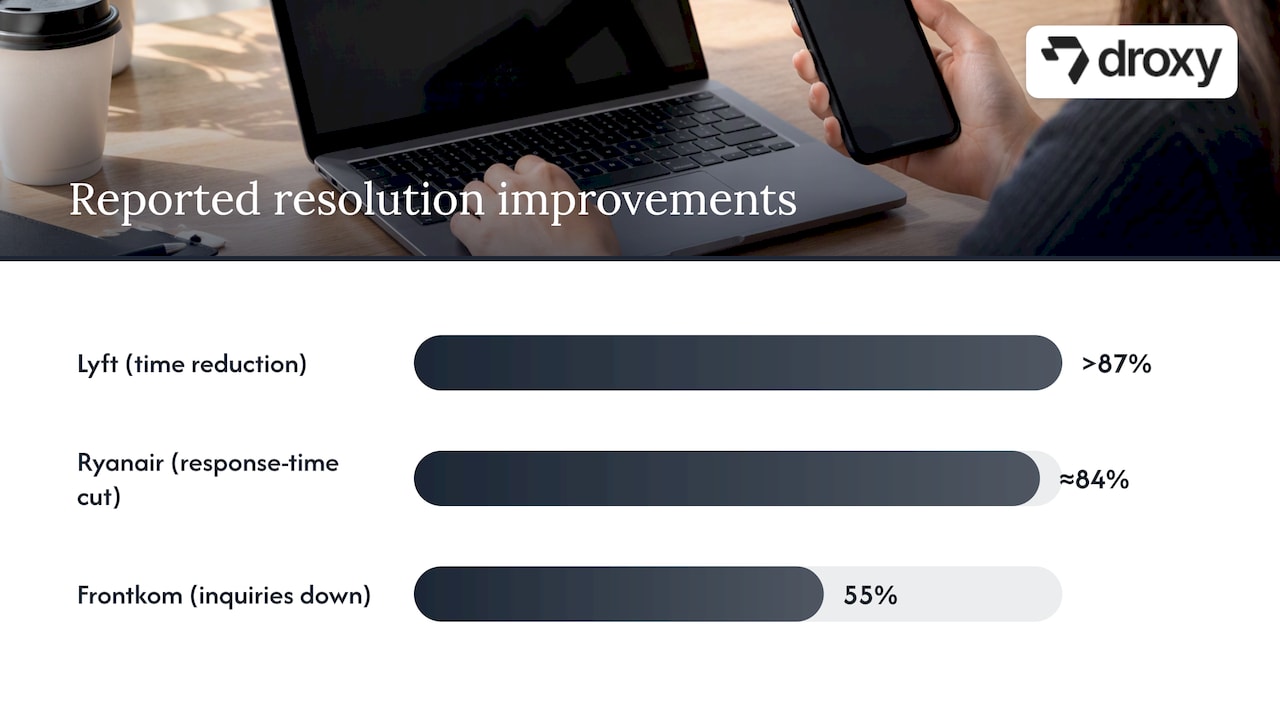
Resolution-time cuts in published case studies range from roughly 55% to over 87%, which means the gap between a mediocre pilot and a strong one often comes down to how well the AI’s knowledge base matches the questions customers actually ask.
When you set up measurement, prioritize four KPIs: containment rate (what percentage of conversations the AI resolves without human help), CSAT (whether customers are satisfied with the resolution, not just that one occurred), first-contact resolution (FCR), and ACW reduction (how much faster agents close tickets with AI assistance). Instrument all four from day one rather than adding them later, because a high containment rate paired with falling CSAT signals a problem that volume metrics alone will hide.
The variability between cases comes down to three factors: how mature and well-organized the underlying knowledge base is, how deeply the AI integrates with CRM and ticketing systems rather than operating as a bolted-on widget, and whether the deployment needs to handle multiple languages from the start. A single-language, well-documented product line will nearly always outperform a multilingual rollout across a messy knowledge base, at least in the early months.
Building pilots that hold up under real traffic
McKinsey’s research on contact centers makes the case for a hybrid model plainly: automate the high-confidence, repetitive tasks and keep humans in the loop for empathy-driven or complex resolution. The businesses that scale past a pilot successfully tend to share a few habits.
They define a single success metric before launch, often a containment percentage in a specific domain, rather than a vague goal like “improve support.” They build retrieval-augmented generation pipelines so answers are grounded in real documentation, and they add disambiguation steps that surface multiple candidate answers ranked by helpfulness before a domain guardrail filters the final response. They test the model against real production questions, not a curated demo script, which is the same discipline that let Ryanair iterate across multiple foundation models before scaling.
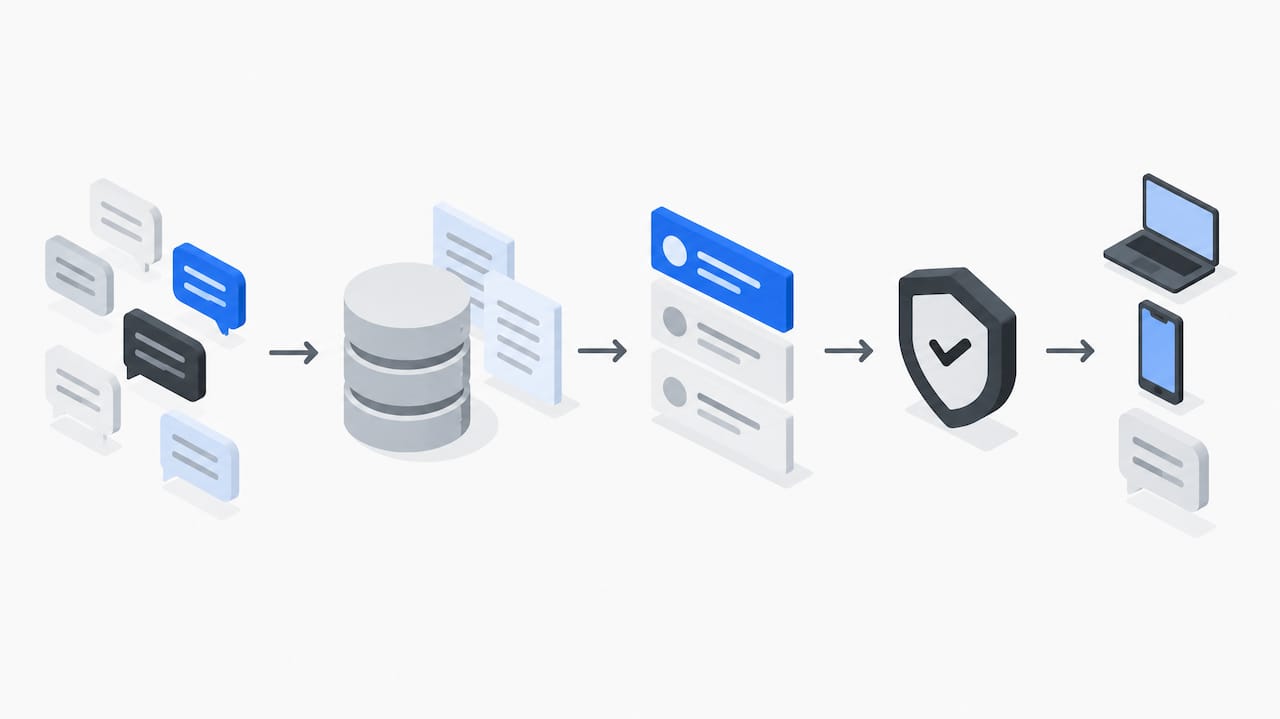
On governance, involve risk and compliance stakeholders early rather than after launch, and build domain-specific exclusions (no medical or financial advice, for instance) directly into the guardrails. On the people side, plan for role redefinition: agents freed from repetitive tickets need new training and a clear sense of what their higher-touch work looks like now.
Pro Tip: Run your pilot against the 50 most common real customer questions from last month’s tickets, not a hypothetical FAQ list.
A step-by-step checklist for your first AI pilot
Running a focused pilot beats a sprawling one every time. Here’s the sequence that keeps a first test measurable and low-risk.
Define scope and KPIs: pick containment percentage, CSAT, and ACW reduction as your three headline numbers before writing a single prompt.
Choose a narrow domain: one product line, one language, or one ticket category works better than an organization-wide rollout.
Map your integrations: confirm how the AI will connect to your knowledge base, CRM, telephony system, and ticketing platform.
Design the experiment: decide what percentage of traffic the AI handles, whether you’re running an A/B test or a phased rollout, and who reviews transcripts weekly.
Set guardrails before launch: define escalation triggers (sentiment thresholds, specific keywords, repeat contacts) that hand a conversation to a human automatically.
Evaluate and scale: compare pilot results against your success metric, then expand to adjacent domains only after the first one is stable.
For a deeper look at use cases to pull from when scoping your pilot, our contact center use case roundup covers 25 scenarios across industries.
Where we’d focus AI customer service investment in 2026
We think the businesses that win in 2026 will be the ones that treat knowledge-base quality as the real bottleneck, not model choice. Pilots that connect retrieval-augmented generation to a genuinely well-organized knowledge base outperform flashier deployments running on thin documentation, every time we’ve seen the pattern play out in published case studies.
Governance deserves equal investment to the technology itself, not an afterthought bolted on after a public mistake. Chat and phone remain the highest-leverage channels to automate first, simply because they carry the highest volume, and realistic scaling takes months of iteration, not a single quarter.
— Elena
Where Droxy fits if you’re ready to pilot
If the examples above have you ready to test an AI agent rather than just read about one, we built Droxy as a no-code platform for exactly this kind of pilot. We let you deploy customizable AI agents across website chat, phone, WhatsApp, Instagram, Facebook, and Shopify, all pulling from the same knowledge base so answers stay consistent no matter where a customer reaches you.
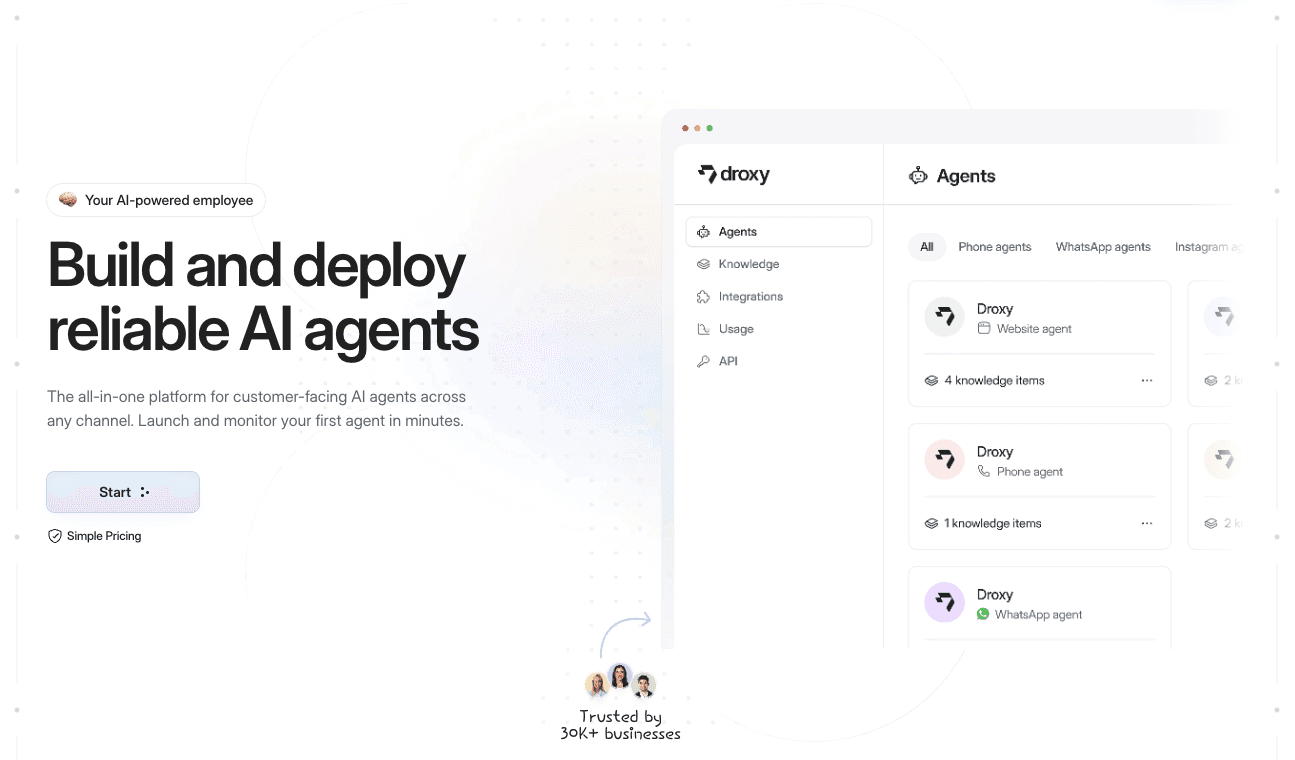
We support multilingual conversations and human hand-off when a conversation needs a real person.
We provide analytics so you can track containment, response time, and conversation volume from day one.
We offer white-labeling for agencies managing AI agents across multiple clients, detailed on our agency page.
You can compare our Basic, Advanced, and Enterprise plans to see which fits your pilot scope, starting with a single channel like our website agent or phone agent before expanding further.
FAQ
What is the 30% rule in AI?
We recommend setting your own containment or accuracy threshold based on your pilot’s specific domain rather than relying on a generic rule.
What is an example of AI as a service?
AI as a service generally refers to a cloud-based AI capability that a business subscribes to rather than builds in-house, such as a hosted chatbot platform or a voice agent accessed through an API. No-code customer service platforms, including Droxy’s website and WhatsApp agents, are examples of this model applied specifically to customer support.
What skills are needed for AI customer service?
Teams running AI customer service well typically need someone who understands the knowledge base and can keep it accurate, someone who can read conversation transcripts and tune escalation rules, and agents trained to handle the more complex cases AI hands off. Technical integration skills (connecting to a CRM or ticketing system) matter most during setup, while ongoing success depends more on content quality and review discipline.
How much does AI customer service software cost?
Pricing varies widely by platform and scope. Droxy’s plans start with Basic from $16 per month, Advanced from $80 per month, and Enterprise from $240 per month.
What results can a business expect from an AI customer service pilot?
Published case studies show containment rates vary widely and resolution-time improvements ranging from about 55% to over 87% in Lyft’s deployment, though results depend heavily on knowledge-base quality and integration depth. A narrow, well-scoped pilot in one domain tends to produce faster, more measurable wins than a broad rollout.
Sources
The contact center crossroads: finding the right mix of humans and AI — McKinsey
Banking on innovation: How ING uses generative AI to put people first — McKinsey
Agentic AI handles 120,000 daily chats using Amazon Nova at Ryanair — AWS case study
Recommended
The AI customer service examples that deliver the biggest operational returns are conversational chatbots, agent assist tools, retrieval-augmented self-service, ticket automation, voice agents, and analytics-driven forecasting. The sections below walk through each use case, real deployment examples, and a pilot plan you can run this quarter.
TL;DR:
Pilot most beneficial domains first, such as ticket routing or self-service, as these deliver rapid resolution improvements and measurable results.
A well-organized knowledge base, deep system integration, and handling multiple languages early are critical factors influencing AI deployment success.
Key KPIs to monitor during pilots include containment rate, customer satisfaction, first-contact resolution, and agent worktime reduction.
Narrow, domain-specific pilots with real customer questions outperform broad, generic tests by enabling more accurate benchmarking and iteration.
Chat and voice support channels offer the highest leverage for automation, especially when combined with governance and knowledge-base quality focus.
DroxyMake Customer Support More ResponsiveDeploy AI agents across your customer channels to provide instant, 24/7 answers while matching your brand's voice.Explore Droxy
Table of Contents
How core AI customer service examples work in practice
Ten real-world deployments and the results they produced
What the numbers tell us about realistic ROI
Building pilots that hold up under real traffic
A step-by-step checklist for your first AI pilot
Where we’d focus AI customer service investment in 2026
Where Droxy fits if you’re ready to pilot
Sources
How core AI customer service examples work in practice
Each AI use case solves a different operational bottleneck, and knowing which lever to pull first matters more than chasing every capability at once.
Conversational AI and chatbots handle routine intents like order status, password resets, and billing questions around the clock. When built on retrieval-augmented generation (RAG), these systems pull answers from your actual knowledge base rather than guessing, which keeps responses accurate and on-brand. Our guide to how conversational AI works breaks down the retrieval and generation components in more depth.
Agent assist tools sit beside human agents rather than replacing them. They suggest replies, recommend next-best-actions, and summarize long chat threads automatically, which shrinks after-call work (ACW) and lets agents close tickets faster.
Self-service and knowledge augmentation use RAG pipelines connected to help centers, product manuals, and internal wikis so customers find answers without opening a ticket at all.
Ticket automation covers three things: auto-creating tickets from web forms or emails, auto-tagging by category and urgency, and smart routing to the right queue or specialist.
Sentiment analysis scans incoming messages for frustration or urgency signals, then triggers escalation rules that route angry or high-value customers straight to a human.
Automated email and outbound messaging uses templated, personalized sequences for order updates, renewal reminders, and proactive outreach.
Voice AI answers phone calls, replaces rigid IVR menus, and increasingly supports multiple languages in real time, letting callers skip the “press 1 for English” maze entirely.
Personalization and product recommendations inside support flows turn a return request into a cross-sell opportunity when the AI understands purchase history.
QA and coaching automation auto-scores agent conversations against quality rubrics and flags coaching opportunities without a supervisor listening to every call.
Analytics and workforce forecasting use historical ticket volume and AI-driven pattern detection to staff contact centers more accurately.
Conversational AI and self-service reduce ticket volume before it ever reaches a human queue.
Agent assist and QA automation make the agents who remain faster and more consistent.
Voice AI and sentiment routing determine how well your highest-stakes conversations get handled.
Ten real-world deployments and the results they produced
These examples span industries and channels, and each one ties a specific capability to a measurable outcome you can benchmark against.
Banking chatbot upgrade. A joint generative-AI chatbot pilot at ING outperformed the bank’s classic chatbot and helped 20% more customers avoid long wait times within seven weeks of testing, with risk stakeholders involved from day one to keep financial-advice guardrails in place.
Airline agentic chat at scale. Ryanair’s agentic AI system now handles 120,000 chat interactions daily, cutting average response latency significantly in testing while reporting a high task accuracy rate in production.
Rideshare support resolution. Lyft deployed an AI assistant that reduced customer support resolution time by more than 87% and improved decision-making accuracy by about 30%.
Public transit inquiry reduction. A Norwegian transit operator working with Frontkom and IBM saw inquiries drop 37% in the first week and up to 55% after six weeks, alongside major cuts in response times.
Insurance virtual assistant. A virtual assistant deployment for Generali Poland reflects a pattern common across insurance and financial services: routine claims and policy questions get automated while agents focus on complex claims review.
Multilingual voice answering. Voice agents that replace traditional IVR trees now support multiple languages in the same call flow, letting a single deployment serve customers who would otherwise need separate regional call centers.
Agency-managed omnichannel support. Agencies running AI across chat, WhatsApp, and social inboxes for multiple clients report productivity gains that compound when the same knowledge base feeds every channel, an approach one agency productivity analysis ties to a 3.2x return on the automation investment.
Call triage before a human ever picks up. Service businesses using automated call triage route bookings and urgent requests before a receptionist answers, a pattern detailed in this call triage automation example for appointment-based businesses.
Sentiment-based escalation. Contact centers running sentiment analysis on inbound chat flag frustrated customers in real time, so a human agent intervenes before a minor complaint becomes a churn risk.
QA scoring at scale. Automated QA scoring lets a quality team review 100% of conversations instead of a small weekly sample, surfacing coaching opportunities that manual spot checks would miss entirely.
Across these examples, the common thread is narrow scope first: each deployment targeted one domain, measured results, then expanded.
What the numbers tell us about realistic ROI
Resolution-time improvements vary just as widely: Lyft reported a reduction of more than 87%, while Ryanair’s latency testing showed response times falling from 18 seconds to 2.9 seconds, a roughly 84% cut. The Frontkom transit deployment landed in between, with inquiries down 55% after six weeks.
Resolution-time cuts in published case studies range from roughly 55% to over 87%, which means the gap between a mediocre pilot and a strong one often comes down to how well the AI’s knowledge base matches the questions customers actually ask.
When you set up measurement, prioritize four KPIs: containment rate (what percentage of conversations the AI resolves without human help), CSAT (whether customers are satisfied with the resolution, not just that one occurred), first-contact resolution (FCR), and ACW reduction (how much faster agents close tickets with AI assistance). Instrument all four from day one rather than adding them later, because a high containment rate paired with falling CSAT signals a problem that volume metrics alone will hide.
The variability between cases comes down to three factors: how mature and well-organized the underlying knowledge base is, how deeply the AI integrates with CRM and ticketing systems rather than operating as a bolted-on widget, and whether the deployment needs to handle multiple languages from the start. A single-language, well-documented product line will nearly always outperform a multilingual rollout across a messy knowledge base, at least in the early months.
Building pilots that hold up under real traffic
McKinsey’s research on contact centers makes the case for a hybrid model plainly: automate the high-confidence, repetitive tasks and keep humans in the loop for empathy-driven or complex resolution. The businesses that scale past a pilot successfully tend to share a few habits.
They define a single success metric before launch, often a containment percentage in a specific domain, rather than a vague goal like “improve support.” They build retrieval-augmented generation pipelines so answers are grounded in real documentation, and they add disambiguation steps that surface multiple candidate answers ranked by helpfulness before a domain guardrail filters the final response. They test the model against real production questions, not a curated demo script, which is the same discipline that let Ryanair iterate across multiple foundation models before scaling.
On governance, involve risk and compliance stakeholders early rather than after launch, and build domain-specific exclusions (no medical or financial advice, for instance) directly into the guardrails. On the people side, plan for role redefinition: agents freed from repetitive tickets need new training and a clear sense of what their higher-touch work looks like now.
Pro Tip: Run your pilot against the 50 most common real customer questions from last month’s tickets, not a hypothetical FAQ list.
A step-by-step checklist for your first AI pilot
Running a focused pilot beats a sprawling one every time. Here’s the sequence that keeps a first test measurable and low-risk.
Define scope and KPIs: pick containment percentage, CSAT, and ACW reduction as your three headline numbers before writing a single prompt.
Choose a narrow domain: one product line, one language, or one ticket category works better than an organization-wide rollout.
Map your integrations: confirm how the AI will connect to your knowledge base, CRM, telephony system, and ticketing platform.
Design the experiment: decide what percentage of traffic the AI handles, whether you’re running an A/B test or a phased rollout, and who reviews transcripts weekly.
Set guardrails before launch: define escalation triggers (sentiment thresholds, specific keywords, repeat contacts) that hand a conversation to a human automatically.
Evaluate and scale: compare pilot results against your success metric, then expand to adjacent domains only after the first one is stable.
For a deeper look at use cases to pull from when scoping your pilot, our contact center use case roundup covers 25 scenarios across industries.
Where we’d focus AI customer service investment in 2026
We think the businesses that win in 2026 will be the ones that treat knowledge-base quality as the real bottleneck, not model choice. Pilots that connect retrieval-augmented generation to a genuinely well-organized knowledge base outperform flashier deployments running on thin documentation, every time we’ve seen the pattern play out in published case studies.
Governance deserves equal investment to the technology itself, not an afterthought bolted on after a public mistake. Chat and phone remain the highest-leverage channels to automate first, simply because they carry the highest volume, and realistic scaling takes months of iteration, not a single quarter.
— Elena
Where Droxy fits if you’re ready to pilot
If the examples above have you ready to test an AI agent rather than just read about one, we built Droxy as a no-code platform for exactly this kind of pilot. We let you deploy customizable AI agents across website chat, phone, WhatsApp, Instagram, Facebook, and Shopify, all pulling from the same knowledge base so answers stay consistent no matter where a customer reaches you.
We support multilingual conversations and human hand-off when a conversation needs a real person.
We provide analytics so you can track containment, response time, and conversation volume from day one.
We offer white-labeling for agencies managing AI agents across multiple clients, detailed on our agency page.
You can compare our Basic, Advanced, and Enterprise plans to see which fits your pilot scope, starting with a single channel like our website agent or phone agent before expanding further.
FAQ
What is the 30% rule in AI?
We recommend setting your own containment or accuracy threshold based on your pilot’s specific domain rather than relying on a generic rule.
What is an example of AI as a service?
AI as a service generally refers to a cloud-based AI capability that a business subscribes to rather than builds in-house, such as a hosted chatbot platform or a voice agent accessed through an API. No-code customer service platforms, including Droxy’s website and WhatsApp agents, are examples of this model applied specifically to customer support.
What skills are needed for AI customer service?
Teams running AI customer service well typically need someone who understands the knowledge base and can keep it accurate, someone who can read conversation transcripts and tune escalation rules, and agents trained to handle the more complex cases AI hands off. Technical integration skills (connecting to a CRM or ticketing system) matter most during setup, while ongoing success depends more on content quality and review discipline.
How much does AI customer service software cost?
Pricing varies widely by platform and scope. Droxy’s plans start with Basic from $16 per month, Advanced from $80 per month, and Enterprise from $240 per month.
What results can a business expect from an AI customer service pilot?
Published case studies show containment rates vary widely and resolution-time improvements ranging from about 55% to over 87% in Lyft’s deployment, though results depend heavily on knowledge-base quality and integration depth. A narrow, well-scoped pilot in one domain tends to produce faster, more measurable wins than a broad rollout.
Sources
The contact center crossroads: finding the right mix of humans and AI — McKinsey
Banking on innovation: How ING uses generative AI to put people first — McKinsey
Agentic AI handles 120,000 daily chats using Amazon Nova at Ryanair — AWS case study
Recommended


🚀
Powered by Droxy
Turn every interaction into a conversion
Customer facing AI agents that engage, convert, and support so you can scale what matters.
✨
Learn more
Recent posts
Insights
3 min read
Introducing Agent Memories
Improve your agents' performance with Agent Memories. Prevent agents from repeating the same mistakes by giving them feedback.
Read more

Insights
15 min read
HVAC Marketing in 2025: The Definitive Lead Gen Guide
Discover 15 proven HVAC marketing strategies, plus learn how Droxy's AI website agent converts curious visitors into qualified leads by answering their questions instantly - right when they're most interested in your services.
Read more
Insights
10 min read
10 Best AI Sales Agents in 2025: Tested & Ranked
Discover the top 10 AI sales agents of 2025, designed to enhance lead generation, personalize outreach, and ultimately, close more deals
Read more
Insights
3 min read
Introducing Agent Memories
Improve your agents' performance with Agent Memories. Prevent agents from repeating the same mistakes by giving them feedback.
Read more
Insights
15 min read
HVAC Marketing in 2025: The Definitive Lead Gen Guide
Discover 15 proven HVAC marketing strategies, plus learn how Droxy's AI website agent converts curious visitors into qualified leads by answering their questions instantly - right when they're most interested in your services.
Read more