Build a Contract First Chatbot Brand Voice That Scales Across Channels
Build a Contract First Chatbot Brand Voice That Scales Across Channels
Insights
13 min
Build a voice contract, ground responses in your product knowledge, test frequently, and design human handoffs. This single approach protects trust because it replaces vague adjectives (“be friendly”) with rules a chatbot can actually execute, and it scales across channels without rewriting your brand from scratch for every new platform you add.
TL;DR:
Define the contract with response length limits, required phrases, banned language, and exact refusal wording; draft the banned word list first.
Ground answers in versioned documentation and synced CRM records, and script an uncertainty response that transfers unanswered questions to a human.
Store reusable escalation, apology, and pricing snippets, including required disclosures; route billing disputes, cancellations, and legal issues to a human.
Trigger human handoffs after three failed resolution attempts, any cancellation mention, or a direct request, and pass the full conversation history to agents.
Review real conversations weekly and conduct monthly qualitative checks; track escalation, repeat contact, and resolution accuracy, while logging contract edits and restricting access.
DroxyKeep Your Brand Voice Across ChannelsDeploy customizable AI agents across website chat, phone, WhatsApp, Instagram, Facebook, and Shopify, with interactions tailored to your brand voice.Explore Droxy
Table of Contents
Write executable voice rules with a voice contract
Ground the bot in your product knowledge to prevent hallucinations
Copyable voice contract fragments and worked rewrites
Keep your voice coherent across handoffs and channels
Testing, review cadence, and governance that protect trust
How teams scale voice: a practitioner’s view
Common mistakes and what to prioritize instead
Where to put these patterns into practice
Sources
Write executable voice rules with a voice contract
A voice is what never changes. Tone is what flexes with context, like a repair technician who stays calm during a troubleshooting call but gets upbeat during a sales inquiry. Most brand guidelines list adjectives such as “warm” or “professional,” but an AI model cannot execute an adjective. It needs a rule.
A voice contract translates those adjectives into instructions the chatbot can follow every time. A workable contract includes:
Sentence length rules: cap most responses at 1-2 sentences unless the customer asks for detail.
Required phrases: a specific greeting, a specific way to confirm understanding before giving an answer.
Banned words: industry jargon, slang, or phrases that clash with your brand (“no worries” versus “you’re all set”).
Refusal templates: exact wording for when the bot cannot help, so it never improvises an apology.
Here is a before and after. Before: “I’m sorry but I can’t help with that right now, maybe try again later!” After, following a contract rule that bans exclamation points and requires a next step: “I can’t complete that here. I can connect you with a specialist who can, or you can try again in a few minutes.”
Practitioners who define voice as a system contract, with explicit tradeoff logic for competing goals like speed versus warmth, report fewer inconsistent responses across long, multi-turn conversations. Rather than one static personality, modular tone fragments can switch based on the customer’s intent, troubleshooting mode versus sales mode, while the underlying contract stays fixed. For turning these rules into prompt-ready fragments, see our guide on prompt engineering for chatbot developers.
Pro Tip: Write your banned-words list before your required-phrases list. It’s easier to spot what breaks your voice than to predict every phrase that fits it.
Ground the bot in your product knowledge to prevent hallucinations
A voice contract only works if the bot’s answers are accurate. A perfectly on-brand response that gives wrong information still destroys trust faster than a clumsy one. This is where retrieval-augmented generation, or RAG, matters: instead of relying only on what a model was trained on, the bot pulls answers from your current documentation, FAQs, and CRM records at the moment of the conversation.
IBM’s work with Vodafone’s TOBi virtual agent found that retrieval-augmented workflows and automation sped up conversation testing and improved the quality of journey content in an enterprise deployment, which is the kind of operational gain that matters when you are managing thousands of daily conversations. Vodafone’s TOBi case study is worth reading in full for the testing workflow alone.
To keep grounding reliable:
Version your knowledge base so updates to pricing or policy propagate immediately, not days later.
Sync CRM and ticketing data so the bot knows a customer’s order status before it answers.
Write an explicit “I don’t know” script that hands off rather than guesses.
Research shows that trustworthiness carries roughly 2.2 times the influence of friendliness on whether a customer recommends a brand. Accuracy, not charm, is what earns repeat business.
Copyable voice contract fragments and worked rewrites
Voice contracts work best when you don’t rebuild them from scratch for every scenario. Store reusable fragments and call them into the right conversation moment.
Escalation fragment: “I’m connecting you with a teammate who can look into this directly. They’ll have your conversation history, so you won’t need to repeat yourself.” Use whenever a request touches billing disputes, cancellations, or anything legal.
Apology and limit fragment: “I can’t do that here, but here’s what I can do instead: [alternative].” This replaces generic apologies with an immediate redirect, which keeps the conversation moving instead of stalling on regret.
Pricing explanation fragment: “Here’s what that includes: [plan details]. If your situation is different, I can connect you with someone who can confirm the exact cost.” This avoids promising a number the bot cannot verify.
Store these as named snippets in your prompt library or template system so your team can call them by reference (“use ESCALATION_01”) rather than retyping wording every time a new flow is built. This keeps the voice identical whether the fragment appears in a return policy conversation or a tech support thread. Our piece on chatbot conversation design walks through building reusable flows like these.
Mandatory disclosures, like data collection notices or refund eligibility rules, should live inside these fragments too, not as separate add-ons the bot might forget to mention.
Keep your voice coherent across handoffs and channels
The moment a bot hands off to a human, or a customer moves from WhatsApp to a phone call, is where brand voice most often breaks. A sudden shift from warm and concise to cold and bureaucratic tells the customer the “friendly brand” was just a script.
Set clear handoff triggers: three failed attempts to resolve, any mention of cancellation, or a direct request for a human.
Use consistent handoff language: “I’m bringing in a teammate who can take it from here. They’ll see everything we just discussed.”
Pass context automatically so the human agent sees the full thread, not a blank screen, which is the single biggest driver of customer frustration during transfers.
Adjust for channel mechanics, not voice: SMS needs shorter messages, voice assistants need phrasing that sounds natural read aloud, but the underlying contract, banned words, required phrases, tone rules, stays the same across all of them.
Testing, review cadence, and governance that protect trust
A voice contract decays without regular review. Sample a set of real conversations weekly, and do a deeper qualitative pass monthly, looking for drift: slang creeping in, refusal templates being ignored, tone mismatches on sensitive topics.
Track escalation rate, repeat-contact rate, and resolution accuracy as your core KPIs, alongside qualitative read-throughs for tone consistency. When testing tone variants, change one variable at a time and watch for negative signals like increased escalation or shorter session length, not just conversion.
A crowdsourced study of 360 participants found that chatbot personality changes how users perceive trust, competence, and emotion, even when it doesn’t always change their final decision, meaning a tone shift can quietly damage perceived competence before it ever shows up in your conversion numbers.
Governance checklist: restrict who can edit the voice contract, log every change with a reason, and keep an incident playbook ready for hallucinated or off-brand responses.
Pro Tip: Review your refusal and escalation templates first. They’re the moments customers remember longest, good or bad. For governance controls at the platform level, see our guide on AI chatbot security for enterprise teams.
How teams scale voice: a practitioner’s view
We built a no-code platform that lets businesses deploy AI agents across website chat, phone, WhatsApp, Instagram, Facebook, and Shopify. Reusable voice fragments, routing rules, and shared analytics let teams update a tone rule once and see it apply everywhere, instead of rebuilding the contract channel by channel.
Common mistakes and what to prioritize instead
The biggest mistake we see is the humanization trap: chasing a chatbot personality that feels delightful instead of one that is accurate. Nielsen Norman Group’s research on smarts versus emotion in AI trust warns that over-humanizing a bot can backfire, since consistent, correct answers build trust more reliably than simulated warmth.
Test your voice contract with real users, not assumptions, and let escalation rates and repeat-contact data tell you when a rule needs revising by using prompting for brand voice techniques to refine your chatbot’s messaging.
— Elena
Where to put these patterns into practice
Everything in this guide, the voice contract, the grounded knowledge base, the handoff templates, the review cadence, is easier to maintain when it lives in one system instead of scattered across separate tools for chat, phone, and social media.
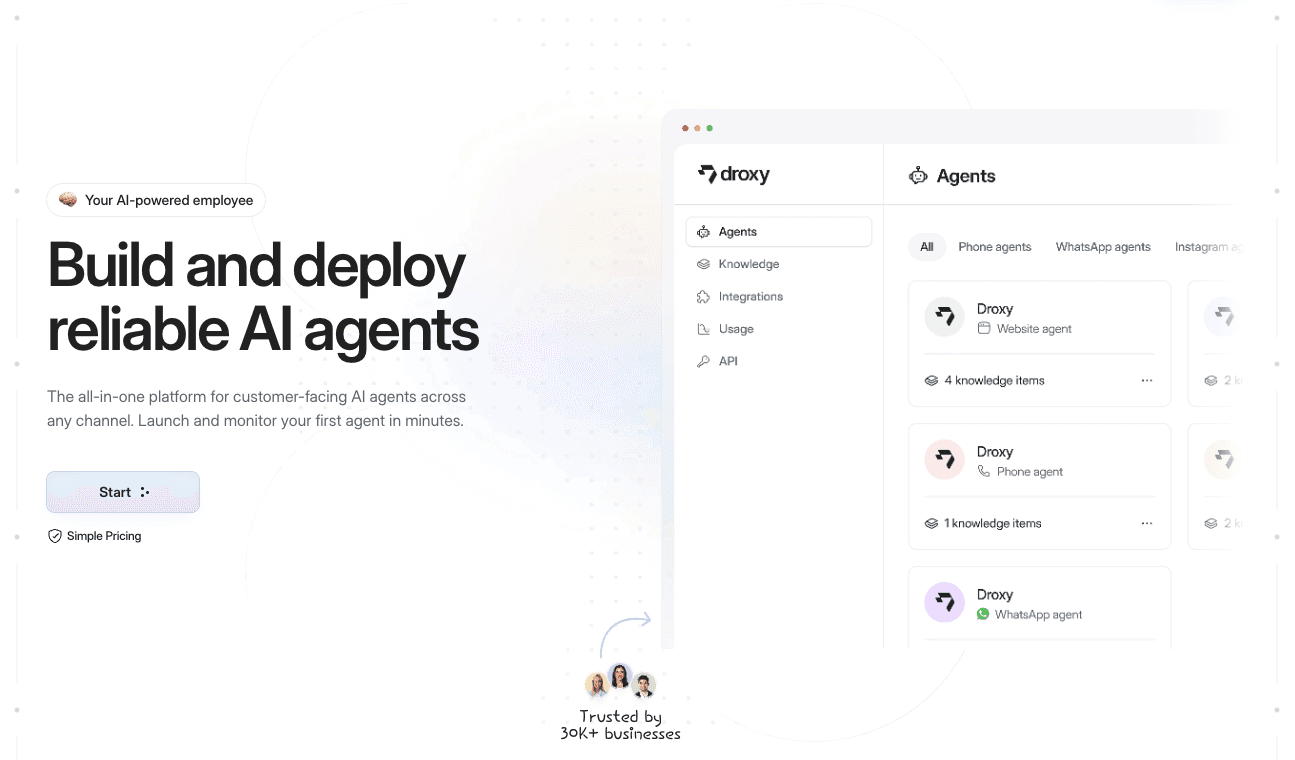
We built our platform around exactly this workflow:
A no-code agent builder for writing and storing voice contract fragments without engineering help.
Omnichannel deployment across website chat, phone, WhatsApp, Instagram, and Facebook from the same knowledge base.
Knowledge integration that keeps responses grounded in your current documentation and CRM data.
Handoff controls and analytics that track escalation and accuracy trends over time.
If you want to see how these pieces fit together for your business, check our plans and pricing or explore the website agent product page to start with a single channel.
FAQ
What AI chatbot has a voice?
Most modern AI chatbot platforms, including website, phone, and messaging agents, can be configured with a defined voice through prompt rules and contract fragments rather than coming with one fixed personality. The voice comes from how a business configures tone rules, banned words, and response templates, not from the underlying model alone.
What is a brand voice example?
A brand voice example might be an apology fragment like “I can’t do that here, but here’s what I can do instead,” paired with a rule banning exclamation points and casual slang. The example shows voice as an executable rule rather than just a descriptive word like “friendly.”
How do I create an AI brand voice?
Start by writing a voice contract with required phrases, banned words, sentence-length rules, and refusal templates, then ground the chatbot’s answers in your actual product documentation using retrieval-based methods. Test the results with real conversations and review escalation and accuracy metrics regularly, since trustworthiness carries far more weight than friendliness in how customers judge a brand.
What are the top chatbots to consider?
Rather than ranking by name, evaluate chatbot platforms by three practical capabilities: whether they support rule-based voice contracts instead of just personality presets, whether they ground answers in your own knowledge base through retrieval, and whether they offer deployment across the channels your customers actually use, like website chat, phone, and WhatsApp.
Sources
Recommended
Build a voice contract, ground responses in your product knowledge, test frequently, and design human handoffs. This single approach protects trust because it replaces vague adjectives (“be friendly”) with rules a chatbot can actually execute, and it scales across channels without rewriting your brand from scratch for every new platform you add.
TL;DR:
Define the contract with response length limits, required phrases, banned language, and exact refusal wording; draft the banned word list first.
Ground answers in versioned documentation and synced CRM records, and script an uncertainty response that transfers unanswered questions to a human.
Store reusable escalation, apology, and pricing snippets, including required disclosures; route billing disputes, cancellations, and legal issues to a human.
Trigger human handoffs after three failed resolution attempts, any cancellation mention, or a direct request, and pass the full conversation history to agents.
Review real conversations weekly and conduct monthly qualitative checks; track escalation, repeat contact, and resolution accuracy, while logging contract edits and restricting access.
DroxyKeep Your Brand Voice Across ChannelsDeploy customizable AI agents across website chat, phone, WhatsApp, Instagram, Facebook, and Shopify, with interactions tailored to your brand voice.Explore Droxy
Table of Contents
Write executable voice rules with a voice contract
Ground the bot in your product knowledge to prevent hallucinations
Copyable voice contract fragments and worked rewrites
Keep your voice coherent across handoffs and channels
Testing, review cadence, and governance that protect trust
How teams scale voice: a practitioner’s view
Common mistakes and what to prioritize instead
Where to put these patterns into practice
Sources
Write executable voice rules with a voice contract
A voice is what never changes. Tone is what flexes with context, like a repair technician who stays calm during a troubleshooting call but gets upbeat during a sales inquiry. Most brand guidelines list adjectives such as “warm” or “professional,” but an AI model cannot execute an adjective. It needs a rule.
A voice contract translates those adjectives into instructions the chatbot can follow every time. A workable contract includes:
Sentence length rules: cap most responses at 1-2 sentences unless the customer asks for detail.
Required phrases: a specific greeting, a specific way to confirm understanding before giving an answer.
Banned words: industry jargon, slang, or phrases that clash with your brand (“no worries” versus “you’re all set”).
Refusal templates: exact wording for when the bot cannot help, so it never improvises an apology.
Here is a before and after. Before: “I’m sorry but I can’t help with that right now, maybe try again later!” After, following a contract rule that bans exclamation points and requires a next step: “I can’t complete that here. I can connect you with a specialist who can, or you can try again in a few minutes.”
Practitioners who define voice as a system contract, with explicit tradeoff logic for competing goals like speed versus warmth, report fewer inconsistent responses across long, multi-turn conversations. Rather than one static personality, modular tone fragments can switch based on the customer’s intent, troubleshooting mode versus sales mode, while the underlying contract stays fixed. For turning these rules into prompt-ready fragments, see our guide on prompt engineering for chatbot developers.
Pro Tip: Write your banned-words list before your required-phrases list. It’s easier to spot what breaks your voice than to predict every phrase that fits it.
Ground the bot in your product knowledge to prevent hallucinations
A voice contract only works if the bot’s answers are accurate. A perfectly on-brand response that gives wrong information still destroys trust faster than a clumsy one. This is where retrieval-augmented generation, or RAG, matters: instead of relying only on what a model was trained on, the bot pulls answers from your current documentation, FAQs, and CRM records at the moment of the conversation.
IBM’s work with Vodafone’s TOBi virtual agent found that retrieval-augmented workflows and automation sped up conversation testing and improved the quality of journey content in an enterprise deployment, which is the kind of operational gain that matters when you are managing thousands of daily conversations. Vodafone’s TOBi case study is worth reading in full for the testing workflow alone.
To keep grounding reliable:
Version your knowledge base so updates to pricing or policy propagate immediately, not days later.
Sync CRM and ticketing data so the bot knows a customer’s order status before it answers.
Write an explicit “I don’t know” script that hands off rather than guesses.
Research shows that trustworthiness carries roughly 2.2 times the influence of friendliness on whether a customer recommends a brand. Accuracy, not charm, is what earns repeat business.
Copyable voice contract fragments and worked rewrites
Voice contracts work best when you don’t rebuild them from scratch for every scenario. Store reusable fragments and call them into the right conversation moment.
Escalation fragment: “I’m connecting you with a teammate who can look into this directly. They’ll have your conversation history, so you won’t need to repeat yourself.” Use whenever a request touches billing disputes, cancellations, or anything legal.
Apology and limit fragment: “I can’t do that here, but here’s what I can do instead: [alternative].” This replaces generic apologies with an immediate redirect, which keeps the conversation moving instead of stalling on regret.
Pricing explanation fragment: “Here’s what that includes: [plan details]. If your situation is different, I can connect you with someone who can confirm the exact cost.” This avoids promising a number the bot cannot verify.
Store these as named snippets in your prompt library or template system so your team can call them by reference (“use ESCALATION_01”) rather than retyping wording every time a new flow is built. This keeps the voice identical whether the fragment appears in a return policy conversation or a tech support thread. Our piece on chatbot conversation design walks through building reusable flows like these.
Mandatory disclosures, like data collection notices or refund eligibility rules, should live inside these fragments too, not as separate add-ons the bot might forget to mention.
Keep your voice coherent across handoffs and channels
The moment a bot hands off to a human, or a customer moves from WhatsApp to a phone call, is where brand voice most often breaks. A sudden shift from warm and concise to cold and bureaucratic tells the customer the “friendly brand” was just a script.
Set clear handoff triggers: three failed attempts to resolve, any mention of cancellation, or a direct request for a human.
Use consistent handoff language: “I’m bringing in a teammate who can take it from here. They’ll see everything we just discussed.”
Pass context automatically so the human agent sees the full thread, not a blank screen, which is the single biggest driver of customer frustration during transfers.
Adjust for channel mechanics, not voice: SMS needs shorter messages, voice assistants need phrasing that sounds natural read aloud, but the underlying contract, banned words, required phrases, tone rules, stays the same across all of them.
Testing, review cadence, and governance that protect trust
A voice contract decays without regular review. Sample a set of real conversations weekly, and do a deeper qualitative pass monthly, looking for drift: slang creeping in, refusal templates being ignored, tone mismatches on sensitive topics.
Track escalation rate, repeat-contact rate, and resolution accuracy as your core KPIs, alongside qualitative read-throughs for tone consistency. When testing tone variants, change one variable at a time and watch for negative signals like increased escalation or shorter session length, not just conversion.
A crowdsourced study of 360 participants found that chatbot personality changes how users perceive trust, competence, and emotion, even when it doesn’t always change their final decision, meaning a tone shift can quietly damage perceived competence before it ever shows up in your conversion numbers.
Governance checklist: restrict who can edit the voice contract, log every change with a reason, and keep an incident playbook ready for hallucinated or off-brand responses.
Pro Tip: Review your refusal and escalation templates first. They’re the moments customers remember longest, good or bad. For governance controls at the platform level, see our guide on AI chatbot security for enterprise teams.
How teams scale voice: a practitioner’s view
We built a no-code platform that lets businesses deploy AI agents across website chat, phone, WhatsApp, Instagram, Facebook, and Shopify. Reusable voice fragments, routing rules, and shared analytics let teams update a tone rule once and see it apply everywhere, instead of rebuilding the contract channel by channel.
Common mistakes and what to prioritize instead
The biggest mistake we see is the humanization trap: chasing a chatbot personality that feels delightful instead of one that is accurate. Nielsen Norman Group’s research on smarts versus emotion in AI trust warns that over-humanizing a bot can backfire, since consistent, correct answers build trust more reliably than simulated warmth.
Test your voice contract with real users, not assumptions, and let escalation rates and repeat-contact data tell you when a rule needs revising by using prompting for brand voice techniques to refine your chatbot’s messaging.
— Elena
Where to put these patterns into practice
Everything in this guide, the voice contract, the grounded knowledge base, the handoff templates, the review cadence, is easier to maintain when it lives in one system instead of scattered across separate tools for chat, phone, and social media.
We built our platform around exactly this workflow:
A no-code agent builder for writing and storing voice contract fragments without engineering help.
Omnichannel deployment across website chat, phone, WhatsApp, Instagram, and Facebook from the same knowledge base.
Knowledge integration that keeps responses grounded in your current documentation and CRM data.
Handoff controls and analytics that track escalation and accuracy trends over time.
If you want to see how these pieces fit together for your business, check our plans and pricing or explore the website agent product page to start with a single channel.
FAQ
What AI chatbot has a voice?
Most modern AI chatbot platforms, including website, phone, and messaging agents, can be configured with a defined voice through prompt rules and contract fragments rather than coming with one fixed personality. The voice comes from how a business configures tone rules, banned words, and response templates, not from the underlying model alone.
What is a brand voice example?
A brand voice example might be an apology fragment like “I can’t do that here, but here’s what I can do instead,” paired with a rule banning exclamation points and casual slang. The example shows voice as an executable rule rather than just a descriptive word like “friendly.”
How do I create an AI brand voice?
Start by writing a voice contract with required phrases, banned words, sentence-length rules, and refusal templates, then ground the chatbot’s answers in your actual product documentation using retrieval-based methods. Test the results with real conversations and review escalation and accuracy metrics regularly, since trustworthiness carries far more weight than friendliness in how customers judge a brand.
What are the top chatbots to consider?
Rather than ranking by name, evaluate chatbot platforms by three practical capabilities: whether they support rule-based voice contracts instead of just personality presets, whether they ground answers in your own knowledge base through retrieval, and whether they offer deployment across the channels your customers actually use, like website chat, phone, and WhatsApp.
Sources
Recommended


🚀
Powered by Droxy
Turn every interaction into a conversion
Customer facing AI agents that engage, convert, and support so you can scale what matters.
✨
Learn more
Recent posts
Insights
3 min read
Introducing Agent Memories
Improve your agents' performance with Agent Memories. Prevent agents from repeating the same mistakes by giving them feedback.
Read more

Insights
15 min read
HVAC Marketing in 2025: The Definitive Lead Gen Guide
Discover 15 proven HVAC marketing strategies, plus learn how Droxy's AI website agent converts curious visitors into qualified leads by answering their questions instantly - right when they're most interested in your services.
Read more
Insights
10 min read
10 Best AI Sales Agents in 2025: Tested & Ranked
Discover the top 10 AI sales agents of 2025, designed to enhance lead generation, personalize outreach, and ultimately, close more deals
Read more
Insights
3 min read
Introducing Agent Memories
Improve your agents' performance with Agent Memories. Prevent agents from repeating the same mistakes by giving them feedback.
Read more
Insights
15 min read
HVAC Marketing in 2025: The Definitive Lead Gen Guide
Discover 15 proven HVAC marketing strategies, plus learn how Droxy's AI website agent converts curious visitors into qualified leads by answering their questions instantly - right when they're most interested in your services.
Read more