26 Best AI Chatbot Software for Your Business in 2026
26 Best AI Chatbot Software for Your Business in 2026
Comparisons
30
Customers expect instant responses at 2 AM, personalized recommendations, and smooth support across every channel. The right AI chatbot software delivers all of this while teams sleep, but choosing from hundreds of options feels overwhelming. Selecting the best chatbot development platform requires understanding which features actually drive customer satisfaction and business results.
Implementation becomes straightforward with the right tools and approach. Modern chatbot platforms offer conversational AI for support tickets, natural language processing to understand customer intent, and machine learning capabilities that improve over time. Businesses ready to transform their customer interactions can leverage an AI agent for your business without wrestling with complicated setup processes or requiring extensive technical expertise.
Table of Contents
What Are the Benefits of Using an AI Chatbot Software for Your Business?
How Is AI Chatbot Software Different From Traditional Chatbots?
How to Choose the Right AI Chatbot Software for Your Business
Summary
AI chatbot software handles 80% of routine customer queries, according to industry research, meaning businesses without this technology answer questions manually while competitors resolve issues instantly. The gap widens daily as customers who experience immediate responses elsewhere lose patience with delayed replies. Companies that delay implementation don't just postpone benefits; they actively surrender market position as expectations shift toward instant engagement across all channels.
Immediate response capability determines conversion outcomes more than most businesses realize. IBM research shows 90% of customers expect instant replies when they have service questions, and that expectation doesn't pause at 5 PM or wait for Monday morning. Every delayed response represents a potential customer evaluating competitor offers instead, especially since prospects comparing vendors choose whoever answers first with relevant information rather than waiting hours for email responses.
Cost savings from AI chatbot deployment reach 30% of customer support expenses, primarily by resolving routine inquiries without human intervention. Password resets, order tracking, basic troubleshooting, and FAQ responses are handled instantly, eliminating the variability that comes with human interpretation across growing teams. The savings extend beyond salary reduction to include training time, quality monitoring, and the consistency challenges that compound as support teams scale.
Traditional chatbots achieve only 30-40% success rates for complex queries because they match keywords to scripted responses rather than interpreting meaning and context dynamically. The moment someone phrases a question differently or combines multiple needs into a single message, rigid decision-tree systems break down, forcing customers to guess the exact phrasing that triggers useful replies. AI systems using natural language processing recognize that different words can express the same intent, handling typos, slang, and multi-part questions without requiring users to reformulate their requests.
Conversational AI platforms that learn from every interaction improve accuracy over weeks and months without manual reprogramming, while traditional implementations deliver fixed capabilities that degrade as business needs shift. When users rephrase questions after receiving unhelpful answers, modern systems flag those exchanges as learning opportunities and prioritize response patterns that consistently lead to successful resolutions. This continuous refinement happens automatically, meaning baseline performance improves daily rather than remaining static until the next developer update.
AI agent for your business addresses deployment speed and channel coverage by syncing knowledge automatically from websites, documents, and existing resources, letting teams launch intelligent agents across multiple platforms in minutes rather than months.
What is an AI Chatbot Software, and How Does It Work?
AI chatbot software uses machine learning and natural language processing to simulate human conversation, whether in text or voice. These systems analyze user intent, generate contextual responses, and improve through repeated interactions. The technology powers everything from customer service automation to interactive sales assistants across websites, mobile apps, and messaging platforms, enabling routine exchanges without human intervention.
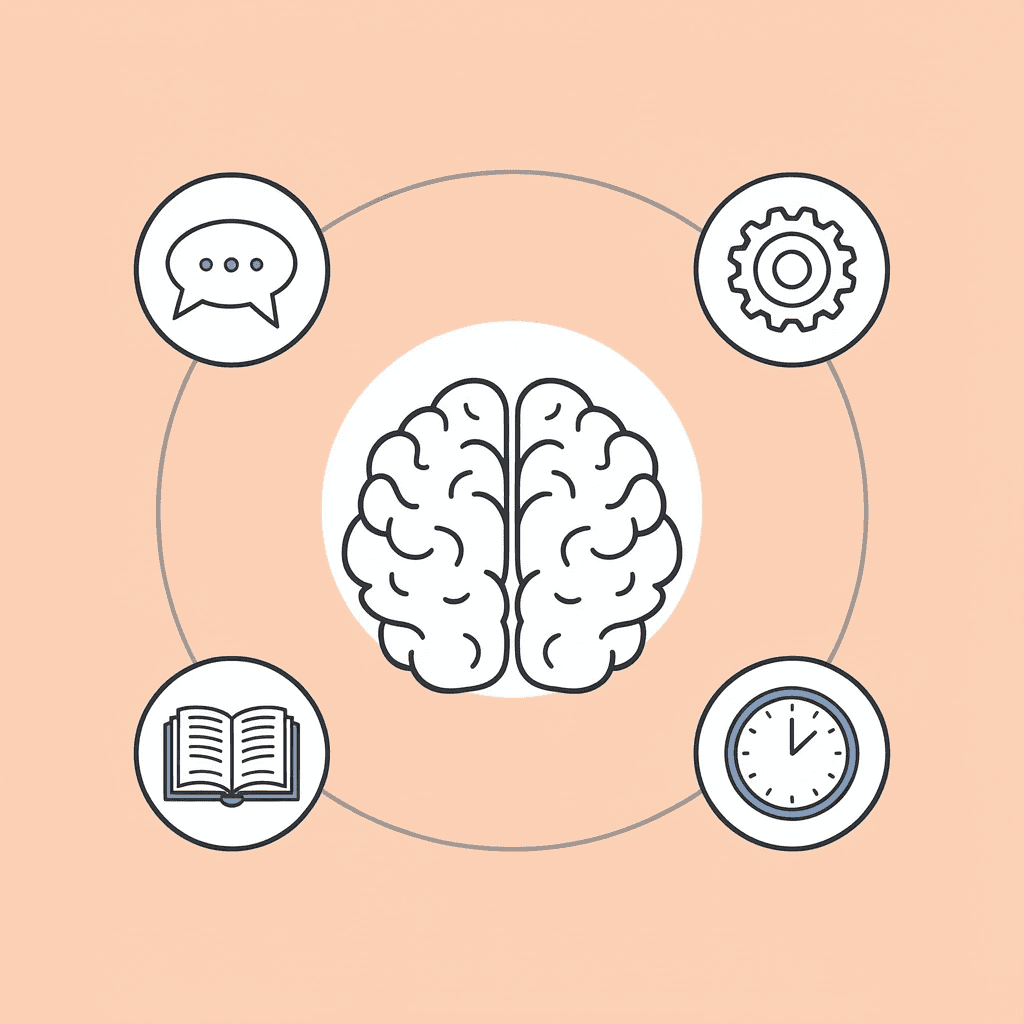
🎯 Key Point: AI chatbots learn and improve automatically with each conversation, making them more accurate and contextually aware over time.
"AI chatbots can handle up to 80% of routine customer inquiries without human intervention, significantly reducing response times and operational costs." — Customer Service Technology Report, 2024
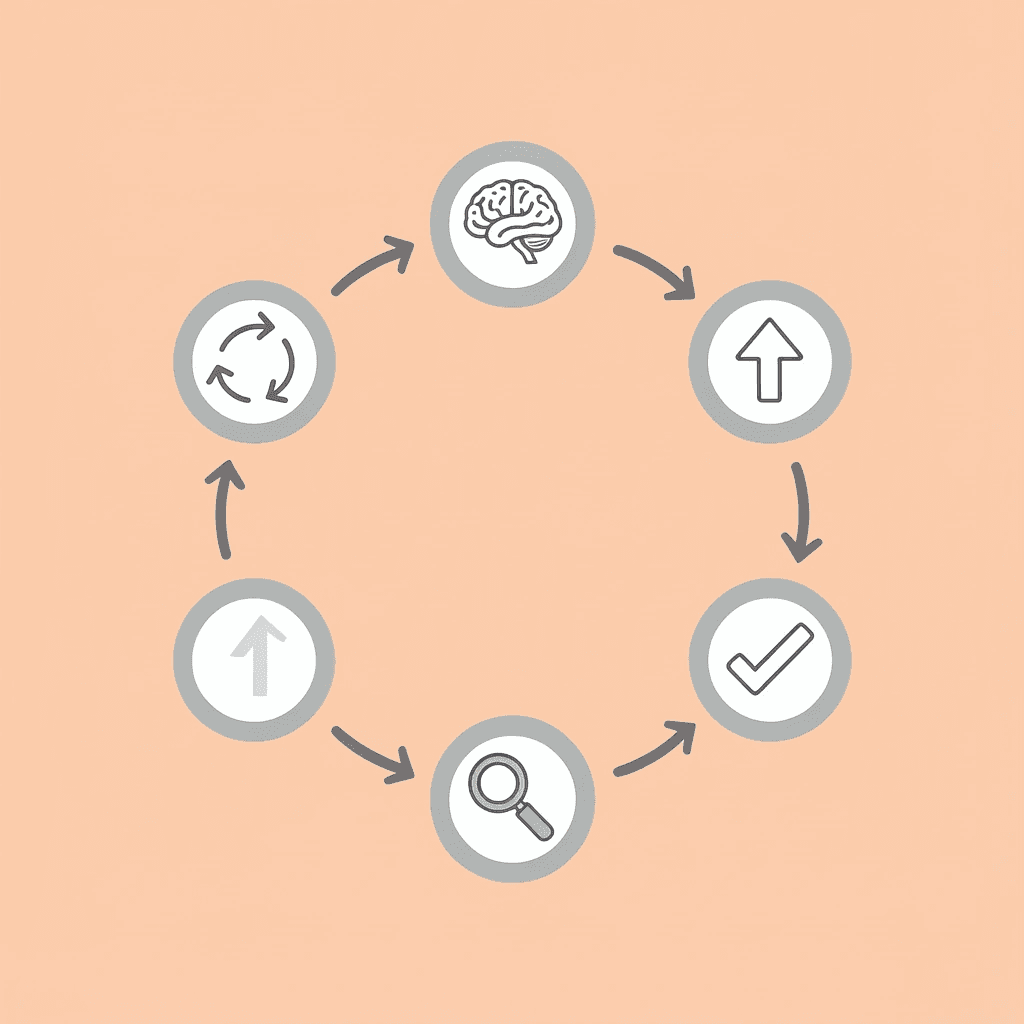
💡 Example: When a customer asks about order status, the chatbot instantly accesses the database, identifies the specific order, and provides real-time updates - all within seconds rather than requiring a human agent to manually search and respond.
How has AI chatbot software evolved from early systems?
Early chatbots could only recognize exact keyword matches and deliver canned responses. Modern systems understand meaning, handle ambiguity, and adjust their tone based on context. Customers now expect instant, accurate responses everywhere, and AI chatbots handle 80% of routine customer questions. Competitors using this technology answer inquiries while you're still routing tickets to overwhelmed support teams.
How does AI chatbot software process user input?
When someone types a question or issues a command, the chatbot receives raw data that needs translation. Natural language processing breaks input into analyzable parts through tokenization, which splits sentences into individual words and phrases. The system removes filler words, corrects spelling errors, and identifies grammatical structure, converting messy human language into clean data that the machine can evaluate.
How does context analysis work in chatbot conversations?
Syntax analysis examines sentence structure to understand how words relate to each other, while semantic analysis extracts meaning. The system distinguishes between "I need help with my order" and "Can you help me place an order?" despite similar wording. Context matters: the same phrase can carry different meanings depending on prior messages or the user's current page. Advanced systems maintain a conversation history, referencing earlier exchanges to avoid having customersrepeat themselves.
How does natural language understanding identify user intent?
Natural language understanding focuses on intent recognition and entity extraction. Intent represents what the user wants: asking a question, making a complaint, requesting a refund, or scheduling an appointment. Entity extraction identifies specific details such as product names, dates, account numbers, or locations. A customer saying "I want to return the blue jacket I bought last Tuesday" triggers intent classification (return request) and entity extraction (product: blue jacket, timeframe: last Tuesday).
Why does AI chatbot software struggle with language variations?
Machine learning models trained on millions of conversations recognize patterns in how people express the same idea. A customer might say "Where's my package?" or "Track my shipment" or "I haven't received my order yet"; all three express the same intent despite different wording.
The system learns these variations by exposure to diverse phrasing, slang, abbreviations, and typos. When the technology fails, you get responses like "I don't understand" after perfectly clear questions, a common frustration when AI misinterprets specialized or field-specific terminology.
How do simple chatbots generate responses?
Once intent is clear, the system decides how to respond. Simpler implementations use decision trees with preset templates. If intent equals "check order status" and entity equals "order number," the system retrieves tracking information and fills in the template. This approach works for straightforward transactions with limited variables.
How does AI chatbot software create original responses?
Generative AI models generate original responses rather than filling in template blanks. Large language models predict the most likely next word based on patterns learned from training data, producing replies that sound natural and conversational.
These systems use context from earlier messages, adapt tone to match the situation, and format responses with helpful suggestions or follow-up questions. Generative responses handle unexpected questions and maintain conversational flow even when users change topics mid-conversation.
What happens when platforms combine both approaches?
Platforms like AI agents for your business combine both approaches: using templates for high-stakes transactions that require precision, while employing generative models for exploratory conversations. This hybrid strategy balances accuracy with flexibility.
How does AI chatbot software learn from interactions?
Machine learning allows chatbots to improve over time without manual reprogramming. The chatbot analyzes past interactions to identify patterns in successful resolutions versus failed exchanges. When users abandon conversations, rephrase questions multiple times, or request human agents, the system flags those interactions as learning opportunities. Supervised learning incorporates human feedback, with trainers reviewing flagged conversations and correcting misinterpretations or inappropriate responses.
What makes reinforcement learning effective for chatbots?
Reinforcement learning tests variations and measures outcomes. 90% of businesses report faster complaint resolution with AI chatbots because these systems identify which response strategies reduce resolution time and which create friction. Over weeks and months, the chatbot shifts toward approaches that work, abandoning tactics that frustrate users or require escalation.
How do AI chatbot systems adapt to business changes?
New products launch, policies change, customer language evolves, and the system adapts by incorporating updated training data. The longer a well-designed chatbot operates, the better it becomes at determining customer needs, understanding context, and delivering problem-solving responses. Businesses that delay adopting this technology delay the learning period their systems require to perform optimally, while competitors who started months earlier continue to pull ahead.
Related Reading
What Are the Benefits of Using an AI Chatbot Software for Your Business?
AI chatbot software automates customer interactions, captures leads instantly, and operates 24/7. It reduces operational costs while improving response quality, creating a competitive advantage that strengthens as the technology learns from each conversation.

🎯 Key Point: AI chatbots transform your business operations by handling multiple customer inquiries simultaneously, something that would require several human agents to accomplish during traditional business hours.
"Businesses using AI chatbots see 67% faster response times and 24/7 availability that drives customer satisfaction scores significantly higher." — Customer Service Technology Report, 2024
Traditional Support | AI Chatbot Software |
|---|---|
Limited hours (9-5) | 24/7 availability |
High labor costs | Reduced operational expenses |
Inconsistent responses | Standardized, quality answers |
Manual lead capture | Instant lead qualification |
Static knowledge | Continuous learning |
💡 Tip: The real power of AI chatbot software lies in its ability to learn and improve from every customer interaction, making your support system smarter and more effective over time while your competitors rely on static support methods.

Cost Savings
AI chatbot software enables organisations to set up automated support without significant investment in software or additional staff. This makes it ideal for startups and smaller businesses. Chatbots reduce staffing costs for routine inquiries, freeing resources and personnel to focus on higher-value work such as product development and marketing.
By handling routine tasks, chatbots lower operating costs and help businesses maintain financial health. According to Deloitte's research on artificial intelligence in business, 70% of financial services respondents increased investments in generative AI for its strong value, including improved efficiency and productivity that reduced costs across departments.
Continuous Availability
AI chatbot software provides 24/7 support for questions, reservations, and first contacts across different time zones, eliminating delays that frustrate customers and maintaining momentum in their experience.
Being available all the time shows that companies are reliable and quick to respond, which helps retain more customers. According to the Stanford AI Index 2025 report, 78% of organizations used AI in 2024, up from 55% the year before, demonstrating how these tools help workers do more and enable companies to deliver a smoother customer experience.
Swift Lead Qualification
AI chatbots identify promising customers by asking targeted questions, gathering information, and routing it to management systems or sales teams. This efficient process converts casual visitors into qualified leads.
These systems help lead progress through personalized follow-ups based on collected information, increasing purchase likelihood without manual intervention. IBM's research shows chatbots generate leads and boost sales by responding faster and connecting users to sales teams.
Quicker Handling Times
AI chatbot software provides quick answers to common questions and helps users find the information they need. This reduces customer abandonment and improves satisfaction. By solving problems rapidly, businesses prevent customers from losing interest during wait times.
This efficiency lets human teams focus on harder problems, creating a balanced support system that scales with demand. According to Deloitte, generative AI applications in customer service enhance relationships and experiences by automating communications, reducing fulfillment times, and improving responsiveness.
Straightforward Implementation
Many AI chatbot software options feature user-friendly interfaces, simple builders, and pre-built components that integrate smoothly with websites or apps, enabling businesses to launch quickly and see results with minimal training.
Keeping the chatbot running is straightforward: your team can handle updates and changes without relying on outside experts. Chatbots manage multiple conversations simultaneously without requiring additional staff, enabling business growth without extra costs.
Tailored Interactions
AI chatbot software uses user data from past conversations to provide customised recommendations and services. It adapts to user preferences and behaviour to make each conversation feel relevant and useful.
This personalization encourages repeat visits, as customers return when the chatbot understands their needs. The Stanford AI Index 2025 notes that AI boosts productivity and narrows skill gaps, which, in chatbot contexts, translates into more effective customer handling that drives satisfaction and long-term relationships.
Expandable Operations
AI chatbot software scales efficiently, handling increased conversations without proportional cost or resource growth. It maintains consistent service quality during demand spikes and enables businesses to expand into new markets or product lines.
It provides a strong foundation for adding advanced features over time, keeping systems current with evolving needs. Deloitte's report demonstrates this through financial services examples where integrating generative AI into processes improves efficiency and drives innovation, enabling scalable operations that adapt to business requirements.
Insightful Analytics
AI chatbot software captures interaction data during conversations, revealing customer trends, preferences, and pain points without invasive methods. This dataset enables teams to improve offerings, optimise marketing, and address issues before they escalate. IBM notes that chatbots collect customer information for lead generation and feedback, providing CRM data that enhances understanding and personalisation.
Boosted Staff Performance
AI chatbot software handles repetitive tasks, freeing employees to focus on high-value tasks that require human empathy and creativity. This improves job satisfaction, reduces burnout, and transforms support roles into strategic contributions.
Over time, this reduces turnover and boosts morale as teams engage in meaningful work. The Stanford AI Index 2025 highlights AI's role in boosting productivity across workforces: in chatbot applications, staff handle complex issues while maintaining efficient operations.
Increased Revenue Streams
AI chatbots increase sales opportunities by suggesting products and upgrades to customers, guiding them toward purchases they might not have considered on their own, while maintaining a non-aggressive approach.
Businesses see their average order values and conversion rates increase. IBM's benefits outline shows how chatbots boost sales by finding new customers, suggesting related products, and responding quickly, creating revenue opportunities through focused interactions.
How Is AI Chatbot Software Different From Traditional Chatbots?
Old chatbots use fixed, scripted conversations that frustrate users because they don't understand context or respond to real questions, leading users to abandon the conversation and miss opportunities.
🎯 Key Point: The difference between traditional and AI chatbots is like comparing a rigid script to a dynamic conversation partner.
AI chatbot software uses advanced intelligence to create smooth, helpful conversations that solve problems faster and build strong loyalty. A Deloitte survey shows that 70% of financial services executives are increasing investments in generative AI due to proven gains in efficiency and stronger client connections.
"70% of financial services executives are increasing investments in generative AI because of proven gains in efficiency and stronger connections with clients." — Deloitte Survey

Traditional Chatbots | AI Chatbot Software |
|---|---|
Fixed scripts | Dynamic responses |
No context understanding | Contextual awareness |
Frustrating interactions | Smooth conversations |
Lost opportunities | Strong customer loyalty |
🔑 Takeaway: The shift from traditional to AI-powered chatbots represents a fundamental change from scripted interactions to intelligent conversations that drive real business results.

Core Technology Foundations
Traditional chatbots operate according to predetermined rules set by developers. Developers map out responses to specific inputs, ensuring consistency for simple tasks but limiting flexibility. When users type unexpected queries, the chatbot becomes confused or provides nonsensical answers. These systems work best in controlled environments, such as answering basic frequently asked questions.
AI chatbots use natural language processing and machine learning to understand and generate responses dynamically. They work by analyzing language patterns and context without rigid scripts, enabling complex conversations that extend beyond simple commands. This makes them valuable for customer service and operational reliability.
Query Handling Capabilities
Traditional chatbots rely on keyword matching and fixed pathways, which fail when users rephrase questions or ask unexpected ones, often leading to repetitive loops or generic redirects.
AI chatbots use contextual understanding and intent recognition to handle nuances like slang, typos, and multi-part questions, delivering relevant responses in complex conversations. This reduces escalation to human agents. A 2022 journal article found that AI systems outperformed traditional systems in satisfaction for functional product queries by adapting to user needs more effectively.
Learning and Adaptation Over Time
Traditional chatbots remain static once deployed. They require manual updates to content and features, and they don't learn from user interactions, which risks them becoming outdated as user needs and business requirements evolve.
AI chatbot software uses machine learning to improve over time based on user interactions and feedback. It identifies patterns, corrects errors, and learns new information autonomously, continuously enhancing performance. A 2025 efficiency report found that these systems cut response times by up to 99.6% when handling high request volumes, reducing maintenance requirements while meeting user and business needs.
Personalization in Interactions
Traditional chatbots deliver identical responses regardless of user history or preferences, treating each conversation as an isolated instance. This creates impersonal experiences that fail to build trust or address user needs.
AI chatbot software analyses user data, past conversations, and behavioural clues to customise replies and suggestions. This personalisation creates more engaging conversations, such as recommending products based on previous preferences, and strengthens user connections. According to McKinsey, AI-powered next-best-experience capabilities can boost customer satisfaction by 15-20 per cent.
Scalability and Operational Efficiency
Traditional chatbots handle a limited number of conversations simultaneously and work well for basic tasks. However, they struggle with high request volumes or complex tasks and often require human intervention. Their growth is constrained by their original programming, making them less suitable for expanding businesses with fluctuating customer demand.
AI chatbot software scales easily across multiple users and channels while operating 24/7 without fatigue. Gartner predicts that by 2029, agentic AI will autonomously resolve 80% of common customer service issues without human intervention, reducing operating costs by 30% and enabling businesses to allocate resources and staff more strategically.
26 Best AI Chatbot Software for Your Business in 2026
Selecting the right chatbot means matching capabilities to your business model, volume, and customer journey. Sales teams need different tools from support operations. E-commerce stores prioritize cart recovery and order processing, while service businesses focus on appointment scheduling and qualification. The platforms below represent proven systems across industries, each solving distinct problems at different scales.
1. Droxy
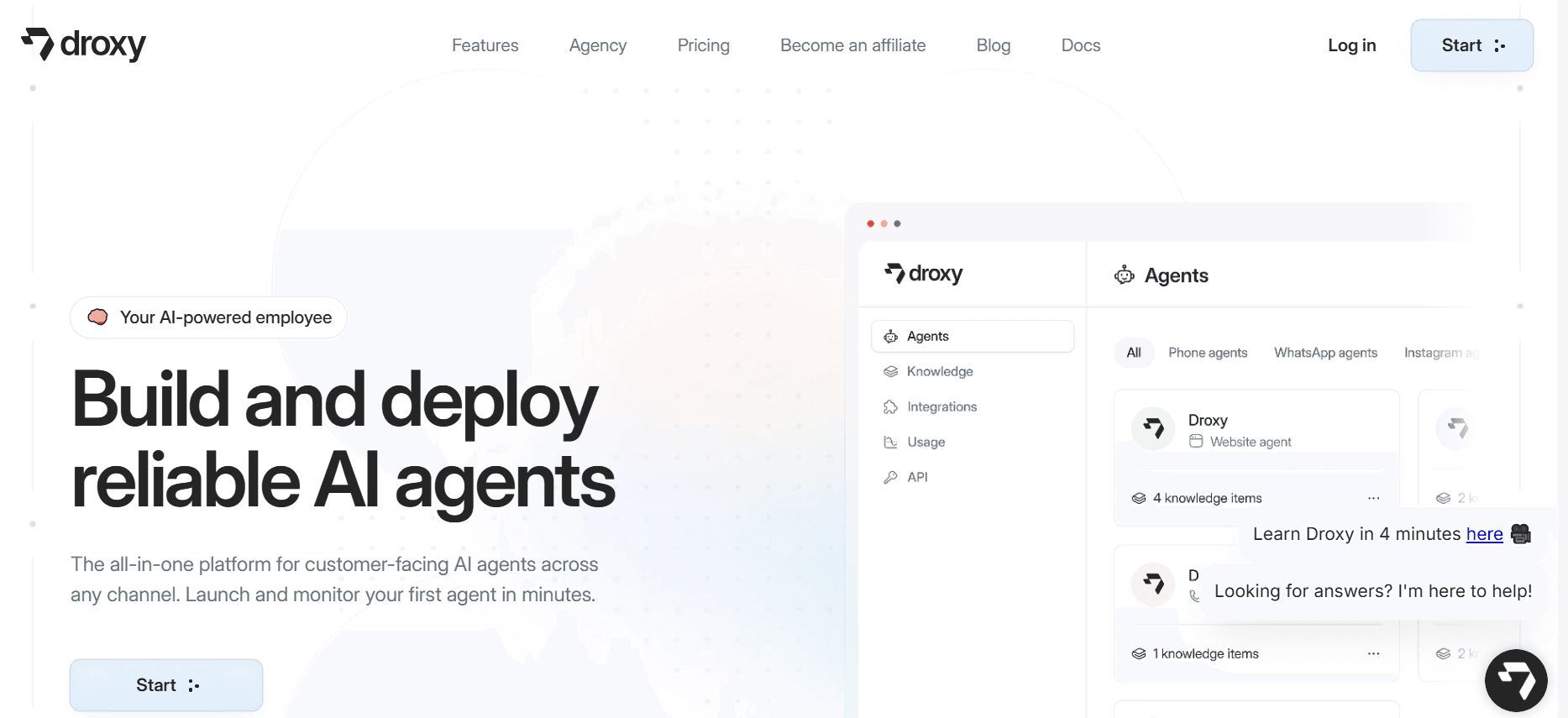
Droxy stands out as a versatile, all-in-one AI-powered platform designed specifically for deploying customer-facing AI agents across multiple channels. It functions as an "AI-powered employee," enabling businesses to automate interactions, deliver instant and accurate responses, qualify leads, and centralize communications without coding expertise. By grounding agents in business-specific knowledge and brand voice, Droxy helps companies scale support to millions of customers, significantly reduce operational costs, and turn routine inquiries into revenue opportunities through proactive engagement.
Key features
No-code setup for launching and monitoring AI agents in minutes
Grounding agents with business knowledge from sources like websites, e-commerce stores, PDFs, YouTube videos, Google Drive, and more, with automatic sync to keep information current
Definition of custom brand voice and goals for consistent, personalized interactions
Multilingual support in over 95 languages instantly, with no additional configuration needed
Deployment to any channel, including websites, WhatsApp, phone, Instagram, and others, for omnichannel coverage
Automated lead collection and qualification to boost conversions
Real-time insights and analytics on customer behavior, conversations, growth trends, and interaction sources
Powered by leading language models from OpenAI, Anthropic, Google, and Meta for advanced performance
Zapier and Droxy API for custom integrations and tailored workflows
Seamless human handoff when needed, with full context preservation
Central unified platform for all customer communications
Why Businesses Choose Droxy
Businesses opt for Droxy because it delivers dramatic efficiency gains and cost savings while enhancing customer experiences and revenue potential. It eliminates hours spent on repetitive questions (reducing from 10+ hours weekly to near zero), provides instant responses instead of delayed ones, achieves 100% call pickup rates (up from 60-70%), and improves lead conversion from around 10% to 25%. Starting at just $20/month, it offers scalable 24/7 support across channels without technical barriers, compared to thousands in human labor costs.
The no-code approach enables quick deployment in minutes, while features such as comprehensive knowledge integration, multilingual capabilities, real-time analytics, and top-tier AI models ensure accurate, human-like conversations that align with brand identity. Trusted by over 30,000 businesses, Droxy empowers teams to focus on high-value work, maintain control over interactions, and continuously improve through data-driven insights—all in an accessible, integrated platform that works with existing tools.
2. Tidio
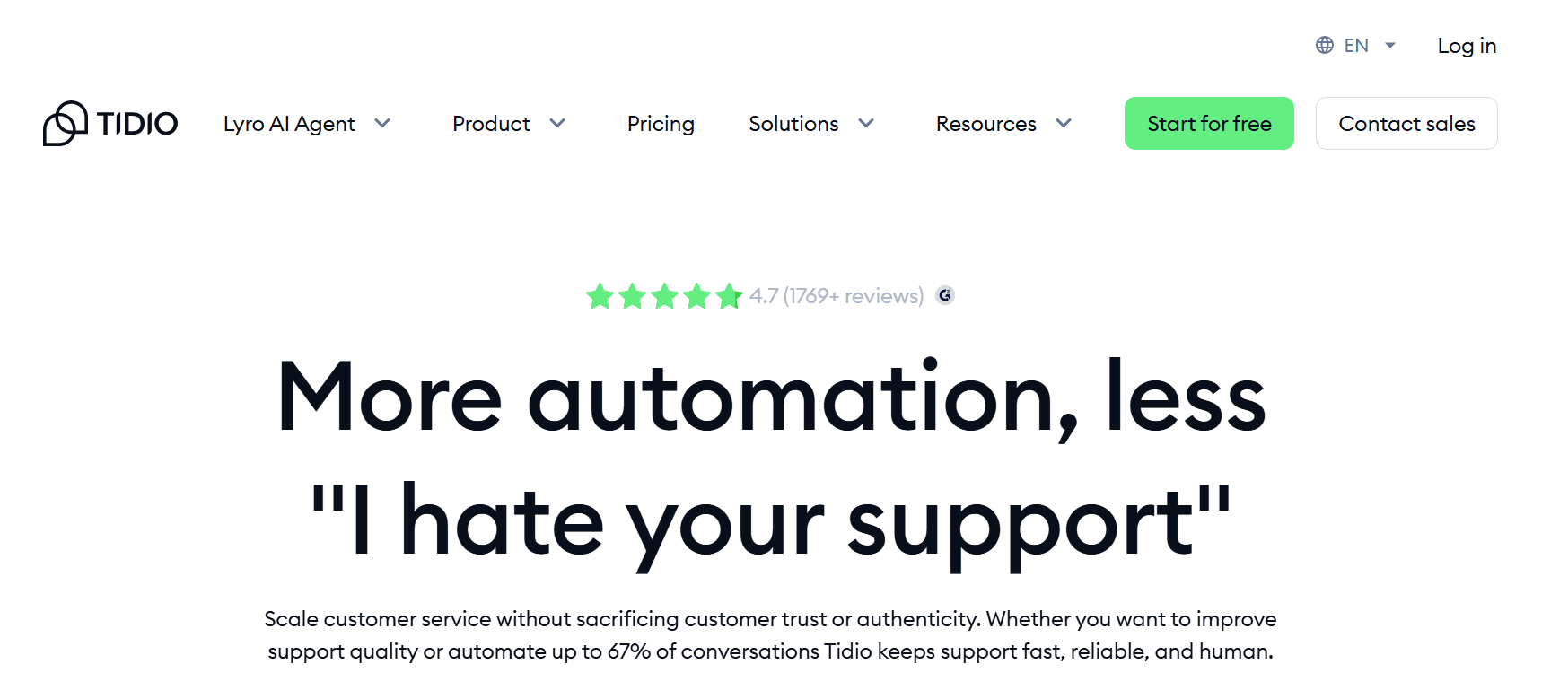
Tidio excels as a versatile platform that prioritizes sales growth through intelligent automation and real-time engagement. Its AI capabilities enable proactive conversations, order processing, and recovery of potential lost revenue, making it ideal for e-commerce and customer-facing websites. With strong analytics and seamless team collaboration, Tidio helps convert visitors into customers while maintaining high support standards.
Key features
Proactive chat triggers based on visitor behavior
AI-powered response generation for instant replies
Abandoned cart recovery with personalized reminders and discounts
Order placement and confirmation handling directly in chat
Shared team inbox for smooth handoffs between bot and agents
Extensive integrations, including Shopify, HubSpot, and WhatsApp
Detailed analytics on conversation metrics and resolution rates
3. Freshdesk
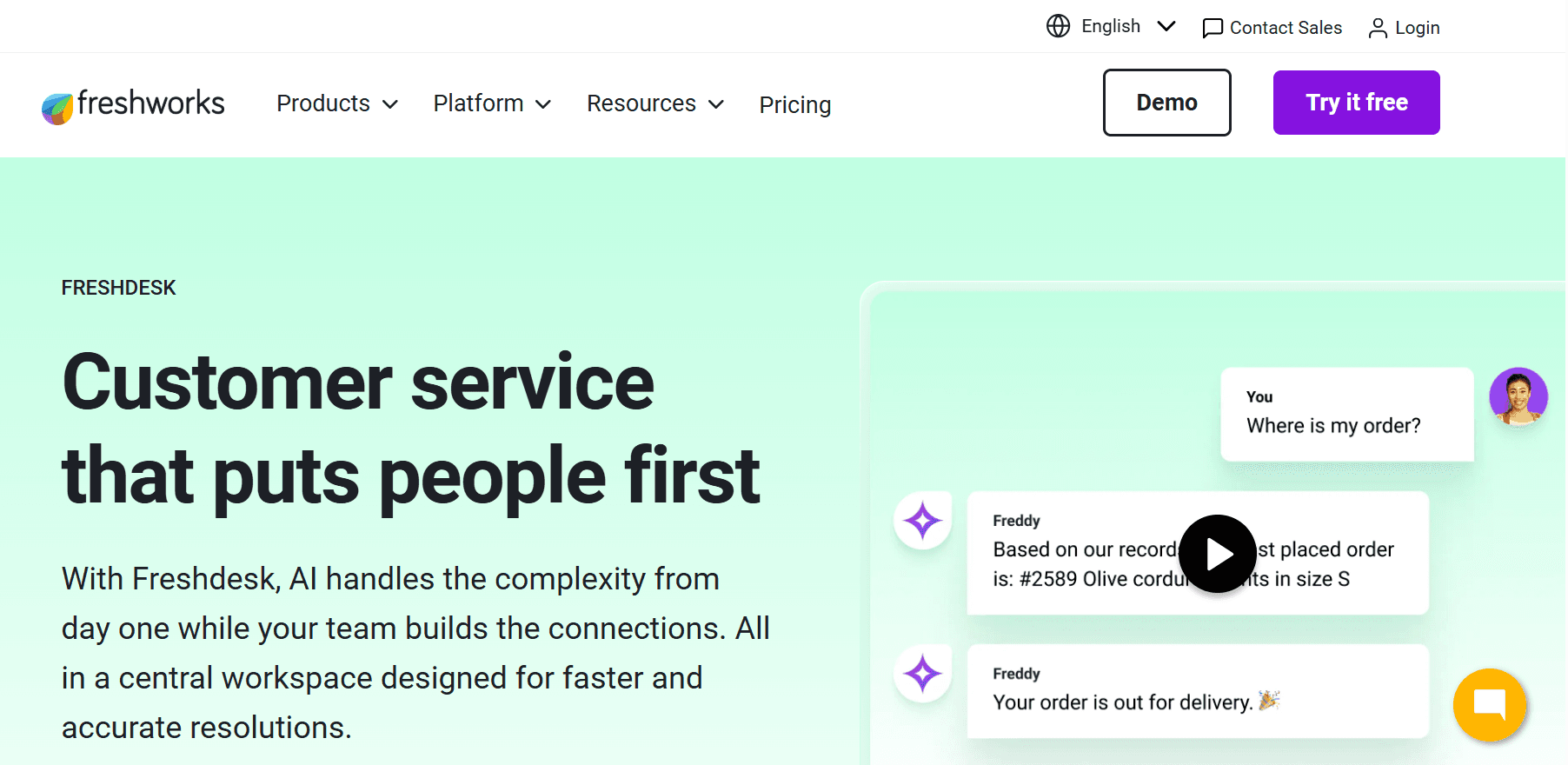
Freshdesk stands out for its low-code approach to building conversational AI, deeply embedding automation into support workflows. Powered by Freddy AI, it handles routine questions autonomously, escalates complex issues, and supports agents with smart suggestions. This makes it a solid choice for teams seeking reliable multichannel support and improved productivity without heavy development effort.
Key features
Low-code chatbot builder for custom dialogue flows
Freddy AI Agent for autonomous query resolution
Omnichannel messaging across chat, email, social, and WhatsApp
AI Copilot for reply suggestions, summaries, and sentiment analysis
Customizable dashboards for real-time performance tracking
Ticket creation and routing from bot interactions
Broad integrations like Slack, Shopify, Salesforce, and Jira
4. SparrowDesk
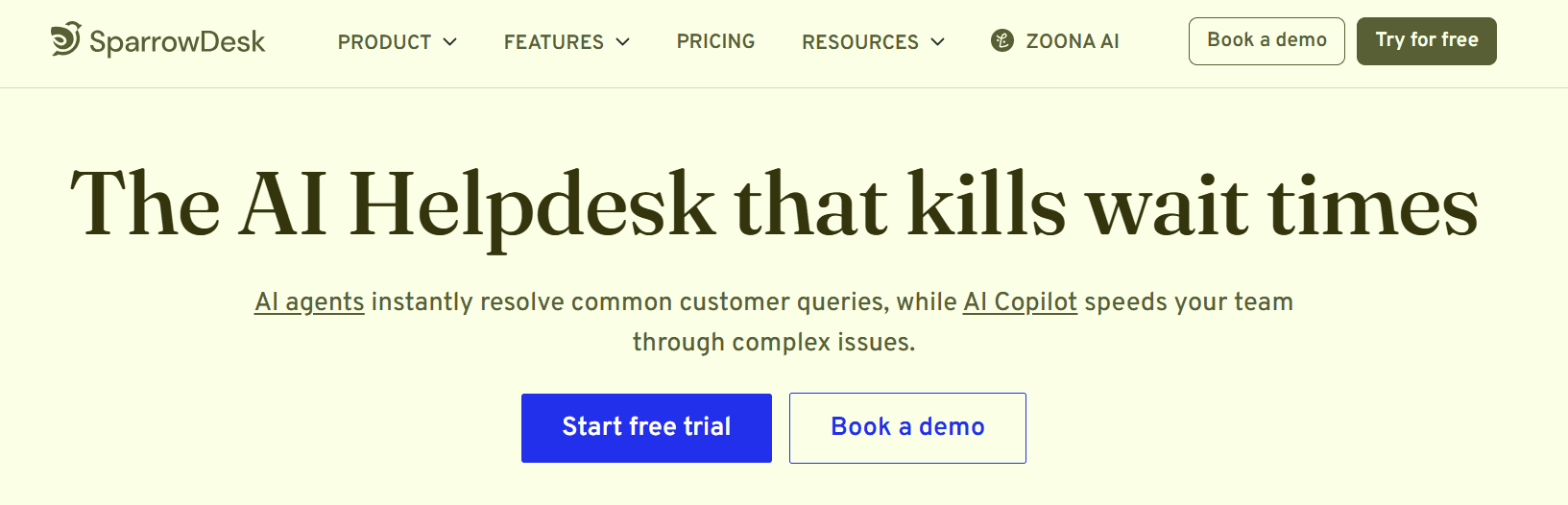
SparrowDesk focuses on AI-enhanced agent support, using tools like Luna AI to auto-resolve inquiries and provide summaries for faster human handling. It unifies customer interactions in a single workspace, enhancing efficiency for chat-centric teams. This platform suits businesses aiming to balance automation with personalized service while maintaining low response times.
Key features
Luna AI Agent for automatic resolution of common queries
AI Copilot for generating summaries and smart reply drafts
Unified workspace for managing all customer channels
Self-service portals to reduce support volume
No-code workflow automation for repetitive tasks
Live chat widget with visitor tracking and real-time engagement
Escalation to human agents for complex cases
5. Zoho SalesIQ
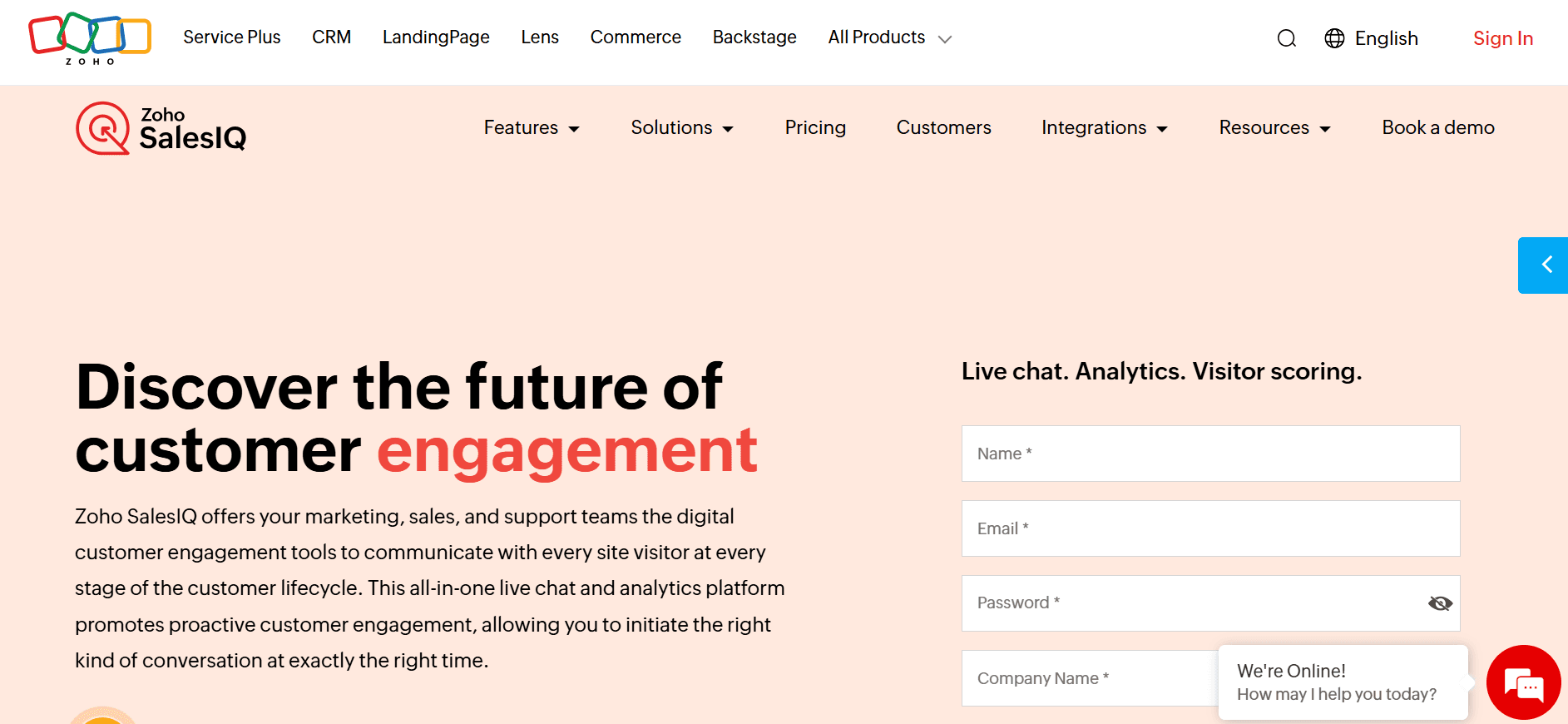
Zoho SalesIQ specializes in delivering in-app and website chat support, with a no-code builder for creating context-aware bots. It pulls answers from knowledge resources and manages interactions across web, mobile apps, and social channels. This option suits businesses that want embedded support directly within products or sites for quicker resolution and better lead capture.
Key features
No-code drag-and-drop chatbot builder with templates
Contextual AI responses from integrated knowledge bases
In-app chat for direct product-based support
Visitor tracking and lead scoring capabilities
Social media message handling
Ticket routing and analytics for performance insights
Integrations with Zoho CRM, Desk, Google Analytics, and Salesforce
6. Hiver
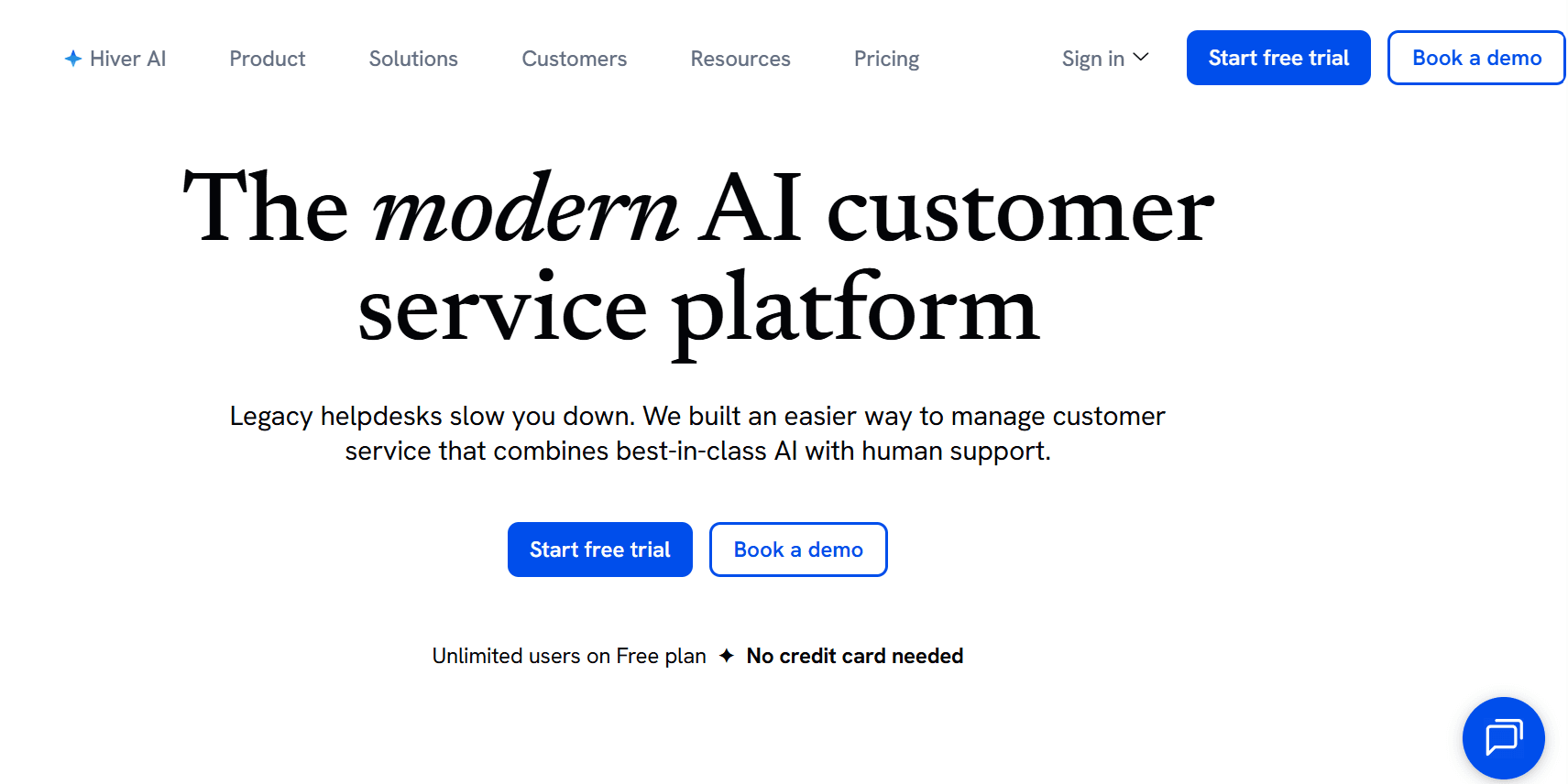
Hiver shines in combining email and chat management with AI for automated drafting and organization. It streamlines workflows for high-volume teams in sectors like e-commerce, offering unified inboxes and sentiment analysis to prioritize responses. This tool helps maintain quick, organized communication across channels while reducing manual effort.
Key features
AI-powered automated response drafting
Omnichannel inbox for emails, chats, and voice
Workflow automation to handle repetitive tasks
Conversation tagging and organization
Knowledge base for customer self-service
Analytics for team performance and satisfaction insights
Integrations with Salesforce, HubSpot, Slack, and Zendesk
7. Intercom
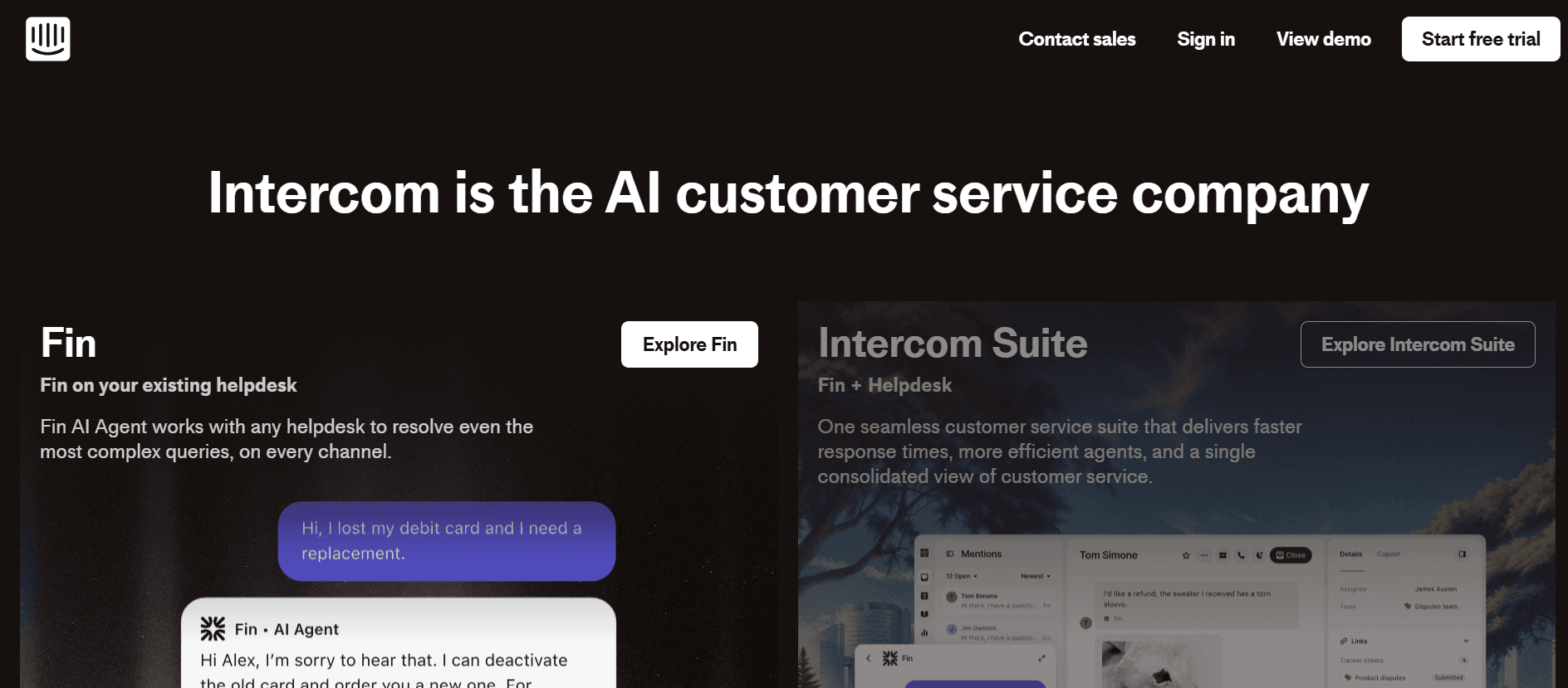
Intercom delivers highly customizable chat widgets that blend seamless messaging with advanced AI to create personalized customer experiences across websites and apps. Its AI-driven bots act as proactive support tools and even product consultants, handling inquiries, qualifying leads, and driving engagement while deeply integrating with help desks and knowledge bases. This makes it especially valuable for growing companies focused on tailored interactions and revenue impact from conversations.
Key features
Customizable chat widgets with branding and dynamic behavior
AI-powered Fin agent for autonomous resolution and proactive messaging
Personalized conversation flows based on user data and context
Built-in automation for ticket deflection and lead qualification
Real-time visitor identification and targeting
Seamless handoff to human agents with full context
Integrations with CRM systems, analytics tools, and third-party apps
8. Drift
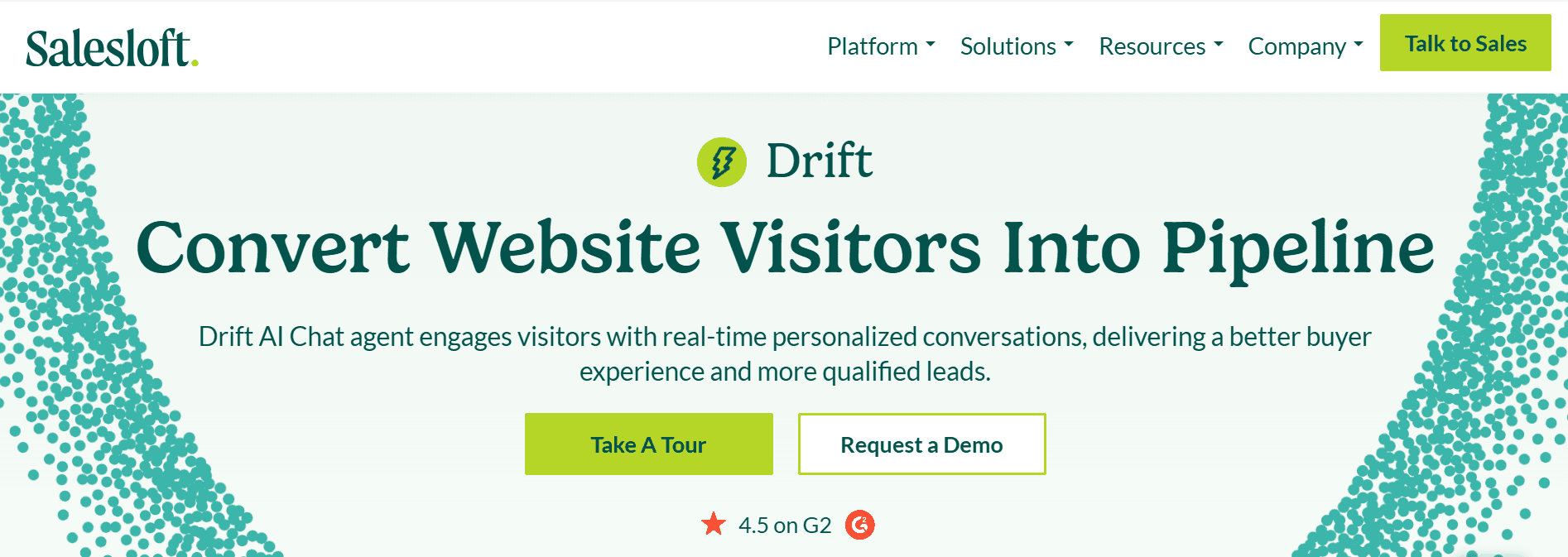
Drift focuses on conversational marketing and sales, using AI chatbots to engage website visitors in real time and convert them into a qualified pipeline. It excels for sales and marketing teams by personalizing interactions, qualifying leads instantly, and shortening sales cycles through intelligent routing and buyer insights. The platform emphasizes turning anonymous traffic into meaningful conversations that align with revenue goals.
Key features
AI Chat agents for 24/7 personalized, brand-aligned dialogues
Real-time lead qualification and high-intent buyer identification
Fastlane for skipping forms and instant connections
Engagement scoring and visitor de-anonymization
Multi-channel support, including chat, email, and video
ROI reporting tied to pipeline and revenue attribution
Integrations with CRMs, sales tools, and revenue orchestration platforms
9. LiveHelpNow
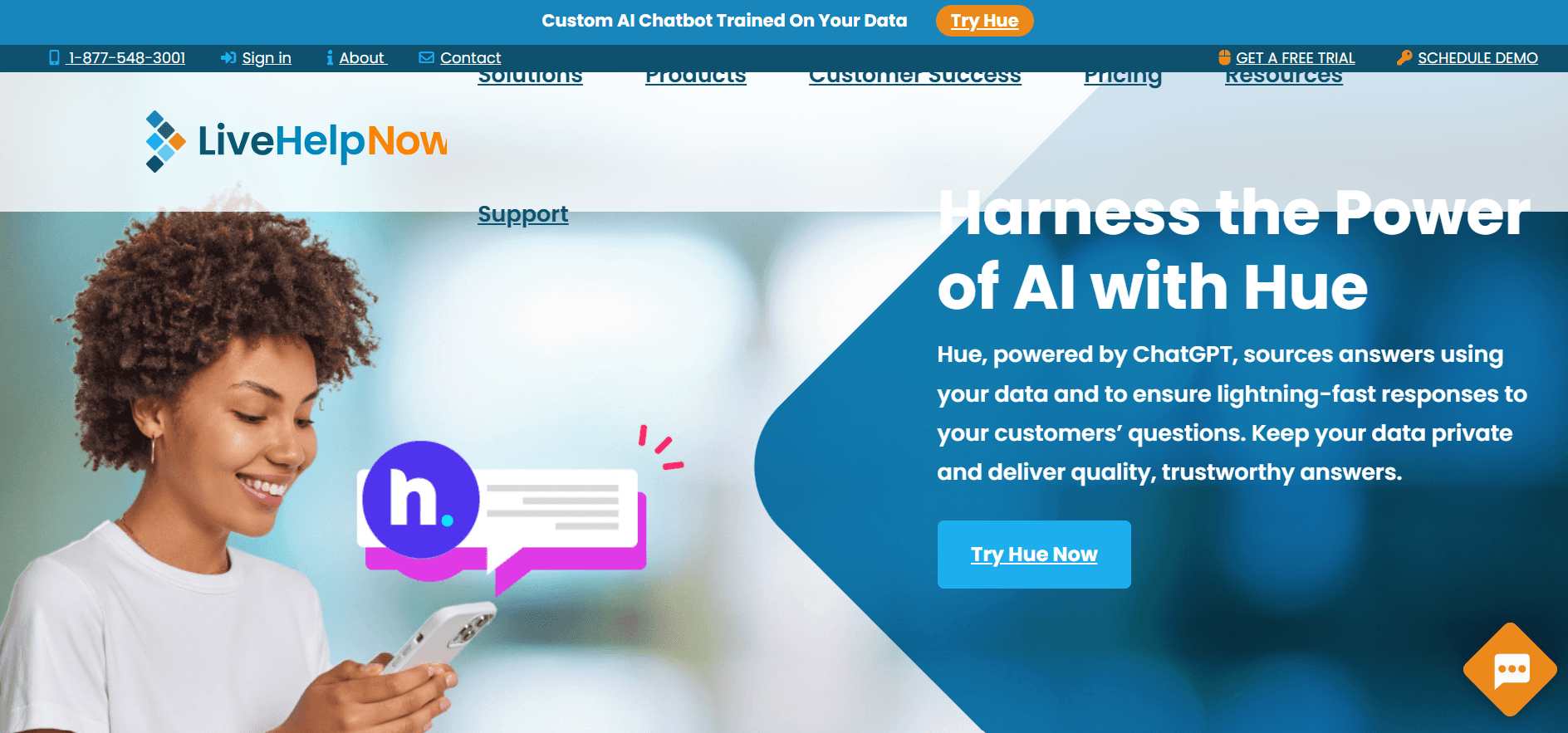
LiveHelpNow provides robust omnichannel customer support with an AI-powered chatbot that draws directly from your knowledge base for accurate, no-training-required responses. It handles overflow inquiries, provides 24/7 availability, and supports agents with tools such as real-time translation and automations. This solution suits businesses that need comprehensive, multichannel support, combining bots with human oversight for enhanced efficiency and satisfaction.
Key features
AI chatbot (Hue) trained on your data, for instance, relevant answers
Omnichannel inbox covering chat, email, social, and more
Real-time agent tool,s including sneak peek, whisper, and file sharing
Automations for lead capture, appointment scheduling, and routing
Video chat and language translation capabilities
Supervisor monitoring and performance analytics
Secure data handling and compliance features
10. Acquire
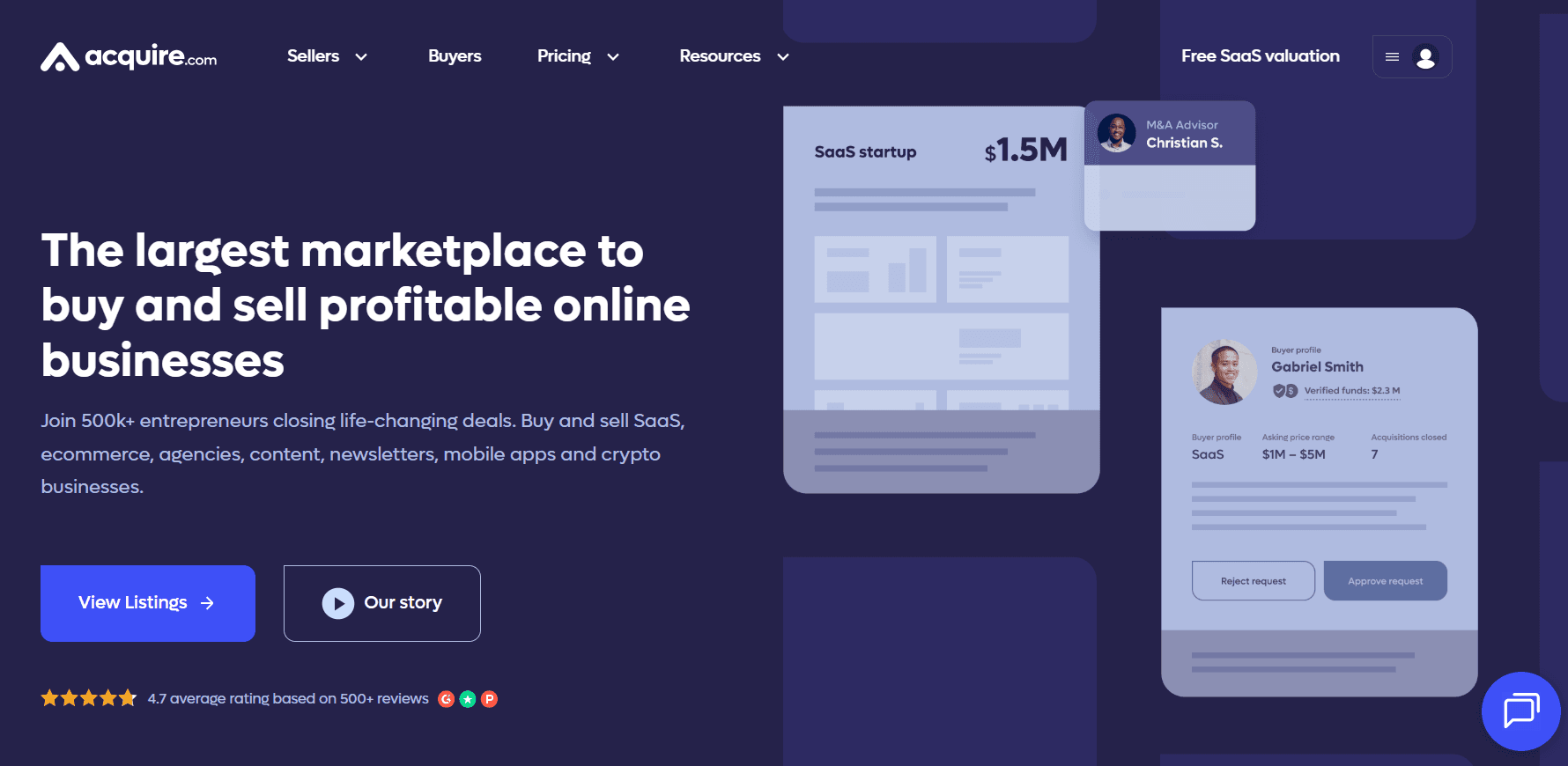
Acquire emphasizes strong reporting and analytics within its conversational platform, allowing businesses to gain deep insights into chat performance, customer journeys, and team effectiveness. Its AI chatbot supports proactive engagement, automation, and smooth escalations while providing detailed metrics to optimize strategies. This makes it a great fit for data-driven teams that prioritize measurable improvements in support and conversions.
Key features
Advanced analytics and customizable reporting dashboards
AI-driven proactive messaging and automation rules
Omnichannel support across web, mobile, and messaging apps
Real-time visitor tracking and behavior insights
Intelligent routing and escalation to agents
Conversation transcripts with sentiment analysis
Integrations with help desks, CRMs, and analytics tools
11. Kommunicate
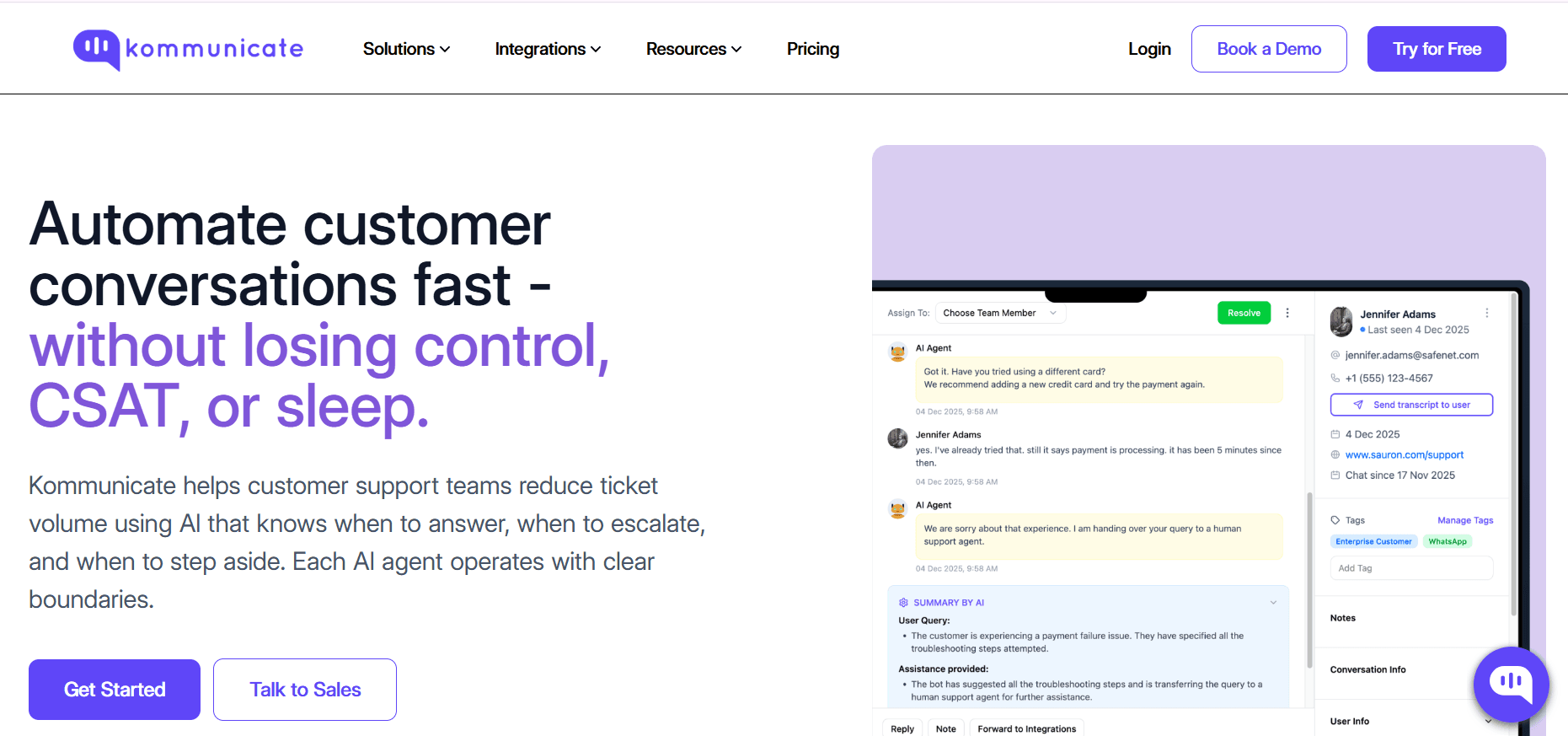
Kommunicate offers a fast setup for AI chatbots, enabling quick deployment of intelligent agents that handle customer queries with minimal configuration. It combines no-code builders, multilingual support, and easy integrations to deliver efficient automation for support and engagement. Ideal for teams looking for rapid implementation without sacrificing capabilities such as bot-human handoffs and performance tracking.
Key features
Quick no-code chatbot builder for fast deployment
AI agents with natural language understanding
Multilingual support for global audiences
Seamless bot-to-human handoff with context preservation
Rich media and interactive elements in chats
Analytics on bot resolution rates and customer satisfaction
Integrations with popular platforms like Zendesk, Slack, and WhatsApp
12. Yellow.ai
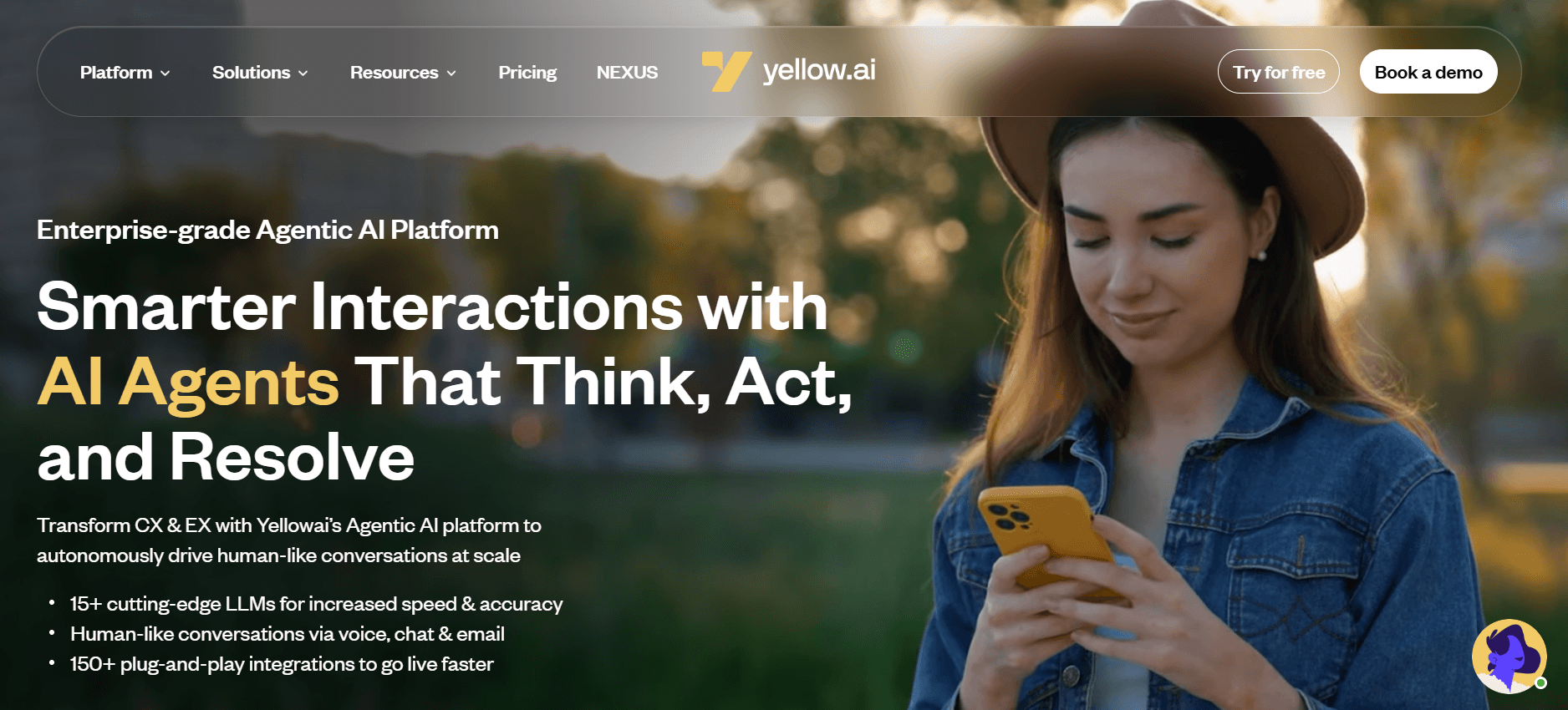
Yellow.ai leads in delivering agentic AI for comprehensive omnichannel customer experiences, shifting beyond basic conversations to autonomous resolutions that handle complex tasks end-to-end. Its platform powers human-like interactions across voice, chat, email, and more, using multiple advanced language models to adapt dynamically and execute actions without rigid scripts. This makes it particularly strong for large enterprises seeking scalable automation that maintains high personalization and efficiency while integrating deeply into existing systems.
Key features
Agentic AI agents that reason, act, and resolve multi-step issues autonomously
Multi-modal support, including voice, chat, email, images, documents, and video
AI Agent Builder 2.0 for rapid creation of enterprise-ready agents across channels
Conversational Knowledge Base with Agentic RAG for accurate, context-aware responses
Multi-LLM architecture leveraging 15+ cutting-edge models for flexibility and performance
Automated testing, optimization, and real-time analytics for continuous improvement
Over 150 plug-and-play integrations for quick deployment and seamless workflows
13. Genesys
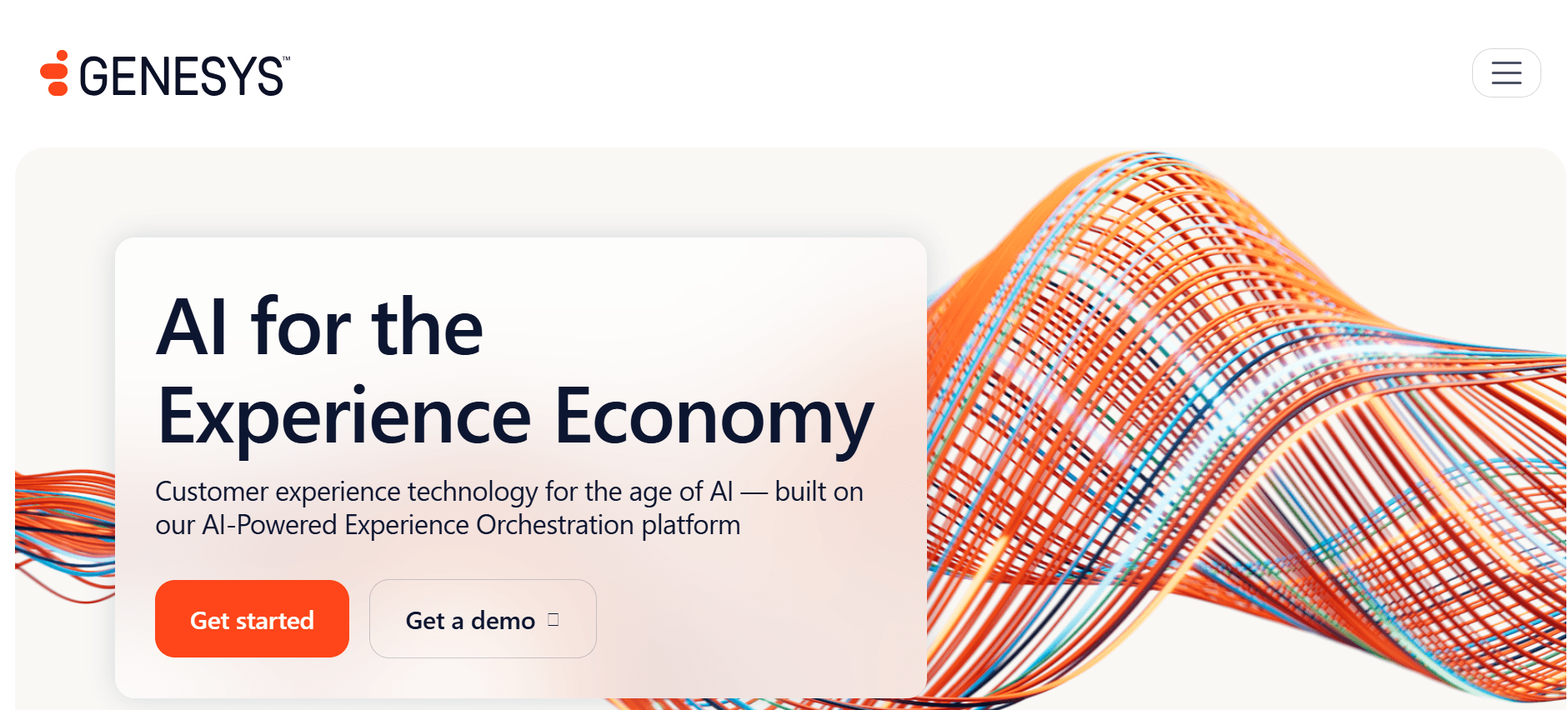
Genesys specializes in contact center-grade chatbots through its Agentic Virtual Agent on the Genesys Cloud platform, enabling autonomous AI that goes beyond scripted responses to complete tasks across multiple enterprise systems. It orchestrates experiences with reasoning, action execution, and full context preservation across channels, helping organizations deliver faster resolutions while reducing operational costs. This positions it as a top choice for large-scale contact centers focused on intelligent automation and seamless human-AI collaboration.
Key features
Agentic Virtual Agent for end-to-end task resolution across CRM, billing, and back-office tools
Multi-channel digital engagement with bots and human agents
Built-in AI for personalization, predictive routing, and proactive outreach
Experience orchestration to uncover insights and suggest next-best actions
Workforce engagement tools with AI-driven guidance and analytics
AppFoundry Marketplace for hundreds of pre-integrated extensions
Compliance-focused security and global cloud scalability
14. Quiq Messaging
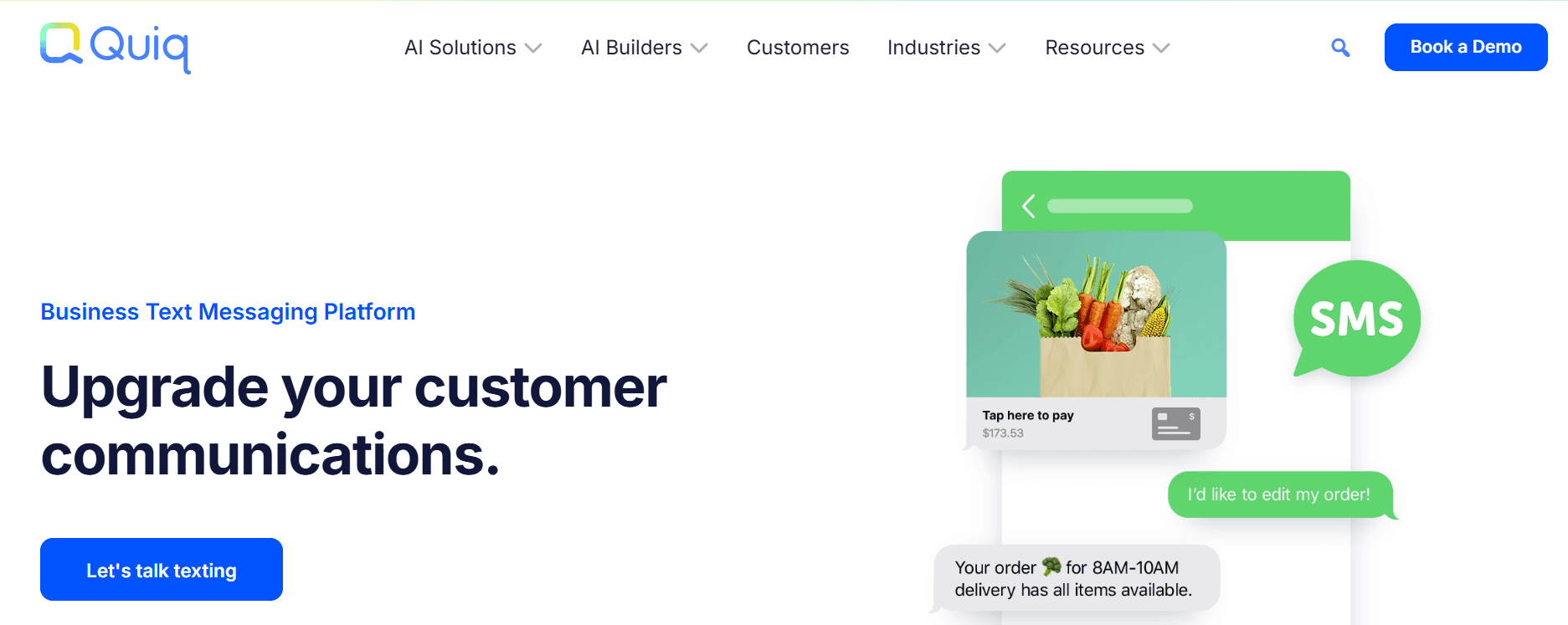
Quiq Messaging excels at facilitating conversations that blend humans and bots seamlessly, using proven agentic AI to drive resolutions across asynchronous channels like SMS, web chat, and messaging apps. Its platform supports goal-oriented AI agents that complete complex tasks while providing AI assistants for human teams during escalations. This hybrid approach suits businesses that prioritize fast, reliable customer journeys, backed by strong analytics to demonstrate ROI.
Key features
Agentic AI agents for autonomous, multi-step task completion without scripts
Hybrid human-bot handoffs with full context preservation in one workspace
Real-time analytics and customizable dashboards for async performance metrics
AI assistants (Copilot) to empower agents during complex interactions
Multi-channel support, including SMS, web chat, and social messengers
Enterprise-grade compliance (SOC 2, HIPAA, GDPR) and high uptime
Lifecycle management for building, testing, and optimizing AI agents
15. Botmock
Botmock focuses on team collaboration in chatbot design and development, offering a collaborative workspace where multiple stakeholders can build, prototype, and refine conversational flows together. It supports visual builders, testing environments, and version control to streamline creation before deployment. This tool benefits agencies, product teams, and enterprises that need efficient handoffs among designers, developers, and business users to achieve high-quality bot outcomes.
Key features
Collaborative real-time editing for teams building chatbot prototypes
Visual flow builder with drag-and-drop conversation design
Built-in testing and simulation tools for previewing bot behavior
Version control and branching for managing iterations
Export options to various deployment platforms
Integration with popular design and dev tools
Analytics on prototype performance and user testing feedback
16. Birdeye
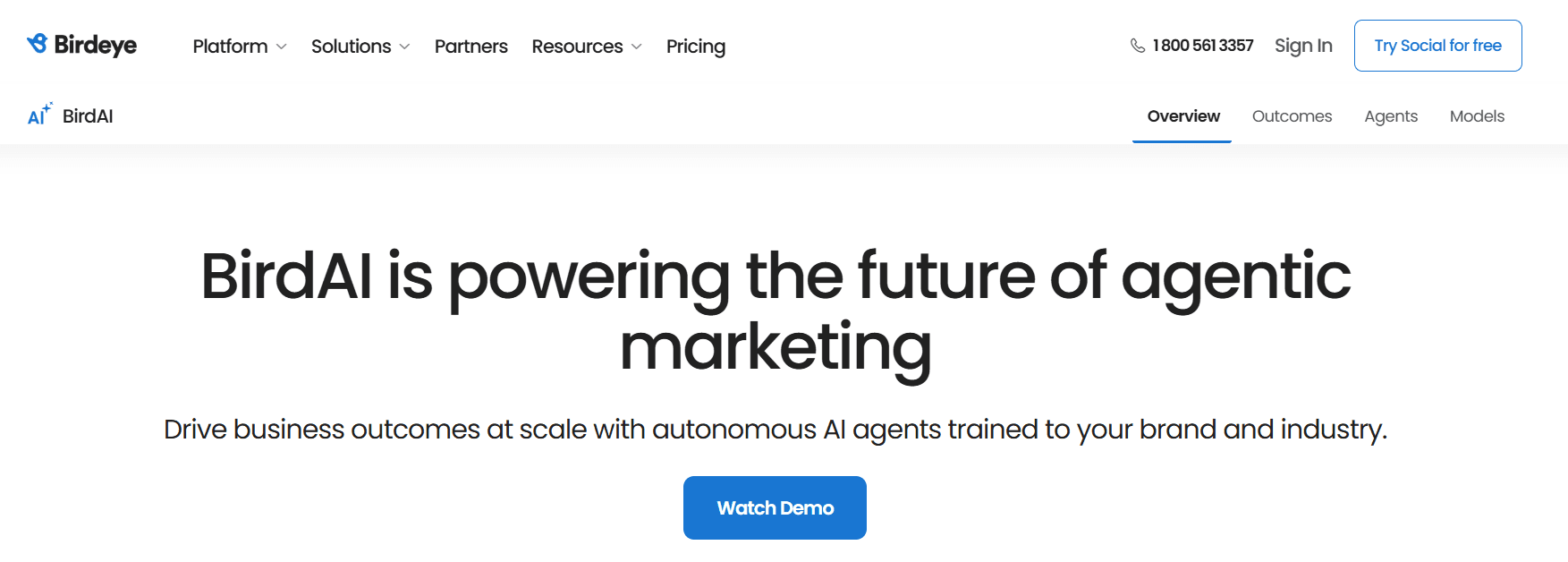
Birdeye combines chatbot functionality with reputation management, enabling businesses to engage customers through conversational AI while collecting reviews, managing feedback, and enhancing online presence. Its bots handle support queries, appointment scheduling, and review requests on a single unified platform. This integrated approach works well for local businesses and multi-location brands aiming to boost satisfaction scores alongside efficient support.
Key features
AI chatbot for automated customer engagement and query handling
Review collection and management integrated into conversations
Reputation monitoring across online platforms
Messaging automation for appointments, reminders, and follow-ups
Omnichannel support, including web, SMS, and social
Analytics on customer sentiment, review trends, and engagement
Integrations with CRM and business tools for seamless data flow
17. Hyro
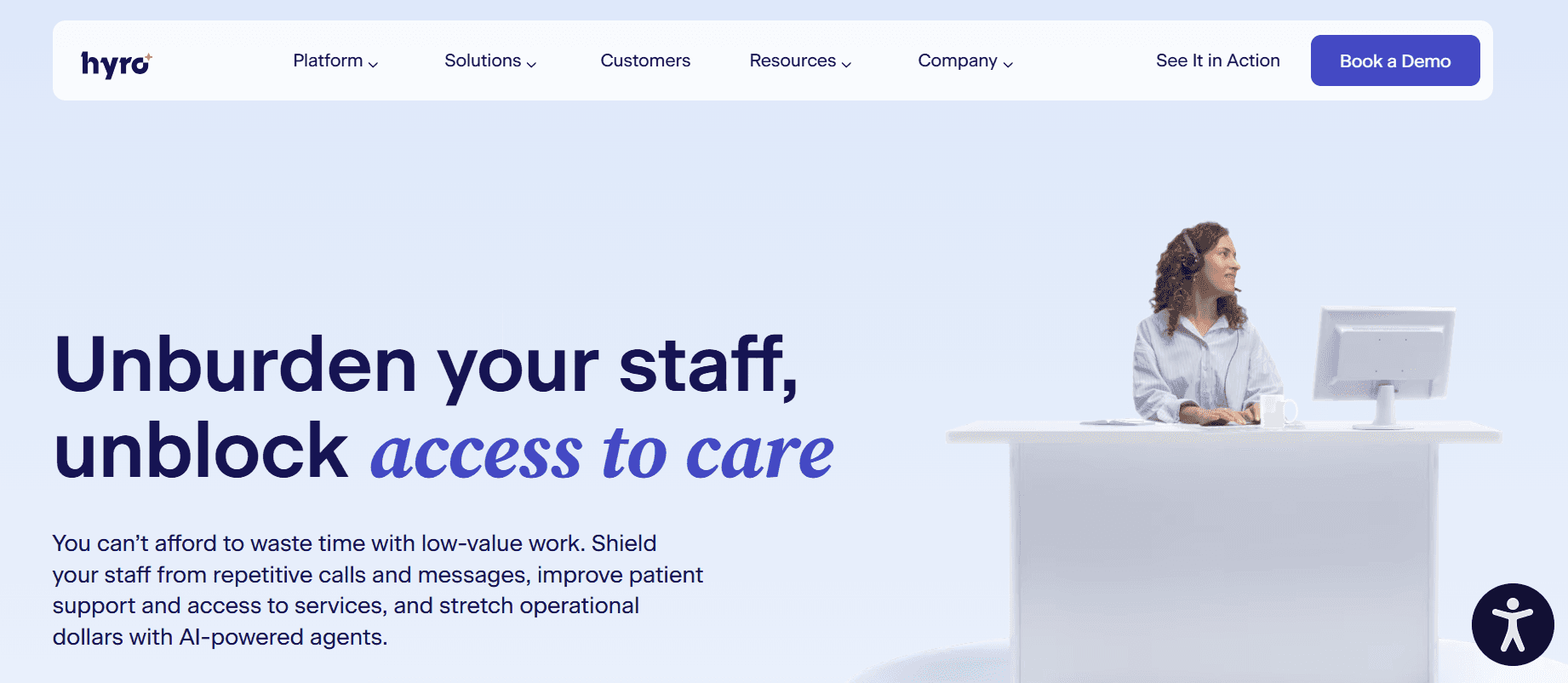
Hyro serves as an adaptive communication platform that deploys conversational AI agents capable of handling dynamic, context-rich interactions across digital channels. It focuses on deeply understanding user intent and adapting responses in real time to deliver personalized experiences, particularly in regulated industries such as healthcare and finance. This tool helps organizations reduce friction in customer journeys while ensuring compliance and accuracy through grounded, enterprise-grade AI.
Key features
Adaptive AI agents that evolve based on conversation context and user behavior
Deep natural language understanding for complex, multi-turn dialogues
Proactive engagement and personalized recommendations
Omnichannel deployment across web, mobile, voice, and messaging apps
Built-in compliance tools for sensitive data handling
Analytics dashboard tracking resolution rates and user satisfaction
Seamless integration with CRM and backend systems for data-driven actions
18. Finn AI
Finn AI targets banks and credit unions by providing specialized conversational AI tailored to financial services, enabling secure, compliant interactions for account inquiries, transaction support, and advisory tasks. It emphasizes high accuracy in regulated environments, using domain-specific training to handle sensitive financial queries while offering proactive guidance to improve member engagement and reduce call center volume.
Key features
Domain-specific AI optimized for banking and credit union use cases
Secure handling of financial data with strong compliance features
Proactive support for account management and product recommendations
Natural language processing for accurate intent detection in finance contexts
Voice and chat support across multiple channels
Escalation paths to human specialists with full context transfer
Performance analytics focused on resolution accuracy and member satisfaction
19. ChatBot
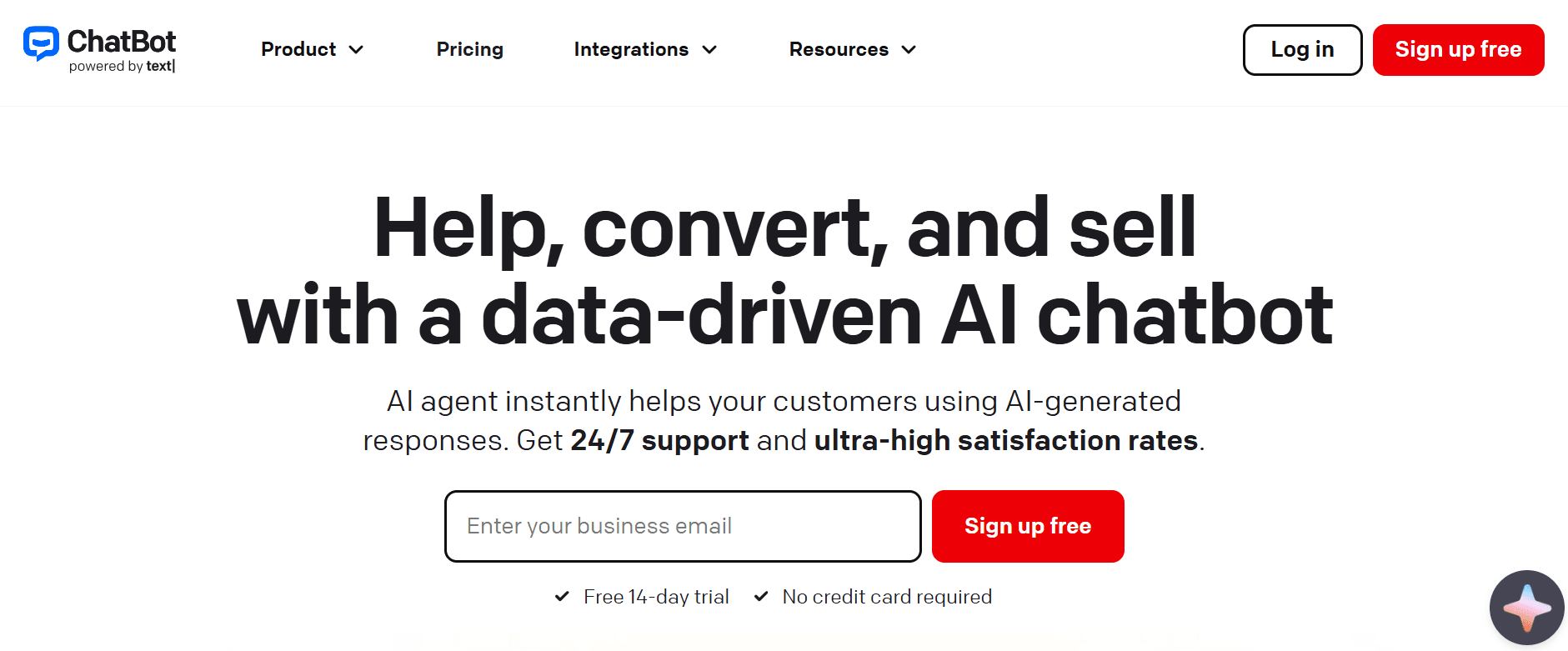
ChatBot (from the Text/ChatBot platform) stands out for users already in the LiveChat ecosystem, delivering AI-powered automation that integrates smoothly with existing live chat setups. It enables quick deployment of intelligent agents trained on website content or knowledge bases to provide instant, accurate responses around the clock, boosting support efficiency and customer satisfaction through seamless bot-human collaboration.
Key features
AI-generated replies with easy training from website scans or help centers
Automated workflows for end-to-end customer service
Multi-channel support, including website, Messenger, and SMS
Live chat handoff with preserved conversation context
Customizable reports and analytics for performance optimization
No-code builder for flows and AI enhancements
Integrations with popular tools for broader automation
20. Userlike
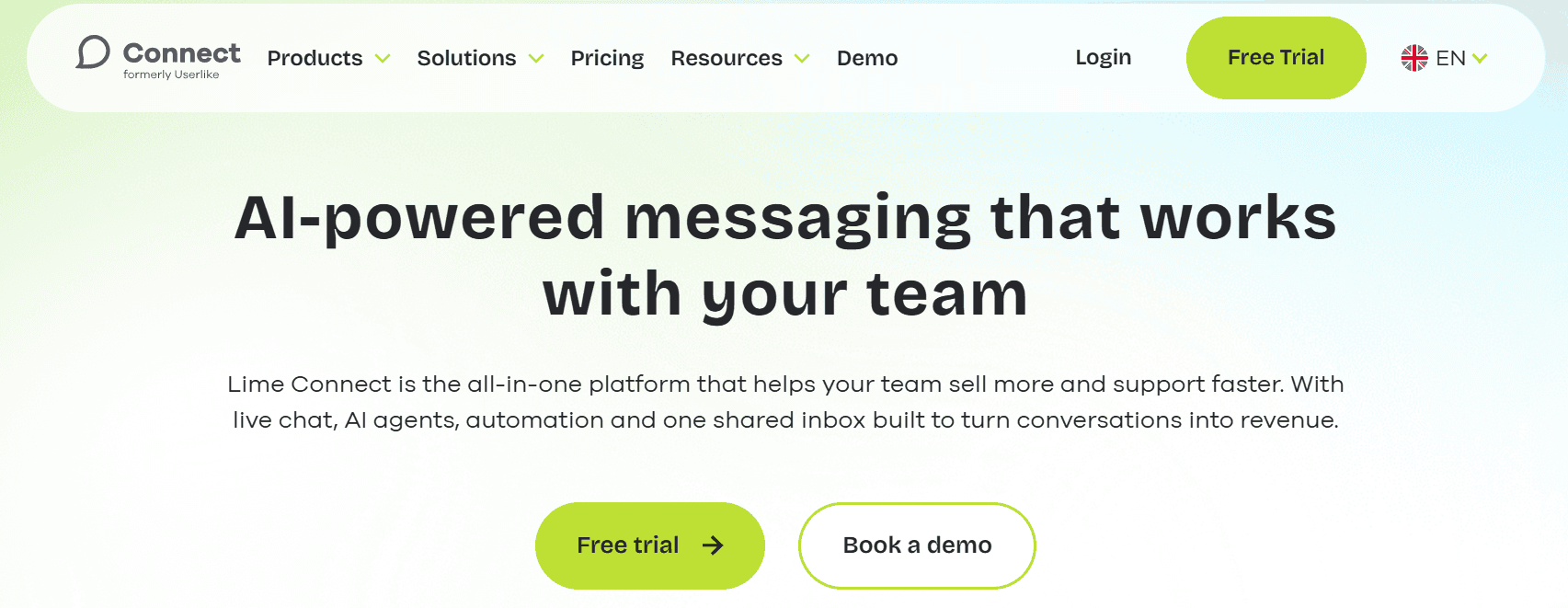
Userlike focuses on tracking customer interactions with a robust live chat foundation enhanced by AI chatbots for 24/7 automation. It excels in providing detailed visitor insights, asynchronous messaging, and intelligent bots that handle routine queries while capturing leads and qualifying prospects. This makes it suitable for businesses that prioritize deep engagement tracking and multichannel support, with strong privacy controls.
Key features
AI-powered chatbots for automated responses and lead qualification
Real-time visitor tracking, including behavior and page views
Asynchronous chat for flexible, non-real-time interactions
Multichannel messaging across web, WhatsApp, and more
Voice/video calls and screen sharing for advanced support
Customizable widgets and automation rules
Detailed analytics on interactions, conversions, and team performance
21. Haptik
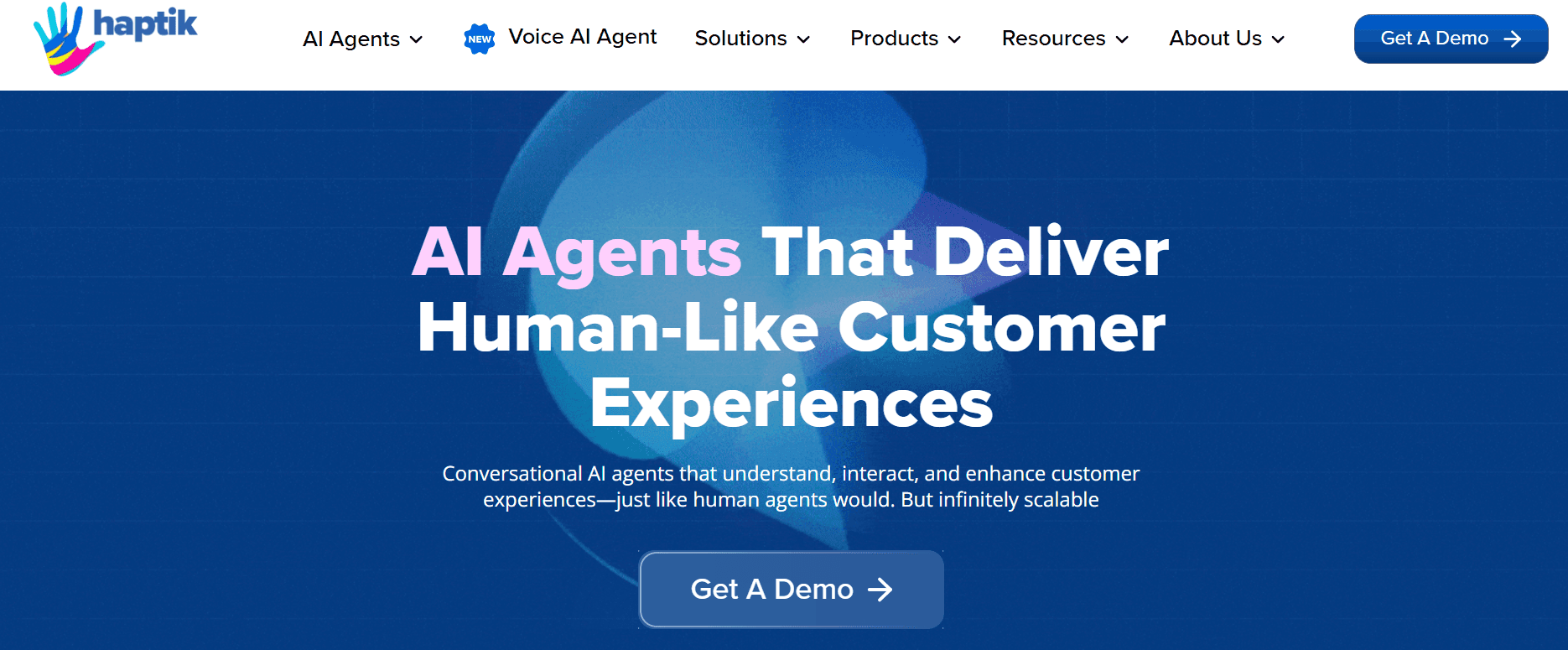
Haptik delivers proactive automated support through enterprise-grade conversational AI agents that go beyond basic chat to resolve issues autonomously. It powers human-like experiences on channels like WhatsApp, focusing on high-volume industries that need scalable, intent-driven interactions to drive engagement, transactions, and satisfaction while minimizing manual intervention.
Key features
Proactive AI agents for automated issue resolution and upselling
Omnichannel support with a strong emphasis on messaging apps like WhatsApp
Advanced natural language understanding for complex queries
Voice AI capabilities for natural spoken interactions
Contextual personalization and action execution (e.g., bookings, refunds)
Analytics for CX metrics and continuous optimization
Enterprise integrations for CRM, backend systems, and compliance
22. Landbot.io
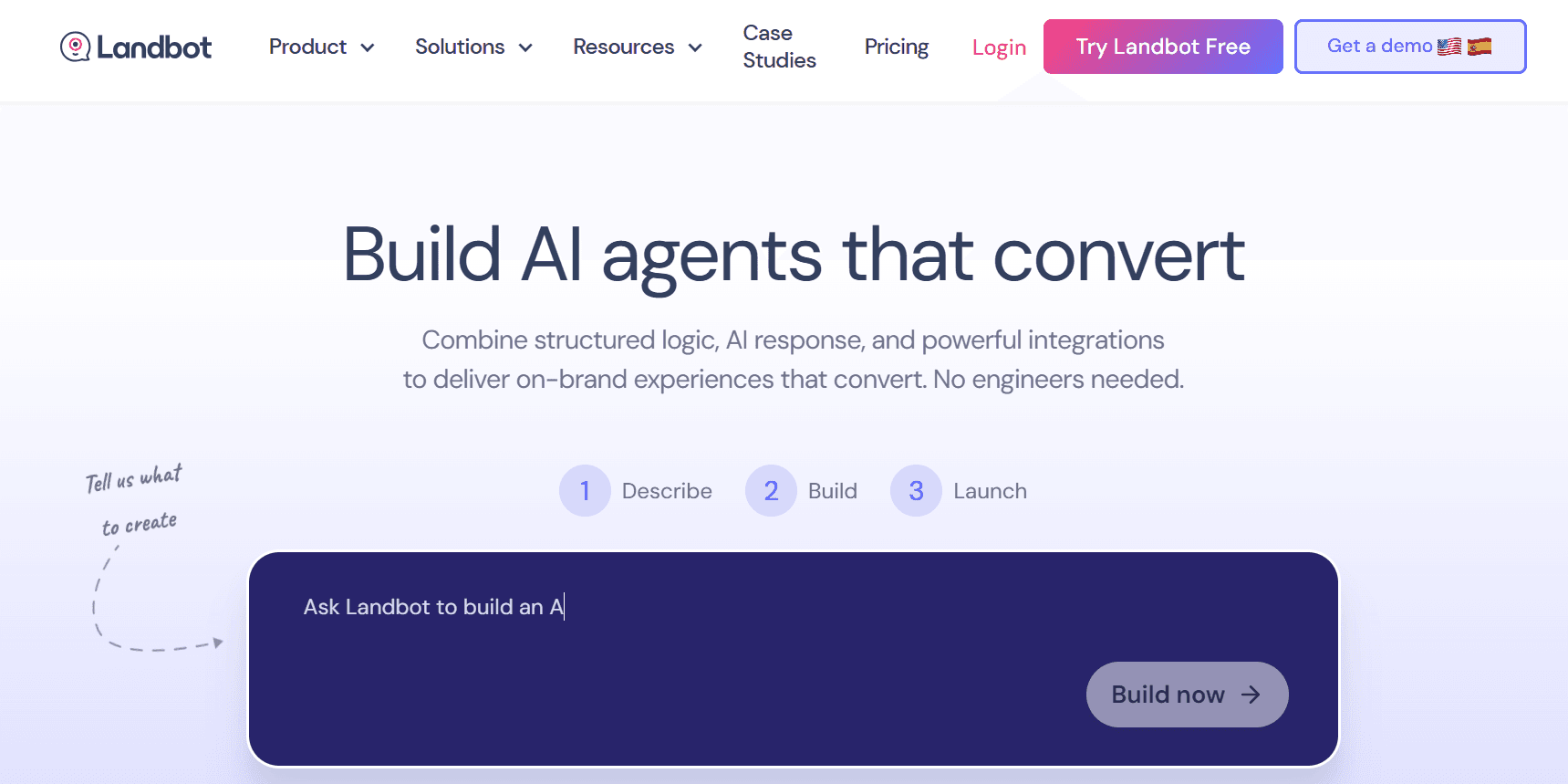
Landbot.io specializes in simple yet effective lead capture through no-code conversational experiences that blend structured flows with AI intelligence. Its visual builder enables quick creation of engaging bots for websites and WhatsApp, converting visitors into qualified leads through interactive forms, quizzes, and personalized paths. This makes it a practical choice for marketing and sales teams seeking fast deployment without technical overhead while maintaining brand consistency.
Key features
No-code visual drag-and-drop builder for conversational flows
AI assistants for lead qualification and FAQ handling
Lead capture with dynamic forms, auto-quoting, and scheduling
Branded, customizable chat UI for professional interactions
WhatsApp and website deployment with opt-in tools
Built-in analytics for tracking conversions and performance
Integrations with Zapier, Slack, CRMs, and automation platforms
23. Acquire
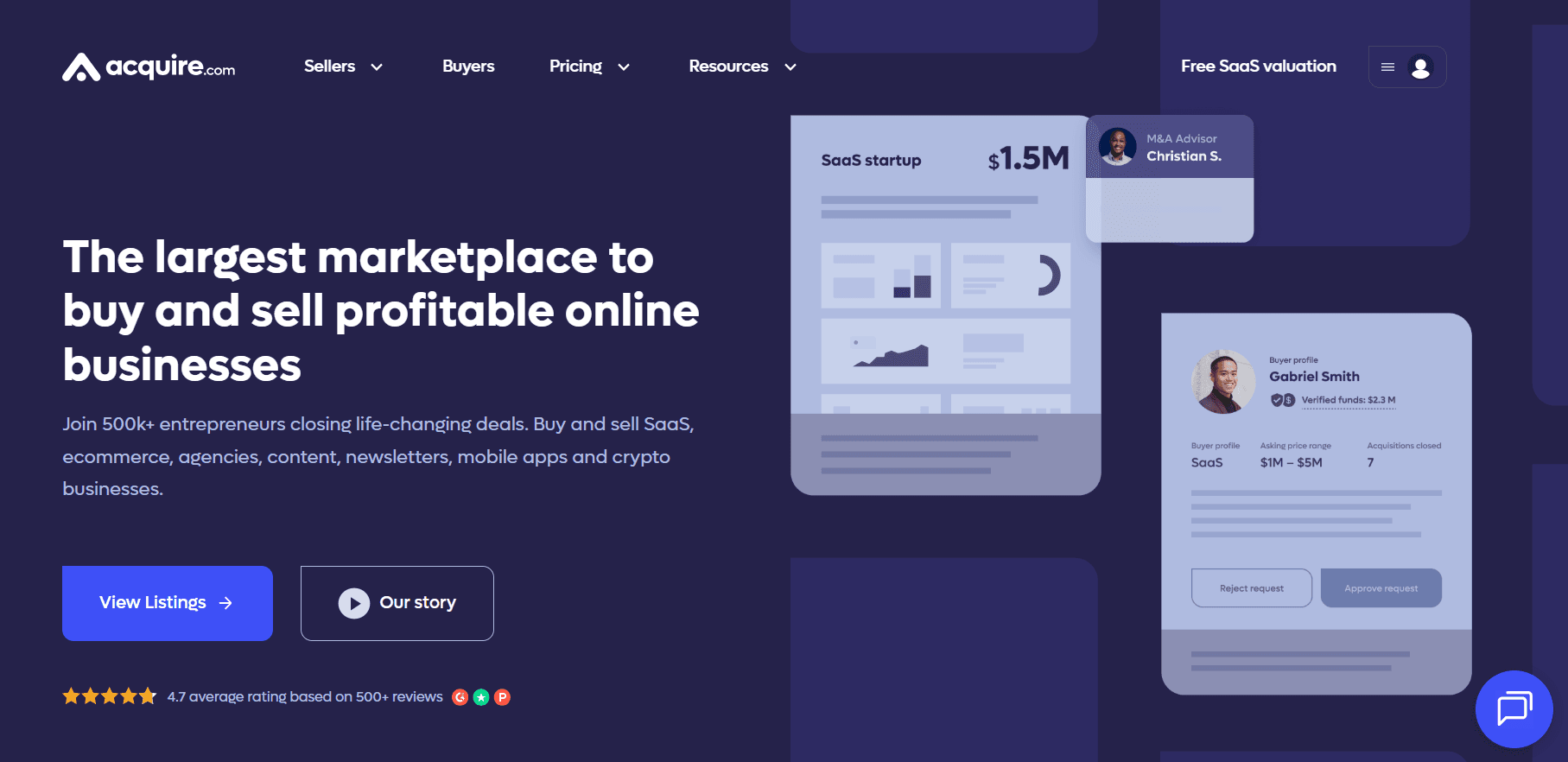
Acquire prioritizes in-depth reporting and analytics within its conversational platform, offering businesses clear visibility into chat metrics, customer behavior, and ROI from bot interactions. Its AI capabilities support proactive outreach, automation, and intelligent escalations, helping teams refine strategies based on data. This positions it well for organizations that rely on performance insights to optimize support, sales, and engagement efforts.
Key features
Comprehensive analytics dashboards with customizable reports
Proactive AI messaging based on visitor triggers
Omnichannel support for web, mobile, and messaging
Real-time visitor tracking and intent detection
Smart routing to agents with context transfer
Conversation sentiment and quality analysis
Integrations with help desks, CRMs, and external analytics tools
24. Kommunicate
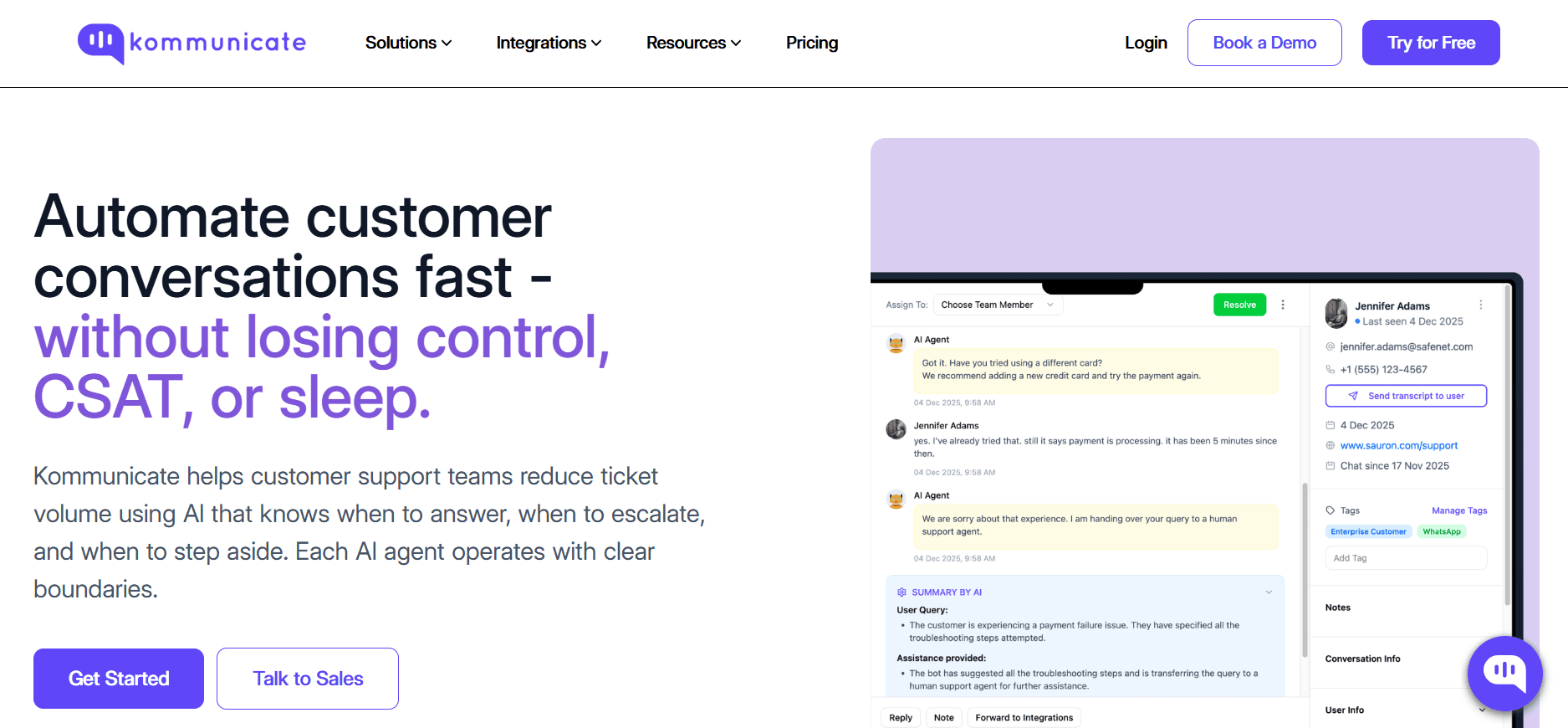
Kommunicate enables the rapid setup of AI chatbots, enabling businesses to launch intelligent agents with minimal configuration. It combines powerful natural language processing, easy handoffs to humans, and multilingual capabilities to deliver efficient customer support and engagement. This tool suits teams needing swift implementation alongside robust features for scaling conversations across channels.
Key features
Fast no-code deployment and chatbot builder
Advanced AI with intent recognition and context handling
Seamless escalation to live agents with full history
Multilingual responses for diverse audiences
Rich interactive elements like buttons and carousels
Performance analytics, including resolution and CSAT metrics
Integrations with Zendesk, Slack, WhatsApp, and more
25. Yellow.ai
Yellow.ai delivers comprehensive omnichannel experiences powered by agentic AI, where bots autonomously handle complex tasks across voice, chat, email, and other channels. Its platform dynamically adapts using multiple LLMs to resolve inquiries end-to-end, making it ideal for enterprises that require scalable, personalized automation to reduce costs and enhance customer journeys in high-volume environments.
Key features
Agentic AI for autonomous multi-step resolutions
Support for voice, chat, email, images, and documents
Rapid AI agent creation with testing and optimization tools
Conversational knowledge base using advanced retrieval
Multi-LLM flexibility for superior response quality
Real-time analytics and performance dashboards
Extensive plug-and-play integrations for enterprise systems
26. Kore
Kore provides powerful AI-powered chatbots optimized for enterprise-grade customer and employee experiences across numerous channels. It accurately detects intent, intelligently routes interactions, and provides in-conversation agent assistance to boost efficiency. This makes it a strong fit for organizations needing robust, multichannel automation with custom workflows and high reliability in complex environments.
Key features
Advanced intent detection and natural language processing
Multi-channel support, including messaging and voice
Dialog builder and testing for custom experiences
In-conversation reply suggestions for agents
Multilingual bots with custom dashboards
Analytics and NLP insights for optimization
API framework for custom integrations with enterprise tools
Most businesses deploying chatbots discover within weeks that choosing the right platform matters far more than they anticipated, because the wrong choice creates friction that compounds daily rather than resolving it.
Related Reading
How to Choose the Right AI Chatbot Software for Your Business
What setup and customization features should you prioritize?
Ease of Setup
Streamlined setup reduces downtime and enables fast deployment without extensive technical resources. Choose platforms with intuitive interfaces, no-code environments, and drag-and-drop tools. Droxy offers simple onboarding that lets you share your agent's business knowledge and set their voice in minutes, with no advanced technical skills required.
Customization Options
Tailoring the chatbot to your brand's identity ensures consistent messaging and improves user engagement. Look for software offering flexibility in visual design, dialogue structures, tone adjustments, and multi-language support. Droxy lets you customize the agent's persona, appearance, and brand voice while supporting over 95 languages, including English, Spanish, and Arabic.
How do AI capabilities and channel compatibility impact performance?
AI Capabilities
A chatbot's AI strength directly affects its ability to understand questions and provide helpful answers. Look for systems with strong natural language processing, contextual understanding, and integration with powerful models. Droxy uses cutting-edge AI from OpenAI, Anthropic, Google, and Meta to deliver context-aware responses tailored to user needs.
Channel Compatibility
Ensure the chatbot works smoothly across multiple communication platforms to reach customers where they are. Choose solutions that integrate with websites, messaging apps like WhatsApp or Messenger, and social media. Droxy lets you deploy to any channel, consolidating all customer communications into a single platform.
What lead capture and analytics features drive business results?
Lead Capture & CRM
Effective lead-gathering tools and CRM integration automate sales processes and boost conversion rates. Choose software with form handling, scheduling integrations, and connections to platforms like HubSpot or Salesforce. Droxy automatically collects and qualifies leads while supporting integrations via Zapier and its API, increasing lead conversion from 10% to 25%.
Analytics & Reporting
Monitor performance through detailed insights to identify strengths and optimise chatbot effectiveness. Prioritise platforms with comprehensive dashboards, real-time tracking, and interaction analysis. Droxy provides real-time insights into customer behaviour, including conversation growth metrics across channels (websites showing increases from 2531 to 3064 sessions) and WhatsApp.
How important are scalability and support for long-term success?
Scalability
A scalable solution grows with your business, handling greater demands without slowing down. Look for options that offer upgrade paths, additional modules, and the ability to handle higher volumes. Droxy scales to millions of customers worldwide by automatically syncing knowledge from websites, PDFs, and Google Drive.
Support & Resources
Reliable help and educational materials solve problems quickly and maximise your tool's value. Choose providers offering live support, documentation, guides, and user communities. Our Droxy includes FAQ resources covering setup, integrations, and controls, and users praise its 4-minute content-to-chatbot conversion.
What security and pricing considerations affect AI chatbot software selection?
Security & Privacy
Protecting sensitive information is critical, especially for companies handling customer data. Breaches damage trust and create legal liability. Strong security measures ensure compliance and safeguard interactions.
Examine platforms for compliance with standards such as GDPR, data encryption, and secure storage protocols. Droxy addresses data security in its resources, emphasising safe handling of information integrated from various sources, which is crucial for businesses prioritising privacy in AI-driven communications.
Free Plan Limitations
Free tiers often impose caps on message limits, bot quantities, platform access, and branding that limit functionality. While Droxy starts at $20 per month, its cost-effective pricing (compared to $5000–$10000 per month for alternatives) allows businesses to access full features from the start, avoiding common free-tier drawbacks such as limited scalability or integrations.
But a perfect platform selection means nothing if deployment takes months rather than minutes.
Create an AI Agent for Your Business within 5 Minutes
Most businesses struggle with the same problem: chatbots that miss key channels, lose brand voice, or require weeks of technical setup. This gap between capability and deployment speed costs opportunities every day.
💡 Tip: Droxy handles inquiries across your website, WhatsApp, phone, and Instagram from one place while keeping your brand voice. Our agents work 24/7 to turn visitors into leads, answer questions right away, and deliver support for a fraction of the cost of traditional staff.

"5 minutes is all it takes to transform your customer engagement from reactive to proactive, capturing leads around the clock." — Droxy AI Platform
🔑 Takeaway: Set up your custom AI agent in five minutes, watch it engage customers in any language, and keep full visibility over every conversation. It only escalates to your team when necessary.

Traditional Setup | Droxy Solution |
|---|---|
Weeks of development | 5 minutes to deploy |
Single channel focus | Multi-channel coverage |
High staffing costs | Fraction of traditional costs |
Limited availability | 24/7 operation |
⚠️ Warning: Every day without an AI agent means missed opportunities and higher support costs. Create your Droxy AI agent in 5 minutes today.

Related Reading
Customers expect instant responses at 2 AM, personalized recommendations, and smooth support across every channel. The right AI chatbot software delivers all of this while teams sleep, but choosing from hundreds of options feels overwhelming. Selecting the best chatbot development platform requires understanding which features actually drive customer satisfaction and business results.
Implementation becomes straightforward with the right tools and approach. Modern chatbot platforms offer conversational AI for support tickets, natural language processing to understand customer intent, and machine learning capabilities that improve over time. Businesses ready to transform their customer interactions can leverage an AI agent for your business without wrestling with complicated setup processes or requiring extensive technical expertise.
Table of Contents
What Are the Benefits of Using an AI Chatbot Software for Your Business?
How Is AI Chatbot Software Different From Traditional Chatbots?
How to Choose the Right AI Chatbot Software for Your Business
Summary
AI chatbot software handles 80% of routine customer queries, according to industry research, meaning businesses without this technology answer questions manually while competitors resolve issues instantly. The gap widens daily as customers who experience immediate responses elsewhere lose patience with delayed replies. Companies that delay implementation don't just postpone benefits; they actively surrender market position as expectations shift toward instant engagement across all channels.
Immediate response capability determines conversion outcomes more than most businesses realize. IBM research shows 90% of customers expect instant replies when they have service questions, and that expectation doesn't pause at 5 PM or wait for Monday morning. Every delayed response represents a potential customer evaluating competitor offers instead, especially since prospects comparing vendors choose whoever answers first with relevant information rather than waiting hours for email responses.
Cost savings from AI chatbot deployment reach 30% of customer support expenses, primarily by resolving routine inquiries without human intervention. Password resets, order tracking, basic troubleshooting, and FAQ responses are handled instantly, eliminating the variability that comes with human interpretation across growing teams. The savings extend beyond salary reduction to include training time, quality monitoring, and the consistency challenges that compound as support teams scale.
Traditional chatbots achieve only 30-40% success rates for complex queries because they match keywords to scripted responses rather than interpreting meaning and context dynamically. The moment someone phrases a question differently or combines multiple needs into a single message, rigid decision-tree systems break down, forcing customers to guess the exact phrasing that triggers useful replies. AI systems using natural language processing recognize that different words can express the same intent, handling typos, slang, and multi-part questions without requiring users to reformulate their requests.
Conversational AI platforms that learn from every interaction improve accuracy over weeks and months without manual reprogramming, while traditional implementations deliver fixed capabilities that degrade as business needs shift. When users rephrase questions after receiving unhelpful answers, modern systems flag those exchanges as learning opportunities and prioritize response patterns that consistently lead to successful resolutions. This continuous refinement happens automatically, meaning baseline performance improves daily rather than remaining static until the next developer update.
AI agent for your business addresses deployment speed and channel coverage by syncing knowledge automatically from websites, documents, and existing resources, letting teams launch intelligent agents across multiple platforms in minutes rather than months.
What is an AI Chatbot Software, and How Does It Work?
AI chatbot software uses machine learning and natural language processing to simulate human conversation, whether in text or voice. These systems analyze user intent, generate contextual responses, and improve through repeated interactions. The technology powers everything from customer service automation to interactive sales assistants across websites, mobile apps, and messaging platforms, enabling routine exchanges without human intervention.
🎯 Key Point: AI chatbots learn and improve automatically with each conversation, making them more accurate and contextually aware over time.
"AI chatbots can handle up to 80% of routine customer inquiries without human intervention, significantly reducing response times and operational costs." — Customer Service Technology Report, 2024
💡 Example: When a customer asks about order status, the chatbot instantly accesses the database, identifies the specific order, and provides real-time updates - all within seconds rather than requiring a human agent to manually search and respond.
How has AI chatbot software evolved from early systems?
Early chatbots could only recognize exact keyword matches and deliver canned responses. Modern systems understand meaning, handle ambiguity, and adjust their tone based on context. Customers now expect instant, accurate responses everywhere, and AI chatbots handle 80% of routine customer questions. Competitors using this technology answer inquiries while you're still routing tickets to overwhelmed support teams.
How does AI chatbot software process user input?
When someone types a question or issues a command, the chatbot receives raw data that needs translation. Natural language processing breaks input into analyzable parts through tokenization, which splits sentences into individual words and phrases. The system removes filler words, corrects spelling errors, and identifies grammatical structure, converting messy human language into clean data that the machine can evaluate.
How does context analysis work in chatbot conversations?
Syntax analysis examines sentence structure to understand how words relate to each other, while semantic analysis extracts meaning. The system distinguishes between "I need help with my order" and "Can you help me place an order?" despite similar wording. Context matters: the same phrase can carry different meanings depending on prior messages or the user's current page. Advanced systems maintain a conversation history, referencing earlier exchanges to avoid having customersrepeat themselves.
How does natural language understanding identify user intent?
Natural language understanding focuses on intent recognition and entity extraction. Intent represents what the user wants: asking a question, making a complaint, requesting a refund, or scheduling an appointment. Entity extraction identifies specific details such as product names, dates, account numbers, or locations. A customer saying "I want to return the blue jacket I bought last Tuesday" triggers intent classification (return request) and entity extraction (product: blue jacket, timeframe: last Tuesday).
Why does AI chatbot software struggle with language variations?
Machine learning models trained on millions of conversations recognize patterns in how people express the same idea. A customer might say "Where's my package?" or "Track my shipment" or "I haven't received my order yet"; all three express the same intent despite different wording.
The system learns these variations by exposure to diverse phrasing, slang, abbreviations, and typos. When the technology fails, you get responses like "I don't understand" after perfectly clear questions, a common frustration when AI misinterprets specialized or field-specific terminology.
How do simple chatbots generate responses?
Once intent is clear, the system decides how to respond. Simpler implementations use decision trees with preset templates. If intent equals "check order status" and entity equals "order number," the system retrieves tracking information and fills in the template. This approach works for straightforward transactions with limited variables.
How does AI chatbot software create original responses?
Generative AI models generate original responses rather than filling in template blanks. Large language models predict the most likely next word based on patterns learned from training data, producing replies that sound natural and conversational.
These systems use context from earlier messages, adapt tone to match the situation, and format responses with helpful suggestions or follow-up questions. Generative responses handle unexpected questions and maintain conversational flow even when users change topics mid-conversation.
What happens when platforms combine both approaches?
Platforms like AI agents for your business combine both approaches: using templates for high-stakes transactions that require precision, while employing generative models for exploratory conversations. This hybrid strategy balances accuracy with flexibility.
How does AI chatbot software learn from interactions?
Machine learning allows chatbots to improve over time without manual reprogramming. The chatbot analyzes past interactions to identify patterns in successful resolutions versus failed exchanges. When users abandon conversations, rephrase questions multiple times, or request human agents, the system flags those interactions as learning opportunities. Supervised learning incorporates human feedback, with trainers reviewing flagged conversations and correcting misinterpretations or inappropriate responses.
What makes reinforcement learning effective for chatbots?
Reinforcement learning tests variations and measures outcomes. 90% of businesses report faster complaint resolution with AI chatbots because these systems identify which response strategies reduce resolution time and which create friction. Over weeks and months, the chatbot shifts toward approaches that work, abandoning tactics that frustrate users or require escalation.
How do AI chatbot systems adapt to business changes?
New products launch, policies change, customer language evolves, and the system adapts by incorporating updated training data. The longer a well-designed chatbot operates, the better it becomes at determining customer needs, understanding context, and delivering problem-solving responses. Businesses that delay adopting this technology delay the learning period their systems require to perform optimally, while competitors who started months earlier continue to pull ahead.
Related Reading
What Are the Benefits of Using an AI Chatbot Software for Your Business?
AI chatbot software automates customer interactions, captures leads instantly, and operates 24/7. It reduces operational costs while improving response quality, creating a competitive advantage that strengthens as the technology learns from each conversation.
🎯 Key Point: AI chatbots transform your business operations by handling multiple customer inquiries simultaneously, something that would require several human agents to accomplish during traditional business hours.
"Businesses using AI chatbots see 67% faster response times and 24/7 availability that drives customer satisfaction scores significantly higher." — Customer Service Technology Report, 2024
Traditional Support | AI Chatbot Software |
|---|---|
Limited hours (9-5) | 24/7 availability |
High labor costs | Reduced operational expenses |
Inconsistent responses | Standardized, quality answers |
Manual lead capture | Instant lead qualification |
Static knowledge | Continuous learning |
💡 Tip: The real power of AI chatbot software lies in its ability to learn and improve from every customer interaction, making your support system smarter and more effective over time while your competitors rely on static support methods.
Cost Savings
AI chatbot software enables organisations to set up automated support without significant investment in software or additional staff. This makes it ideal for startups and smaller businesses. Chatbots reduce staffing costs for routine inquiries, freeing resources and personnel to focus on higher-value work such as product development and marketing.
By handling routine tasks, chatbots lower operating costs and help businesses maintain financial health. According to Deloitte's research on artificial intelligence in business, 70% of financial services respondents increased investments in generative AI for its strong value, including improved efficiency and productivity that reduced costs across departments.
Continuous Availability
AI chatbot software provides 24/7 support for questions, reservations, and first contacts across different time zones, eliminating delays that frustrate customers and maintaining momentum in their experience.
Being available all the time shows that companies are reliable and quick to respond, which helps retain more customers. According to the Stanford AI Index 2025 report, 78% of organizations used AI in 2024, up from 55% the year before, demonstrating how these tools help workers do more and enable companies to deliver a smoother customer experience.
Swift Lead Qualification
AI chatbots identify promising customers by asking targeted questions, gathering information, and routing it to management systems or sales teams. This efficient process converts casual visitors into qualified leads.
These systems help lead progress through personalized follow-ups based on collected information, increasing purchase likelihood without manual intervention. IBM's research shows chatbots generate leads and boost sales by responding faster and connecting users to sales teams.
Quicker Handling Times
AI chatbot software provides quick answers to common questions and helps users find the information they need. This reduces customer abandonment and improves satisfaction. By solving problems rapidly, businesses prevent customers from losing interest during wait times.
This efficiency lets human teams focus on harder problems, creating a balanced support system that scales with demand. According to Deloitte, generative AI applications in customer service enhance relationships and experiences by automating communications, reducing fulfillment times, and improving responsiveness.
Straightforward Implementation
Many AI chatbot software options feature user-friendly interfaces, simple builders, and pre-built components that integrate smoothly with websites or apps, enabling businesses to launch quickly and see results with minimal training.
Keeping the chatbot running is straightforward: your team can handle updates and changes without relying on outside experts. Chatbots manage multiple conversations simultaneously without requiring additional staff, enabling business growth without extra costs.
Tailored Interactions
AI chatbot software uses user data from past conversations to provide customised recommendations and services. It adapts to user preferences and behaviour to make each conversation feel relevant and useful.
This personalization encourages repeat visits, as customers return when the chatbot understands their needs. The Stanford AI Index 2025 notes that AI boosts productivity and narrows skill gaps, which, in chatbot contexts, translates into more effective customer handling that drives satisfaction and long-term relationships.
Expandable Operations
AI chatbot software scales efficiently, handling increased conversations without proportional cost or resource growth. It maintains consistent service quality during demand spikes and enables businesses to expand into new markets or product lines.
It provides a strong foundation for adding advanced features over time, keeping systems current with evolving needs. Deloitte's report demonstrates this through financial services examples where integrating generative AI into processes improves efficiency and drives innovation, enabling scalable operations that adapt to business requirements.
Insightful Analytics
AI chatbot software captures interaction data during conversations, revealing customer trends, preferences, and pain points without invasive methods. This dataset enables teams to improve offerings, optimise marketing, and address issues before they escalate. IBM notes that chatbots collect customer information for lead generation and feedback, providing CRM data that enhances understanding and personalisation.
Boosted Staff Performance
AI chatbot software handles repetitive tasks, freeing employees to focus on high-value tasks that require human empathy and creativity. This improves job satisfaction, reduces burnout, and transforms support roles into strategic contributions.
Over time, this reduces turnover and boosts morale as teams engage in meaningful work. The Stanford AI Index 2025 highlights AI's role in boosting productivity across workforces: in chatbot applications, staff handle complex issues while maintaining efficient operations.
Increased Revenue Streams
AI chatbots increase sales opportunities by suggesting products and upgrades to customers, guiding them toward purchases they might not have considered on their own, while maintaining a non-aggressive approach.
Businesses see their average order values and conversion rates increase. IBM's benefits outline shows how chatbots boost sales by finding new customers, suggesting related products, and responding quickly, creating revenue opportunities through focused interactions.
How Is AI Chatbot Software Different From Traditional Chatbots?
Old chatbots use fixed, scripted conversations that frustrate users because they don't understand context or respond to real questions, leading users to abandon the conversation and miss opportunities.
🎯 Key Point: The difference between traditional and AI chatbots is like comparing a rigid script to a dynamic conversation partner.
AI chatbot software uses advanced intelligence to create smooth, helpful conversations that solve problems faster and build strong loyalty. A Deloitte survey shows that 70% of financial services executives are increasing investments in generative AI due to proven gains in efficiency and stronger client connections.
"70% of financial services executives are increasing investments in generative AI because of proven gains in efficiency and stronger connections with clients." — Deloitte Survey
Traditional Chatbots | AI Chatbot Software |
|---|---|
Fixed scripts | Dynamic responses |
No context understanding | Contextual awareness |
Frustrating interactions | Smooth conversations |
Lost opportunities | Strong customer loyalty |
🔑 Takeaway: The shift from traditional to AI-powered chatbots represents a fundamental change from scripted interactions to intelligent conversations that drive real business results.
Core Technology Foundations
Traditional chatbots operate according to predetermined rules set by developers. Developers map out responses to specific inputs, ensuring consistency for simple tasks but limiting flexibility. When users type unexpected queries, the chatbot becomes confused or provides nonsensical answers. These systems work best in controlled environments, such as answering basic frequently asked questions.
AI chatbots use natural language processing and machine learning to understand and generate responses dynamically. They work by analyzing language patterns and context without rigid scripts, enabling complex conversations that extend beyond simple commands. This makes them valuable for customer service and operational reliability.
Query Handling Capabilities
Traditional chatbots rely on keyword matching and fixed pathways, which fail when users rephrase questions or ask unexpected ones, often leading to repetitive loops or generic redirects.
AI chatbots use contextual understanding and intent recognition to handle nuances like slang, typos, and multi-part questions, delivering relevant responses in complex conversations. This reduces escalation to human agents. A 2022 journal article found that AI systems outperformed traditional systems in satisfaction for functional product queries by adapting to user needs more effectively.
Learning and Adaptation Over Time
Traditional chatbots remain static once deployed. They require manual updates to content and features, and they don't learn from user interactions, which risks them becoming outdated as user needs and business requirements evolve.
AI chatbot software uses machine learning to improve over time based on user interactions and feedback. It identifies patterns, corrects errors, and learns new information autonomously, continuously enhancing performance. A 2025 efficiency report found that these systems cut response times by up to 99.6% when handling high request volumes, reducing maintenance requirements while meeting user and business needs.
Personalization in Interactions
Traditional chatbots deliver identical responses regardless of user history or preferences, treating each conversation as an isolated instance. This creates impersonal experiences that fail to build trust or address user needs.
AI chatbot software analyses user data, past conversations, and behavioural clues to customise replies and suggestions. This personalisation creates more engaging conversations, such as recommending products based on previous preferences, and strengthens user connections. According to McKinsey, AI-powered next-best-experience capabilities can boost customer satisfaction by 15-20 per cent.
Scalability and Operational Efficiency
Traditional chatbots handle a limited number of conversations simultaneously and work well for basic tasks. However, they struggle with high request volumes or complex tasks and often require human intervention. Their growth is constrained by their original programming, making them less suitable for expanding businesses with fluctuating customer demand.
AI chatbot software scales easily across multiple users and channels while operating 24/7 without fatigue. Gartner predicts that by 2029, agentic AI will autonomously resolve 80% of common customer service issues without human intervention, reducing operating costs by 30% and enabling businesses to allocate resources and staff more strategically.
26 Best AI Chatbot Software for Your Business in 2026
Selecting the right chatbot means matching capabilities to your business model, volume, and customer journey. Sales teams need different tools from support operations. E-commerce stores prioritize cart recovery and order processing, while service businesses focus on appointment scheduling and qualification. The platforms below represent proven systems across industries, each solving distinct problems at different scales.
1. Droxy
Droxy stands out as a versatile, all-in-one AI-powered platform designed specifically for deploying customer-facing AI agents across multiple channels. It functions as an "AI-powered employee," enabling businesses to automate interactions, deliver instant and accurate responses, qualify leads, and centralize communications without coding expertise. By grounding agents in business-specific knowledge and brand voice, Droxy helps companies scale support to millions of customers, significantly reduce operational costs, and turn routine inquiries into revenue opportunities through proactive engagement.
Key features
No-code setup for launching and monitoring AI agents in minutes
Grounding agents with business knowledge from sources like websites, e-commerce stores, PDFs, YouTube videos, Google Drive, and more, with automatic sync to keep information current
Definition of custom brand voice and goals for consistent, personalized interactions
Multilingual support in over 95 languages instantly, with no additional configuration needed
Deployment to any channel, including websites, WhatsApp, phone, Instagram, and others, for omnichannel coverage
Automated lead collection and qualification to boost conversions
Real-time insights and analytics on customer behavior, conversations, growth trends, and interaction sources
Powered by leading language models from OpenAI, Anthropic, Google, and Meta for advanced performance
Zapier and Droxy API for custom integrations and tailored workflows
Seamless human handoff when needed, with full context preservation
Central unified platform for all customer communications
Why Businesses Choose Droxy
Businesses opt for Droxy because it delivers dramatic efficiency gains and cost savings while enhancing customer experiences and revenue potential. It eliminates hours spent on repetitive questions (reducing from 10+ hours weekly to near zero), provides instant responses instead of delayed ones, achieves 100% call pickup rates (up from 60-70%), and improves lead conversion from around 10% to 25%. Starting at just $20/month, it offers scalable 24/7 support across channels without technical barriers, compared to thousands in human labor costs.
The no-code approach enables quick deployment in minutes, while features such as comprehensive knowledge integration, multilingual capabilities, real-time analytics, and top-tier AI models ensure accurate, human-like conversations that align with brand identity. Trusted by over 30,000 businesses, Droxy empowers teams to focus on high-value work, maintain control over interactions, and continuously improve through data-driven insights—all in an accessible, integrated platform that works with existing tools.
2. Tidio
Tidio excels as a versatile platform that prioritizes sales growth through intelligent automation and real-time engagement. Its AI capabilities enable proactive conversations, order processing, and recovery of potential lost revenue, making it ideal for e-commerce and customer-facing websites. With strong analytics and seamless team collaboration, Tidio helps convert visitors into customers while maintaining high support standards.
Key features
Proactive chat triggers based on visitor behavior
AI-powered response generation for instant replies
Abandoned cart recovery with personalized reminders and discounts
Order placement and confirmation handling directly in chat
Shared team inbox for smooth handoffs between bot and agents
Extensive integrations, including Shopify, HubSpot, and WhatsApp
Detailed analytics on conversation metrics and resolution rates
3. Freshdesk
Freshdesk stands out for its low-code approach to building conversational AI, deeply embedding automation into support workflows. Powered by Freddy AI, it handles routine questions autonomously, escalates complex issues, and supports agents with smart suggestions. This makes it a solid choice for teams seeking reliable multichannel support and improved productivity without heavy development effort.
Key features
Low-code chatbot builder for custom dialogue flows
Freddy AI Agent for autonomous query resolution
Omnichannel messaging across chat, email, social, and WhatsApp
AI Copilot for reply suggestions, summaries, and sentiment analysis
Customizable dashboards for real-time performance tracking
Ticket creation and routing from bot interactions
Broad integrations like Slack, Shopify, Salesforce, and Jira
4. SparrowDesk
SparrowDesk focuses on AI-enhanced agent support, using tools like Luna AI to auto-resolve inquiries and provide summaries for faster human handling. It unifies customer interactions in a single workspace, enhancing efficiency for chat-centric teams. This platform suits businesses aiming to balance automation with personalized service while maintaining low response times.
Key features
Luna AI Agent for automatic resolution of common queries
AI Copilot for generating summaries and smart reply drafts
Unified workspace for managing all customer channels
Self-service portals to reduce support volume
No-code workflow automation for repetitive tasks
Live chat widget with visitor tracking and real-time engagement
Escalation to human agents for complex cases
5. Zoho SalesIQ
Zoho SalesIQ specializes in delivering in-app and website chat support, with a no-code builder for creating context-aware bots. It pulls answers from knowledge resources and manages interactions across web, mobile apps, and social channels. This option suits businesses that want embedded support directly within products or sites for quicker resolution and better lead capture.
Key features
No-code drag-and-drop chatbot builder with templates
Contextual AI responses from integrated knowledge bases
In-app chat for direct product-based support
Visitor tracking and lead scoring capabilities
Social media message handling
Ticket routing and analytics for performance insights
Integrations with Zoho CRM, Desk, Google Analytics, and Salesforce
6. Hiver
Hiver shines in combining email and chat management with AI for automated drafting and organization. It streamlines workflows for high-volume teams in sectors like e-commerce, offering unified inboxes and sentiment analysis to prioritize responses. This tool helps maintain quick, organized communication across channels while reducing manual effort.
Key features
AI-powered automated response drafting
Omnichannel inbox for emails, chats, and voice
Workflow automation to handle repetitive tasks
Conversation tagging and organization
Knowledge base for customer self-service
Analytics for team performance and satisfaction insights
Integrations with Salesforce, HubSpot, Slack, and Zendesk
7. Intercom
Intercom delivers highly customizable chat widgets that blend seamless messaging with advanced AI to create personalized customer experiences across websites and apps. Its AI-driven bots act as proactive support tools and even product consultants, handling inquiries, qualifying leads, and driving engagement while deeply integrating with help desks and knowledge bases. This makes it especially valuable for growing companies focused on tailored interactions and revenue impact from conversations.
Key features
Customizable chat widgets with branding and dynamic behavior
AI-powered Fin agent for autonomous resolution and proactive messaging
Personalized conversation flows based on user data and context
Built-in automation for ticket deflection and lead qualification
Real-time visitor identification and targeting
Seamless handoff to human agents with full context
Integrations with CRM systems, analytics tools, and third-party apps
8. Drift
Drift focuses on conversational marketing and sales, using AI chatbots to engage website visitors in real time and convert them into a qualified pipeline. It excels for sales and marketing teams by personalizing interactions, qualifying leads instantly, and shortening sales cycles through intelligent routing and buyer insights. The platform emphasizes turning anonymous traffic into meaningful conversations that align with revenue goals.
Key features
AI Chat agents for 24/7 personalized, brand-aligned dialogues
Real-time lead qualification and high-intent buyer identification
Fastlane for skipping forms and instant connections
Engagement scoring and visitor de-anonymization
Multi-channel support, including chat, email, and video
ROI reporting tied to pipeline and revenue attribution
Integrations with CRMs, sales tools, and revenue orchestration platforms
9. LiveHelpNow
LiveHelpNow provides robust omnichannel customer support with an AI-powered chatbot that draws directly from your knowledge base for accurate, no-training-required responses. It handles overflow inquiries, provides 24/7 availability, and supports agents with tools such as real-time translation and automations. This solution suits businesses that need comprehensive, multichannel support, combining bots with human oversight for enhanced efficiency and satisfaction.
Key features
AI chatbot (Hue) trained on your data, for instance, relevant answers
Omnichannel inbox covering chat, email, social, and more
Real-time agent tool,s including sneak peek, whisper, and file sharing
Automations for lead capture, appointment scheduling, and routing
Video chat and language translation capabilities
Supervisor monitoring and performance analytics
Secure data handling and compliance features
10. Acquire
Acquire emphasizes strong reporting and analytics within its conversational platform, allowing businesses to gain deep insights into chat performance, customer journeys, and team effectiveness. Its AI chatbot supports proactive engagement, automation, and smooth escalations while providing detailed metrics to optimize strategies. This makes it a great fit for data-driven teams that prioritize measurable improvements in support and conversions.
Key features
Advanced analytics and customizable reporting dashboards
AI-driven proactive messaging and automation rules
Omnichannel support across web, mobile, and messaging apps
Real-time visitor tracking and behavior insights
Intelligent routing and escalation to agents
Conversation transcripts with sentiment analysis
Integrations with help desks, CRMs, and analytics tools
11. Kommunicate
Kommunicate offers a fast setup for AI chatbots, enabling quick deployment of intelligent agents that handle customer queries with minimal configuration. It combines no-code builders, multilingual support, and easy integrations to deliver efficient automation for support and engagement. Ideal for teams looking for rapid implementation without sacrificing capabilities such as bot-human handoffs and performance tracking.
Key features
Quick no-code chatbot builder for fast deployment
AI agents with natural language understanding
Multilingual support for global audiences
Seamless bot-to-human handoff with context preservation
Rich media and interactive elements in chats
Analytics on bot resolution rates and customer satisfaction
Integrations with popular platforms like Zendesk, Slack, and WhatsApp
12. Yellow.ai
Yellow.ai leads in delivering agentic AI for comprehensive omnichannel customer experiences, shifting beyond basic conversations to autonomous resolutions that handle complex tasks end-to-end. Its platform powers human-like interactions across voice, chat, email, and more, using multiple advanced language models to adapt dynamically and execute actions without rigid scripts. This makes it particularly strong for large enterprises seeking scalable automation that maintains high personalization and efficiency while integrating deeply into existing systems.
Key features
Agentic AI agents that reason, act, and resolve multi-step issues autonomously
Multi-modal support, including voice, chat, email, images, documents, and video
AI Agent Builder 2.0 for rapid creation of enterprise-ready agents across channels
Conversational Knowledge Base with Agentic RAG for accurate, context-aware responses
Multi-LLM architecture leveraging 15+ cutting-edge models for flexibility and performance
Automated testing, optimization, and real-time analytics for continuous improvement
Over 150 plug-and-play integrations for quick deployment and seamless workflows
13. Genesys
Genesys specializes in contact center-grade chatbots through its Agentic Virtual Agent on the Genesys Cloud platform, enabling autonomous AI that goes beyond scripted responses to complete tasks across multiple enterprise systems. It orchestrates experiences with reasoning, action execution, and full context preservation across channels, helping organizations deliver faster resolutions while reducing operational costs. This positions it as a top choice for large-scale contact centers focused on intelligent automation and seamless human-AI collaboration.
Key features
Agentic Virtual Agent for end-to-end task resolution across CRM, billing, and back-office tools
Multi-channel digital engagement with bots and human agents
Built-in AI for personalization, predictive routing, and proactive outreach
Experience orchestration to uncover insights and suggest next-best actions
Workforce engagement tools with AI-driven guidance and analytics
AppFoundry Marketplace for hundreds of pre-integrated extensions
Compliance-focused security and global cloud scalability
14. Quiq Messaging
Quiq Messaging excels at facilitating conversations that blend humans and bots seamlessly, using proven agentic AI to drive resolutions across asynchronous channels like SMS, web chat, and messaging apps. Its platform supports goal-oriented AI agents that complete complex tasks while providing AI assistants for human teams during escalations. This hybrid approach suits businesses that prioritize fast, reliable customer journeys, backed by strong analytics to demonstrate ROI.
Key features
Agentic AI agents for autonomous, multi-step task completion without scripts
Hybrid human-bot handoffs with full context preservation in one workspace
Real-time analytics and customizable dashboards for async performance metrics
AI assistants (Copilot) to empower agents during complex interactions
Multi-channel support, including SMS, web chat, and social messengers
Enterprise-grade compliance (SOC 2, HIPAA, GDPR) and high uptime
Lifecycle management for building, testing, and optimizing AI agents
15. Botmock
Botmock focuses on team collaboration in chatbot design and development, offering a collaborative workspace where multiple stakeholders can build, prototype, and refine conversational flows together. It supports visual builders, testing environments, and version control to streamline creation before deployment. This tool benefits agencies, product teams, and enterprises that need efficient handoffs among designers, developers, and business users to achieve high-quality bot outcomes.
Key features
Collaborative real-time editing for teams building chatbot prototypes
Visual flow builder with drag-and-drop conversation design
Built-in testing and simulation tools for previewing bot behavior
Version control and branching for managing iterations
Export options to various deployment platforms
Integration with popular design and dev tools
Analytics on prototype performance and user testing feedback
16. Birdeye
Birdeye combines chatbot functionality with reputation management, enabling businesses to engage customers through conversational AI while collecting reviews, managing feedback, and enhancing online presence. Its bots handle support queries, appointment scheduling, and review requests on a single unified platform. This integrated approach works well for local businesses and multi-location brands aiming to boost satisfaction scores alongside efficient support.
Key features
AI chatbot for automated customer engagement and query handling
Review collection and management integrated into conversations
Reputation monitoring across online platforms
Messaging automation for appointments, reminders, and follow-ups
Omnichannel support, including web, SMS, and social
Analytics on customer sentiment, review trends, and engagement
Integrations with CRM and business tools for seamless data flow
17. Hyro
Hyro serves as an adaptive communication platform that deploys conversational AI agents capable of handling dynamic, context-rich interactions across digital channels. It focuses on deeply understanding user intent and adapting responses in real time to deliver personalized experiences, particularly in regulated industries such as healthcare and finance. This tool helps organizations reduce friction in customer journeys while ensuring compliance and accuracy through grounded, enterprise-grade AI.
Key features
Adaptive AI agents that evolve based on conversation context and user behavior
Deep natural language understanding for complex, multi-turn dialogues
Proactive engagement and personalized recommendations
Omnichannel deployment across web, mobile, voice, and messaging apps
Built-in compliance tools for sensitive data handling
Analytics dashboard tracking resolution rates and user satisfaction
Seamless integration with CRM and backend systems for data-driven actions
18. Finn AI
Finn AI targets banks and credit unions by providing specialized conversational AI tailored to financial services, enabling secure, compliant interactions for account inquiries, transaction support, and advisory tasks. It emphasizes high accuracy in regulated environments, using domain-specific training to handle sensitive financial queries while offering proactive guidance to improve member engagement and reduce call center volume.
Key features
Domain-specific AI optimized for banking and credit union use cases
Secure handling of financial data with strong compliance features
Proactive support for account management and product recommendations
Natural language processing for accurate intent detection in finance contexts
Voice and chat support across multiple channels
Escalation paths to human specialists with full context transfer
Performance analytics focused on resolution accuracy and member satisfaction
19. ChatBot
ChatBot (from the Text/ChatBot platform) stands out for users already in the LiveChat ecosystem, delivering AI-powered automation that integrates smoothly with existing live chat setups. It enables quick deployment of intelligent agents trained on website content or knowledge bases to provide instant, accurate responses around the clock, boosting support efficiency and customer satisfaction through seamless bot-human collaboration.
Key features
AI-generated replies with easy training from website scans or help centers
Automated workflows for end-to-end customer service
Multi-channel support, including website, Messenger, and SMS
Live chat handoff with preserved conversation context
Customizable reports and analytics for performance optimization
No-code builder for flows and AI enhancements
Integrations with popular tools for broader automation
20. Userlike
Userlike focuses on tracking customer interactions with a robust live chat foundation enhanced by AI chatbots for 24/7 automation. It excels in providing detailed visitor insights, asynchronous messaging, and intelligent bots that handle routine queries while capturing leads and qualifying prospects. This makes it suitable for businesses that prioritize deep engagement tracking and multichannel support, with strong privacy controls.
Key features
AI-powered chatbots for automated responses and lead qualification
Real-time visitor tracking, including behavior and page views
Asynchronous chat for flexible, non-real-time interactions
Multichannel messaging across web, WhatsApp, and more
Voice/video calls and screen sharing for advanced support
Customizable widgets and automation rules
Detailed analytics on interactions, conversions, and team performance
21. Haptik
Haptik delivers proactive automated support through enterprise-grade conversational AI agents that go beyond basic chat to resolve issues autonomously. It powers human-like experiences on channels like WhatsApp, focusing on high-volume industries that need scalable, intent-driven interactions to drive engagement, transactions, and satisfaction while minimizing manual intervention.
Key features
Proactive AI agents for automated issue resolution and upselling
Omnichannel support with a strong emphasis on messaging apps like WhatsApp
Advanced natural language understanding for complex queries
Voice AI capabilities for natural spoken interactions
Contextual personalization and action execution (e.g., bookings, refunds)
Analytics for CX metrics and continuous optimization
Enterprise integrations for CRM, backend systems, and compliance
22. Landbot.io
Landbot.io specializes in simple yet effective lead capture through no-code conversational experiences that blend structured flows with AI intelligence. Its visual builder enables quick creation of engaging bots for websites and WhatsApp, converting visitors into qualified leads through interactive forms, quizzes, and personalized paths. This makes it a practical choice for marketing and sales teams seeking fast deployment without technical overhead while maintaining brand consistency.
Key features
No-code visual drag-and-drop builder for conversational flows
AI assistants for lead qualification and FAQ handling
Lead capture with dynamic forms, auto-quoting, and scheduling
Branded, customizable chat UI for professional interactions
WhatsApp and website deployment with opt-in tools
Built-in analytics for tracking conversions and performance
Integrations with Zapier, Slack, CRMs, and automation platforms
23. Acquire
Acquire prioritizes in-depth reporting and analytics within its conversational platform, offering businesses clear visibility into chat metrics, customer behavior, and ROI from bot interactions. Its AI capabilities support proactive outreach, automation, and intelligent escalations, helping teams refine strategies based on data. This positions it well for organizations that rely on performance insights to optimize support, sales, and engagement efforts.
Key features
Comprehensive analytics dashboards with customizable reports
Proactive AI messaging based on visitor triggers
Omnichannel support for web, mobile, and messaging
Real-time visitor tracking and intent detection
Smart routing to agents with context transfer
Conversation sentiment and quality analysis
Integrations with help desks, CRMs, and external analytics tools
24. Kommunicate
Kommunicate enables the rapid setup of AI chatbots, enabling businesses to launch intelligent agents with minimal configuration. It combines powerful natural language processing, easy handoffs to humans, and multilingual capabilities to deliver efficient customer support and engagement. This tool suits teams needing swift implementation alongside robust features for scaling conversations across channels.
Key features
Fast no-code deployment and chatbot builder
Advanced AI with intent recognition and context handling
Seamless escalation to live agents with full history
Multilingual responses for diverse audiences
Rich interactive elements like buttons and carousels
Performance analytics, including resolution and CSAT metrics
Integrations with Zendesk, Slack, WhatsApp, and more
25. Yellow.ai
Yellow.ai delivers comprehensive omnichannel experiences powered by agentic AI, where bots autonomously handle complex tasks across voice, chat, email, and other channels. Its platform dynamically adapts using multiple LLMs to resolve inquiries end-to-end, making it ideal for enterprises that require scalable, personalized automation to reduce costs and enhance customer journeys in high-volume environments.
Key features
Agentic AI for autonomous multi-step resolutions
Support for voice, chat, email, images, and documents
Rapid AI agent creation with testing and optimization tools
Conversational knowledge base using advanced retrieval
Multi-LLM flexibility for superior response quality
Real-time analytics and performance dashboards
Extensive plug-and-play integrations for enterprise systems
26. Kore
Kore provides powerful AI-powered chatbots optimized for enterprise-grade customer and employee experiences across numerous channels. It accurately detects intent, intelligently routes interactions, and provides in-conversation agent assistance to boost efficiency. This makes it a strong fit for organizations needing robust, multichannel automation with custom workflows and high reliability in complex environments.
Key features
Advanced intent detection and natural language processing
Multi-channel support, including messaging and voice
Dialog builder and testing for custom experiences
In-conversation reply suggestions for agents
Multilingual bots with custom dashboards
Analytics and NLP insights for optimization
API framework for custom integrations with enterprise tools
Most businesses deploying chatbots discover within weeks that choosing the right platform matters far more than they anticipated, because the wrong choice creates friction that compounds daily rather than resolving it.
Related Reading
How to Choose the Right AI Chatbot Software for Your Business
What setup and customization features should you prioritize?
Ease of Setup
Streamlined setup reduces downtime and enables fast deployment without extensive technical resources. Choose platforms with intuitive interfaces, no-code environments, and drag-and-drop tools. Droxy offers simple onboarding that lets you share your agent's business knowledge and set their voice in minutes, with no advanced technical skills required.
Customization Options
Tailoring the chatbot to your brand's identity ensures consistent messaging and improves user engagement. Look for software offering flexibility in visual design, dialogue structures, tone adjustments, and multi-language support. Droxy lets you customize the agent's persona, appearance, and brand voice while supporting over 95 languages, including English, Spanish, and Arabic.
How do AI capabilities and channel compatibility impact performance?
AI Capabilities
A chatbot's AI strength directly affects its ability to understand questions and provide helpful answers. Look for systems with strong natural language processing, contextual understanding, and integration with powerful models. Droxy uses cutting-edge AI from OpenAI, Anthropic, Google, and Meta to deliver context-aware responses tailored to user needs.
Channel Compatibility
Ensure the chatbot works smoothly across multiple communication platforms to reach customers where they are. Choose solutions that integrate with websites, messaging apps like WhatsApp or Messenger, and social media. Droxy lets you deploy to any channel, consolidating all customer communications into a single platform.
What lead capture and analytics features drive business results?
Lead Capture & CRM
Effective lead-gathering tools and CRM integration automate sales processes and boost conversion rates. Choose software with form handling, scheduling integrations, and connections to platforms like HubSpot or Salesforce. Droxy automatically collects and qualifies leads while supporting integrations via Zapier and its API, increasing lead conversion from 10% to 25%.
Analytics & Reporting
Monitor performance through detailed insights to identify strengths and optimise chatbot effectiveness. Prioritise platforms with comprehensive dashboards, real-time tracking, and interaction analysis. Droxy provides real-time insights into customer behaviour, including conversation growth metrics across channels (websites showing increases from 2531 to 3064 sessions) and WhatsApp.
How important are scalability and support for long-term success?
Scalability
A scalable solution grows with your business, handling greater demands without slowing down. Look for options that offer upgrade paths, additional modules, and the ability to handle higher volumes. Droxy scales to millions of customers worldwide by automatically syncing knowledge from websites, PDFs, and Google Drive.
Support & Resources
Reliable help and educational materials solve problems quickly and maximise your tool's value. Choose providers offering live support, documentation, guides, and user communities. Our Droxy includes FAQ resources covering setup, integrations, and controls, and users praise its 4-minute content-to-chatbot conversion.
What security and pricing considerations affect AI chatbot software selection?
Security & Privacy
Protecting sensitive information is critical, especially for companies handling customer data. Breaches damage trust and create legal liability. Strong security measures ensure compliance and safeguard interactions.
Examine platforms for compliance with standards such as GDPR, data encryption, and secure storage protocols. Droxy addresses data security in its resources, emphasising safe handling of information integrated from various sources, which is crucial for businesses prioritising privacy in AI-driven communications.
Free Plan Limitations
Free tiers often impose caps on message limits, bot quantities, platform access, and branding that limit functionality. While Droxy starts at $20 per month, its cost-effective pricing (compared to $5000–$10000 per month for alternatives) allows businesses to access full features from the start, avoiding common free-tier drawbacks such as limited scalability or integrations.
But a perfect platform selection means nothing if deployment takes months rather than minutes.
Create an AI Agent for Your Business within 5 Minutes
Most businesses struggle with the same problem: chatbots that miss key channels, lose brand voice, or require weeks of technical setup. This gap between capability and deployment speed costs opportunities every day.
💡 Tip: Droxy handles inquiries across your website, WhatsApp, phone, and Instagram from one place while keeping your brand voice. Our agents work 24/7 to turn visitors into leads, answer questions right away, and deliver support for a fraction of the cost of traditional staff.
"5 minutes is all it takes to transform your customer engagement from reactive to proactive, capturing leads around the clock." — Droxy AI Platform
🔑 Takeaway: Set up your custom AI agent in five minutes, watch it engage customers in any language, and keep full visibility over every conversation. It only escalates to your team when necessary.
Traditional Setup | Droxy Solution |
|---|---|
Weeks of development | 5 minutes to deploy |
Single channel focus | Multi-channel coverage |
High staffing costs | Fraction of traditional costs |
Limited availability | 24/7 operation |
⚠️ Warning: Every day without an AI agent means missed opportunities and higher support costs. Create your Droxy AI agent in 5 minutes today.
Related Reading


🚀
Powered by Droxy
Turn every interaction into a conversion
Customer facing AI agents that engage, convert, and support so you can scale what matters.
✨
Learn more
Recent posts
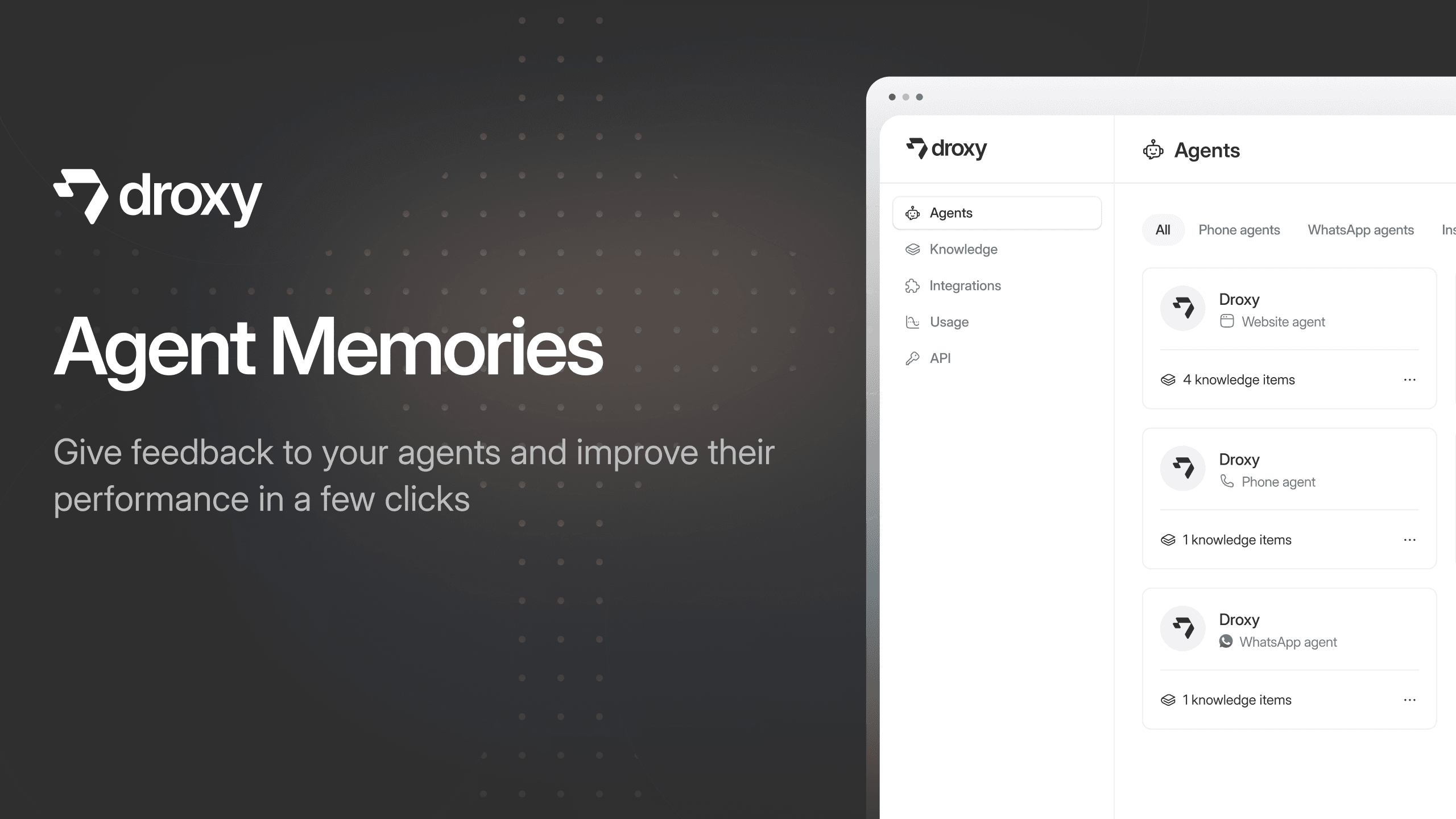
Comparisons
3 min read
Introducing Agent Memories
Improve your agents' performance with Agent Memories. Prevent agents from repeating the same mistakes by giving them feedback.
Read more

Comparisons
15 min read
HVAC Marketing in 2025: The Definitive Lead Gen Guide
Discover 15 proven HVAC marketing strategies, plus learn how Droxy's AI website agent converts curious visitors into qualified leads by answering their questions instantly - right when they're most interested in your services.
Read more
Comparisons
10 min read
10 Best AI Sales Agents in 2025: Tested & Ranked
Discover the top 10 AI sales agents of 2025, designed to enhance lead generation, personalize outreach, and ultimately, close more deals
Read more
Comparisons
3 min read
Introducing Agent Memories
Improve your agents' performance with Agent Memories. Prevent agents from repeating the same mistakes by giving them feedback.
Read more
Comparisons
15 min read
HVAC Marketing in 2025: The Definitive Lead Gen Guide
Discover 15 proven HVAC marketing strategies, plus learn how Droxy's AI website agent converts curious visitors into qualified leads by answering their questions instantly - right when they're most interested in your services.
Read more