Chatbot Hallucination Control for Engineers: Why Generic Fixes Fail
Chatbot Hallucination Control for Engineers: Why Generic Fixes Fail
Insights
24 min

Grounded retrieval with verified citations, abstention and refusal mechanisms, guided decoding or token-level detectors, rigorous data governance, and continuous LLM-based evaluation form the core of effective chatbot hallucination control. NIST’s generative AI profile confirms confabulation is common enough to require formal governance, and authentic-interaction benchmarks show the problem is both widespread and measurable.
TL;DR:
Authentic interaction research found hallucinations in roughly one third of real query and response pairs, with fact conflicts forming the largest category.
A study spanning 37 models and 4 datasets found evaluation by large language models aligned with human judgments better than text overlap metrics.
For chatbots answering from a defined knowledge base, repair retrieval and verify citations before retraining; systems handling open questions need stronger abstention controls.
When retrieval returns weak or conflicting evidence, ask a clarifying question or abstain instead of guessing, especially for incomplete or ambiguous requests.
Route user flagged errors into the test set and have knowledge base owners review them weekly, since failures often trace to outdated sources.
DroxyBuild More Reliable Customer ConversationsDroxy lets businesses deploy customizable AI agents across chat, phone, and social channels to answer customer inquiries around the clock.Explore Droxy
Table of Contents
What Chatbot Hallucinations Are and Their Common Types
Why Hallucinations Happen: Root Causes Engineers Can Fix
How to Detect and Measure Hallucinations Reliably
Mitigation Techniques: Implementing Grounding, Citation Verification, Abstention, and Guided Decoding
Testing, Monitoring, and Continuous Validation for Production Chatbots
Operational Checklist: A Prioritized Playbook to Reduce Hallucinations Quickly
Strategies for Integrating User Feedback Loops to Identify and Correct Hallucinations
Best Practices for Multi-Modal Grounding Beyond Text Data
The Role of Model Updates and Fine-Tuning Cycles in Hallucination Control
Techniques for Handling Ambiguous or Incomplete User Queries
Customizing Hallucination Controls Across Platforms Like WhatsApp and Website Chat
What Teams Actually Get Wrong About Prioritization
How Droxy Helps You Put Hallucination Controls to Work Across Channels
Sources
What Chatbot Hallucinations Are and Their Common Types
NIST defines confabulation, the formal term for what most teams call hallucination, as content that is confidently stated but erroneous or false. Confidently stated errors can be difficult for reviewers and users to spot.
Hallucinations show up in a few recognizable patterns, and naming them correctly is the first step toward fixing them:
Fact-conflicting hallucinations: the chatbot states something that contradicts verifiable, real-world facts, and this is the largest category by far.
Context-conflicting hallucinations: the response contradicts information the user already provided earlier in the conversation.
Logical or inference hallucinations: the model draws a conclusion that does not actually follow from the facts it was given.
Multimodal mismatches: when images, audio, or structured data are involved, the generated description drifts from what the source material actually shows.
The scale of the problem is not theoretical. Authentic-interaction research described in NIST’s risk management framework found that roughly one-third of real query and response pairs contained some form of hallucination, and fact-conflicting errors made up the largest share of those cases. That is the baseline most production systems are working from before any mitigation is applied.
Why Hallucinations Happen: Root Causes Engineers Can Fix
Hallucinations can have different causes across the pipeline. Mapping a suspected cause can help you decide which control to try.
Parametric knowledge limits: the model’s internal training data has gaps or conflicts, and SEAL research ties this knowledge misalignment directly to a measurable rise in factuality errors.
Retrieval and RAG pipeline failures: poor vector indices, semantic mismatches between the query and the indexed chunks, incomplete metadata, or sources that went stale months ago.
Prompt and context enforcement gaps: prompts that do not require the model to cite or stick to supplied context leave room for invention. Decoding choices can also affect generation behavior, so evaluate them on your own chatbot and tasks.
Data quality issues: noisy source documents, ambiguous phrasing in the knowledge base, or missing canonical records that force the model to guess.
Each of these causes has a corresponding control, which is why a one-size-fits-all fix rarely works. A model with solid parametric knowledge but a broken retrieval index will still hallucinate, and no amount of prompt tuning will patch a stale knowledge base. If your chatbot runs on your own documents, training it on your data the right way addresses the knowledge misalignment piece directly.
How to Detect and Measure Hallucinations Reliably
You cannot fix what you cannot measure, and this is where most teams underinvest. Automated metrics like BLEU or ROUGE compare surface-level text overlap, but they frequently miss factual errors entirely because a sentence can be fluent and well-formed while still being wrong.
A large empirical study across 37 models and 4 datasets found that automated metrics often fail to align with human judgments, and LLM-based evaluation, particularly using GPT-4 as the judge, currently produces the closest match to how humans actually assess hallucinations. This matters because it changes where teams should put their testing budget: toward LLM-based evaluation loops rather than only toward traditional NLP scoring.
A repeatable detection and measurement approach looks like this:
Build a curated test set of real questions your chatbot gets, labeled by a human reviewer for correctness.
Run LLM-based evaluation using a strong model as a critic to flag responses that appear unsupported or contradictory.
Score groundedness and relevance for every retrieval-augmented response, checking whether cited passages actually support the claim.
Apply NLI-based verification to confirm the retrieved evidence entails the generated statement rather than merely mentioning the topic.
Escalate edge cases to human labeling when automated scores disagree or fall in an ambiguous range.
Run red-team prompts periodically designed to probe weak spots: ambiguous questions, adversarial phrasing, and topics outside the knowledge base.
Authentic-interaction benchmarks can provide a useful complement to tests based on researcher-written questions because they reflect real chatbot conversations. Combining that kind of benchmark with LLM-as-critic scoring gives you both a realistic baseline and a fast, repeatable way to track whether your mitigation work is actually moving the needle.
Mitigation Techniques: Implementing Grounding, Citation Verification, Abstention, and Guided Decoding
This is where strategy becomes engineering. Each technique below solves a different failure mode, and choosing the right combination depends on your team’s resources and risk tolerance.
Retrieval-augmented generation and grounding. Start with clean indexing: chunk documents at a size that preserves context, attach rich metadata (source, date, section), and score retrieval results for relevance before they ever reach the model. Insert inline citations so every factual claim points to a specific passage. Hybrid retrieval with confidence gating catches cases where the retrieved evidence is too weak to support a confident answer, routing those to a fallback response instead of a guess.
Citation and verification. Grounding alone is not enough if the model cites a source without actually following it. The VeriCite approach frames this as a three-stage pipeline: generate an initial answer, select verified supporting evidence using natural language inference, then refine the final answer against that evidence. This catches the common failure where a chatbot cites a real document but misrepresents what it says. Claude’s citation tooling takes a similar approach, letting developers trace every source a response relies on, which is worth studying if you are designing your own verification layer.
Abstention and refusal mechanisms. Sometimes the correct answer is “I don’t know,” and most chatbots are never trained to say it. SEAL-style training introduces an explicit rejection token that teaches the model to decline unsupported claims rather than invent a plausible-sounding one, and this showed measurable factuality gains on question-answering benchmarks. Exposing this to users well matters too: a flat “I don’t know” feels unhelpful, while “I don’t have verified information on that, but here’s where you can check” maintains trust.
Guided decoding and token-level detectors. For teams that cannot fine-tune a model, KCTS-style guided decoding is an approach to consider. Token-level detectors like RIPA flag risky tokens during generation, and the decoding process is constrained to stay aligned with reference knowledge, cutting hallucinations without touching model weights.
Data governance. None of the above works without clean inputs. Maintain canonical source documents, enforce freshness checks on a set schedule, and run validation pipelines that catch contradictions before they reach the index.
Prompt engineering. Templates that explicitly require the model to cite a source for every claim, and to say so when no source supports a statement, reduce hallucination rates measurably. Pair these templates with consistency testing, where the same question is asked multiple ways to confirm stable answers.
Retrieval and metadata quality fixes semantic mismatch errors at the source.
Citation verification catches cases where a real source is cited but misquoted.
Abstention training addresses knowledge gaps the model cannot fill safely.
Guided decoding offers a lighter-weight fix for teams without fine-tuning resources.
Pro Tip: Start with retrieval and citation verification before investing in fine-tuning. Some hallucinations in production chatbots may stem from pipeline issues rather than the model itself.
A simple decision rule: if your chatbot answers from a defined knowledge base, prioritize retrieval and citation verification first. If it handles open-ended questions where no source exists, abstention training matters more. If you cannot touch the model at all, guided decoding is your best lever.
Testing, Monitoring, and Continuous Validation for Production Chatbots
Hallucination control is not a one-time project. Models drift, source documents change, and user questions shift over time, so the monitoring loop has to run continuously.
Track these metrics on a recurring basis:
Hallucination rate by category (fact-conflicting, context-conflicting, logical), so you know which failure mode is growing.
Abstention rate, watching for both too few refusals (overconfidence) and too many (an overly cautious bot that frustrates users).
Citation match rate, confirming cited sources actually support the claims made.
User correction and rollback rate, a direct signal of real-world accuracy problems.
Drift indicators, flagging when response patterns shift after a model or data update.
Set up periodic LLM-based re-evaluation alongside sampled human review, with automated alerts triggered by sudden shifts in any of these metrics. A practical cadence can combine regular smoke tests on core flows, regression suites against your curated test set, red-team sessions probing new attack angles, and periodic full benchmark re-runs. When testing a new mitigation technique, run it as an A/B test against a small percentage of real traffic before a full rollout, comparing hallucination and abstention rates directly between the two versions.
Operational Checklist: A Prioritized Playbook to Reduce Hallucinations Quickly
Teams that move fastest on this problem treat it in phases rather than trying to fix everything at once.
Days: enable retrieval grounding against one canonical source set, add inline citation templates, switch risky flows to greedy or beam decoding, and add a basic refusal template for unsupported questions.
Weeks: audit and repair retrieval indexing and metadata, add LLM-based evaluation into your continuous integration pipeline, and implement NLI verification for high-stakes claims.
Quarters: invest in abstention-aware fine-tuning, integrate guided decoding for sensitive flows, and formalize full data governance with an incident response process.
Phase | Primary action | Expected outcome |
|---|---|---|
Days | Enable grounding and refusal templates | Fewer confident wrong answers on common questions |
Weeks | Fix retrieval indexing, add LLM evaluation to CI | Lower fact-conflicting error rate, earlier detection |
Quarters | Abstention fine-tuning, guided decoding, governance | Sustained accuracy improvement across model updates |
This phased approach matches effort to urgency. The quick wins buy you time and visible improvement while the deeper pipeline and governance work, which takes longer, gets built properly instead of rushed.
Strategies for Integrating User Feedback Loops to Identify and Correct Hallucinations
Your users are already finding the hallucinations your test suite missed. The question is whether you are capturing that signal.
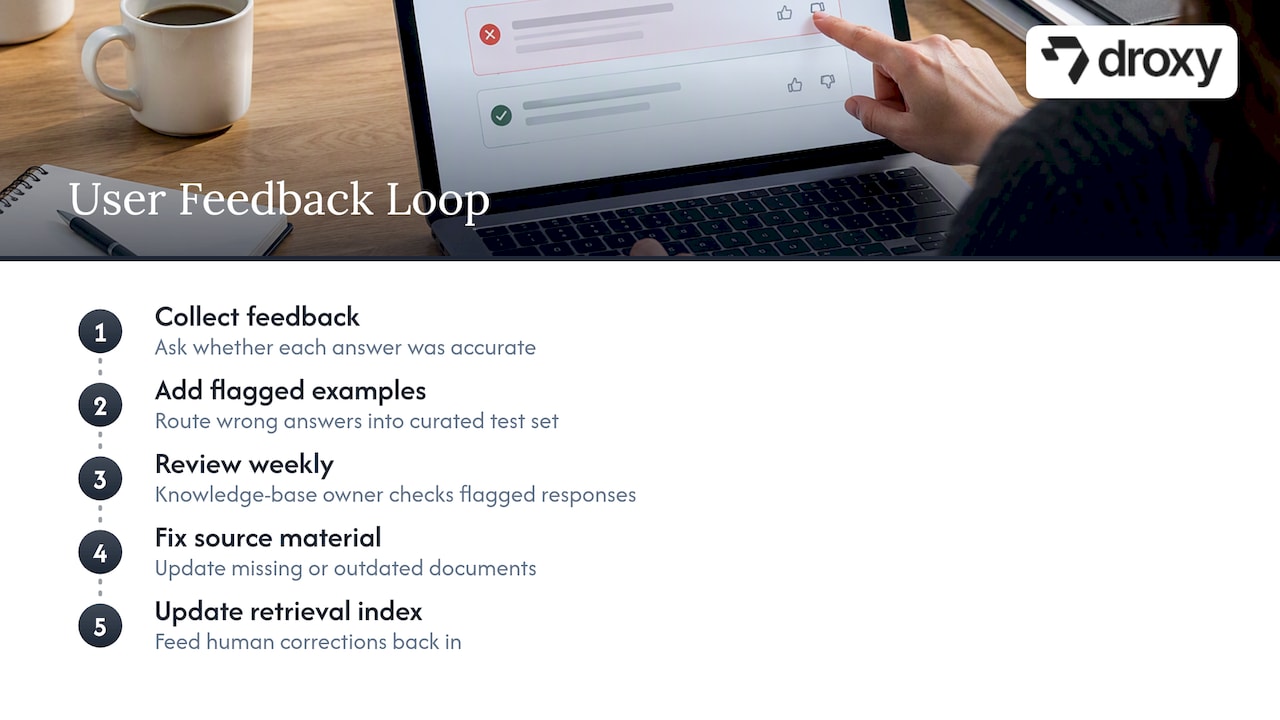
Add a simple, low-friction feedback mechanism to every chatbot response: a thumbs up or down, or a short “was this accurate?” prompt. The goal is not just satisfaction data but accuracy data, so phrase the question specifically rather than generically. When a user flags a response as wrong, route that example into your curated test set rather than letting it disappear into a support ticket queue. Over time, this turns real user corrections into your most realistic hallucination benchmark, often more useful than synthetic red-team prompts because it reflects actual usage patterns.
Build a review cycle where flagged responses get checked weekly by whoever owns the knowledge base, not just the engineering team. A factual error often traces back to a missing or outdated source document, and the person who can fix that fastest is usually not the person who wrote the prompt.
Close the loop visibly where possible. If a chatbot handed off a wrong answer and a human corrected it, feed that correction back into the retrieval index so the same mistake does not repeat. Teams that skip this step end up fixing the same hallucination manually, repeatedly, instead of fixing it once in the source material.
Best Practices for Multi-Modal Grounding Beyond Text Data
Text-based grounding techniques do not automatically transfer to images, audio, or structured data, and that gap is where many chatbots quietly start hallucinating about things they were never meant to describe.
When a chatbot references an image, a product photo, or a diagram, ground the description in structured metadata attached to that asset rather than letting the model free-associate from pixels alone. A product catalog with explicit attributes (color, dimensions, material) gives a model something concrete to cite instead of guessing from a thumbnail.
For voice and phone-based chatbots, the same grounding principle applies to transcripts: verify that the transcribed input actually matches what was intended before generating a response, since transcription errors compound into hallucinations further down the pipeline.
Structured data, like tables, specification sheets, or inventory records, deserves its own retrieval path separate from unstructured text. Mixing both into a single vector index often produces semantic mismatches, since a table row and a paragraph do not embed the same way. Keep them in distinct, well-labeled indices so retrieval scoring stays accurate for each data type.
The Role of Model Updates and Fine-Tuning Cycles in Hallucination Control
Every model update is a reset point for hallucination behavior, and treating it as a routine deployment rather than a fresh evaluation cycle is a common mistake.
When a new model version replaces an old one, rerun your full curated test set before rolling it out to production traffic. A newer model can improve on one hallucination category while quietly regressing on another, and the only way to catch that is a direct before-and-after comparison on the same benchmark.
Fine-tuning cycles carry similar risk. Updating a model on new domain data can shift its parametric knowledge in ways that affect topics far outside the new training set, so a narrow fine-tune deserves a broad regression test, not just a check on the specific topic it targeted. Abstention-aware fine-tuning, the approach introduced in SEAL-style research, is worth building into this cycle specifically because it trains the model to recognize when it lacks sufficient support for a claim, rather than just updating what it knows.
Set a fixed cadence for these reviews rather than waiting for a visible failure. Quarterly re-evaluation against your benchmark, paired with a documented rollback plan, keeps model updates from becoming a silent source of new hallucinations.
Techniques for Handling Ambiguous or Incomplete User Queries
A vague question is an invitation for a chatbot to guess, and guessing is where hallucinations start.
When a query is ambiguous, the safest response is a clarifying question rather than a confident guess at intent. “Do you mean the warranty for the product you bought last month, or our general warranty policy?” costs one extra turn and avoids a wrong answer built on an assumed interpretation.
For incomplete queries, where a user leaves out a detail the chatbot needs, build a template that asks for the missing piece explicitly rather than filling the gap with an assumption. This is especially important for anything involving dates, account details, or specific product variants, where a wrong assumption produces a response that sounds right but answers the wrong question entirely.
Confidence thresholds help here too. If the model’s retrieval step returns weak or conflicting matches for an ambiguous query, that is the signal to trigger a clarifying question or an abstention response instead of pushing forward with a low-confidence guess. Teams that skip this step often see their highest hallucination rates concentrated in exactly these ambiguous-query scenarios, since the model has to invent structure that was never given to it.
Customizing Hallucination Controls Across Platforms Like WhatsApp and Website Chat
The same chatbot logic does not behave identically across every channel, because each platform shapes how people phrase questions and how much context they provide.
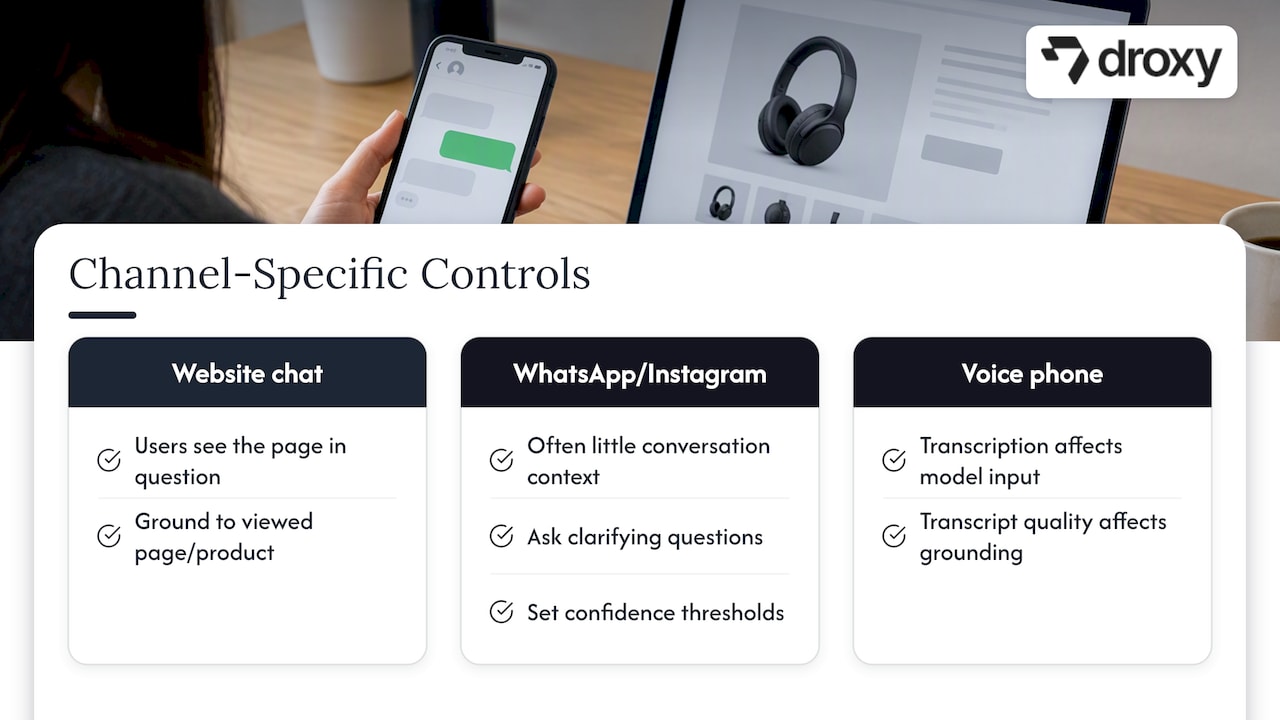
Website chat tends to carry more context since users can see the page they are asking about, so grounding against the specific page or product they are viewing cuts hallucination risk significantly. WhatsApp and Instagram conversations, by contrast, often arrive with little context: a one-line question with no history, which makes clarifying questions and confidence thresholds more important on those channels than on a website widget.
Voice-based phone interactions add another layer, since transcription accuracy affects what the model is even responding to, making the grounding and verification steps dependent on transcript quality in a way text channels are not.
Brand voice consistency matters across all of these without compromising factuality. The citation and abstention templates you build should be flexible enough to match a conversational WhatsApp tone or a more formal website chat tone, while still enforcing the same underlying verification logic. A platform that lets you customize agent behavior per channel while keeping the same grounding and governance rules underneath avoids the common trap of building separate, inconsistent hallucination controls for each surface.
What Teams Actually Get Wrong About Prioritization
Most teams reach for fine-tuning first because it feels like the “real” fix, when retrieval and citation verification usually deliver more measurable improvement for far less engineering effort. If your team is small, prioritize grounded retrieval, citation checks, and LLM-based evaluation, and accept that some questions will get a refusal rather than a confident guess. That trade-off is worth it.
Mid-size and larger teams should invest further upstream: pipeline quality, guided decoding, and abstention-aware training. But every team, regardless of size, needs to own the monitoring loop. Controls that are not measured quietly decay.
— Elena
How Droxy Helps You Put Hallucination Controls to Work Across Channels
We built our platform so you do not have to assemble these controls from scratch. Deploying a no-code AI agent through Droxy means hand-off comes built into the setup, whether you are running conversations on your website, phone, WhatsApp, Instagram, Facebook, or Shopify.
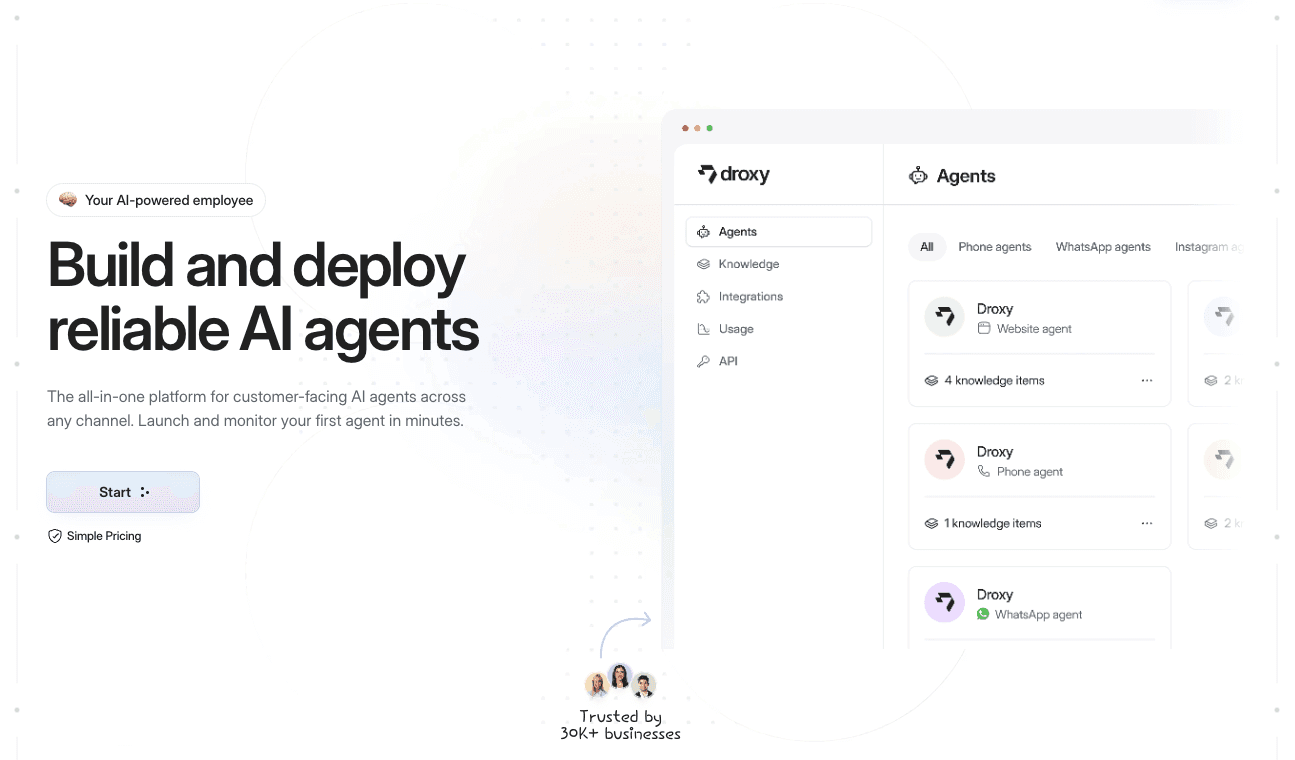
Our platform is designed to bring knowledge from multiple sources together and provide tools for tracking response patterns and handing conversations to a person. Check the product details to confirm which capabilities are available for your setup.
If you want to deploy chat on your website, our website agent is built for that. Check our pricing page to compare the Basic, Advanced, and Enterprise plans and find the fit for your team.
FAQ
How can I reduce hallucinations in my chatbot?
The most effective combination is grounded retrieval with verified citations, abstention training so the model can decline unsupported claims, and continuous LLM-based evaluation to catch new errors as they appear. Retrieval grounding and citation verification are approaches teams can evaluate as part of their mitigation efforts.
What should I avoid asking an AI chatbot?
Avoid asking highly specific factual questions, like exact statistics, dates, or legal and medical details, without a way to verify the answer against a trusted source. Ambiguous or incomplete questions also raise hallucination risk since the model has to guess at missing context.
Does Microsoft Copilot hallucinate?
Like all large language model based assistants, Copilot can produce confidently stated but incorrect information, a pattern NIST describes broadly as confabulation across generative AI tools. The rate and type of errors vary by task and how much grounding the specific deployment uses.
Which AI chatbot is best for mental health support?
No AI chatbot is positioned as a substitute for professional mental health care, and hallucination risk is a serious concern in sensitive, high-stakes topics like this one. Anyone evaluating a chatbot for mental health related use should confirm it was built with clinical oversight and verify claims with a licensed professional rather than relying on chatbot output alone.
How do I measure whether my hallucination fixes are working?
Track hallucination rate by category, citation match rate, and abstention rate over time against a fixed, curated test set. LLM-based evaluation using a strong model as critic can help teams assess hallucinations, though evaluation methods may perform differently across tasks.
Recommended
Grounded retrieval with verified citations, abstention and refusal mechanisms, guided decoding or token-level detectors, rigorous data governance, and continuous LLM-based evaluation form the core of effective chatbot hallucination control. NIST’s generative AI profile confirms confabulation is common enough to require formal governance, and authentic-interaction benchmarks show the problem is both widespread and measurable.
TL;DR:
Authentic interaction research found hallucinations in roughly one third of real query and response pairs, with fact conflicts forming the largest category.
A study spanning 37 models and 4 datasets found evaluation by large language models aligned with human judgments better than text overlap metrics.
For chatbots answering from a defined knowledge base, repair retrieval and verify citations before retraining; systems handling open questions need stronger abstention controls.
When retrieval returns weak or conflicting evidence, ask a clarifying question or abstain instead of guessing, especially for incomplete or ambiguous requests.
Route user flagged errors into the test set and have knowledge base owners review them weekly, since failures often trace to outdated sources.
DroxyBuild More Reliable Customer ConversationsDroxy lets businesses deploy customizable AI agents across chat, phone, and social channels to answer customer inquiries around the clock.Explore Droxy
Table of Contents
What Chatbot Hallucinations Are and Their Common Types
Why Hallucinations Happen: Root Causes Engineers Can Fix
How to Detect and Measure Hallucinations Reliably
Mitigation Techniques: Implementing Grounding, Citation Verification, Abstention, and Guided Decoding
Testing, Monitoring, and Continuous Validation for Production Chatbots
Operational Checklist: A Prioritized Playbook to Reduce Hallucinations Quickly
Strategies for Integrating User Feedback Loops to Identify and Correct Hallucinations
Best Practices for Multi-Modal Grounding Beyond Text Data
The Role of Model Updates and Fine-Tuning Cycles in Hallucination Control
Techniques for Handling Ambiguous or Incomplete User Queries
Customizing Hallucination Controls Across Platforms Like WhatsApp and Website Chat
What Teams Actually Get Wrong About Prioritization
How Droxy Helps You Put Hallucination Controls to Work Across Channels
Sources
What Chatbot Hallucinations Are and Their Common Types
NIST defines confabulation, the formal term for what most teams call hallucination, as content that is confidently stated but erroneous or false. Confidently stated errors can be difficult for reviewers and users to spot.
Hallucinations show up in a few recognizable patterns, and naming them correctly is the first step toward fixing them:
Fact-conflicting hallucinations: the chatbot states something that contradicts verifiable, real-world facts, and this is the largest category by far.
Context-conflicting hallucinations: the response contradicts information the user already provided earlier in the conversation.
Logical or inference hallucinations: the model draws a conclusion that does not actually follow from the facts it was given.
Multimodal mismatches: when images, audio, or structured data are involved, the generated description drifts from what the source material actually shows.
The scale of the problem is not theoretical. Authentic-interaction research described in NIST’s risk management framework found that roughly one-third of real query and response pairs contained some form of hallucination, and fact-conflicting errors made up the largest share of those cases. That is the baseline most production systems are working from before any mitigation is applied.
Why Hallucinations Happen: Root Causes Engineers Can Fix
Hallucinations can have different causes across the pipeline. Mapping a suspected cause can help you decide which control to try.
Parametric knowledge limits: the model’s internal training data has gaps or conflicts, and SEAL research ties this knowledge misalignment directly to a measurable rise in factuality errors.
Retrieval and RAG pipeline failures: poor vector indices, semantic mismatches between the query and the indexed chunks, incomplete metadata, or sources that went stale months ago.
Prompt and context enforcement gaps: prompts that do not require the model to cite or stick to supplied context leave room for invention. Decoding choices can also affect generation behavior, so evaluate them on your own chatbot and tasks.
Data quality issues: noisy source documents, ambiguous phrasing in the knowledge base, or missing canonical records that force the model to guess.
Each of these causes has a corresponding control, which is why a one-size-fits-all fix rarely works. A model with solid parametric knowledge but a broken retrieval index will still hallucinate, and no amount of prompt tuning will patch a stale knowledge base. If your chatbot runs on your own documents, training it on your data the right way addresses the knowledge misalignment piece directly.
How to Detect and Measure Hallucinations Reliably
You cannot fix what you cannot measure, and this is where most teams underinvest. Automated metrics like BLEU or ROUGE compare surface-level text overlap, but they frequently miss factual errors entirely because a sentence can be fluent and well-formed while still being wrong.
A large empirical study across 37 models and 4 datasets found that automated metrics often fail to align with human judgments, and LLM-based evaluation, particularly using GPT-4 as the judge, currently produces the closest match to how humans actually assess hallucinations. This matters because it changes where teams should put their testing budget: toward LLM-based evaluation loops rather than only toward traditional NLP scoring.
A repeatable detection and measurement approach looks like this:
Build a curated test set of real questions your chatbot gets, labeled by a human reviewer for correctness.
Run LLM-based evaluation using a strong model as a critic to flag responses that appear unsupported or contradictory.
Score groundedness and relevance for every retrieval-augmented response, checking whether cited passages actually support the claim.
Apply NLI-based verification to confirm the retrieved evidence entails the generated statement rather than merely mentioning the topic.
Escalate edge cases to human labeling when automated scores disagree or fall in an ambiguous range.
Run red-team prompts periodically designed to probe weak spots: ambiguous questions, adversarial phrasing, and topics outside the knowledge base.
Authentic-interaction benchmarks can provide a useful complement to tests based on researcher-written questions because they reflect real chatbot conversations. Combining that kind of benchmark with LLM-as-critic scoring gives you both a realistic baseline and a fast, repeatable way to track whether your mitigation work is actually moving the needle.
Mitigation Techniques: Implementing Grounding, Citation Verification, Abstention, and Guided Decoding
This is where strategy becomes engineering. Each technique below solves a different failure mode, and choosing the right combination depends on your team’s resources and risk tolerance.
Retrieval-augmented generation and grounding. Start with clean indexing: chunk documents at a size that preserves context, attach rich metadata (source, date, section), and score retrieval results for relevance before they ever reach the model. Insert inline citations so every factual claim points to a specific passage. Hybrid retrieval with confidence gating catches cases where the retrieved evidence is too weak to support a confident answer, routing those to a fallback response instead of a guess.
Citation and verification. Grounding alone is not enough if the model cites a source without actually following it. The VeriCite approach frames this as a three-stage pipeline: generate an initial answer, select verified supporting evidence using natural language inference, then refine the final answer against that evidence. This catches the common failure where a chatbot cites a real document but misrepresents what it says. Claude’s citation tooling takes a similar approach, letting developers trace every source a response relies on, which is worth studying if you are designing your own verification layer.
Abstention and refusal mechanisms. Sometimes the correct answer is “I don’t know,” and most chatbots are never trained to say it. SEAL-style training introduces an explicit rejection token that teaches the model to decline unsupported claims rather than invent a plausible-sounding one, and this showed measurable factuality gains on question-answering benchmarks. Exposing this to users well matters too: a flat “I don’t know” feels unhelpful, while “I don’t have verified information on that, but here’s where you can check” maintains trust.
Guided decoding and token-level detectors. For teams that cannot fine-tune a model, KCTS-style guided decoding is an approach to consider. Token-level detectors like RIPA flag risky tokens during generation, and the decoding process is constrained to stay aligned with reference knowledge, cutting hallucinations without touching model weights.
Data governance. None of the above works without clean inputs. Maintain canonical source documents, enforce freshness checks on a set schedule, and run validation pipelines that catch contradictions before they reach the index.
Prompt engineering. Templates that explicitly require the model to cite a source for every claim, and to say so when no source supports a statement, reduce hallucination rates measurably. Pair these templates with consistency testing, where the same question is asked multiple ways to confirm stable answers.
Retrieval and metadata quality fixes semantic mismatch errors at the source.
Citation verification catches cases where a real source is cited but misquoted.
Abstention training addresses knowledge gaps the model cannot fill safely.
Guided decoding offers a lighter-weight fix for teams without fine-tuning resources.
Pro Tip: Start with retrieval and citation verification before investing in fine-tuning. Some hallucinations in production chatbots may stem from pipeline issues rather than the model itself.
A simple decision rule: if your chatbot answers from a defined knowledge base, prioritize retrieval and citation verification first. If it handles open-ended questions where no source exists, abstention training matters more. If you cannot touch the model at all, guided decoding is your best lever.
Testing, Monitoring, and Continuous Validation for Production Chatbots
Hallucination control is not a one-time project. Models drift, source documents change, and user questions shift over time, so the monitoring loop has to run continuously.
Track these metrics on a recurring basis:
Hallucination rate by category (fact-conflicting, context-conflicting, logical), so you know which failure mode is growing.
Abstention rate, watching for both too few refusals (overconfidence) and too many (an overly cautious bot that frustrates users).
Citation match rate, confirming cited sources actually support the claims made.
User correction and rollback rate, a direct signal of real-world accuracy problems.
Drift indicators, flagging when response patterns shift after a model or data update.
Set up periodic LLM-based re-evaluation alongside sampled human review, with automated alerts triggered by sudden shifts in any of these metrics. A practical cadence can combine regular smoke tests on core flows, regression suites against your curated test set, red-team sessions probing new attack angles, and periodic full benchmark re-runs. When testing a new mitigation technique, run it as an A/B test against a small percentage of real traffic before a full rollout, comparing hallucination and abstention rates directly between the two versions.
Operational Checklist: A Prioritized Playbook to Reduce Hallucinations Quickly
Teams that move fastest on this problem treat it in phases rather than trying to fix everything at once.
Days: enable retrieval grounding against one canonical source set, add inline citation templates, switch risky flows to greedy or beam decoding, and add a basic refusal template for unsupported questions.
Weeks: audit and repair retrieval indexing and metadata, add LLM-based evaluation into your continuous integration pipeline, and implement NLI verification for high-stakes claims.
Quarters: invest in abstention-aware fine-tuning, integrate guided decoding for sensitive flows, and formalize full data governance with an incident response process.
Phase | Primary action | Expected outcome |
|---|---|---|
Days | Enable grounding and refusal templates | Fewer confident wrong answers on common questions |
Weeks | Fix retrieval indexing, add LLM evaluation to CI | Lower fact-conflicting error rate, earlier detection |
Quarters | Abstention fine-tuning, guided decoding, governance | Sustained accuracy improvement across model updates |
This phased approach matches effort to urgency. The quick wins buy you time and visible improvement while the deeper pipeline and governance work, which takes longer, gets built properly instead of rushed.
Strategies for Integrating User Feedback Loops to Identify and Correct Hallucinations
Your users are already finding the hallucinations your test suite missed. The question is whether you are capturing that signal.
Add a simple, low-friction feedback mechanism to every chatbot response: a thumbs up or down, or a short “was this accurate?” prompt. The goal is not just satisfaction data but accuracy data, so phrase the question specifically rather than generically. When a user flags a response as wrong, route that example into your curated test set rather than letting it disappear into a support ticket queue. Over time, this turns real user corrections into your most realistic hallucination benchmark, often more useful than synthetic red-team prompts because it reflects actual usage patterns.
Build a review cycle where flagged responses get checked weekly by whoever owns the knowledge base, not just the engineering team. A factual error often traces back to a missing or outdated source document, and the person who can fix that fastest is usually not the person who wrote the prompt.
Close the loop visibly where possible. If a chatbot handed off a wrong answer and a human corrected it, feed that correction back into the retrieval index so the same mistake does not repeat. Teams that skip this step end up fixing the same hallucination manually, repeatedly, instead of fixing it once in the source material.
Best Practices for Multi-Modal Grounding Beyond Text Data
Text-based grounding techniques do not automatically transfer to images, audio, or structured data, and that gap is where many chatbots quietly start hallucinating about things they were never meant to describe.
When a chatbot references an image, a product photo, or a diagram, ground the description in structured metadata attached to that asset rather than letting the model free-associate from pixels alone. A product catalog with explicit attributes (color, dimensions, material) gives a model something concrete to cite instead of guessing from a thumbnail.
For voice and phone-based chatbots, the same grounding principle applies to transcripts: verify that the transcribed input actually matches what was intended before generating a response, since transcription errors compound into hallucinations further down the pipeline.
Structured data, like tables, specification sheets, or inventory records, deserves its own retrieval path separate from unstructured text. Mixing both into a single vector index often produces semantic mismatches, since a table row and a paragraph do not embed the same way. Keep them in distinct, well-labeled indices so retrieval scoring stays accurate for each data type.
The Role of Model Updates and Fine-Tuning Cycles in Hallucination Control
Every model update is a reset point for hallucination behavior, and treating it as a routine deployment rather than a fresh evaluation cycle is a common mistake.
When a new model version replaces an old one, rerun your full curated test set before rolling it out to production traffic. A newer model can improve on one hallucination category while quietly regressing on another, and the only way to catch that is a direct before-and-after comparison on the same benchmark.
Fine-tuning cycles carry similar risk. Updating a model on new domain data can shift its parametric knowledge in ways that affect topics far outside the new training set, so a narrow fine-tune deserves a broad regression test, not just a check on the specific topic it targeted. Abstention-aware fine-tuning, the approach introduced in SEAL-style research, is worth building into this cycle specifically because it trains the model to recognize when it lacks sufficient support for a claim, rather than just updating what it knows.
Set a fixed cadence for these reviews rather than waiting for a visible failure. Quarterly re-evaluation against your benchmark, paired with a documented rollback plan, keeps model updates from becoming a silent source of new hallucinations.
Techniques for Handling Ambiguous or Incomplete User Queries
A vague question is an invitation for a chatbot to guess, and guessing is where hallucinations start.
When a query is ambiguous, the safest response is a clarifying question rather than a confident guess at intent. “Do you mean the warranty for the product you bought last month, or our general warranty policy?” costs one extra turn and avoids a wrong answer built on an assumed interpretation.
For incomplete queries, where a user leaves out a detail the chatbot needs, build a template that asks for the missing piece explicitly rather than filling the gap with an assumption. This is especially important for anything involving dates, account details, or specific product variants, where a wrong assumption produces a response that sounds right but answers the wrong question entirely.
Confidence thresholds help here too. If the model’s retrieval step returns weak or conflicting matches for an ambiguous query, that is the signal to trigger a clarifying question or an abstention response instead of pushing forward with a low-confidence guess. Teams that skip this step often see their highest hallucination rates concentrated in exactly these ambiguous-query scenarios, since the model has to invent structure that was never given to it.
Customizing Hallucination Controls Across Platforms Like WhatsApp and Website Chat
The same chatbot logic does not behave identically across every channel, because each platform shapes how people phrase questions and how much context they provide.
Website chat tends to carry more context since users can see the page they are asking about, so grounding against the specific page or product they are viewing cuts hallucination risk significantly. WhatsApp and Instagram conversations, by contrast, often arrive with little context: a one-line question with no history, which makes clarifying questions and confidence thresholds more important on those channels than on a website widget.
Voice-based phone interactions add another layer, since transcription accuracy affects what the model is even responding to, making the grounding and verification steps dependent on transcript quality in a way text channels are not.
Brand voice consistency matters across all of these without compromising factuality. The citation and abstention templates you build should be flexible enough to match a conversational WhatsApp tone or a more formal website chat tone, while still enforcing the same underlying verification logic. A platform that lets you customize agent behavior per channel while keeping the same grounding and governance rules underneath avoids the common trap of building separate, inconsistent hallucination controls for each surface.
What Teams Actually Get Wrong About Prioritization
Most teams reach for fine-tuning first because it feels like the “real” fix, when retrieval and citation verification usually deliver more measurable improvement for far less engineering effort. If your team is small, prioritize grounded retrieval, citation checks, and LLM-based evaluation, and accept that some questions will get a refusal rather than a confident guess. That trade-off is worth it.
Mid-size and larger teams should invest further upstream: pipeline quality, guided decoding, and abstention-aware training. But every team, regardless of size, needs to own the monitoring loop. Controls that are not measured quietly decay.
— Elena
How Droxy Helps You Put Hallucination Controls to Work Across Channels
We built our platform so you do not have to assemble these controls from scratch. Deploying a no-code AI agent through Droxy means hand-off comes built into the setup, whether you are running conversations on your website, phone, WhatsApp, Instagram, Facebook, or Shopify.
Our platform is designed to bring knowledge from multiple sources together and provide tools for tracking response patterns and handing conversations to a person. Check the product details to confirm which capabilities are available for your setup.
If you want to deploy chat on your website, our website agent is built for that. Check our pricing page to compare the Basic, Advanced, and Enterprise plans and find the fit for your team.
FAQ
How can I reduce hallucinations in my chatbot?
The most effective combination is grounded retrieval with verified citations, abstention training so the model can decline unsupported claims, and continuous LLM-based evaluation to catch new errors as they appear. Retrieval grounding and citation verification are approaches teams can evaluate as part of their mitigation efforts.
What should I avoid asking an AI chatbot?
Avoid asking highly specific factual questions, like exact statistics, dates, or legal and medical details, without a way to verify the answer against a trusted source. Ambiguous or incomplete questions also raise hallucination risk since the model has to guess at missing context.
Does Microsoft Copilot hallucinate?
Like all large language model based assistants, Copilot can produce confidently stated but incorrect information, a pattern NIST describes broadly as confabulation across generative AI tools. The rate and type of errors vary by task and how much grounding the specific deployment uses.
Which AI chatbot is best for mental health support?
No AI chatbot is positioned as a substitute for professional mental health care, and hallucination risk is a serious concern in sensitive, high-stakes topics like this one. Anyone evaluating a chatbot for mental health related use should confirm it was built with clinical oversight and verify claims with a licensed professional rather than relying on chatbot output alone.
How do I measure whether my hallucination fixes are working?
Track hallucination rate by category, citation match rate, and abstention rate over time against a fixed, curated test set. LLM-based evaluation using a strong model as critic can help teams assess hallucinations, though evaluation methods may perform differently across tasks.
Recommended



🚀
Powered by Droxy
Turn every interaction into a conversion
Customer facing AI agents that engage, convert, and support so you can scale what matters.
✨
Learn more
Recent posts
Insights
3 min read
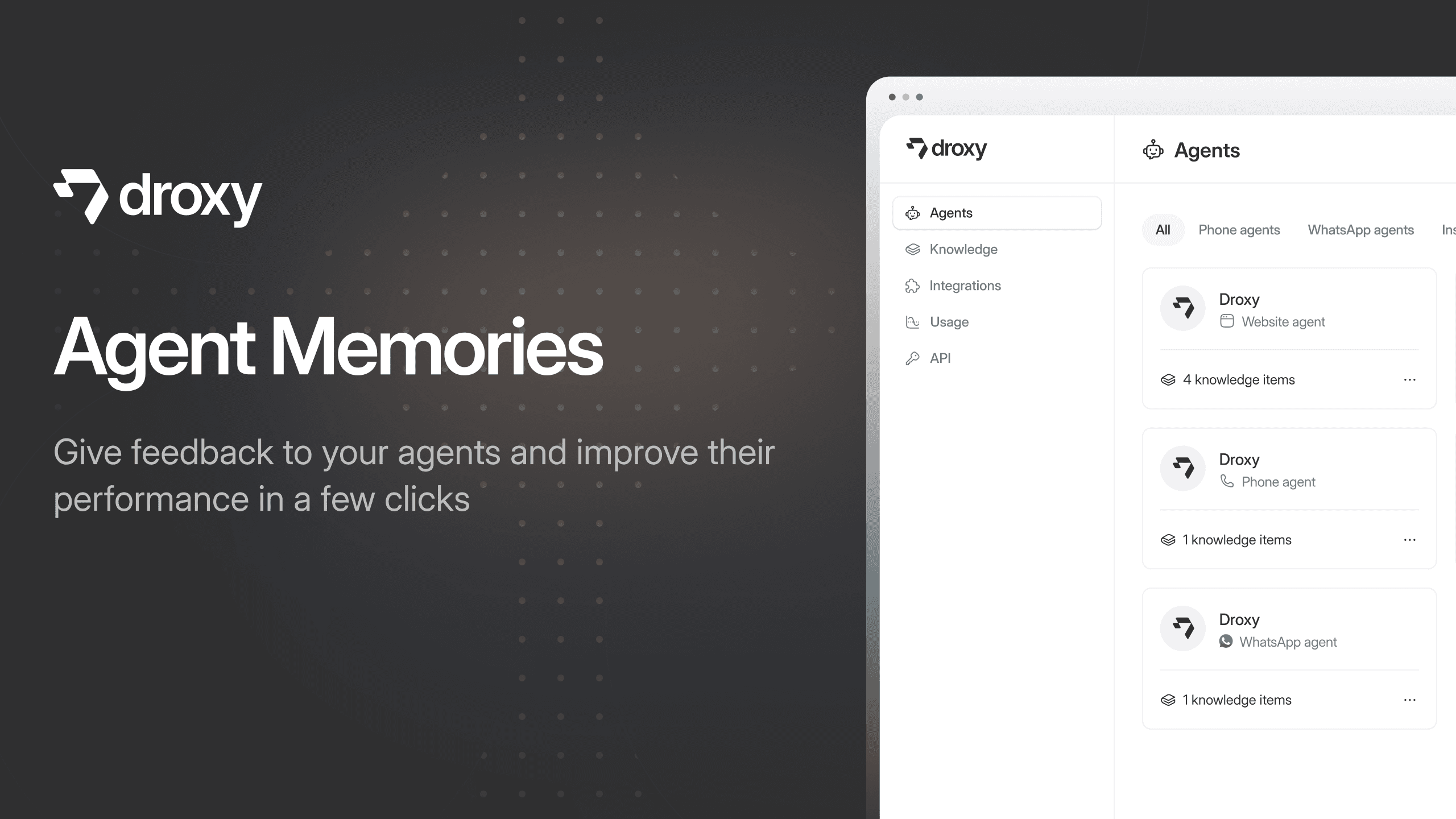
Introducing Agent Memories
Improve your agents' performance with Agent Memories. Prevent agents from repeating the same mistakes by giving them feedback.
Read more

Insights
15 min read
HVAC Marketing in 2025: The Definitive Lead Gen Guide
Discover 15 proven HVAC marketing strategies, plus learn how Droxy's AI website agent converts curious visitors into qualified leads by answering their questions instantly - right when they're most interested in your services.
Read more

Insights
10 min read
10 Best AI Sales Agents in 2025: Tested & Ranked
Discover the top 10 AI sales agents of 2025, designed to enhance lead generation, personalize outreach, and ultimately, close more deals
Read more
Insights
3 min read
Introducing Agent Memories
Improve your agents' performance with Agent Memories. Prevent agents from repeating the same mistakes by giving them feedback.
Read more
Insights
15 min read
HVAC Marketing in 2025: The Definitive Lead Gen Guide
Discover 15 proven HVAC marketing strategies, plus learn how Droxy's AI website agent converts curious visitors into qualified leads by answering their questions instantly - right when they're most interested in your services.
Read more