Omnichannel Support Strategy for Leaders: 4 Cs, AI Testing
Omnichannel Support Strategy for Leaders: 4 Cs, AI Testing
Insights
16 min

A strong omni channel support strategy eliminates the context loss that happens when customers bounce between email, chat, and phone, and it measurably lowers your Cost Per Interaction (CPI) while improving satisfaction scores like transactional NPS (tNPS). To get there, you need to preserve customer context across every handoff, build right-channel routing rules, and put governance around any automation you deploy. Start with those three priorities, and the rest of your strategy falls into place.
TL;DR:
Pilot the journey with the highest repeat contact rate, not the busiest one, because context loss can cost more per customer there.
Baseline CPI, tNPS, SSR, and CES, then run a pilot lasting four to eight weeks across one or two channels, with success gates before expanding.
Prioritize voice for high stakes interactions, while web chat and messaging suit routine queries; add social support when public brand visibility justifies it.
Set confidence thresholds and issue rules for human handoffs, then test AI offline, verify scoring agreement, and run production trials before deployment.
Transfers without context lower CES by 0.5 to 0.8 points on a scale of seven, while surfacing history can recover up to 1.1 points.
DroxyKeep Support Connected Across ChannelsDroxy deploys customizable AI agents across chat, phone, messaging, and social channels to answer customer inquiries around the clock.Explore Droxy
Table of Contents
The Four C’s of Omnichannel Support and What They Deliver
How to Build and Run an Omnichannel Support Strategy
Which Channels and Technology You Need to Unify
How to Govern and Test AI Agents in Production
A Phased Rollout Roadmap for Omnichannel Support
What Leaders Consistently Get Wrong About Omnichannel
How Droxy Supports an Omnichannel Support Strategy
Sources
The Four C’s of Omnichannel Support and What They Deliver
Most omnichannel frameworks boil down to four principles, often called the “4 C’s”: consistency, convenience, context, and channel integration. Each one translates into a specific operational change, and together they’re the difference between a support operation that scales and one that buckles under its own complexity.
Consistency means a customer gets the same answer and the same tone whether they’re on live chat or the phone. Convenience means you meet customers where they already are instead of forcing a channel switch. Context means every agent, human or AI, can see the full history of an interaction the moment it starts. Channel integration means your systems actually talk to each other instead of operating as disconnected silos.
These aren’t abstract ideals. Cross-channel orchestration research shows that unifying data and aligning service policies across channels reduces repeat contacts and service costs while improving retention and customer lifetime value. The same research found that operational continuity, meaning the simple act of surfacing prior context to the next handler, delivers larger Customer Effort Score (CES) improvements than adding new channels ever does.
Contact centers that have adopted omnichannel integration can see significant business value, including a notable reduction in cost per assisted contact. Deloitte Digital’s 2024 report recommends that contact centers shift away from volume metrics like calls handled and toward Cost Per Interaction as the core efficiency measure, because CPI captures the real savings from right-channeling work to the cheapest effective channel.
The business case for getting this right includes:
Lower cost per contact: right-channeling and context preservation cut the rework that drives up CPI.
Higher retention: customers who don’t have to repeat themselves stay longer and spend more.
Better CES: consistent context handoffs improve effort scores more than channel expansion does.
Fewer escalations: policy-aligned responses across channels reduce the friction that triggers complaints.
How to Build and Run an Omnichannel Support Strategy
Once the principles are clear, the work becomes operational. Here’s the sequence we recommend for moving from strategy document to live pilot.
Define your outcomes and KPIs first. Before touching a single tool, agree on what you’re measuring: Cost Per Interaction (CPI), transactional NPS (tNPS), Self-Service Rate (SSR), Customer Effort Score (CES), and deflection rate. These five give you a complete picture of cost, satisfaction, and effort.
Map the customer journey and the data it requires. Identify where customers currently switch channels and what information gets lost at each switch point.
Decide which channels to unify first. Most teams start with the two or three channels carrying the highest volume, since that’s where context loss does the most damage.
Write channel policies and right-channeling rules. Define which issue types route to self-service, which go to chat, and which require a live agent or phone call.
Design the agent desktop and routing logic. Agents, human or AI, need one screen showing the full interaction history regardless of originating channel.
Plan staffing and training around the new workflow. Agents need to understand not just their channel but how work flows into it from others.
Set clear human fallback rules. Define the confidence thresholds and issue types that always route to a person.
Run a scoped pilot with success gates. Pick one journey, one or two channels, a defined customer segment, and a fixed duration, then measure against the KPIs from step one before expanding.
Reducing repeat contacts often starts upstream of support entirely. If a product issue is generating a steady stream of tickets, fixing the product reduces ticket volume more durably than any amount of channel optimization downstream.
Pro Tip: Run your pilot on the journey with the highest repeat-contact rate, not the highest total volume. That’s where context loss is costing you the most per customer.
Which Channels and Technology You Need to Unify
Not every channel deserves equal investment on day one. Voice still carries the highest-stakes, highest-emotion interactions, which makes it a priority for context continuity even though it’s technically harder to integrate than text channels. Web chat and messaging apps like WhatsApp handle the highest volume of routine queries and are usually the cheapest place to deflect work through self-service. Social channels like Instagram and Facebook matter most for brands with a strong public-facing presence, where a slow reply is visible to more than just the customer who sent it.
The technology stack that supports this sits on a few core components:
A unified inbox that pulls every channel into one agent-facing view.
Omnichannel routing that applies your right-channeling rules automatically.
A CDP or CRM that holds the single customer record every channel reads from and writes to.
A knowledge base that both human agents and AI agents query for consistent answers.
Analytics that track CPI, tNPS, SSR, CES, and deflection in one place.
Conversational AI agents that handle first-line responses and escalate when needed.
The hardest part of integration is usually session stitching: making sure a conversation that starts on chat and moves to phone retains its full working memory rather than starting over. This requires your systems to invoke the same underlying data and tools regardless of channel, which is a different architecture problem than simply adding another channel to a dashboard. For teams weighing a bot-first approach against a live-chat-first one, the trade-offs are worth mapping out before you commit to an architecture choice. Voice adds its own constraint: conversational AI agents handling phone calls need low enough latency that the conversation feels natural, which is a harder engineering bar than text-based channels face.
How to Govern and Test AI Agents in Production
Deploying AI across your channels without an evaluation framework is how good intentions turn into inconsistent, untrustworthy answers at scale. The teams getting this right follow an evaluation-driven pipeline: offline simulation of conversations before anything goes live, calibrated LLM-as-judge scoring to catch quality drift, measurement of inter-rater agreement to confirm the judge is reliable, and only then a production A/B test against the existing process.
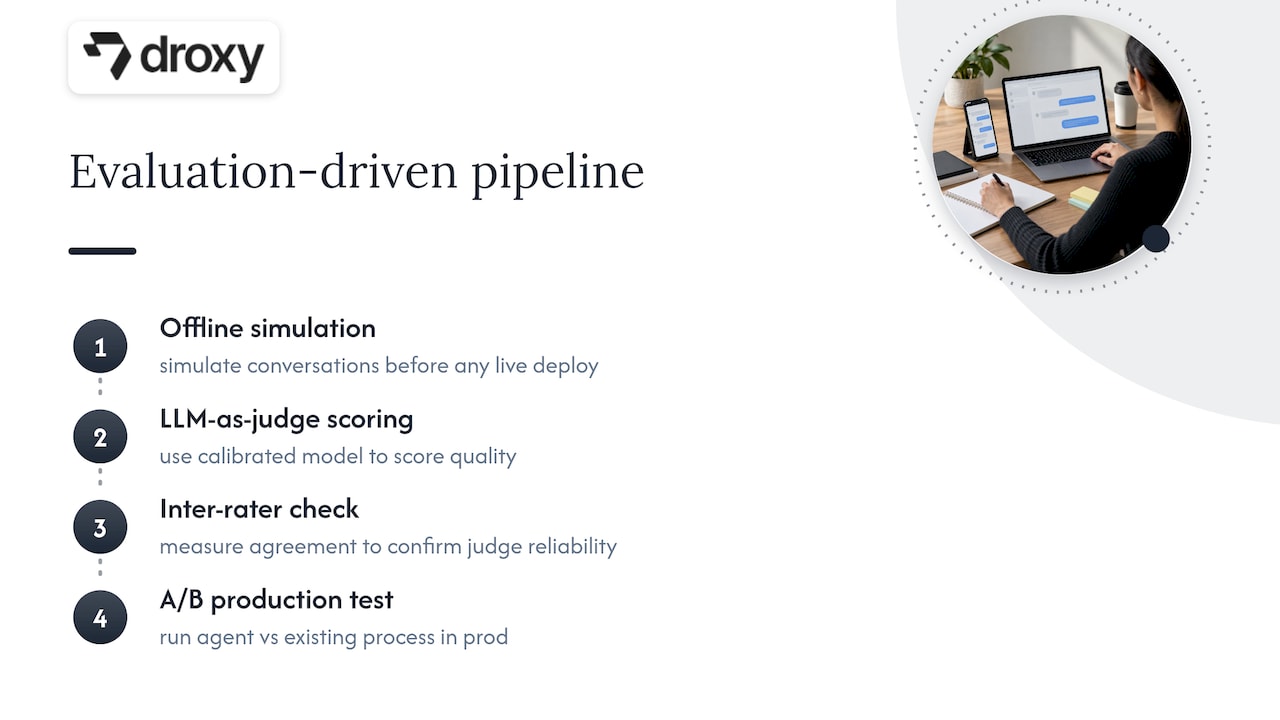
An evaluation-driven framework applied across five production use cases produced significant improvements in transactional NPS and self-service rate, with offline evaluation results closely tracking online outcomes. That ACM research also found that converting standard operating procedures into ordered, versioned routines, such as greet, retrieve data, run diagnostics, offer resolution, lets teams iterate on one step without destabilizing the rest of the agent’s behavior.
Human-in-loop thresholds matter as much as the automation itself. Define the confidence score below which an AI agent hands off automatically, and design that handoff so the human agent inherits full context instead of starting cold. Every additional handoff without context costs you measurable effort: practitioner data on Customer Effort Score shows each transfer event between agents or channels drops CES by roughly 0.5 to 0.8 points on a 7-point scale, while surfacing prior context to the next handler can recover up to 1.1 points. Fast, context-aware handoffs are worth engineering around directly, down to the time it takes to get a customer to a human.
Governance on top of evaluation means policy-aware decision engines that encode your return policies, refund thresholds, and escalation criteria so autonomous agents can’t operate outside brand or regulatory limits, paired with audit logs and explainability checkpoints for every automated decision. A governance-constrained framework for agentic AI makes the same point from an operations lens: efficiency gains from automation only hold up when they’re paired with real-time observability and compliance monitoring.
Pro Tip: Correlate your offline evaluation scores with live CPI and tNPS weekly during rollout. A gap between the two is your earliest signal that production conditions differ from your test set.
A Phased Rollout Roadmap for Omnichannel Support
Moving from plan to production works best in four phases, each with its own gate before you proceed.
Discovery (weeks 1 to 3): build journey maps, audit your current tech stack for integration gaps, and set baseline KPIs for CPI, tNPS, SSR, and CES so you have something to measure against later.
Pilot design (weeks 3 to 5): scope one or two channels, one customer segment, and a fixed duration, usually four to eight weeks, with explicit success gates tied to your baseline numbers.
Pilot execution and iteration (weeks 5 to 12): run the pilot, review results on a weekly cadence, and adjust routing rules or agent routines based on what the data shows rather than waiting for the full pilot window to close.
Scale (after validated KPIs): expand to additional channels and segments only once the pilot has cleared its success gates, and build out the organizational supports, a governance board, ongoing QA, agent training, and named cross-functional owners, that keep quality consistent as volume grows.
Executive sponsors should expect to see directional KPI movement by the end of the pilot phase, with fuller confidence arriving once a full reporting cycle has passed under the new workflow. Tracking concrete deployment examples alongside your own pilot data gives your governance board a useful benchmark for what reasonable progress looks like at each gate.
What Leaders Consistently Get Wrong About Omnichannel
The biggest mistake we see is treating channel expansion as the goal instead of context preservation. Adding WhatsApp or Instagram support feels like progress, but if a customer still has to re-explain their issue after switching channels, you’ve added cost without fixing the problem that actually drives dissatisfaction. The data backs this up again and again: continuity moves the effort needle more than coverage does.
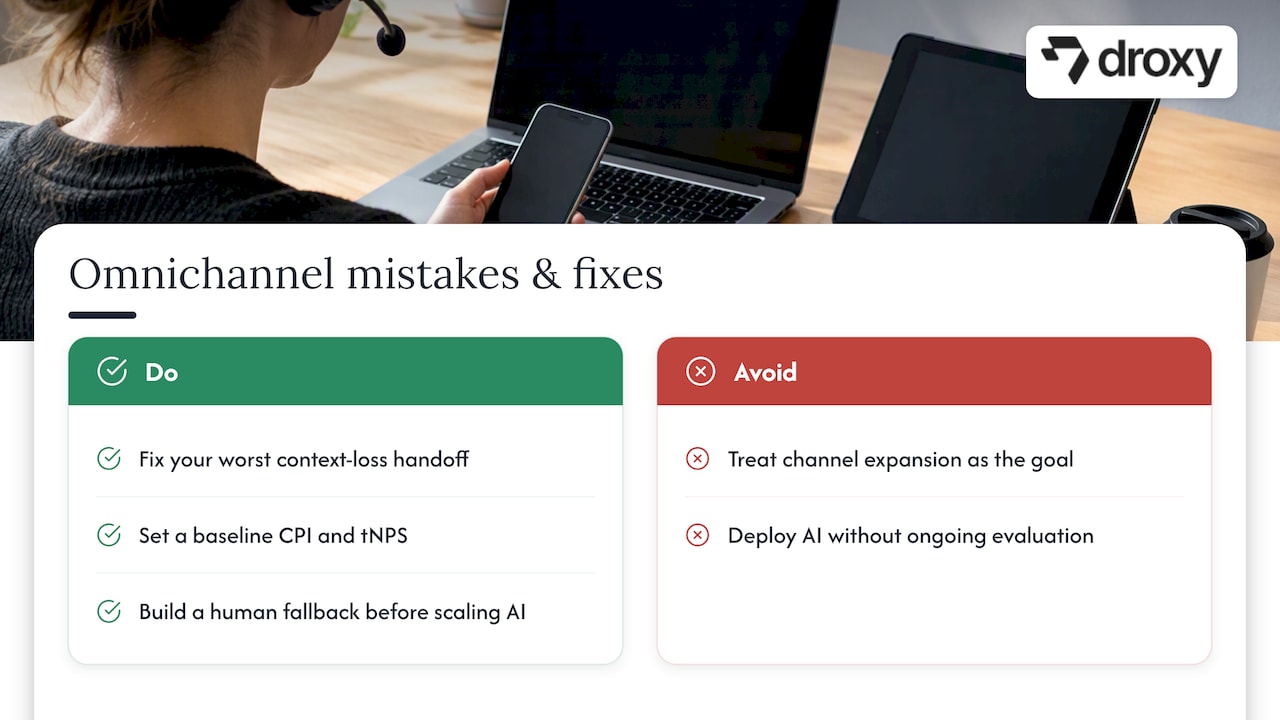
The second mistake is deploying AI agents without an evaluation loop, then being surprised when quality drifts in production. Evaluation isn’t a one-time gate before launch, it’s an ongoing practice that should run alongside every routine update.
If you only act on three things this quarter: fix your worst context-loss handoff, set a baseline CPI and tNPS before changing anything, and build a human fallback rule before you scale any AI agent past a pilot. Everything else in an omnichannel strategy builds on those three decisions.
— Elena
How Droxy Supports an Omnichannel Support Strategy
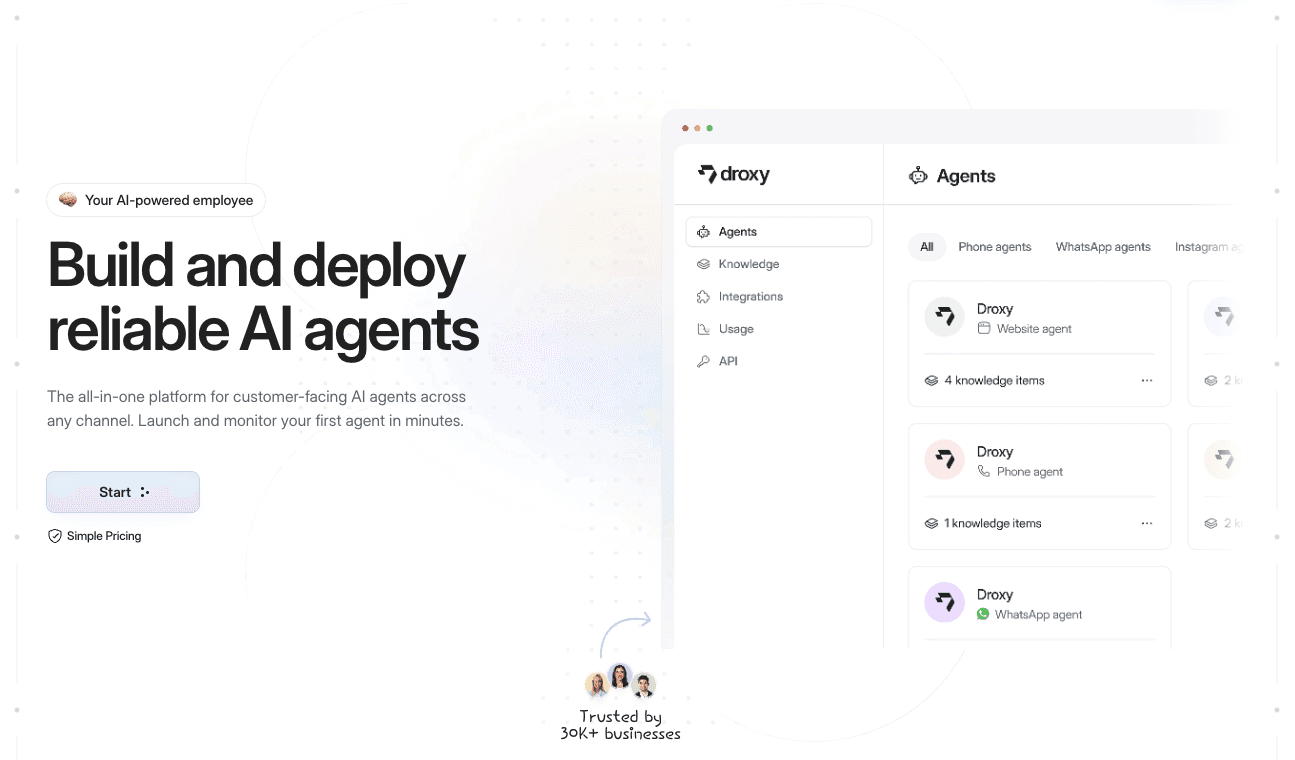
We built a no-code platform for deploying AI agents across multiple communication channels, so the context-preservation and channel-integration work described above doesn’t require a custom engineering team. Our agents carry conversation history across channels, hand off to a human when confidence drops, and connect into the systems you already run.
Plans start at our Basic tier, with Advanced and Enterprise options as your channel footprint grows. If you’re ready to pilot one channel against the framework above, check our pricing and see which plan fits your rollout.
FAQ
What are the four C’s of omnichannel support?
The four C’s are consistency, convenience, context, and channel integration: delivering the same quality of answer everywhere, meeting customers on their preferred channel, preserving conversation history across handoffs, and making sure your systems actually share data. Together they form the operational backbone behind most effective omnichannel strategies.
What is an omni channel support strategy?
An omni channel support strategy is a coordinated approach to customer service that unifies every contact channel, chat, phone, email, and social, around a single customer record so that context carries over regardless of where a conversation starts or ends. It differs from a multichannel approach, where channels exist independently without shared data or consistent policies.
What are the four pillars of an omnichannel strategy?
The four pillars most commonly cited are the same as the four C’s: consistency, convenience, context, and channel integration. Some frameworks also describe speed, personalization, data unification, and governance as supporting pillars that sit underneath those four.
What is an omnichannel support system?
An omnichannel support system is the combined technology stack, a unified inbox, routing engine, CDP or CRM, knowledge base, and analytics, that lets agents and AI tools see full customer context regardless of channel. Platforms like Droxy’s AI agents are one way to deploy this across website, phone, and messaging channels without building custom infrastructure.
How do I measure whether my omnichannel strategy is working?
Track Cost Per Interaction (CPI), transactional NPS (tNPS), Self-Service Rate (SSR), Customer Effort Score (CES), and deflection rate together rather than in isolation, since no single metric captures both cost and satisfaction. Deloitte’s research recommends CPI specifically as the metric that best reflects the real savings from effective channel orchestration.
Sources
Contact centers find balance in a transformed world (Deloitte Digital)
Building Customer Support AI Agents at 100M-User Scale: An Evaluation-Driven Framework (ACM)
Recommended
A strong omni channel support strategy eliminates the context loss that happens when customers bounce between email, chat, and phone, and it measurably lowers your Cost Per Interaction (CPI) while improving satisfaction scores like transactional NPS (tNPS). To get there, you need to preserve customer context across every handoff, build right-channel routing rules, and put governance around any automation you deploy. Start with those three priorities, and the rest of your strategy falls into place.
TL;DR:
Pilot the journey with the highest repeat contact rate, not the busiest one, because context loss can cost more per customer there.
Baseline CPI, tNPS, SSR, and CES, then run a pilot lasting four to eight weeks across one or two channels, with success gates before expanding.
Prioritize voice for high stakes interactions, while web chat and messaging suit routine queries; add social support when public brand visibility justifies it.
Set confidence thresholds and issue rules for human handoffs, then test AI offline, verify scoring agreement, and run production trials before deployment.
Transfers without context lower CES by 0.5 to 0.8 points on a scale of seven, while surfacing history can recover up to 1.1 points.
DroxyKeep Support Connected Across ChannelsDroxy deploys customizable AI agents across chat, phone, messaging, and social channels to answer customer inquiries around the clock.Explore Droxy
Table of Contents
The Four C’s of Omnichannel Support and What They Deliver
How to Build and Run an Omnichannel Support Strategy
Which Channels and Technology You Need to Unify
How to Govern and Test AI Agents in Production
A Phased Rollout Roadmap for Omnichannel Support
What Leaders Consistently Get Wrong About Omnichannel
How Droxy Supports an Omnichannel Support Strategy
Sources
The Four C’s of Omnichannel Support and What They Deliver
Most omnichannel frameworks boil down to four principles, often called the “4 C’s”: consistency, convenience, context, and channel integration. Each one translates into a specific operational change, and together they’re the difference between a support operation that scales and one that buckles under its own complexity.
Consistency means a customer gets the same answer and the same tone whether they’re on live chat or the phone. Convenience means you meet customers where they already are instead of forcing a channel switch. Context means every agent, human or AI, can see the full history of an interaction the moment it starts. Channel integration means your systems actually talk to each other instead of operating as disconnected silos.
These aren’t abstract ideals. Cross-channel orchestration research shows that unifying data and aligning service policies across channels reduces repeat contacts and service costs while improving retention and customer lifetime value. The same research found that operational continuity, meaning the simple act of surfacing prior context to the next handler, delivers larger Customer Effort Score (CES) improvements than adding new channels ever does.
Contact centers that have adopted omnichannel integration can see significant business value, including a notable reduction in cost per assisted contact. Deloitte Digital’s 2024 report recommends that contact centers shift away from volume metrics like calls handled and toward Cost Per Interaction as the core efficiency measure, because CPI captures the real savings from right-channeling work to the cheapest effective channel.
The business case for getting this right includes:
Lower cost per contact: right-channeling and context preservation cut the rework that drives up CPI.
Higher retention: customers who don’t have to repeat themselves stay longer and spend more.
Better CES: consistent context handoffs improve effort scores more than channel expansion does.
Fewer escalations: policy-aligned responses across channels reduce the friction that triggers complaints.
How to Build and Run an Omnichannel Support Strategy
Once the principles are clear, the work becomes operational. Here’s the sequence we recommend for moving from strategy document to live pilot.
Define your outcomes and KPIs first. Before touching a single tool, agree on what you’re measuring: Cost Per Interaction (CPI), transactional NPS (tNPS), Self-Service Rate (SSR), Customer Effort Score (CES), and deflection rate. These five give you a complete picture of cost, satisfaction, and effort.
Map the customer journey and the data it requires. Identify where customers currently switch channels and what information gets lost at each switch point.
Decide which channels to unify first. Most teams start with the two or three channels carrying the highest volume, since that’s where context loss does the most damage.
Write channel policies and right-channeling rules. Define which issue types route to self-service, which go to chat, and which require a live agent or phone call.
Design the agent desktop and routing logic. Agents, human or AI, need one screen showing the full interaction history regardless of originating channel.
Plan staffing and training around the new workflow. Agents need to understand not just their channel but how work flows into it from others.
Set clear human fallback rules. Define the confidence thresholds and issue types that always route to a person.
Run a scoped pilot with success gates. Pick one journey, one or two channels, a defined customer segment, and a fixed duration, then measure against the KPIs from step one before expanding.
Reducing repeat contacts often starts upstream of support entirely. If a product issue is generating a steady stream of tickets, fixing the product reduces ticket volume more durably than any amount of channel optimization downstream.
Pro Tip: Run your pilot on the journey with the highest repeat-contact rate, not the highest total volume. That’s where context loss is costing you the most per customer.
Which Channels and Technology You Need to Unify
Not every channel deserves equal investment on day one. Voice still carries the highest-stakes, highest-emotion interactions, which makes it a priority for context continuity even though it’s technically harder to integrate than text channels. Web chat and messaging apps like WhatsApp handle the highest volume of routine queries and are usually the cheapest place to deflect work through self-service. Social channels like Instagram and Facebook matter most for brands with a strong public-facing presence, where a slow reply is visible to more than just the customer who sent it.
The technology stack that supports this sits on a few core components:
A unified inbox that pulls every channel into one agent-facing view.
Omnichannel routing that applies your right-channeling rules automatically.
A CDP or CRM that holds the single customer record every channel reads from and writes to.
A knowledge base that both human agents and AI agents query for consistent answers.
Analytics that track CPI, tNPS, SSR, CES, and deflection in one place.
Conversational AI agents that handle first-line responses and escalate when needed.
The hardest part of integration is usually session stitching: making sure a conversation that starts on chat and moves to phone retains its full working memory rather than starting over. This requires your systems to invoke the same underlying data and tools regardless of channel, which is a different architecture problem than simply adding another channel to a dashboard. For teams weighing a bot-first approach against a live-chat-first one, the trade-offs are worth mapping out before you commit to an architecture choice. Voice adds its own constraint: conversational AI agents handling phone calls need low enough latency that the conversation feels natural, which is a harder engineering bar than text-based channels face.
How to Govern and Test AI Agents in Production
Deploying AI across your channels without an evaluation framework is how good intentions turn into inconsistent, untrustworthy answers at scale. The teams getting this right follow an evaluation-driven pipeline: offline simulation of conversations before anything goes live, calibrated LLM-as-judge scoring to catch quality drift, measurement of inter-rater agreement to confirm the judge is reliable, and only then a production A/B test against the existing process.
An evaluation-driven framework applied across five production use cases produced significant improvements in transactional NPS and self-service rate, with offline evaluation results closely tracking online outcomes. That ACM research also found that converting standard operating procedures into ordered, versioned routines, such as greet, retrieve data, run diagnostics, offer resolution, lets teams iterate on one step without destabilizing the rest of the agent’s behavior.
Human-in-loop thresholds matter as much as the automation itself. Define the confidence score below which an AI agent hands off automatically, and design that handoff so the human agent inherits full context instead of starting cold. Every additional handoff without context costs you measurable effort: practitioner data on Customer Effort Score shows each transfer event between agents or channels drops CES by roughly 0.5 to 0.8 points on a 7-point scale, while surfacing prior context to the next handler can recover up to 1.1 points. Fast, context-aware handoffs are worth engineering around directly, down to the time it takes to get a customer to a human.
Governance on top of evaluation means policy-aware decision engines that encode your return policies, refund thresholds, and escalation criteria so autonomous agents can’t operate outside brand or regulatory limits, paired with audit logs and explainability checkpoints for every automated decision. A governance-constrained framework for agentic AI makes the same point from an operations lens: efficiency gains from automation only hold up when they’re paired with real-time observability and compliance monitoring.
Pro Tip: Correlate your offline evaluation scores with live CPI and tNPS weekly during rollout. A gap between the two is your earliest signal that production conditions differ from your test set.
A Phased Rollout Roadmap for Omnichannel Support
Moving from plan to production works best in four phases, each with its own gate before you proceed.
Discovery (weeks 1 to 3): build journey maps, audit your current tech stack for integration gaps, and set baseline KPIs for CPI, tNPS, SSR, and CES so you have something to measure against later.
Pilot design (weeks 3 to 5): scope one or two channels, one customer segment, and a fixed duration, usually four to eight weeks, with explicit success gates tied to your baseline numbers.
Pilot execution and iteration (weeks 5 to 12): run the pilot, review results on a weekly cadence, and adjust routing rules or agent routines based on what the data shows rather than waiting for the full pilot window to close.
Scale (after validated KPIs): expand to additional channels and segments only once the pilot has cleared its success gates, and build out the organizational supports, a governance board, ongoing QA, agent training, and named cross-functional owners, that keep quality consistent as volume grows.
Executive sponsors should expect to see directional KPI movement by the end of the pilot phase, with fuller confidence arriving once a full reporting cycle has passed under the new workflow. Tracking concrete deployment examples alongside your own pilot data gives your governance board a useful benchmark for what reasonable progress looks like at each gate.
What Leaders Consistently Get Wrong About Omnichannel
The biggest mistake we see is treating channel expansion as the goal instead of context preservation. Adding WhatsApp or Instagram support feels like progress, but if a customer still has to re-explain their issue after switching channels, you’ve added cost without fixing the problem that actually drives dissatisfaction. The data backs this up again and again: continuity moves the effort needle more than coverage does.
The second mistake is deploying AI agents without an evaluation loop, then being surprised when quality drifts in production. Evaluation isn’t a one-time gate before launch, it’s an ongoing practice that should run alongside every routine update.
If you only act on three things this quarter: fix your worst context-loss handoff, set a baseline CPI and tNPS before changing anything, and build a human fallback rule before you scale any AI agent past a pilot. Everything else in an omnichannel strategy builds on those three decisions.
— Elena
How Droxy Supports an Omnichannel Support Strategy
We built a no-code platform for deploying AI agents across multiple communication channels, so the context-preservation and channel-integration work described above doesn’t require a custom engineering team. Our agents carry conversation history across channels, hand off to a human when confidence drops, and connect into the systems you already run.
Plans start at our Basic tier, with Advanced and Enterprise options as your channel footprint grows. If you’re ready to pilot one channel against the framework above, check our pricing and see which plan fits your rollout.
FAQ
What are the four C’s of omnichannel support?
The four C’s are consistency, convenience, context, and channel integration: delivering the same quality of answer everywhere, meeting customers on their preferred channel, preserving conversation history across handoffs, and making sure your systems actually share data. Together they form the operational backbone behind most effective omnichannel strategies.
What is an omni channel support strategy?
An omni channel support strategy is a coordinated approach to customer service that unifies every contact channel, chat, phone, email, and social, around a single customer record so that context carries over regardless of where a conversation starts or ends. It differs from a multichannel approach, where channels exist independently without shared data or consistent policies.
What are the four pillars of an omnichannel strategy?
The four pillars most commonly cited are the same as the four C’s: consistency, convenience, context, and channel integration. Some frameworks also describe speed, personalization, data unification, and governance as supporting pillars that sit underneath those four.
What is an omnichannel support system?
An omnichannel support system is the combined technology stack, a unified inbox, routing engine, CDP or CRM, knowledge base, and analytics, that lets agents and AI tools see full customer context regardless of channel. Platforms like Droxy’s AI agents are one way to deploy this across website, phone, and messaging channels without building custom infrastructure.
How do I measure whether my omnichannel strategy is working?
Track Cost Per Interaction (CPI), transactional NPS (tNPS), Self-Service Rate (SSR), Customer Effort Score (CES), and deflection rate together rather than in isolation, since no single metric captures both cost and satisfaction. Deloitte’s research recommends CPI specifically as the metric that best reflects the real savings from effective channel orchestration.
Sources
Contact centers find balance in a transformed world (Deloitte Digital)
Building Customer Support AI Agents at 100M-User Scale: An Evaluation-Driven Framework (ACM)
Recommended


🚀
Powered by Droxy
Turn every interaction into a conversion
Customer facing AI agents that engage, convert, and support so you can scale what matters.
✨
Learn more
Recent posts
Insights
3 min read
Introducing Agent Memories
Improve your agents' performance with Agent Memories. Prevent agents from repeating the same mistakes by giving them feedback.
Read more

Insights
15 min read
HVAC Marketing in 2025: The Definitive Lead Gen Guide
Discover 15 proven HVAC marketing strategies, plus learn how Droxy's AI website agent converts curious visitors into qualified leads by answering their questions instantly - right when they're most interested in your services.
Read more
Insights
10 min read
10 Best AI Sales Agents in 2025: Tested & Ranked
Discover the top 10 AI sales agents of 2025, designed to enhance lead generation, personalize outreach, and ultimately, close more deals
Read more
Insights
3 min read
Introducing Agent Memories
Improve your agents' performance with Agent Memories. Prevent agents from repeating the same mistakes by giving them feedback.
Read more
Insights
15 min read
HVAC Marketing in 2025: The Definitive Lead Gen Guide
Discover 15 proven HVAC marketing strategies, plus learn how Droxy's AI website agent converts curious visitors into qualified leads by answering their questions instantly - right when they're most interested in your services.
Read more