AI Chatbot Ethics: A Practical Guide for Businesses
AI Chatbot Ethics: A Practical Guide for Businesses
Insights
17 min

AI chatbot ethics comes down to five commitments: tell people they are talking to AI, protect the data they share, test for bias, keep answers accurate, and give every customer an easy path to a human. If your chatbot does those five things and someone on your team owns the result, you are ahead of most deployments. This guide shows you how to do each one, with examples from customer support, bookings and healthcare.
Droxydroxy.aiMake Customer Support More ResponsiveDroxy helps businesses answer customer inquiries instantly across chat, phone, messaging apps, and Shopify, with interactions tailored to their brand voice.Explore Droxy
TL;DR
Say clearly that customers are chatting with AI, and never let a bot pretend to be a person.
Collect only the data you need, tell people how it is used, and warn users not to type sensitive details into the chat.
Bias, wrong answers and harm are management problems as much as technical ones: test, monitor and name an owner.
Build a human hand-off into every flow, and make it mandatory for health, money, legal and distress situations.
Ethical design is also good business: it builds trust, reduces complaints and protects your brand.
Table of Contents
What AI chatbot ethics actually covers
Be honest that it is AI
Protect what customers tell the bot
Test for bias and treat customers fairly
Keep answers accurate and know when to stop
Mental health and sensitive conversations
Who is accountable when something goes wrong
Our perspective
Putting it into practice with Droxy
A one-page ethics checklist
Sources
What AI chatbot ethics actually covers
The phrase sounds abstract, but for a business it is a list of practical risks. Academic reviewers of ChatGPT-style tools group the concerns under themes such as social justice, autonomy, responsibility, safety, bias and accountability. Because these systems produce human-like text at scale, researchers also flag authorship, plagiarism and the spread of misinformation as real risks.
Some of those themes, such as environmental impact or intellectual property, are society-level debates. When you deploy a chatbot for customers, six matter most day to day:
Transparency: do customers know it is AI?
Privacy: what happens to what they type?
Fairness: does it treat every customer equally?
Accuracy: can it mislead someone into a bad decision?
Human oversight: can a person step in?
Accountability: who answers when something goes wrong?
The rest of this guide works through them in that order.
Be honest that it is AI
The simplest ethical rule is also the one customers notice first. If a person believes they are talking to a human and later finds out otherwise, trust drops, and it usually drops on the very interaction you wanted to go well.
The WHO’s guidance on AI for health lists transparency, explainability and intelligibility among its core ethical principles. That guidance is written for health, but the principle carries over to any customer-facing bot.
In practice, disclosure looks like this:
A clear label at the start. “Hi, I’m the virtual assistant for Maple Dental. I’m an AI, and I can connect you to our team anytime.”
No invented human identity. A friendly name and a brand-matched tone are fine. A fake photo, a made-up job title or claims like “I’m in the office today” are not.
Disclosure on every channel. A phone agent should say it is automated at the start of the call. A WhatsApp or Instagram agent should say so in its first message, because customers often arrive mid-thread without seeing a website banner.
Honest limits. Tell users what the bot can do (answer questions, book appointments, capture a request) and what it cannot.
Disclosure laws are developing quickly and differ by US state and by country. Have your attorney confirm what applies where your customers live, especially if you serve people in the EU or in several states.
A brand-matched voice and honesty are not in conflict. You can make an agent warm, on-brand and human-sounding in its phrasing while being fully open about what it is. That is how we think about it at Droxy, and more on that below.
Protect what customers tell the bot
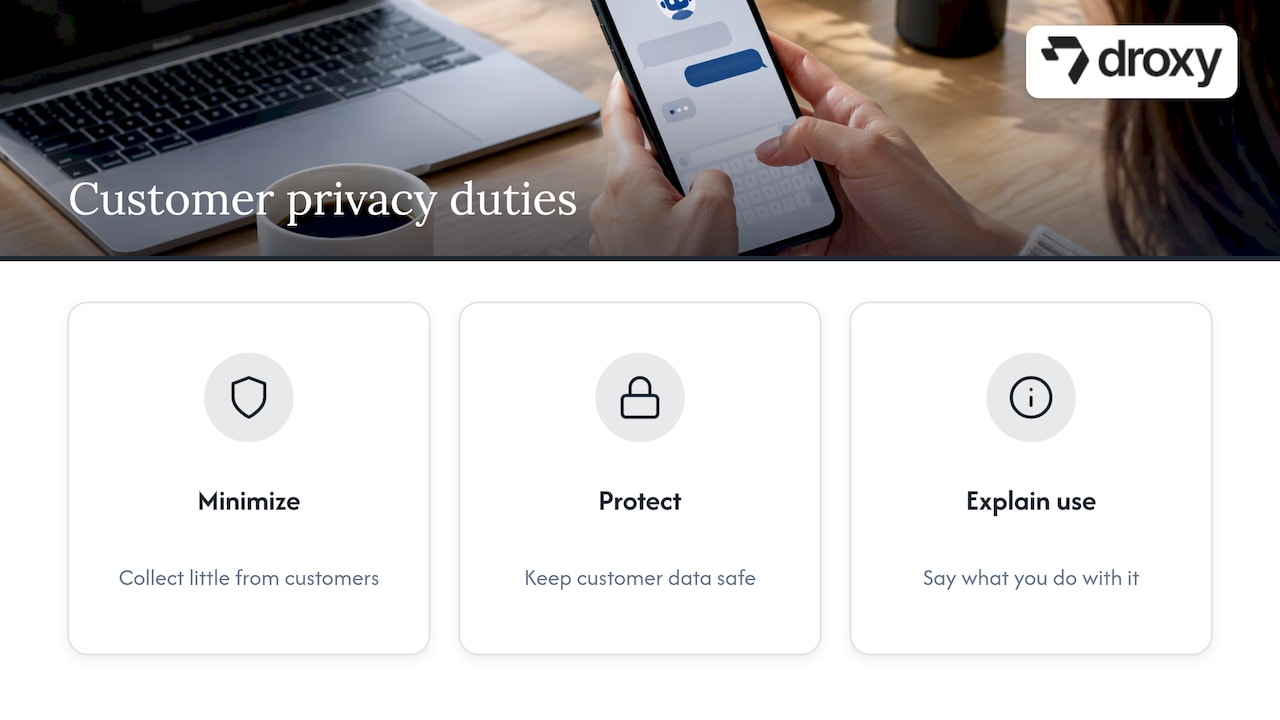
Chat feels private, so people type things they would never put in a web form: health details, account numbers, home addresses, complaints about a neighbor. Your ethical duty is to collect little, keep it safe and say what you do with it.
What customers should not share
A good chatbot protects people from over-sharing. Build your prompts and welcome message so they discourage typing:
Full payment card numbers, bank details or passwords
Government ID numbers, such as a Social Security number
Detailed medical records or diagnoses, unless the channel is specifically set up and approved for that
Other people’s personal information
Confidential business information, if your bot serves business clients
One line near the start works well: “Please don’t share card numbers, passwords or medical details here. I’ll connect you to our team for anything sensitive.”
What your business should do
European data protection authorities have published technical and organizational measures for language models that support data protection by design and by default under GDPR Article 25. Even if you do not serve EU customers, the logic is a useful standard: build privacy in from the first design step instead of adding it later.
A practical privacy baseline:
Minimize. Ask for the name and contact detail you need to follow up, and nothing more.
Disclose. Link your privacy policy inside the chat. Our guide to the clauses a chatbot privacy policy needs covers what to include.
Control training use. Know whether customer conversations are used to train any model, and tell customers if they are. Ask every vendor this in writing.
Secure access. Limit who on your team can read transcripts, and set retention periods. Our piece on AI chatbot security for enterprise teams walks through the controls.
Redact where you can. Mask card numbers and similar patterns before they are stored.
If you want a wider view of how teams apply privacy-first AI practices across design and deployment, that is a good next read.
Test for bias and treat customers fairly
Bias is not a rare edge case. A 2024 study identifies it as the most prevalent ethical concern for large language models, tracing it to biased data, model bias and non-representative data labelers during pre-processing. You cannot fix the underlying model as a small business, but you can control a lot of what your customers experience.
Where bias shows up in customer chat
Language and dialect. A bot that understands formal English but stumbles on slang, accents on a phone call or non-native phrasing gives some customers worse service.
Assumptions. Product recommendations that assume a gender, income or household type.
Uneven escalation. Some customers get routed to a human quickly, others get stuck in a loop.
Lead scoring. Automated qualification that quietly favors certain names, neighborhoods or phrasing.
How to reduce it
Researchers point to diverse, representative training data and attention to bias in models, data and labeling. For a business using a platform instead of training its own model, that translates into a few habits:
Ground answers in your own approved content. A bot that answers from your knowledge base is more predictable than one improvising from general training.
Test with varied personas. Run the same question phrased by different kinds of customers, in different languages and registers, and compare the answers. Our chatbot testing checklist gives you cases to start with.
Review transcripts monthly. Look for patterns, such as the same customer type abandoning chats at the same step.
Write rules, not hopes. In your instructions, state that recommendations must never depend on a customer’s personal characteristics.
Keep a way to flag. Let your team mark a bad answer and fix its source.
Keep answers accurate and know when to stop
A chatbot that confidently states the wrong refund policy, opening hours or dosage instruction is an ethical failure, not just a quality issue. The customer acted in good faith on what you told them.
The WHO says designers of AI in health must meet regulatory requirements for safety, accuracy and efficacy and that AI should not be used where it causes preventable mental or physical harm. You do not need to run a hospital to adopt the spirit of that rule.
Design rules that lower the risk of wrong answers
Answer only from sources you control. Connect your website, documents and help center, and tell the bot to say “I don’t know” when the answer is not there.
Set hard boundaries. Prices, legal terms, medical advice and guarantees should come from approved text, or go to a person.
Cite or confirm. For policy answers, show the source page so the customer can check.
Keep content current. An outdated knowledge base produces confident, wrong replies. Assign someone to update it whenever policies change.
Write careful instructions. Good prompt engineering for chatbots treats instructions like code: versioned, tested and reviewed.
When a human must take over
Human hand-off is the safety net under every other safeguard. Build it in as a standard feature, not an apology. Trigger it when:
Situation | What the bot should do |
|---|---|
Customer asks for a person | Hand off immediately, no argument |
Bot cannot answer after two attempts | Offer a person and pass along the chat summary |
Complaint, billing dispute or cancellation | Route to a trained team member |
Medical, legal or financial advice requested | Decline to advise, share approved information, offer a professional or appointment |
Signs of distress or risk of self-harm | Show crisis resources and alert a person right away |
Anger or repeated frustration | Escalate with context so the customer need not repeat themselves |
Our guide to FAQ chatbot design shows how to make hand-off feel smooth, and conversation design principles cover wording for these moments.
Mental health and sensitive conversations
Can a chatbot support someone who is struggling? For a business, the careful answer is that it can point to help, but it should not act as a counselor. A support bot for a clinic, a hotel or a retailer is not designed or approved to provide therapy, and customers in distress may take its words more seriously than you expect.
Set these limits where the customer will meet them:
Detect words that suggest crisis and respond with a short, kind message that gives local emergency numbers and the 988 Suicide & Crisis Lifeline for US users. Confirm the current contact details on the official site before you publish them.
Alert a staff member immediately where your business can act on the alert, such as a healthcare practice with a monitored inbox.
Never let the bot diagnose, reassure about symptoms or suggest changes to treatment.
Have a licensed clinician or your compliance advisor review the exact wording for any health-related deployment.
For healthcare practices, the right use of AI is administrative: answering questions about hours and insurance, booking appointments, sending reminders and routing urgent matters to staff, all around the clock.
Who is accountable when something goes wrong
A chatbot cannot be held responsible. You can. The customer will blame your brand, not the software vendor, and regulators generally look at the business that deployed the tool.
The academic literature lists responsibility and accountability among the core ethical concerns. Turn that into an operating structure:
Name an owner. One person is responsible for the bot’s content, performance and complaints. In a small company, that may be you.
Define what is in scope. Write down what the bot may and may not do.
Log and review. Keep transcripts for a set period, sample them weekly at launch and monthly afterward.
Track the right numbers. Resolution rate, hand-off rate, customer ratings and flagged answers show where the bot fails. Our overview of AI chatbot benchmarks for buyers helps you choose useful measures.
Have an incident plan. If the bot gives harmful or wrong information, know who pauses it, who contacts affected customers and how you fix the source.
Review vendors. Ask where data is stored, who can access it, how the platform handles safeguards and what controls you have over the agent’s behavior.
Our perspective
We see the same pattern with businesses that adopt AI agents. The ones that treat ethics as a launch checklist get little from it. The ones that treat it as part of how they serve customers get more: fewer escalated complaints, better reviews and customers who return to the chat because it was straight with them.
At Droxy, our approach rests on a few beliefs. An agent can sound human and still be open about being AI. Customization should make an agent more helpful and on brand, never more deceptive. A hand-off to a person should always be available, because the best automated service knows its limits. And your business, not the software, remains accountable, so you need tools to see what your agents say: analytics, transcripts and control over what knowledge they draw on.
If you are an agency building agents for clients, the same applies twice. Your clients trust you to set the guardrails they will not think to ask for. Make disclosure, privacy wording and escalation rules part of every setup, not an optional extra.
— Elena
Putting it into practice with Droxy
Ethics only works when it is easy to do. Droxy lets you build AI agents without code for website chat, phone, WhatsApp, Instagram, Facebook and Shopify. You can set the agent’s voice, connect your own knowledge sources, route conversations and hand off to your team when a person is needed. Analytics show you what customers actually ask and where the agent needs work.
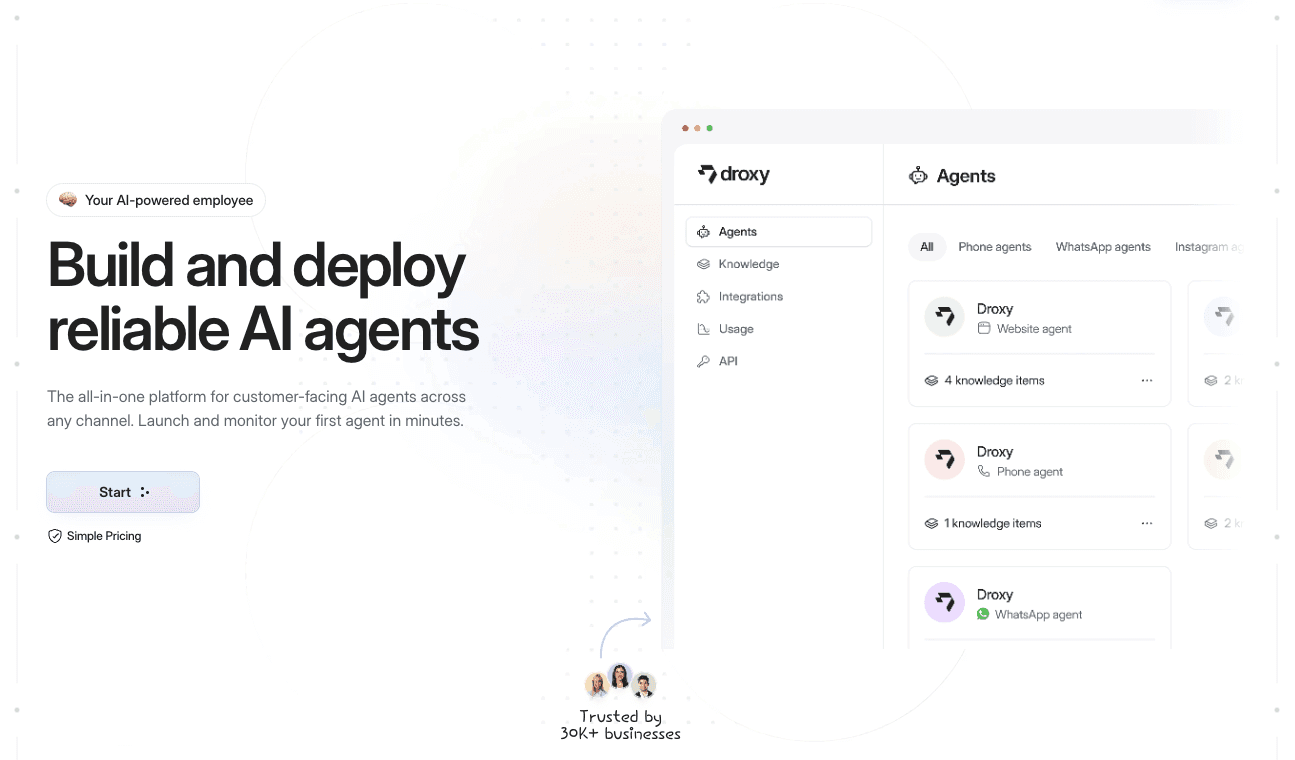
Plans start at $16 per month for Basic, $80 for Advanced and $240 for Enterprise, and you can see how each channel works on the website agent and phone agent pages. If you are weighing a fully scripted bot against a more capable agent, our explainer on AI agents versus chatbots shows what changes for oversight.
A one-page ethics checklist
Before you launch or review a chatbot, confirm each item:
[ ] The first message says it is AI and what it can do
[ ] Customers are told not to share passwords, card numbers or medical details
[ ] A privacy policy link is available in the chat
[ ] You know whether conversations are used for model training
[ ] Answers draw on approved, current content, and “I don’t know” is allowed
[ ] You tested varied customer types, languages and phrasing
[ ] A human hand-off exists on every channel and works outside business hours with a clear promise of follow-up
[ ] Crisis and sensitive topics have written protocols reviewed by a qualified professional
[ ] One named person owns the bot and reviews transcripts on a schedule
[ ] You have an incident plan
FAQ
What are the main ethical issues with AI chatbots?
The most common are bias, privacy, accuracy, transparency and accountability. Researchers also point to safety, misinformation and authorship concerns. For a business, the practical risks are customers being misled, data being mishandled and nobody being responsible for errors.
What shouldn’t you share with an AI chatbot?
Avoid passwords, full card or bank numbers, government ID numbers, detailed medical records and other people’s private information. Confidential company material also does not belong in a public chatbot. Businesses should say this inside the chat and check how a vendor stores and uses conversations.
Do I have to tell customers they are talking to AI?
It is the right practice everywhere, and some US states and other countries require it in certain situations. Rules differ by location and industry, so ask your attorney what applies to your customers. A clear first-message label is simple and protects trust either way.
Can AI chatbots support mental health?
Not as a replacement for professional care. A business chatbot should recognize distress, share crisis resources and bring in a person. It should not diagnose, reassure about symptoms or give treatment advice.
Who is responsible if a chatbot gives harmful advice?
The business that deployed it is the one customers and regulators will look to. Name an internal owner, review conversations regularly and keep a plan for pausing the bot and correcting mistakes.
Sources
The ethics of ChatGPT: exploring the ethical issues of an emerging technology
Large Language Models: AI privacy risks and mitigations, EDPB
Ethics and governance of artificial intelligence for health, WHO
Recommended
AI chatbot ethics comes down to five commitments: tell people they are talking to AI, protect the data they share, test for bias, keep answers accurate, and give every customer an easy path to a human. If your chatbot does those five things and someone on your team owns the result, you are ahead of most deployments. This guide shows you how to do each one, with examples from customer support, bookings and healthcare.
Droxydroxy.aiMake Customer Support More ResponsiveDroxy helps businesses answer customer inquiries instantly across chat, phone, messaging apps, and Shopify, with interactions tailored to their brand voice.Explore Droxy
TL;DR
Say clearly that customers are chatting with AI, and never let a bot pretend to be a person.
Collect only the data you need, tell people how it is used, and warn users not to type sensitive details into the chat.
Bias, wrong answers and harm are management problems as much as technical ones: test, monitor and name an owner.
Build a human hand-off into every flow, and make it mandatory for health, money, legal and distress situations.
Ethical design is also good business: it builds trust, reduces complaints and protects your brand.
Table of Contents
What AI chatbot ethics actually covers
Be honest that it is AI
Protect what customers tell the bot
Test for bias and treat customers fairly
Keep answers accurate and know when to stop
Mental health and sensitive conversations
Who is accountable when something goes wrong
Our perspective
Putting it into practice with Droxy
A one-page ethics checklist
Sources
What AI chatbot ethics actually covers
The phrase sounds abstract, but for a business it is a list of practical risks. Academic reviewers of ChatGPT-style tools group the concerns under themes such as social justice, autonomy, responsibility, safety, bias and accountability. Because these systems produce human-like text at scale, researchers also flag authorship, plagiarism and the spread of misinformation as real risks.
Some of those themes, such as environmental impact or intellectual property, are society-level debates. When you deploy a chatbot for customers, six matter most day to day:
Transparency: do customers know it is AI?
Privacy: what happens to what they type?
Fairness: does it treat every customer equally?
Accuracy: can it mislead someone into a bad decision?
Human oversight: can a person step in?
Accountability: who answers when something goes wrong?
The rest of this guide works through them in that order.
Be honest that it is AI
The simplest ethical rule is also the one customers notice first. If a person believes they are talking to a human and later finds out otherwise, trust drops, and it usually drops on the very interaction you wanted to go well.
The WHO’s guidance on AI for health lists transparency, explainability and intelligibility among its core ethical principles. That guidance is written for health, but the principle carries over to any customer-facing bot.
In practice, disclosure looks like this:
A clear label at the start. “Hi, I’m the virtual assistant for Maple Dental. I’m an AI, and I can connect you to our team anytime.”
No invented human identity. A friendly name and a brand-matched tone are fine. A fake photo, a made-up job title or claims like “I’m in the office today” are not.
Disclosure on every channel. A phone agent should say it is automated at the start of the call. A WhatsApp or Instagram agent should say so in its first message, because customers often arrive mid-thread without seeing a website banner.
Honest limits. Tell users what the bot can do (answer questions, book appointments, capture a request) and what it cannot.
Disclosure laws are developing quickly and differ by US state and by country. Have your attorney confirm what applies where your customers live, especially if you serve people in the EU or in several states.
A brand-matched voice and honesty are not in conflict. You can make an agent warm, on-brand and human-sounding in its phrasing while being fully open about what it is. That is how we think about it at Droxy, and more on that below.
Protect what customers tell the bot
Chat feels private, so people type things they would never put in a web form: health details, account numbers, home addresses, complaints about a neighbor. Your ethical duty is to collect little, keep it safe and say what you do with it.
What customers should not share
A good chatbot protects people from over-sharing. Build your prompts and welcome message so they discourage typing:
Full payment card numbers, bank details or passwords
Government ID numbers, such as a Social Security number
Detailed medical records or diagnoses, unless the channel is specifically set up and approved for that
Other people’s personal information
Confidential business information, if your bot serves business clients
One line near the start works well: “Please don’t share card numbers, passwords or medical details here. I’ll connect you to our team for anything sensitive.”
What your business should do
European data protection authorities have published technical and organizational measures for language models that support data protection by design and by default under GDPR Article 25. Even if you do not serve EU customers, the logic is a useful standard: build privacy in from the first design step instead of adding it later.
A practical privacy baseline:
Minimize. Ask for the name and contact detail you need to follow up, and nothing more.
Disclose. Link your privacy policy inside the chat. Our guide to the clauses a chatbot privacy policy needs covers what to include.
Control training use. Know whether customer conversations are used to train any model, and tell customers if they are. Ask every vendor this in writing.
Secure access. Limit who on your team can read transcripts, and set retention periods. Our piece on AI chatbot security for enterprise teams walks through the controls.
Redact where you can. Mask card numbers and similar patterns before they are stored.
If you want a wider view of how teams apply privacy-first AI practices across design and deployment, that is a good next read.
Test for bias and treat customers fairly
Bias is not a rare edge case. A 2024 study identifies it as the most prevalent ethical concern for large language models, tracing it to biased data, model bias and non-representative data labelers during pre-processing. You cannot fix the underlying model as a small business, but you can control a lot of what your customers experience.
Where bias shows up in customer chat
Language and dialect. A bot that understands formal English but stumbles on slang, accents on a phone call or non-native phrasing gives some customers worse service.
Assumptions. Product recommendations that assume a gender, income or household type.
Uneven escalation. Some customers get routed to a human quickly, others get stuck in a loop.
Lead scoring. Automated qualification that quietly favors certain names, neighborhoods or phrasing.
How to reduce it
Researchers point to diverse, representative training data and attention to bias in models, data and labeling. For a business using a platform instead of training its own model, that translates into a few habits:
Ground answers in your own approved content. A bot that answers from your knowledge base is more predictable than one improvising from general training.
Test with varied personas. Run the same question phrased by different kinds of customers, in different languages and registers, and compare the answers. Our chatbot testing checklist gives you cases to start with.
Review transcripts monthly. Look for patterns, such as the same customer type abandoning chats at the same step.
Write rules, not hopes. In your instructions, state that recommendations must never depend on a customer’s personal characteristics.
Keep a way to flag. Let your team mark a bad answer and fix its source.
Keep answers accurate and know when to stop
A chatbot that confidently states the wrong refund policy, opening hours or dosage instruction is an ethical failure, not just a quality issue. The customer acted in good faith on what you told them.
The WHO says designers of AI in health must meet regulatory requirements for safety, accuracy and efficacy and that AI should not be used where it causes preventable mental or physical harm. You do not need to run a hospital to adopt the spirit of that rule.
Design rules that lower the risk of wrong answers
Answer only from sources you control. Connect your website, documents and help center, and tell the bot to say “I don’t know” when the answer is not there.
Set hard boundaries. Prices, legal terms, medical advice and guarantees should come from approved text, or go to a person.
Cite or confirm. For policy answers, show the source page so the customer can check.
Keep content current. An outdated knowledge base produces confident, wrong replies. Assign someone to update it whenever policies change.
Write careful instructions. Good prompt engineering for chatbots treats instructions like code: versioned, tested and reviewed.
When a human must take over
Human hand-off is the safety net under every other safeguard. Build it in as a standard feature, not an apology. Trigger it when:
Situation | What the bot should do |
|---|---|
Customer asks for a person | Hand off immediately, no argument |
Bot cannot answer after two attempts | Offer a person and pass along the chat summary |
Complaint, billing dispute or cancellation | Route to a trained team member |
Medical, legal or financial advice requested | Decline to advise, share approved information, offer a professional or appointment |
Signs of distress or risk of self-harm | Show crisis resources and alert a person right away |
Anger or repeated frustration | Escalate with context so the customer need not repeat themselves |
Our guide to FAQ chatbot design shows how to make hand-off feel smooth, and conversation design principles cover wording for these moments.
Mental health and sensitive conversations
Can a chatbot support someone who is struggling? For a business, the careful answer is that it can point to help, but it should not act as a counselor. A support bot for a clinic, a hotel or a retailer is not designed or approved to provide therapy, and customers in distress may take its words more seriously than you expect.
Set these limits where the customer will meet them:
Detect words that suggest crisis and respond with a short, kind message that gives local emergency numbers and the 988 Suicide & Crisis Lifeline for US users. Confirm the current contact details on the official site before you publish them.
Alert a staff member immediately where your business can act on the alert, such as a healthcare practice with a monitored inbox.
Never let the bot diagnose, reassure about symptoms or suggest changes to treatment.
Have a licensed clinician or your compliance advisor review the exact wording for any health-related deployment.
For healthcare practices, the right use of AI is administrative: answering questions about hours and insurance, booking appointments, sending reminders and routing urgent matters to staff, all around the clock.
Who is accountable when something goes wrong
A chatbot cannot be held responsible. You can. The customer will blame your brand, not the software vendor, and regulators generally look at the business that deployed the tool.
The academic literature lists responsibility and accountability among the core ethical concerns. Turn that into an operating structure:
Name an owner. One person is responsible for the bot’s content, performance and complaints. In a small company, that may be you.
Define what is in scope. Write down what the bot may and may not do.
Log and review. Keep transcripts for a set period, sample them weekly at launch and monthly afterward.
Track the right numbers. Resolution rate, hand-off rate, customer ratings and flagged answers show where the bot fails. Our overview of AI chatbot benchmarks for buyers helps you choose useful measures.
Have an incident plan. If the bot gives harmful or wrong information, know who pauses it, who contacts affected customers and how you fix the source.
Review vendors. Ask where data is stored, who can access it, how the platform handles safeguards and what controls you have over the agent’s behavior.
Our perspective
We see the same pattern with businesses that adopt AI agents. The ones that treat ethics as a launch checklist get little from it. The ones that treat it as part of how they serve customers get more: fewer escalated complaints, better reviews and customers who return to the chat because it was straight with them.
At Droxy, our approach rests on a few beliefs. An agent can sound human and still be open about being AI. Customization should make an agent more helpful and on brand, never more deceptive. A hand-off to a person should always be available, because the best automated service knows its limits. And your business, not the software, remains accountable, so you need tools to see what your agents say: analytics, transcripts and control over what knowledge they draw on.
If you are an agency building agents for clients, the same applies twice. Your clients trust you to set the guardrails they will not think to ask for. Make disclosure, privacy wording and escalation rules part of every setup, not an optional extra.
— Elena
Putting it into practice with Droxy
Ethics only works when it is easy to do. Droxy lets you build AI agents without code for website chat, phone, WhatsApp, Instagram, Facebook and Shopify. You can set the agent’s voice, connect your own knowledge sources, route conversations and hand off to your team when a person is needed. Analytics show you what customers actually ask and where the agent needs work.
Plans start at $16 per month for Basic, $80 for Advanced and $240 for Enterprise, and you can see how each channel works on the website agent and phone agent pages. If you are weighing a fully scripted bot against a more capable agent, our explainer on AI agents versus chatbots shows what changes for oversight.
A one-page ethics checklist
Before you launch or review a chatbot, confirm each item:
[ ] The first message says it is AI and what it can do
[ ] Customers are told not to share passwords, card numbers or medical details
[ ] A privacy policy link is available in the chat
[ ] You know whether conversations are used for model training
[ ] Answers draw on approved, current content, and “I don’t know” is allowed
[ ] You tested varied customer types, languages and phrasing
[ ] A human hand-off exists on every channel and works outside business hours with a clear promise of follow-up
[ ] Crisis and sensitive topics have written protocols reviewed by a qualified professional
[ ] One named person owns the bot and reviews transcripts on a schedule
[ ] You have an incident plan
FAQ
What are the main ethical issues with AI chatbots?
The most common are bias, privacy, accuracy, transparency and accountability. Researchers also point to safety, misinformation and authorship concerns. For a business, the practical risks are customers being misled, data being mishandled and nobody being responsible for errors.
What shouldn’t you share with an AI chatbot?
Avoid passwords, full card or bank numbers, government ID numbers, detailed medical records and other people’s private information. Confidential company material also does not belong in a public chatbot. Businesses should say this inside the chat and check how a vendor stores and uses conversations.
Do I have to tell customers they are talking to AI?
It is the right practice everywhere, and some US states and other countries require it in certain situations. Rules differ by location and industry, so ask your attorney what applies to your customers. A clear first-message label is simple and protects trust either way.
Can AI chatbots support mental health?
Not as a replacement for professional care. A business chatbot should recognize distress, share crisis resources and bring in a person. It should not diagnose, reassure about symptoms or give treatment advice.
Who is responsible if a chatbot gives harmful advice?
The business that deployed it is the one customers and regulators will look to. Name an internal owner, review conversations regularly and keep a plan for pausing the bot and correcting mistakes.
Sources
The ethics of ChatGPT: exploring the ethical issues of an emerging technology
Large Language Models: AI privacy risks and mitigations, EDPB
Ethics and governance of artificial intelligence for health, WHO
Recommended


🚀
Powered by Droxy
Turn every interaction into a conversion
Customer facing AI agents that engage, convert, and support so you can scale what matters.
✨
Learn more
Recent posts
Insights
3 min read
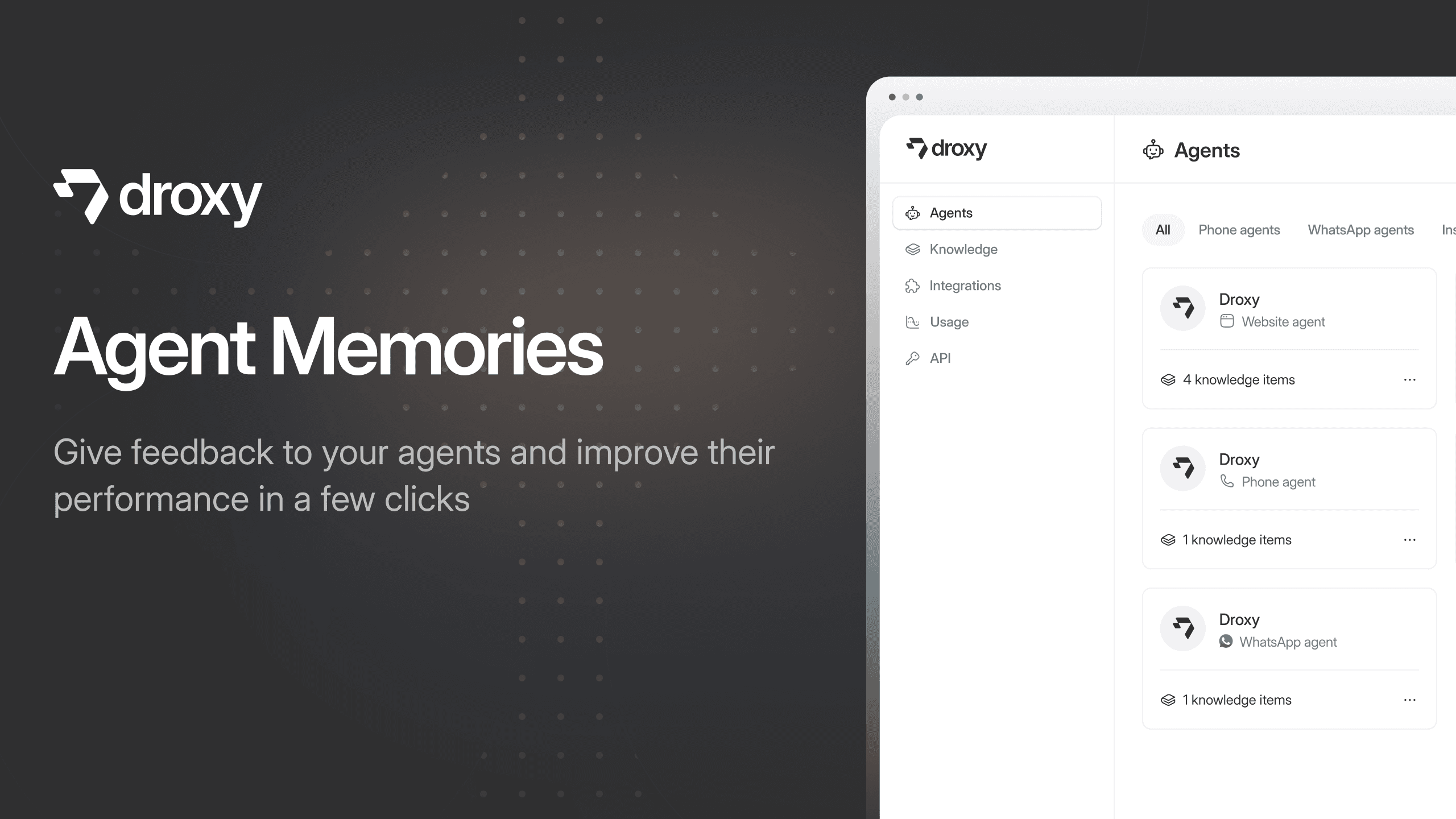
Introducing Agent Memories
Improve your agents' performance with Agent Memories. Prevent agents from repeating the same mistakes by giving them feedback.
Read more

Insights
15 min read
HVAC Marketing in 2025: The Definitive Lead Gen Guide
Discover 15 proven HVAC marketing strategies, plus learn how Droxy's AI website agent converts curious visitors into qualified leads by answering their questions instantly - right when they're most interested in your services.
Read more
Insights
10 min read
10 Best AI Sales Agents in 2025: Tested & Ranked
Discover the top 10 AI sales agents of 2025, designed to enhance lead generation, personalize outreach, and ultimately, close more deals
Read more
Insights
3 min read
Introducing Agent Memories
Improve your agents' performance with Agent Memories. Prevent agents from repeating the same mistakes by giving them feedback.
Read more
Insights
15 min read
HVAC Marketing in 2025: The Definitive Lead Gen Guide
Discover 15 proven HVAC marketing strategies, plus learn how Droxy's AI website agent converts curious visitors into qualified leads by answering their questions instantly - right when they're most interested in your services.
Read more