How to Reduce Missed Inquiries: A Practical Playbook
How to Reduce Missed Inquiries: A Practical Playbook
Insights
16 min

You reduce missed inquiries by doing four things in order: find every place an inquiry can arrive, trace what happens to a sample of recent ones, give each channel a named owner and a response target, and let automation answer instantly whatever does not need a person. Most businesses skip the first two steps and buy more traffic or hire more staff instead. That fixes nothing if the leaks are still open.
This guide walks you through each step, with a simple audit you can run this week, the metrics worth tracking, and how AI agents fit in without making your business sound like a robot.
Droxydroxy.aiAnswer Inquiries Without the WaitDroxy AI agents answer customer inquiries around the clock across website chat, phone, WhatsApp, Instagram, Facebook, and Shopify.Explore Droxy
TL;DR
Missed inquiries are usually a process problem, not a traffic problem. Audit a sample of recent calls, forms, chats and DMs before changing anything.
Every entry point needs a first owner, a backup and a response target based on how high-intent the inquiry is.
Instant automated answers handle repeat questions and after-hours messages, and a clean hand-off sends the rest to a person with full context.
Track median time to first useful response, unanswered share, and booking share. Keep automatic acknowledgments out of those numbers.
Droxy plans start from $16 per month, so covering website chat, phone and social messages does not require a new hire.
Table of Contents
Why inquiries get missed in the first place
Step 1: Find where inquiries are leaking
Step 2: Set response targets that match intent
Step 3: Give every inquiry a named owner
Step 4: Use instant answers to cover the gaps
Step 5: Know when to hand off to a human
Perspective: automate the first answer, not the relationship
Metrics that show you are improving
Protect customer data while you automate
Where Droxy fits
A 30-day plan to cut missed inquiries
Sources
Why inquiries get missed in the first place
A missed inquiry is rarely a dramatic failure. It is a voicemail nobody checked on Saturday, a website form that emailed an inbox no one watches, an Instagram DM that sat under a pile of comments, or a chat message that arrived at 9 p.m. and was answered at 10 a.m. the next day, long after the customer called someone else.
The common causes are predictable:
No coverage outside business hours. Customers ask when it suits them, not when your team is at their desks.
Too many channels, no single view. Phone, web chat, WhatsApp, Instagram, Facebook and email each live in a different app.
No owner. When everyone can answer, often no one does.
Broken plumbing. A form or integration fails silently and the inquiry never reaches your CRM.
Repeat questions that clog the queue. Hours, prices, shipping, availability and directions crowd out the real sales conversations.
The good news is that each cause has a concrete fix. The first step is knowing which ones apply to you.
Step 1: Find where inquiries are leaking
Do not guess. Trace a defined set of recent inquiries from the moment they arrived to their latest outcome. One lead-response audit method suggests checking when each inquiry received a useful response, who owned the next action, and whether it became an appointment, estimate or closed request, including missed calls and unanswered forms.
Here is a version you can run in an afternoon.
List every entry point. Phone number, contact form, quote request form, web chat, WhatsApp, Instagram, Facebook, Google Business Profile messages, email, marketplace messages. Include the ones you rarely look at.
Pull a sample. Take the last 30 to 50 inquiries across all channels. For small samples, record actual counts next to percentages, so that 4 of 30 does not get reported as a vague figure.
Trace each one. Record arrival time, time of the first useful response, who handled it, the next action and the outcome. Log automatic acknowledgments separately from real answers, since an autoresponder is not an answer.
Test as a stranger. Submit your own forms, send a DM, call after hours and try it all on a phone. A walkthrough of website inquiry loss recommends checking whether each test inquiry arrived, received an owner and got a response.
Check the plumbing. If you use a CRM, reconcile an independent log of website inquiries against what the CRM registered. CRM audit guidance suggests comparing inquiry identifiers, receipt times and delivery status to locate integration failures.
Rank the leaks. Fix the one that loses the most high-intent inquiries first, usually after-hours phone calls or an unmonitored form.
You may find you are in the majority if you do not measure this today. Bitrix24’s 2026 benchmark of 1,001 companies found that about 26% of companies worldwide do not track response times for inbound leads at all.
What a typical audit reveals
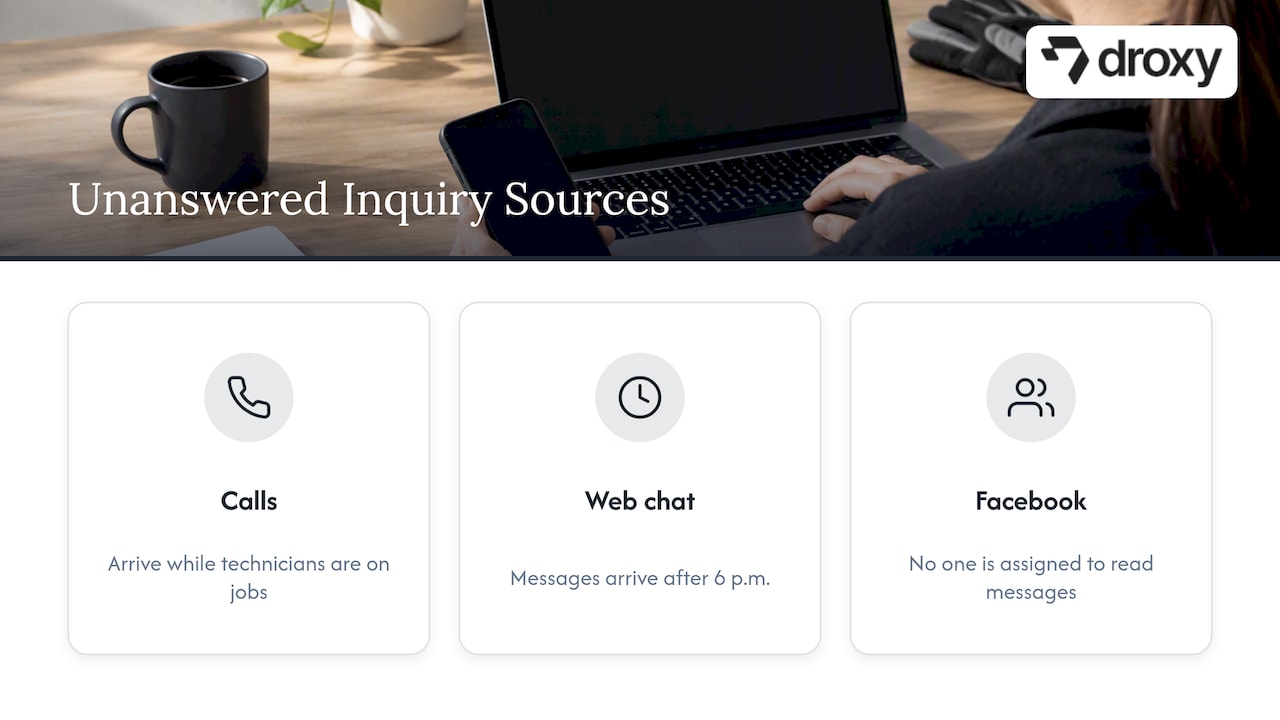
A local service business might discover that most unanswered inquiries come from three places: calls that arrive while technicians are on jobs, web chat messages after 6 p.m., and Facebook messages that nobody is assigned to read. Those are three different fixes, and none of them is more advertising. That is the point of auditing before spending.
Step 2: Set response targets that match intent
There is no universal rule for how fast to reply. One agency guide argues that response standards should reflect the customer’s intent: an appointment or quote request deserves immediate priority, while a content download can wait.
A practical way to apply this:
Inquiry type | Example | Suggested target |
|---|---|---|
High intent | Booking request, quote request, “are you open now?” call | Immediate answer, human follow-up the same business day |
Medium intent | Product or service question, pricing question | Instant answer from your knowledge base, human if unresolved |
Low intent | Newsletter reply, general feedback, resource download | Within one business day |
These targets are our suggestions, not an industry standard. Set yours based on your own data from the audit, then tighten them as your capacity grows.
For context, Bitrix24’s benchmark reports that 68% of English-speaking companies respond to new leads within an hour. If you are not there yet, the gap is likely coverage, not effort.
One caution: an automatic acknowledgment can build confidence, but it should not be reported as a meaningful response time. Measure the first useful answer.
Step 3: Give every inquiry a named owner
Coverage fails when ownership is vague. For each channel, name a first owner and a backup, test that notifications actually reach them, and make sure the customer sees a clear next step, such as a booking link, a callback time or a confirmation message.
Ownership also means a process after the first reply. Strong follow-up turns a one-off question into a booked job. If you want to go deeper on what happens after the first answer, this guide to lead nurturing strategies covers how workflows assign incoming inquiries to a named owner and keep the next action on schedule.
For teams that handle many inquiries, smart routing helps. Real estate brokerages, for example, route new leads to the agent who is available or best matched, and we have written about how lead routing helps brokerages reply in seconds. The same principle works for a home services dispatcher or a clinic front desk.
Step 4: Use instant answers to cover the gaps
After the audit, you will usually see two kinds of missed inquiries. The first is simple and repetitive: opening hours, pricing, availability, order status, service areas. The second needs a person: a complex quote, a complaint, a clinical question.
Automation is built for the first kind. An AI agent that knows your business can answer repeat questions in seconds, at any hour, on the channel where the customer asked. That cuts wait times, trims the ticket queue and leaves your team free for the conversations that need judgment.
Bitrix24’s research team makes a related observation: market share is won less by adding sales headcount than by automating basic workflows to remove friction at intake and freeing existing people for higher-value work.
Chatbot or AI agent?
A rule-based chatbot follows a script and fails when a customer words something unexpectedly. An AI agent draws on your knowledge sources, handles natural language and can take actions such as capturing a lead or booking an appointment. We explain the difference in our guide to AI agents versus chatbots.
What to teach the agent
The quality of automated answers depends on what it knows. Feed it:
Your service or product pages, pricing and policies
Frequently asked questions from your inbox and call notes
Booking rules, service areas and hours
Your brand voice, so replies sound like your team and not a template
Then review real conversations weekly for the first month and fix any gaps. Accuracy is something you maintain, not a setting you switch on once.
Step 5: Know when to hand off to a human
Automation should not hold on to every conversation. Define the triggers that send a customer to a person, and make the hand-off carry context so the customer never repeats themselves.
Good escalation triggers include:
The customer asks for a person
The topic is sensitive, such as a complaint, a refund dispute, a billing error or anything medical or legal
The agent cannot find a confident answer in your knowledge base
A high-value lead is ready to buy or book a large job
The customer sounds frustrated or has asked the same thing twice
When the hand-off happens, the human should receive the full transcript, the captured contact details and the reason for escalation. After hours, the agent should collect details and promise a specific callback window rather than a vague “someone will be in touch.” Our engineering-focused write-up on chatbot human hand-off goes into the mechanics.
Perspective: automate the first answer, not the relationship
We built Droxy because we kept seeing the same pattern: owners did not lose customers to better competitors, they lost them to silence. A question went unanswered for a few hours, and the customer moved on. Our view is that the first response is the part of customer service that should be fast, consistent and always on, and the relationship is the part that should stay human.
That is why we focus on agents that can be customized to your voice, that connect to the systems you already use, and that hand off cleanly instead of stonewalling. It is also why we ask owners to start with an audit, not a purchase. If you do not know where inquiries leak, an AI agent will still help, but you will get far more from it when it is pointed at the right channel with the right knowledge behind it.
Our advice: pick your biggest leak, cover it well, measure it for a month, then expand to the next channel.
— Elena
Metrics that show you are improving
Once the fixes are live, track a small set of numbers. The same audit method recommends tracking median time to first useful response, unanswered inquiry share, ownership coverage, booking share, and downstream outcomes such as estimates, wins or completed work.
A simple monthly scorecard:
Metric | What it tells you |
|---|---|
Median time to first useful response | Whether customers get answers quickly in practice |
Unanswered inquiry share | How many inquiries still fall through |
Ownership coverage | Share of inquiries with a named owner |
Booking share | How many inquiries become appointments |
Estimates, wins, completed jobs | Whether faster replies produce revenue |
Keep inquiries, estimates, signed jobs, completed work and revenue as separate lines, so you can see where the funnel narrows. Use the median, not the average, for response time: one overnight delay can distort an average badly.
Droxy’s analytics show conversation volume and outcomes by channel, which gives you much of this data without manual spreadsheets. Combine it with your CRM for the downstream numbers.
Protect customer data while you automate
More channels and more automation mean more places where contact details live. Basic hygiene helps: restrict access to contact details, define permissions and procedures for data exports, and keep an inquiry log so you can recover saved inquiries if an integration fails, as the CRM audit guidance advises.
If you are in healthcare, finance or another regulated field, have the person responsible for compliance review what the agent may say and what data it may collect before launch. Configure it to avoid giving medical, legal or financial advice and to hand off those topics to a qualified person.
Where Droxy fits
Droxy is a no-code platform for deploying AI agents on website chat, phone, WhatsApp, Instagram, Facebook and Shopify. You can capture leads automatically, book appointments, support multiple languages, route conversations and hand off to your team, then connect everything to existing systems through the API or Zapier.
Which agent should you start with? Match it to your biggest leak:
Missed calls: the phone agent
After-hours web visitors: the website agent
Unread DMs: the WhatsApp agent, Instagram agent or Facebook agent
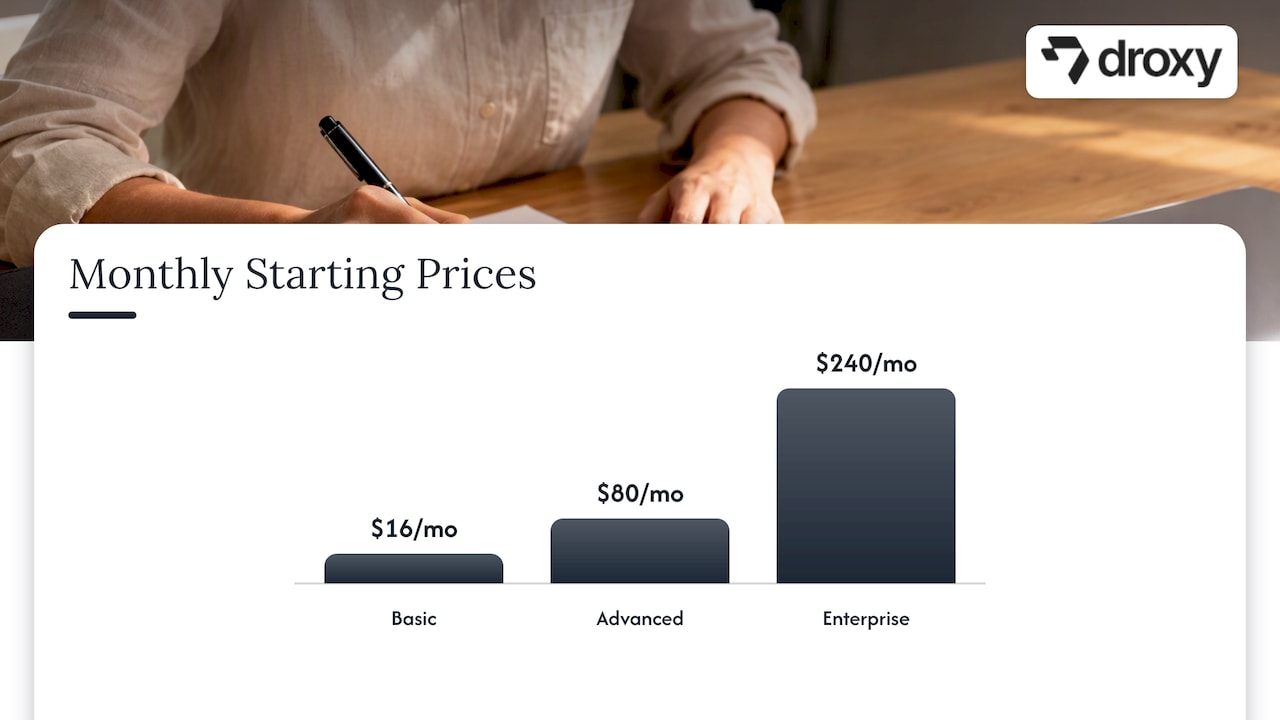
Plans start from $16 per month on Basic, from $80 per month on Advanced and from $240 per month on Enterprise. You can compare them on the Droxy pricing page. Agencies can also create white-labeled agents for their own clients through the agency solution.
If your inquiries come mostly through an online store, our list of ecommerce chatbot use cases shows what to automate first.
A 30-day plan to cut missed inquiries
Week 1: List entry points, pull a sample of 30 to 50 inquiries and trace each one. Test every path as a stranger.
Week 2: Name owners and backups. Set response targets by intent. Fix any broken forms or notifications.
Week 3: Launch an AI agent on your biggest leak. Load it with your FAQs, policies and booking rules. Set escalation triggers.
Week 4: Review transcripts, fill knowledge gaps, and compare your scorecard with the Week 1 baseline.
Repeat the audit every quarter. Channels change, staff change and forms break quietly.
FAQ
What is the fastest way to reduce missed inquiries?
Cover the channel where you lose the most high-intent inquiries, usually after-hours calls or chat. An AI agent can answer instantly at any hour and pass the lead to a person with the details captured. Pair it with a named owner for next-day follow-up.
How do I know how many inquiries I am missing?
Trace a sample of 30 to 50 recent inquiries across every channel, noting arrival time, first useful response and outcome. Include missed calls and unanswered forms. Then test each channel yourself, including after hours and on mobile.
Will an AI agent make my business sound robotic?
Not if it is set up well. Droxy agents can be customized to match your brand voice and trained on your own content, and they hand off to a person when a conversation needs one. Reviewing real transcripts in the first month keeps the tone and accuracy on track.
Does automation replace my team?
No. It takes over repeat questions and after-hours coverage so your team can spend time on quotes, complaints and relationships. The human hand-off is part of the design.
Sources
Recommended
You reduce missed inquiries by doing four things in order: find every place an inquiry can arrive, trace what happens to a sample of recent ones, give each channel a named owner and a response target, and let automation answer instantly whatever does not need a person. Most businesses skip the first two steps and buy more traffic or hire more staff instead. That fixes nothing if the leaks are still open.
This guide walks you through each step, with a simple audit you can run this week, the metrics worth tracking, and how AI agents fit in without making your business sound like a robot.
Droxydroxy.aiAnswer Inquiries Without the WaitDroxy AI agents answer customer inquiries around the clock across website chat, phone, WhatsApp, Instagram, Facebook, and Shopify.Explore Droxy
TL;DR
Missed inquiries are usually a process problem, not a traffic problem. Audit a sample of recent calls, forms, chats and DMs before changing anything.
Every entry point needs a first owner, a backup and a response target based on how high-intent the inquiry is.
Instant automated answers handle repeat questions and after-hours messages, and a clean hand-off sends the rest to a person with full context.
Track median time to first useful response, unanswered share, and booking share. Keep automatic acknowledgments out of those numbers.
Droxy plans start from $16 per month, so covering website chat, phone and social messages does not require a new hire.
Table of Contents
Why inquiries get missed in the first place
Step 1: Find where inquiries are leaking
Step 2: Set response targets that match intent
Step 3: Give every inquiry a named owner
Step 4: Use instant answers to cover the gaps
Step 5: Know when to hand off to a human
Perspective: automate the first answer, not the relationship
Metrics that show you are improving
Protect customer data while you automate
Where Droxy fits
A 30-day plan to cut missed inquiries
Sources
Why inquiries get missed in the first place
A missed inquiry is rarely a dramatic failure. It is a voicemail nobody checked on Saturday, a website form that emailed an inbox no one watches, an Instagram DM that sat under a pile of comments, or a chat message that arrived at 9 p.m. and was answered at 10 a.m. the next day, long after the customer called someone else.
The common causes are predictable:
No coverage outside business hours. Customers ask when it suits them, not when your team is at their desks.
Too many channels, no single view. Phone, web chat, WhatsApp, Instagram, Facebook and email each live in a different app.
No owner. When everyone can answer, often no one does.
Broken plumbing. A form or integration fails silently and the inquiry never reaches your CRM.
Repeat questions that clog the queue. Hours, prices, shipping, availability and directions crowd out the real sales conversations.
The good news is that each cause has a concrete fix. The first step is knowing which ones apply to you.
Step 1: Find where inquiries are leaking
Do not guess. Trace a defined set of recent inquiries from the moment they arrived to their latest outcome. One lead-response audit method suggests checking when each inquiry received a useful response, who owned the next action, and whether it became an appointment, estimate or closed request, including missed calls and unanswered forms.
Here is a version you can run in an afternoon.
List every entry point. Phone number, contact form, quote request form, web chat, WhatsApp, Instagram, Facebook, Google Business Profile messages, email, marketplace messages. Include the ones you rarely look at.
Pull a sample. Take the last 30 to 50 inquiries across all channels. For small samples, record actual counts next to percentages, so that 4 of 30 does not get reported as a vague figure.
Trace each one. Record arrival time, time of the first useful response, who handled it, the next action and the outcome. Log automatic acknowledgments separately from real answers, since an autoresponder is not an answer.
Test as a stranger. Submit your own forms, send a DM, call after hours and try it all on a phone. A walkthrough of website inquiry loss recommends checking whether each test inquiry arrived, received an owner and got a response.
Check the plumbing. If you use a CRM, reconcile an independent log of website inquiries against what the CRM registered. CRM audit guidance suggests comparing inquiry identifiers, receipt times and delivery status to locate integration failures.
Rank the leaks. Fix the one that loses the most high-intent inquiries first, usually after-hours phone calls or an unmonitored form.
You may find you are in the majority if you do not measure this today. Bitrix24’s 2026 benchmark of 1,001 companies found that about 26% of companies worldwide do not track response times for inbound leads at all.
What a typical audit reveals
A local service business might discover that most unanswered inquiries come from three places: calls that arrive while technicians are on jobs, web chat messages after 6 p.m., and Facebook messages that nobody is assigned to read. Those are three different fixes, and none of them is more advertising. That is the point of auditing before spending.
Step 2: Set response targets that match intent
There is no universal rule for how fast to reply. One agency guide argues that response standards should reflect the customer’s intent: an appointment or quote request deserves immediate priority, while a content download can wait.
A practical way to apply this:
Inquiry type | Example | Suggested target |
|---|---|---|
High intent | Booking request, quote request, “are you open now?” call | Immediate answer, human follow-up the same business day |
Medium intent | Product or service question, pricing question | Instant answer from your knowledge base, human if unresolved |
Low intent | Newsletter reply, general feedback, resource download | Within one business day |
These targets are our suggestions, not an industry standard. Set yours based on your own data from the audit, then tighten them as your capacity grows.
For context, Bitrix24’s benchmark reports that 68% of English-speaking companies respond to new leads within an hour. If you are not there yet, the gap is likely coverage, not effort.
One caution: an automatic acknowledgment can build confidence, but it should not be reported as a meaningful response time. Measure the first useful answer.
Step 3: Give every inquiry a named owner
Coverage fails when ownership is vague. For each channel, name a first owner and a backup, test that notifications actually reach them, and make sure the customer sees a clear next step, such as a booking link, a callback time or a confirmation message.
Ownership also means a process after the first reply. Strong follow-up turns a one-off question into a booked job. If you want to go deeper on what happens after the first answer, this guide to lead nurturing strategies covers how workflows assign incoming inquiries to a named owner and keep the next action on schedule.
For teams that handle many inquiries, smart routing helps. Real estate brokerages, for example, route new leads to the agent who is available or best matched, and we have written about how lead routing helps brokerages reply in seconds. The same principle works for a home services dispatcher or a clinic front desk.
Step 4: Use instant answers to cover the gaps
After the audit, you will usually see two kinds of missed inquiries. The first is simple and repetitive: opening hours, pricing, availability, order status, service areas. The second needs a person: a complex quote, a complaint, a clinical question.
Automation is built for the first kind. An AI agent that knows your business can answer repeat questions in seconds, at any hour, on the channel where the customer asked. That cuts wait times, trims the ticket queue and leaves your team free for the conversations that need judgment.
Bitrix24’s research team makes a related observation: market share is won less by adding sales headcount than by automating basic workflows to remove friction at intake and freeing existing people for higher-value work.
Chatbot or AI agent?
A rule-based chatbot follows a script and fails when a customer words something unexpectedly. An AI agent draws on your knowledge sources, handles natural language and can take actions such as capturing a lead or booking an appointment. We explain the difference in our guide to AI agents versus chatbots.
What to teach the agent
The quality of automated answers depends on what it knows. Feed it:
Your service or product pages, pricing and policies
Frequently asked questions from your inbox and call notes
Booking rules, service areas and hours
Your brand voice, so replies sound like your team and not a template
Then review real conversations weekly for the first month and fix any gaps. Accuracy is something you maintain, not a setting you switch on once.
Step 5: Know when to hand off to a human
Automation should not hold on to every conversation. Define the triggers that send a customer to a person, and make the hand-off carry context so the customer never repeats themselves.
Good escalation triggers include:
The customer asks for a person
The topic is sensitive, such as a complaint, a refund dispute, a billing error or anything medical or legal
The agent cannot find a confident answer in your knowledge base
A high-value lead is ready to buy or book a large job
The customer sounds frustrated or has asked the same thing twice
When the hand-off happens, the human should receive the full transcript, the captured contact details and the reason for escalation. After hours, the agent should collect details and promise a specific callback window rather than a vague “someone will be in touch.” Our engineering-focused write-up on chatbot human hand-off goes into the mechanics.
Perspective: automate the first answer, not the relationship
We built Droxy because we kept seeing the same pattern: owners did not lose customers to better competitors, they lost them to silence. A question went unanswered for a few hours, and the customer moved on. Our view is that the first response is the part of customer service that should be fast, consistent and always on, and the relationship is the part that should stay human.
That is why we focus on agents that can be customized to your voice, that connect to the systems you already use, and that hand off cleanly instead of stonewalling. It is also why we ask owners to start with an audit, not a purchase. If you do not know where inquiries leak, an AI agent will still help, but you will get far more from it when it is pointed at the right channel with the right knowledge behind it.
Our advice: pick your biggest leak, cover it well, measure it for a month, then expand to the next channel.
— Elena
Metrics that show you are improving
Once the fixes are live, track a small set of numbers. The same audit method recommends tracking median time to first useful response, unanswered inquiry share, ownership coverage, booking share, and downstream outcomes such as estimates, wins or completed work.
A simple monthly scorecard:
Metric | What it tells you |
|---|---|
Median time to first useful response | Whether customers get answers quickly in practice |
Unanswered inquiry share | How many inquiries still fall through |
Ownership coverage | Share of inquiries with a named owner |
Booking share | How many inquiries become appointments |
Estimates, wins, completed jobs | Whether faster replies produce revenue |
Keep inquiries, estimates, signed jobs, completed work and revenue as separate lines, so you can see where the funnel narrows. Use the median, not the average, for response time: one overnight delay can distort an average badly.
Droxy’s analytics show conversation volume and outcomes by channel, which gives you much of this data without manual spreadsheets. Combine it with your CRM for the downstream numbers.
Protect customer data while you automate
More channels and more automation mean more places where contact details live. Basic hygiene helps: restrict access to contact details, define permissions and procedures for data exports, and keep an inquiry log so you can recover saved inquiries if an integration fails, as the CRM audit guidance advises.
If you are in healthcare, finance or another regulated field, have the person responsible for compliance review what the agent may say and what data it may collect before launch. Configure it to avoid giving medical, legal or financial advice and to hand off those topics to a qualified person.
Where Droxy fits
Droxy is a no-code platform for deploying AI agents on website chat, phone, WhatsApp, Instagram, Facebook and Shopify. You can capture leads automatically, book appointments, support multiple languages, route conversations and hand off to your team, then connect everything to existing systems through the API or Zapier.
Which agent should you start with? Match it to your biggest leak:
Missed calls: the phone agent
After-hours web visitors: the website agent
Unread DMs: the WhatsApp agent, Instagram agent or Facebook agent
Plans start from $16 per month on Basic, from $80 per month on Advanced and from $240 per month on Enterprise. You can compare them on the Droxy pricing page. Agencies can also create white-labeled agents for their own clients through the agency solution.
If your inquiries come mostly through an online store, our list of ecommerce chatbot use cases shows what to automate first.
A 30-day plan to cut missed inquiries
Week 1: List entry points, pull a sample of 30 to 50 inquiries and trace each one. Test every path as a stranger.
Week 2: Name owners and backups. Set response targets by intent. Fix any broken forms or notifications.
Week 3: Launch an AI agent on your biggest leak. Load it with your FAQs, policies and booking rules. Set escalation triggers.
Week 4: Review transcripts, fill knowledge gaps, and compare your scorecard with the Week 1 baseline.
Repeat the audit every quarter. Channels change, staff change and forms break quietly.
FAQ
What is the fastest way to reduce missed inquiries?
Cover the channel where you lose the most high-intent inquiries, usually after-hours calls or chat. An AI agent can answer instantly at any hour and pass the lead to a person with the details captured. Pair it with a named owner for next-day follow-up.
How do I know how many inquiries I am missing?
Trace a sample of 30 to 50 recent inquiries across every channel, noting arrival time, first useful response and outcome. Include missed calls and unanswered forms. Then test each channel yourself, including after hours and on mobile.
Will an AI agent make my business sound robotic?
Not if it is set up well. Droxy agents can be customized to match your brand voice and trained on your own content, and they hand off to a person when a conversation needs one. Reviewing real transcripts in the first month keeps the tone and accuracy on track.
Does automation replace my team?
No. It takes over repeat questions and after-hours coverage so your team can spend time on quotes, complaints and relationships. The human hand-off is part of the design.
Sources
Recommended


🚀
Powered by Droxy
Turn every interaction into a conversion
Customer facing AI agents that engage, convert, and support so you can scale what matters.
✨
Learn more
Recent posts
Insights
3 min read
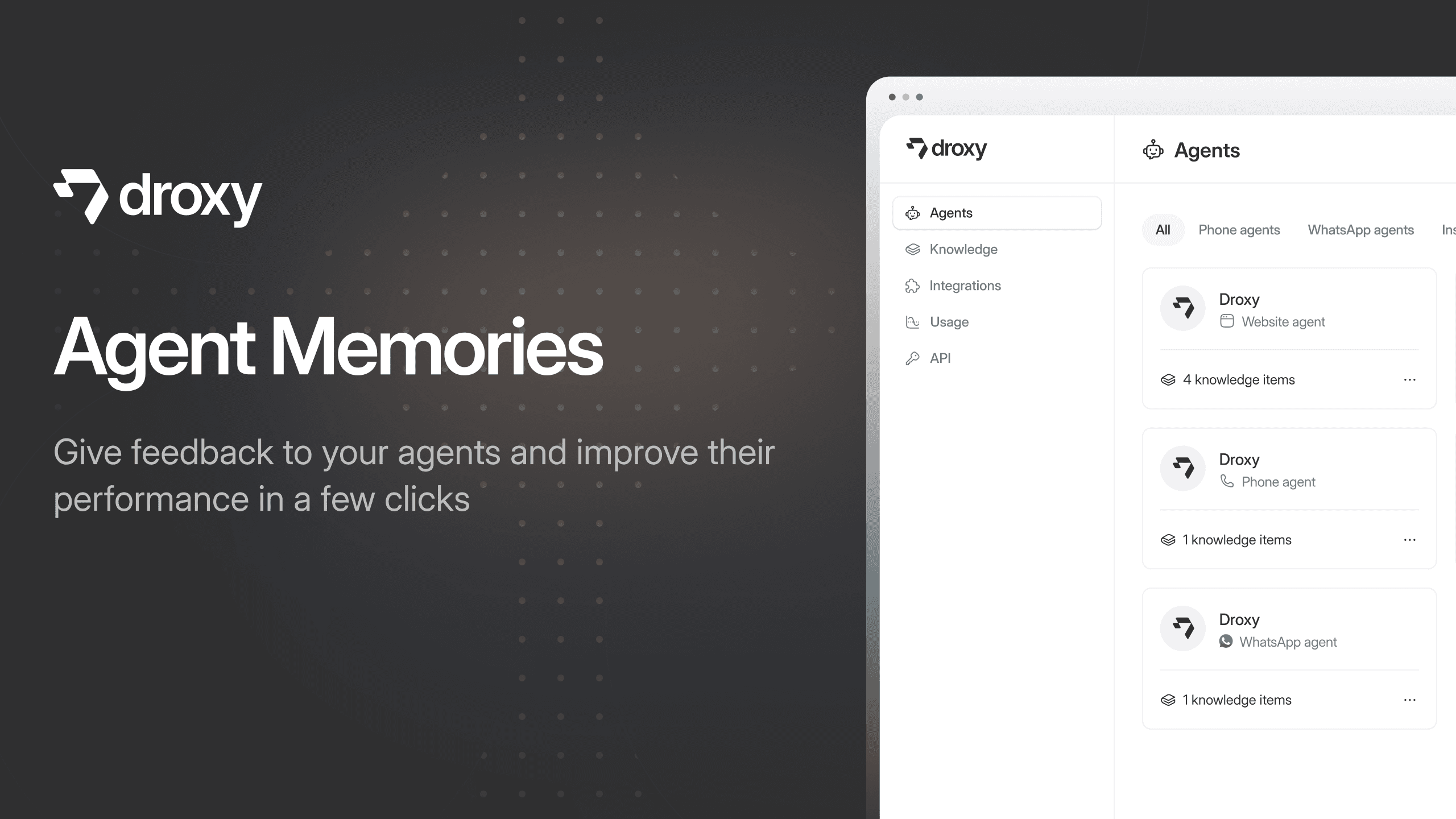
Introducing Agent Memories
Improve your agents' performance with Agent Memories. Prevent agents from repeating the same mistakes by giving them feedback.
Read more

Insights
15 min read
HVAC Marketing in 2025: The Definitive Lead Gen Guide
Discover 15 proven HVAC marketing strategies, plus learn how Droxy's AI website agent converts curious visitors into qualified leads by answering their questions instantly - right when they're most interested in your services.
Read more
Insights
10 min read
10 Best AI Sales Agents in 2025: Tested & Ranked
Discover the top 10 AI sales agents of 2025, designed to enhance lead generation, personalize outreach, and ultimately, close more deals
Read more
Insights
3 min read
Introducing Agent Memories
Improve your agents' performance with Agent Memories. Prevent agents from repeating the same mistakes by giving them feedback.
Read more
Insights
15 min read
HVAC Marketing in 2025: The Definitive Lead Gen Guide
Discover 15 proven HVAC marketing strategies, plus learn how Droxy's AI website agent converts curious visitors into qualified leads by answering their questions instantly - right when they're most interested in your services.
Read more