White Label Chatbot Benefits for Agencies and Businesses
White Label Chatbot Benefits for Agencies and Businesses
Insights
16 min

A white label chatbot lets you put an AI agent in front of customers under your own brand, without building the technology yourself. The main benefits are speed to launch, lower development cost, full brand control, round-the-clock replies and, for agencies, a recurring revenue line. The evidence for faster, better support is solid. The evidence for “set it and forget it” is not, so this guide covers both sides.
DroxyOffer Branded AI Support Without Building ItDroxy lets agencies and businesses deploy customizable AI agents across customer channels, with instant answers that reflect your brand's voice.Explore Droxy
TL;DR
A white label chatbot is software built by one company and deployed under another company’s name, logo and voice.
Businesses gain instant, 24/7 answers, fewer routine tickets and faster lead follow-up without hiring developers.
Agencies and consultants gain a service they can resell, with recurring revenue and no engineering team.
Field experiments show AI assistance speeds up replies and lifts customer ratings, but gains vary by agent and conversation type.
Plan for privacy, human oversight and a clean hand-off to a person before you go live.
Table of Contents
What a white label chatbot actually is
Benefits for businesses
Benefits for agencies and consultants
What the evidence says about results
Risks and costs to plan for
Our perspective
How to choose a white label chatbot platform
Where Droxy fits
A simple rollout plan
Sources
What a white label chatbot actually is
White labeling means one company builds the product and another presents it as its own. With a chatbot, the platform provider supplies the AI, the channels and the dashboard. You supply the name, the colors, the tone of voice and the knowledge about your business or your client’s business.
The customer chatting on a website, WhatsApp or Instagram never sees the platform vendor. They see your brand, and the answers sound like your team.
Two types of buyers use this model:
Businesses that want a branded assistant on their own channels, with custom colors, tone and knowledge, and no code.
Agencies and consultants that deploy agents for many clients, each under the agency’s brand or the client’s brand, and charge for the service.
The benefits differ for each, so we take them in turn.
Benefits for businesses
Instant answers, any hour
Missed inquiries are the quiet cost of a small team. A visitor asks about price at 9 p.m., nobody replies until morning, and by then they have called a competitor. An AI agent answers immediately, every night and weekend, and hands off to a person when the question needs one.
This is the benefit owners feel first. Response time stops depending on staffing.
Fewer repetitive tickets
Most support queues are dominated by the same questions: order status, opening hours, return policy, pricing, “do you service my area?” A chatbot trained on your own documents and website handles those without a ticket ever being created. Your people spend their time on billing disputes, complex bookings and upset customers.
The research on this is worth reading closely. A Dartmouth Tuck School summary of an Alibaba field experiment reports that generative AI assistance reduced agent chat time and improved customer ratings while lowering dissatisfaction. Tuck reads this as augmentation rather than replacement: automation takes over rote communication so human agents can concentrate on each customer’s specific needs.
Lead capture and conversion
A chatbot is also a front desk that never goes home. It can ask qualifying questions, collect a name and phone number, recommend products, and book an appointment while the visitor is still interested. For real estate agents, home service providers and healthcare practices, that speed-to-lead is often the difference between a booked job and a lost one.
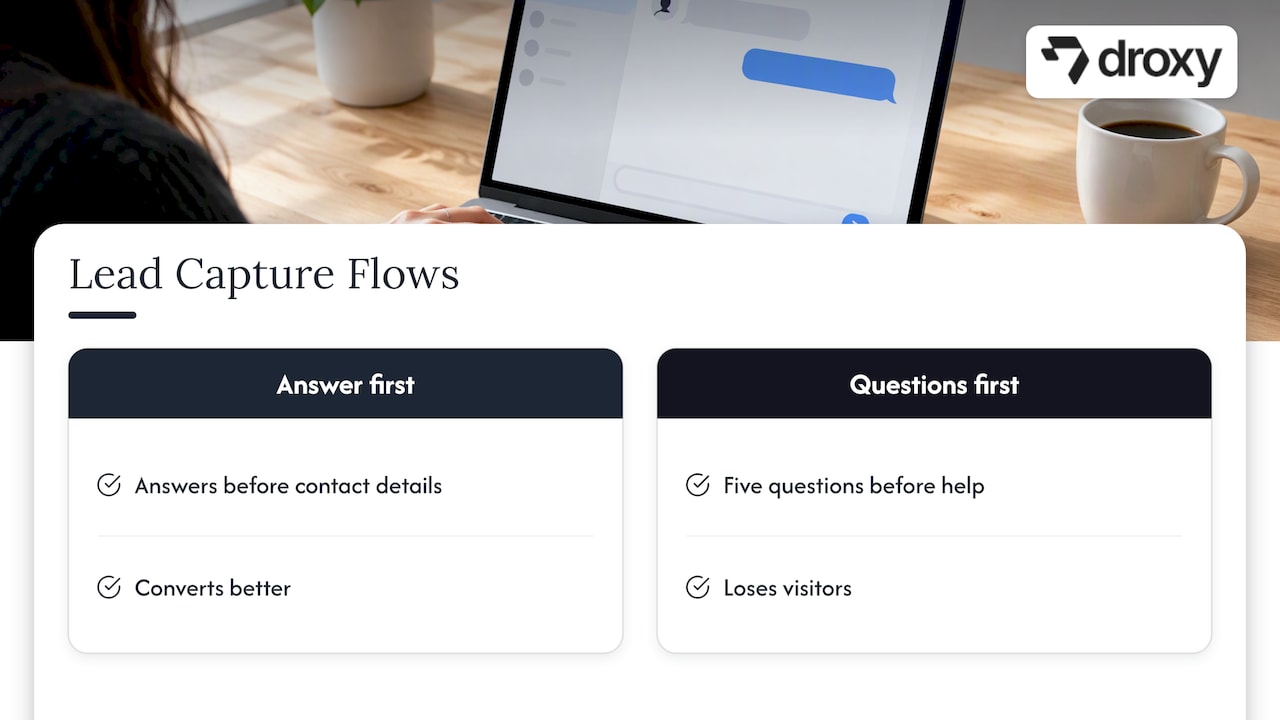
The benefit here depends on how well the agent is set up. A bot that asks five questions before offering help loses people. A bot that answers first and then asks for contact details converts better. Treat the conversation flow as something you test and tune.
Consistent brand voice
With white labeling, tone is yours to set. You decide whether the agent is formal or relaxed, whether it uses first names, how it handles a complaint. Every customer gets the same standard on the first reply and the thousandth, which is hard to guarantee with a rotating human team.
Multiple channels, one setup
Customers do not stay on one channel. They start on your website, follow up on WhatsApp, and message you on Instagram. A single platform that deploys the same knowledge across website chat, phone, WhatsApp, Instagram and Facebook means answers stay consistent and you manage one system instead of five.
No development cost
Building a chatbot from scratch means language models, hosting, security, channel integrations and ongoing maintenance. A white label platform removes that. No-code setup means a marketing manager or business owner can launch an agent, and update it when prices or policies change, without waiting for an engineer.
Benefits for agencies and consultants
A service you can resell
Clients already ask their agencies about AI. White label lets you answer with a product under your brand rather than a referral to someone else’s. You keep the client relationship, the data conversation and the margin.
Recurring revenue
Building an agent is a project. Running, tuning and reporting on it is a retainer. Agencies typically structure this as a setup fee plus a monthly management fee, which turns one-off work into predictable income. The real value you sell is not the software but the ongoing improvement: reviewing conversations, closing knowledge gaps and reporting results.
If you are weighing how AI changes agency economics more broadly, this overview of AI productivity results for agencies is a good companion read.
Speed to market
An agency that builds its own bot spends months and real money before the first client sees anything. With a white label platform you can set up a working agent for a client in days, using their website, documents and FAQs as the knowledge base. A faster first win makes the next sale easier.
Control over branding and client access
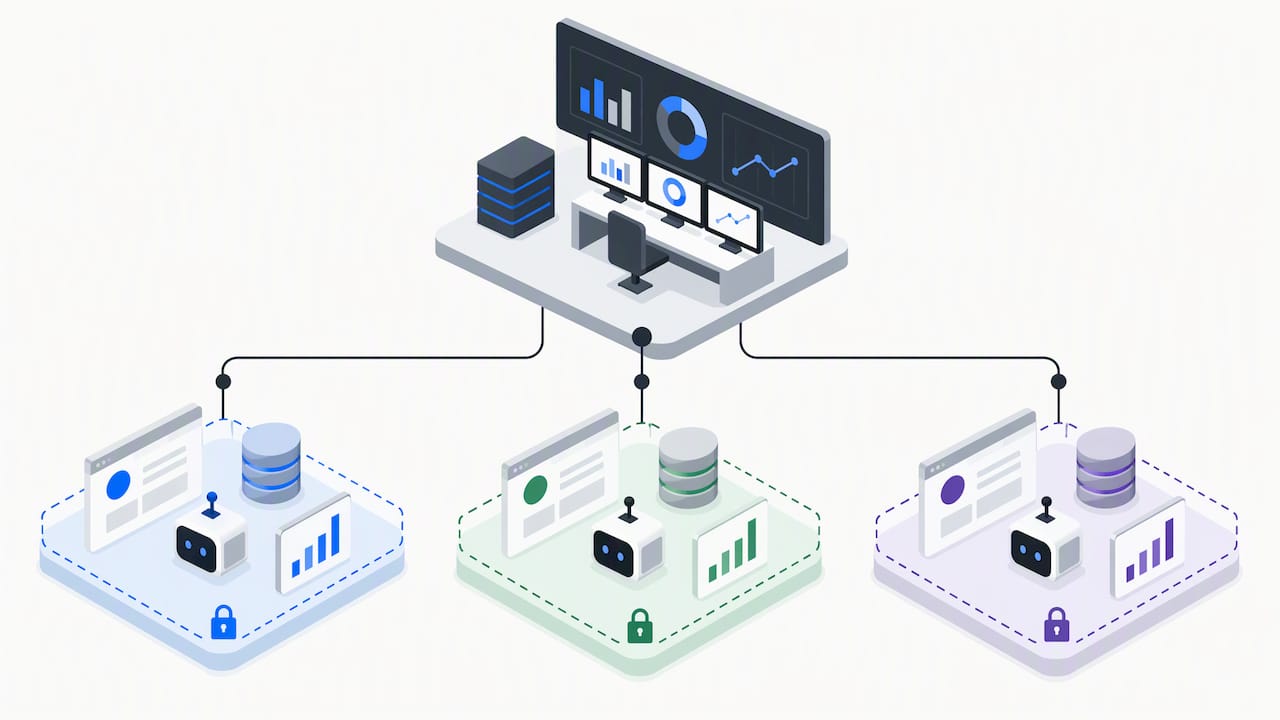
A good white label setup lets you manage each client’s agent separately: their branding, their knowledge sources, their analytics, their team’s access. You see everything from one place, and each client sees only theirs. If you want the details on how this works on our side, our agency page explains the setup.
Margin that scales
The cost of adding a client is mostly setup time, not new infrastructure. Once you have a repeatable onboarding process, the tenth client takes a fraction of the effort of the first. That is where the economics of reselling become attractive compared with custom development.
What the evidence says about results
It is tempting to quote big percentages. The better move is to look at what controlled studies actually found, because the details matter for how you set expectations with clients.
Finding | What it means for you |
|---|---|
AI assistance cut chat handling time and improved customer ratings in an Alibaba field experiment (Tuck summary) | Speed and satisfaction can rise together |
Responses were faster and subjective service quality was higher, but objective quality, measured by customer retrials, did not significantly improve (SSRN paper) | Customers feel better served, but track whether problems are actually solved |
Lower-performing agents benefited most, while top performers saw declines consistent with workflow disruption (SSRN paper) | Introduce AI in a way that fits how your best people already work |
The lesson is not that AI disappoints. It is that the gains are real but uneven. A chatbot raises the floor of your service quickly. It does not automatically raise the ceiling, and it can get in the way if it is bolted onto a workflow that already works well.
A second randomized experiment, with a meal delivery company, points the same way: AI-assisted agents responded faster and engaged customers more deeply, with the biggest benefit for less-experienced agents. It also found that effects varied by conversation type, and that earlier chatbot comprehension failures could make AI-assisted replies hurt customer sentiment. A bot that misunderstands people once makes the next interaction harder.
These studies concern AI assistance to human agents in specific companies, not white label platforms as a category. Use them as a guide to what to measure, not as a promised result for your own deployment.
Risks and costs to plan for
A fair look at benefits includes what can go wrong. None of these should stop you, but each needs an owner.
Privacy and data handling
Chatbots collect names, phone numbers, sometimes health or financial details. Before launch, decide what the agent may collect, where it is stored and who can see it. Government guidance on generative AI, such as New Zealand’s Responsible AI Guidance, recommends protecting personal information and carrying out privacy impact assessments where appropriate. It is written for public bodies, but the habit is sound for any business. If you serve patients or work in a regulated field, ask your own compliance adviser or attorney which rules apply to you. Our guide to AI chatbot security covers the technical safeguards to look for.
Human oversight
The same guidance says organizations should keep accountable human oversight and risk-assess higher-risk uses. In practice, that means someone reads real conversations every week, fixes wrong answers and decides which topics the bot must never handle alone, such as medical advice, refunds above a limit or legal questions.
Hand-off quality
The worst chatbot experience is a customer stuck in a loop. Build a clear route to a person, with the conversation history passed along so the customer does not repeat themselves. We go deeper in our piece on chatbot human handoff.
Platform dependence
When you white label, your service runs on someone else’s infrastructure. Before you commit clients to a platform, check how it handles uptime, data export, pricing changes and what happens to client agents if you leave. Agencies in particular should read this part of any contract twice.
Costs beyond the subscription
The subscription is only part of the cost. Budget time for writing and cleaning the knowledge base, testing, and monthly review. For agencies, add onboarding and reporting time to your pricing so margins hold.
Our perspective
We build Droxy for people who want AI customer service to work without a development team, and we see the same pattern across ecommerce shops, clinics, home service companies and agencies. The businesses that get the most from a branded agent do three things. They feed it accurate, current knowledge. They treat the first month as tuning, not launch day. And they make it easy to reach a person.
For agencies, our view is that the software is the smaller part of the offer. Clients pay for judgment: what the agent should say, when it should step aside, and how its results are reported. A platform that lets you manage unlimited white labeled agents, control each client’s access and customize the voice gives you room to sell that judgment. The platform should disappear into your brand, and your expertise should be what the client remembers.
We also tell every new customer the same thing: do not measure success by how many chats the bot closes. Measure how many customers got what they needed, and how many leads turned into bookings.
— Elena
How to choose a white label chatbot platform
When you compare options, weigh these criteria rather than headline features:
Channels. Does it cover the places your customers already are: website, phone, WhatsApp, Instagram, Facebook, Shopify?
Branding depth. Can you change name, logo, colors, tone and the domain where the agent lives?
Knowledge sources. Can it learn from your website, documents and other sources, and be updated easily?
Hand-off and routing. Can it pass a conversation to a person with context?
Integrations. Does it connect to your existing systems through API or Zapier?
Analytics. Can you see what customers ask, where the agent fails and what it converts?
Multi-client management. For agencies: separate workspaces, access control and billing.
Pricing clarity. Are tiers published and predictable as you add clients?
For a wider survey of the market by type of provider, see our overview of white label AI chatbot providers and our guide to chatbot development platforms. If you are unsure whether you need a simple chatbot or something more capable, read AI agent vs chatbot.
Where Droxy fits
Droxy is a no-code platform for deploying AI agents on website chat, phone, WhatsApp, Instagram, Facebook and Shopify. You can customize the agent’s voice, connect your knowledge sources, capture leads, book appointments, route conversations and hand off to a person, all from one dashboard with analytics. Agencies can create unlimited white labeled agents and manage branding and client access from the same platform.
Plans start at $16 per month for Basic, $80 per month for Advanced and $240 per month for Enterprise. You can see which channels suit you on the pages for the website agent, phone agent and WhatsApp agent, or start with Droxy and build your first agent today.
A simple rollout plan
Whether you are a business owner or an agency, the first 30 days decide how well the agent performs.
Pick one channel and one goal. Start with website chat and a single outcome, such as booking appointments or answering pricing questions.
Write the knowledge base properly. Gather your FAQs, policies, price lists and service areas. Remove anything outdated.
Set the voice. Write three or four example replies in your brand’s tone, including how it handles a frustrated customer.
Define the limits. List topics the agent must pass to a person immediately.
Test with real questions. Use past emails and chats. Fix every wrong answer.
Launch, then read conversations daily for the first two weeks. Weekly after that.
Add channels. Once website chat works, extend the same knowledge to WhatsApp, Instagram or phone.
For ideas on where to start, our examples of AI in customer service show how different businesses apply it, and how to choose the right chatbot walks through the decision.
FAQ
What is the main benefit of a white label chatbot?
Speed and control. You launch a branded AI agent without building the technology, and it answers customers instantly at any hour in your voice. For agencies, the main benefit is a resellable service with recurring revenue.
Is white labeling only for agencies?
No. Agencies use it to resell to clients, but any business can use a white label platform to run a chatbot under its own brand. The difference is whether you deploy one agent for yourself or many for clients.
Will a chatbot replace my support team?
It should not. Research on AI in customer service points to augmentation: the bot handles repetitive questions while people handle complex or sensitive ones. Keep a clear hand-off to a person for anything the agent cannot resolve.
How long does it take to launch a white label chatbot?
A basic agent trained on your website and documents can be live within days on a no-code platform. Plan more time for writing a clean knowledge base and testing, since answer quality depends on them.
What should I watch out for?
Privacy, wrong answers and dead-end conversations. Decide what data the agent collects, review conversations regularly and make sure customers can reach a human easily.
Sources
How Gen AI Can Boost Customer Service, Tuck School of Business
Responsible AI Guidance for the Public Service: GenAI, New Zealand Government
Recommended
A white label chatbot lets you put an AI agent in front of customers under your own brand, without building the technology yourself. The main benefits are speed to launch, lower development cost, full brand control, round-the-clock replies and, for agencies, a recurring revenue line. The evidence for faster, better support is solid. The evidence for “set it and forget it” is not, so this guide covers both sides.
DroxyOffer Branded AI Support Without Building ItDroxy lets agencies and businesses deploy customizable AI agents across customer channels, with instant answers that reflect your brand's voice.Explore Droxy
TL;DR
A white label chatbot is software built by one company and deployed under another company’s name, logo and voice.
Businesses gain instant, 24/7 answers, fewer routine tickets and faster lead follow-up without hiring developers.
Agencies and consultants gain a service they can resell, with recurring revenue and no engineering team.
Field experiments show AI assistance speeds up replies and lifts customer ratings, but gains vary by agent and conversation type.
Plan for privacy, human oversight and a clean hand-off to a person before you go live.
Table of Contents
What a white label chatbot actually is
Benefits for businesses
Benefits for agencies and consultants
What the evidence says about results
Risks and costs to plan for
Our perspective
How to choose a white label chatbot platform
Where Droxy fits
A simple rollout plan
Sources
What a white label chatbot actually is
White labeling means one company builds the product and another presents it as its own. With a chatbot, the platform provider supplies the AI, the channels and the dashboard. You supply the name, the colors, the tone of voice and the knowledge about your business or your client’s business.
The customer chatting on a website, WhatsApp or Instagram never sees the platform vendor. They see your brand, and the answers sound like your team.
Two types of buyers use this model:
Businesses that want a branded assistant on their own channels, with custom colors, tone and knowledge, and no code.
Agencies and consultants that deploy agents for many clients, each under the agency’s brand or the client’s brand, and charge for the service.
The benefits differ for each, so we take them in turn.
Benefits for businesses
Instant answers, any hour
Missed inquiries are the quiet cost of a small team. A visitor asks about price at 9 p.m., nobody replies until morning, and by then they have called a competitor. An AI agent answers immediately, every night and weekend, and hands off to a person when the question needs one.
This is the benefit owners feel first. Response time stops depending on staffing.
Fewer repetitive tickets
Most support queues are dominated by the same questions: order status, opening hours, return policy, pricing, “do you service my area?” A chatbot trained on your own documents and website handles those without a ticket ever being created. Your people spend their time on billing disputes, complex bookings and upset customers.
The research on this is worth reading closely. A Dartmouth Tuck School summary of an Alibaba field experiment reports that generative AI assistance reduced agent chat time and improved customer ratings while lowering dissatisfaction. Tuck reads this as augmentation rather than replacement: automation takes over rote communication so human agents can concentrate on each customer’s specific needs.
Lead capture and conversion
A chatbot is also a front desk that never goes home. It can ask qualifying questions, collect a name and phone number, recommend products, and book an appointment while the visitor is still interested. For real estate agents, home service providers and healthcare practices, that speed-to-lead is often the difference between a booked job and a lost one.
The benefit here depends on how well the agent is set up. A bot that asks five questions before offering help loses people. A bot that answers first and then asks for contact details converts better. Treat the conversation flow as something you test and tune.
Consistent brand voice
With white labeling, tone is yours to set. You decide whether the agent is formal or relaxed, whether it uses first names, how it handles a complaint. Every customer gets the same standard on the first reply and the thousandth, which is hard to guarantee with a rotating human team.
Multiple channels, one setup
Customers do not stay on one channel. They start on your website, follow up on WhatsApp, and message you on Instagram. A single platform that deploys the same knowledge across website chat, phone, WhatsApp, Instagram and Facebook means answers stay consistent and you manage one system instead of five.
No development cost
Building a chatbot from scratch means language models, hosting, security, channel integrations and ongoing maintenance. A white label platform removes that. No-code setup means a marketing manager or business owner can launch an agent, and update it when prices or policies change, without waiting for an engineer.
Benefits for agencies and consultants
A service you can resell
Clients already ask their agencies about AI. White label lets you answer with a product under your brand rather than a referral to someone else’s. You keep the client relationship, the data conversation and the margin.
Recurring revenue
Building an agent is a project. Running, tuning and reporting on it is a retainer. Agencies typically structure this as a setup fee plus a monthly management fee, which turns one-off work into predictable income. The real value you sell is not the software but the ongoing improvement: reviewing conversations, closing knowledge gaps and reporting results.
If you are weighing how AI changes agency economics more broadly, this overview of AI productivity results for agencies is a good companion read.
Speed to market
An agency that builds its own bot spends months and real money before the first client sees anything. With a white label platform you can set up a working agent for a client in days, using their website, documents and FAQs as the knowledge base. A faster first win makes the next sale easier.
Control over branding and client access
A good white label setup lets you manage each client’s agent separately: their branding, their knowledge sources, their analytics, their team’s access. You see everything from one place, and each client sees only theirs. If you want the details on how this works on our side, our agency page explains the setup.
Margin that scales
The cost of adding a client is mostly setup time, not new infrastructure. Once you have a repeatable onboarding process, the tenth client takes a fraction of the effort of the first. That is where the economics of reselling become attractive compared with custom development.
What the evidence says about results
It is tempting to quote big percentages. The better move is to look at what controlled studies actually found, because the details matter for how you set expectations with clients.
Finding | What it means for you |
|---|---|
AI assistance cut chat handling time and improved customer ratings in an Alibaba field experiment (Tuck summary) | Speed and satisfaction can rise together |
Responses were faster and subjective service quality was higher, but objective quality, measured by customer retrials, did not significantly improve (SSRN paper) | Customers feel better served, but track whether problems are actually solved |
Lower-performing agents benefited most, while top performers saw declines consistent with workflow disruption (SSRN paper) | Introduce AI in a way that fits how your best people already work |
The lesson is not that AI disappoints. It is that the gains are real but uneven. A chatbot raises the floor of your service quickly. It does not automatically raise the ceiling, and it can get in the way if it is bolted onto a workflow that already works well.
A second randomized experiment, with a meal delivery company, points the same way: AI-assisted agents responded faster and engaged customers more deeply, with the biggest benefit for less-experienced agents. It also found that effects varied by conversation type, and that earlier chatbot comprehension failures could make AI-assisted replies hurt customer sentiment. A bot that misunderstands people once makes the next interaction harder.
These studies concern AI assistance to human agents in specific companies, not white label platforms as a category. Use them as a guide to what to measure, not as a promised result for your own deployment.
Risks and costs to plan for
A fair look at benefits includes what can go wrong. None of these should stop you, but each needs an owner.
Privacy and data handling
Chatbots collect names, phone numbers, sometimes health or financial details. Before launch, decide what the agent may collect, where it is stored and who can see it. Government guidance on generative AI, such as New Zealand’s Responsible AI Guidance, recommends protecting personal information and carrying out privacy impact assessments where appropriate. It is written for public bodies, but the habit is sound for any business. If you serve patients or work in a regulated field, ask your own compliance adviser or attorney which rules apply to you. Our guide to AI chatbot security covers the technical safeguards to look for.
Human oversight
The same guidance says organizations should keep accountable human oversight and risk-assess higher-risk uses. In practice, that means someone reads real conversations every week, fixes wrong answers and decides which topics the bot must never handle alone, such as medical advice, refunds above a limit or legal questions.
Hand-off quality
The worst chatbot experience is a customer stuck in a loop. Build a clear route to a person, with the conversation history passed along so the customer does not repeat themselves. We go deeper in our piece on chatbot human handoff.
Platform dependence
When you white label, your service runs on someone else’s infrastructure. Before you commit clients to a platform, check how it handles uptime, data export, pricing changes and what happens to client agents if you leave. Agencies in particular should read this part of any contract twice.
Costs beyond the subscription
The subscription is only part of the cost. Budget time for writing and cleaning the knowledge base, testing, and monthly review. For agencies, add onboarding and reporting time to your pricing so margins hold.
Our perspective
We build Droxy for people who want AI customer service to work without a development team, and we see the same pattern across ecommerce shops, clinics, home service companies and agencies. The businesses that get the most from a branded agent do three things. They feed it accurate, current knowledge. They treat the first month as tuning, not launch day. And they make it easy to reach a person.
For agencies, our view is that the software is the smaller part of the offer. Clients pay for judgment: what the agent should say, when it should step aside, and how its results are reported. A platform that lets you manage unlimited white labeled agents, control each client’s access and customize the voice gives you room to sell that judgment. The platform should disappear into your brand, and your expertise should be what the client remembers.
We also tell every new customer the same thing: do not measure success by how many chats the bot closes. Measure how many customers got what they needed, and how many leads turned into bookings.
— Elena
How to choose a white label chatbot platform
When you compare options, weigh these criteria rather than headline features:
Channels. Does it cover the places your customers already are: website, phone, WhatsApp, Instagram, Facebook, Shopify?
Branding depth. Can you change name, logo, colors, tone and the domain where the agent lives?
Knowledge sources. Can it learn from your website, documents and other sources, and be updated easily?
Hand-off and routing. Can it pass a conversation to a person with context?
Integrations. Does it connect to your existing systems through API or Zapier?
Analytics. Can you see what customers ask, where the agent fails and what it converts?
Multi-client management. For agencies: separate workspaces, access control and billing.
Pricing clarity. Are tiers published and predictable as you add clients?
For a wider survey of the market by type of provider, see our overview of white label AI chatbot providers and our guide to chatbot development platforms. If you are unsure whether you need a simple chatbot or something more capable, read AI agent vs chatbot.
Where Droxy fits
Droxy is a no-code platform for deploying AI agents on website chat, phone, WhatsApp, Instagram, Facebook and Shopify. You can customize the agent’s voice, connect your knowledge sources, capture leads, book appointments, route conversations and hand off to a person, all from one dashboard with analytics. Agencies can create unlimited white labeled agents and manage branding and client access from the same platform.
Plans start at $16 per month for Basic, $80 per month for Advanced and $240 per month for Enterprise. You can see which channels suit you on the pages for the website agent, phone agent and WhatsApp agent, or start with Droxy and build your first agent today.
A simple rollout plan
Whether you are a business owner or an agency, the first 30 days decide how well the agent performs.
Pick one channel and one goal. Start with website chat and a single outcome, such as booking appointments or answering pricing questions.
Write the knowledge base properly. Gather your FAQs, policies, price lists and service areas. Remove anything outdated.
Set the voice. Write three or four example replies in your brand’s tone, including how it handles a frustrated customer.
Define the limits. List topics the agent must pass to a person immediately.
Test with real questions. Use past emails and chats. Fix every wrong answer.
Launch, then read conversations daily for the first two weeks. Weekly after that.
Add channels. Once website chat works, extend the same knowledge to WhatsApp, Instagram or phone.
For ideas on where to start, our examples of AI in customer service show how different businesses apply it, and how to choose the right chatbot walks through the decision.
FAQ
What is the main benefit of a white label chatbot?
Speed and control. You launch a branded AI agent without building the technology, and it answers customers instantly at any hour in your voice. For agencies, the main benefit is a resellable service with recurring revenue.
Is white labeling only for agencies?
No. Agencies use it to resell to clients, but any business can use a white label platform to run a chatbot under its own brand. The difference is whether you deploy one agent for yourself or many for clients.
Will a chatbot replace my support team?
It should not. Research on AI in customer service points to augmentation: the bot handles repetitive questions while people handle complex or sensitive ones. Keep a clear hand-off to a person for anything the agent cannot resolve.
How long does it take to launch a white label chatbot?
A basic agent trained on your website and documents can be live within days on a no-code platform. Plan more time for writing a clean knowledge base and testing, since answer quality depends on them.
What should I watch out for?
Privacy, wrong answers and dead-end conversations. Decide what data the agent collects, review conversations regularly and make sure customers can reach a human easily.
Sources
How Gen AI Can Boost Customer Service, Tuck School of Business
Responsible AI Guidance for the Public Service: GenAI, New Zealand Government
Recommended


🚀
Powered by Droxy
Turn every interaction into a conversion
Customer facing AI agents that engage, convert, and support so you can scale what matters.
✨
Learn more
Recent posts
Insights
3 min read
Introducing Agent Memories
Improve your agents' performance with Agent Memories. Prevent agents from repeating the same mistakes by giving them feedback.
Read more

Insights
15 min read
HVAC Marketing in 2025: The Definitive Lead Gen Guide
Discover 15 proven HVAC marketing strategies, plus learn how Droxy's AI website agent converts curious visitors into qualified leads by answering their questions instantly - right when they're most interested in your services.
Read more
Insights
10 min read
10 Best AI Sales Agents in 2025: Tested & Ranked
Discover the top 10 AI sales agents of 2025, designed to enhance lead generation, personalize outreach, and ultimately, close more deals
Read more
Insights
3 min read
Introducing Agent Memories
Improve your agents' performance with Agent Memories. Prevent agents from repeating the same mistakes by giving them feedback.
Read more
Insights
15 min read
HVAC Marketing in 2025: The Definitive Lead Gen Guide
Discover 15 proven HVAC marketing strategies, plus learn how Droxy's AI website agent converts curious visitors into qualified leads by answering their questions instantly - right when they're most interested in your services.
Read more